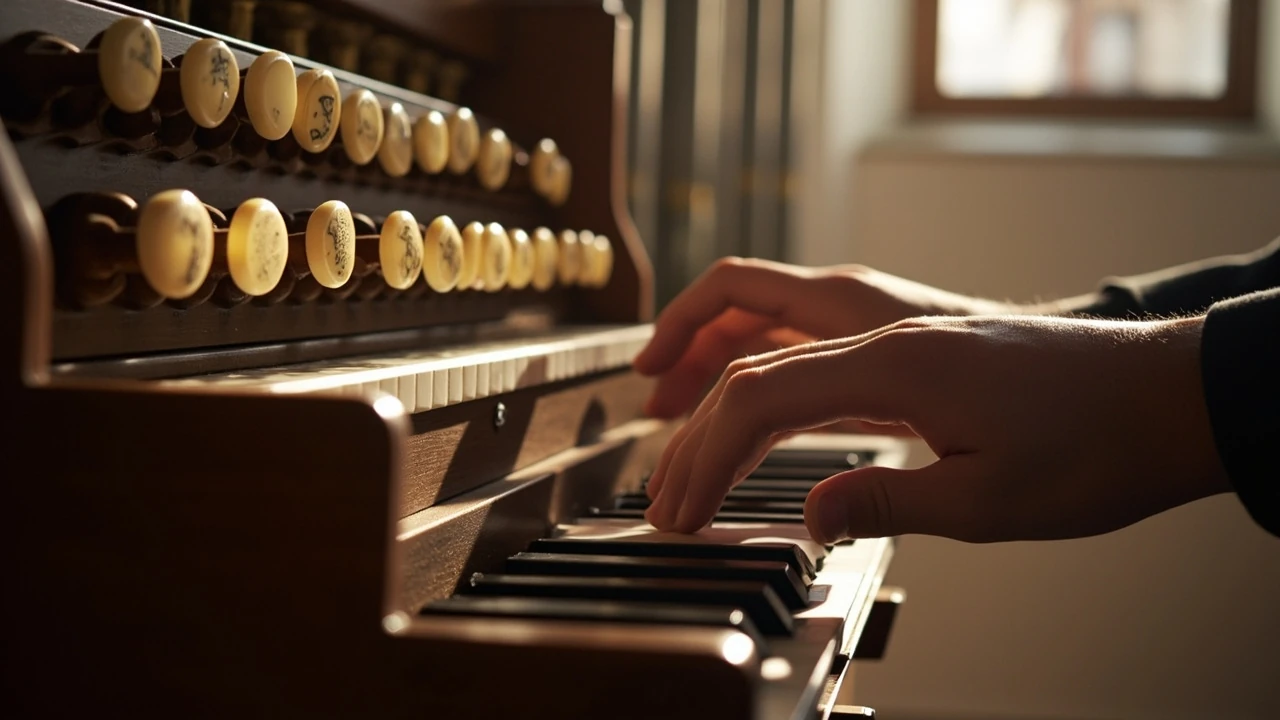
Organ registration: shaping the sound of a pipe organ stop by stop
An organist at the console faces a wall of labeled drawknobs before the first note sounds, and the choices made on that wall decide almost everything the listener hears. Organ registration is the practical craft of selecting which ranks of pipes will speak for each manual and pedal, balancing their volumes, and shaping a combination that suits the music, the room, and the listener. Done well, registration turns a familiar piece into something a congregation or concert audience actually feels; done badly, even a fine instrument can sound thin, muddy, or shrill.
This guide is written for organists who already play but want to register with more confidence, for students working with a teacher, and for advanced players who want to refresh their approach. The aim is not to memorize rules, but to build a working method that survives contact with unfamiliar organs, tricky acoustics, and music that does not behave.
What organ registration actually means
Registration is sometimes treated as a synonym for “stop selection,” but the term covers more. A complete act of registration decides which stops are drawn, on which manual and pedal, in which combination, at what relative volume, with which couplers, and often with which expression or enclosure. The same instrument can sound like a chamber orchestra, a stark Baroque chorus, or a Romantic thundercloud depending on the choices made at the console.
Most pipe organs expose registration through physical controls. On a classical or Baroque-style instrument, stops are usually drawknobs that pull out toward the player to engage a rank. On a Romantic or symphonic organ, stops are often pistons or rocker tabs near the keycheeks, and a central setter board lets the player pre-program combinations. Whichever interface is used, the underlying idea is the same: each stop controls one rank, one extension, or one accessory such as a tremulant or coupler.
A useful first step is to read the stop list and notice which families are present. A clearer picture of organ families, ranks, and the way stop lists are organized can be found in the article on organ stops explained: families, ranks, and how to read a stop list. That background matters here, because registration choices only make sense once you know what the labels in front of you actually describe.
Why organ registration is harder than it looks
Beginners often assume that the loudest stops are best, or that a single principal chorus on every manual will work for everything. Real organs punish both habits. A few reasons registration is genuinely difficult:
- Voicing is personal to the instrument. A Principal 8′ on one organ may be bright and assertive; on another it may be soft and round. Registration is always relative to the pipes in front of you.
- Acoustics change the answer. The same registration that sings in a dry practice room can vanish in a long-reverb church, and a soft setup can suddenly work in a carpeted chapel.
- Music sets the goal, not the stops. A Bach trio sonata, a Duruflé Scherzo, and a hymn accompaniment call for very different sounds, even on the same instrument.
- Couplers multiply the choices. Engaging the swell-to-great coupler changes the balance of a registration in ways that are not always obvious until you listen.
The good news is that registration responds to method. With a clear plan, you can approach an unfamiliar console, build a working palette within an hour, and refine it as the service or concert approaches.
A four-part framework for organ registration
Before pulling any stops, decide four things in order. Each later step depends on the earlier one.
- Choose the manual or pedal that carries the music. This is the “home” division for the piece. It sets the basic color.
- Choose a foundation stop on that division. A single 8′ principal or a stopped flute is usually enough to start.
- Add color stops in layers, listening between each layer. Mixtures, mutations, and reeds come on top, not at the same time as the foundation.
- Balance the whole and test the extremes. Play a soft passage, a loud passage, and a held chord, then adjust.
Following this order prevents the most common mistake: pulling in too many stops at once and trying to fix a muddy result by removing stops at random.
Reading the stop list before you touch a knob
Spend five minutes with the stop list before the first registration attempt. On many instruments, the list is printed on a card above the manuals or on the inside of the bench lid. If not, the builder or restorer usually supplies a digital version. Look for three things:
- Which families are available in each division? A great division with principals, mixtures, and reeds gives far more room to maneuver than a division with only flutes and strings.
- What pitch levels exist? A division with 32′, 16′, 8′, 4′, 2′, and mixture ranks can sustain both the lowest pedals and the highest chorus work.
- What accessories are present? Tremulants, chorus reeds, single reeds, celestes, and sub and super couplers change what “full organ” means on this specific console.
If you are playing a new instrument for the first time, identify the organ’s scaling impression as well. A large-scaled, high-pressure division will carry the building by itself; a small-scaled, low-pressure division is likely to disappear next to other stops unless you are careful.
Foundations: principal choruses, flutes, and strings
Most organ music sits on a small number of basic color families. Knowing what each family contributes is more useful than memorizing any single combination.
| Family | Typical role | Common pitch levels | Best for |
|---|---|---|---|
| Principal chorus | Bright foundation and climax | 16′, 8′, 4′, 2′, mixtures | Hymn finales, fugal climaxes, French Classical writing |
| Flute family | Smooth foundation, solo color | 8′, 4′, 2′, nazard, tierce | Slow movements, hymn verses, Renaissance and early-Baroque music |
| String family | Light, singing line | 8′, 4′, 2′ with narrow mouths | Solo melodies, Romantic expressive writing |
| Reeds | Edge, projection, climax | 16′, 8′, 4′, chorus and solo | Tutti climaxes, solo cantilenas, dramatic dialogue |
| Mixtures and mutations | Brilliance, definition, color | High pitches, non-octave ranks | Adding chorus body, French Classical color, solo reed support |
Within each family, the goal of registration is to choose a foundation and then add only the stops that serve a clear purpose. A common error is to draw a 4′ principal and a 2′ principal at the same time as a mixture; the three together can sound sharp and thin rather than full, especially in a dry room.
How to start a registration from silence
Once you know the home division and the family, the actual sequence of pulling stops is short and repeatable. The following method works on most classical and Romantic instruments.
- Draw a single 8′ principal or stopped flute on the home manual. Play a held chord in the middle of the keyboard.
- Add the next stop you think you need, usually a 4′ or 2′ of the same family, and listen to the chord again. The chord should sound more full, not more shrill.
- Add one color stop, for example a 2-2/3′ nazard or an 8′ flute, and listen for color rather than loudness.
- Engage a single reed or mixture if the music calls for it, and listen at a quiet dynamic as well as a loud one.
- Add pedal stops, starting with a 16′ and an 8′ principal, and balance the manual against the pedal with the swell shoes closed.
If at any step the chord becomes harsh, muddier, or uneven, the previous step was already too much. A practiced organist revises the previous step rather than adding yet another stop on top.
Balancing manual and pedal in organ registration
Manual and pedal balance is one of the most underestimated parts of registration. The pedal can easily dominate a soft manual registration without the player noticing, because the lowest pitches mask higher ones. A useful habit is to play the manual line alone with the right hand while the left hand holds a pedal note, and then add the pedal stops one at a time until the pedal note can be felt but not heard above the manual.
In a resonant room, the pedal often needs to be cut back further than feels natural at the console. A practical test is to walk to the back of the nave and listen from there. If the pedal line is intrusive, the 16′ is probably too prominent, or the 8′ pedal is doubling it in a way that adds weight without adding clarity.
| Symptom in the room | Likely cause in the registration | Quick fix |
|---|---|---|
| Pedal overwhelms manual | 16′ too heavy, or 8′ pedal reinforcing the bass too much | Reduce pedal 8′, or replace 16′ with 8′ alone for soft passages |
| Manual floats over pedal | Pedal too soft, or manual mixture too bright | Add a 4′ pedal, or close one manual mixture rank |
| Bass line is unclear | 16′ principal alone, or mixture missing | Add a 4′ principal to the pedal, or add a mixture to the manual |
| Soft verse sounds thin | Foundation stops removed, leaving only mutations | Restore the 8′ foundation on the manual and a soft 8′ on the pedal |
Building choruses: how principals, mixtures, and reeds stack
A chorus is the registration that carries the climaxes of most organ music. It is built in layers, and each layer should make sense on its own before the next is added.
- Foundation: 8′ principal, then 4′ principal of the same family.
- Acute: 2′ principal, then a mixture. The mixture should reinforce, not dominate.
- Color: A 2-2/3′ or 1-3/5′ mutation, if the room and the piece call for it.
- Power: 8′ trumpet, then 4′ clarinet or shawm, then 16′ reed if available.
A chorus sounds balanced when the listener cannot easily identify which stop was added last. If adding the 4′ trumpet makes the texture shout, the 8′ trumpet was already too aggressive for the room, and the 16′ will only make that worse. Cut back earlier in the chain.
Solo and accompaniment registration
Many pieces, especially hymn-based repertoire, require one manual to sing a solo line while another accompanies. The solo manual should be clearly brighter or clearly different in color than the accompaniment. Three reliable approaches:
- Flute solo over a string accompaniment. A stopped or open flute 8′ on one division, with a narrow-scaled string 8′ on another, gives a clear dialogue without reed noise.
- Reed solo over a principal chorus. An 8′ trumpet on a Solo division, with the Great chorus set to a moderate level, projects even in resonant spaces.
- String solo over a flute accompaniment. A soft string 8′ on a swell or choir division, with a stopped flute 8′ on a separate manual, often works well for Romantic melodies.
To keep the dialogue legible, the accompaniment manual should be at most two-thirds as loud as the solo manual, and the dynamic ranges of the two should be different. A swell box that the player can open and close during the solo is one of the most powerful tools for this kind of writing.
Working with enclosed divisions
Many Romantic and modern organs include an enclosed division, usually the Swell, with its pipes in a louvered box and a pedal-operated swell shoe. Enclosure adds a second dimension to registration: stops that cannot easily be added can be balanced in volume with the shoe, which means a single registration can cover a wider dynamic range than an open division can.
When using an enclosed division, two habits help. First, register for the closed position, because that is where the music often begins, and the sound there is thinner than at the open position. Second, plan the swell curve in advance: where will the shoe open, where will it close, and how much dynamic range is needed between those points. Registrations that need constant adjustment at the console usually signal that the swell curve was not planned.
Acoustics and how they change registration choices
The same registration that sings in a 200-seat hall can vanish in a 1000-seat cathedral with a long reverberation time. Two principles help:
- In live rooms, cut back the upper work. Mixtures and high mutations carry far in long reverb, and they can dominate the texture. A 4′ principal often does the work of a 2′ and mixture elsewhere.
- In dry rooms, add upper work and keep the foundation lighter. Without reverb to fill the gaps, a 2′ or mixture adds needed brilliance. A heavy 16′ on the manual will sound oppressive without a room to carry it.
When in doubt, sit in the back of the room for a full verse and a chorus before fixing the registration. The console position is misleading in most organs because the player sits close to the pipes and the sound is still developing.
Hymn registration in practice
Most working organists spend more time accompanying hymns than playing solo repertoire. A reliable method for a four-verse hymn on an unfamiliar organ is to pre-register three combinations and switch between them.
- Verse 1: a soft 8′ foundation. Flute or string on a single manual, pedal 16′ and 8′ principal at a low level.
- Verse 2: a moderate chorus. Add a 4′ and a 2′ to the manual, and add a mixture if the room allows.
- Verse 3: a full chorus. Add reeds, both manual and pedal, and engage the principal chorus mixture at full strength.
- Verse 4: return to the verse 2 setup, or a gentle variant. The final verse is not always the loudest; it depends on the hymn’s words.
The art is in matching the registration to the text, not to the verse number. A hymn about peace often sounds wrong in a full chorus on the final verse, while a triumphant tune can feel underwhelming on a soft foundation throughout.
Common registration mistakes and how to avoid them
Even experienced players fall into predictable traps. The following are the most common, and each has a straightforward remedy.
- Drawing too many stops before listening. The fix is to reset, then build the registration one stop at a time.
- Choosing stops by name rather than by family. “Bourdon” and “Rohrflöte” both stop at 8′, but they sound different. Listen to families, not labels.
- Forgetting the room. Always test the registration from the back of the room, not the console.
- Coupling everything to the main manual. Couplers add weight and dull attack. Use only the couplers the music actually needs.
- Using the same registration for the whole piece. Even a short piece usually needs at least two contrasting registrations, and many need three or four.
Planning ahead: combinations, sequencers, and the setter board
On instruments with pistons, the work of registration happens twice. The first time is at the console, choosing stops. The second time is on the setter board, pre-programming the combinations that will be recalled during the music. On a well-set organ, the pistons feel almost invisible; the player presses them in time, and the registrations change smoothly. On a poorly set organ, every piston change brings a small surprise.
A useful habit is to set the pistons for a single piece in advance, ideally away from the instrument, using the printed stop list. The planner can write down the registrations as plain English sentences rather than stop names, for example “soft 8′ flute foundation, pedal 16′ and 8′ principal at two-thirds,” and then translate those into actual stop combinations at the console.
Using tremulants, celestes, and other accessories
Accessories are easy to overuse and hard to undo. A tremulant is a gentle modulation of the wind that adds a vocal quiver to the pipes. A celeste is a rank tuned slightly sharp or flat of another rank, producing a shimmering beat. Both can transform a registration, and both can ruin one if applied to the wrong family.
- Tremulants usually belong on flutes and strings, not on principals or mixtures. A tremulated principal chorus sounds restless rather than grand.
- Celestes need a partner rank to beat against. A celeste alone sounds out of tune; a celeste plus its matching string sounds like a gentle halo.
- Sub and super couplers shift the pitch of an entire manual. They are powerful for solo writing but can produce extreme combinations that are not idiomatic in any historical style.
Registration and historical style
Registration is also a question of style. The same piece can be played convincingly on a Bach-style organ, a French Classical organ, a Romantic German organ, or a twentieth-century eclectic instrument, but the registration will look quite different.
| Style | Typical foundation | Typical climax | Common mistakes to avoid |
|---|---|---|---|
| Baroque German | 8′ principal with 4′ | Plenum with mixture and pedal 16′ | Adding heavy reeds too early |
| French Classical | 8′ montre with flutes | Grand jeu with cromorne and plein-jeu | Mixing English-style string tone with French reeds |
| Romantic German | 8′ flute with 8′ string | Full chorus with heavy trumpet and tuba | Ignoring the swell box and the dynamic curve |
| Twentieth-century eclectic | Multiple foundations across manuals | Full organ with all divisions coupled | Using the same registration as for a Baroque piece |
For organists who want to explore the broader world of pipe organ instruments, the pipe organ instruments page offers a useful starting point to see how the craft relates to specific kinds of instruments and their mechanical setups.
A short method for a new instrument
When facing an unfamiliar console, especially in a limited amount of time, a condensed method is more useful than a long plan. The following takes about an hour.
- Read the stop list and identify the families on each division.
- Draw a single 8′ principal on the Great and a 16′ on the pedal. Play a hymn tune. Listen from the back of the room.
- Add a 4′ principal, then a 2′ and a mixture, listening at each step. This is your loud Great plenum.
- Move to the Swell and build a soft registration with a flute 8′ and a string 8′. Test the swell shoe across its full range.
- Build a small solo registration on a Solo or Choir division. A flute and a reed together usually work.
- Combine manual and pedal for a final test passage, checking both the loudest registration and a soft one.
With those four building blocks, the organist can play most service music and a wide range of solo repertoire. Refinements come with time on the specific instrument.
When registration is a memory problem
For students, registration is partly a memory problem: the player must remember which stops are drawn without looking away from the score. Two habits help. First, draw stops by hand, one at a time, and say the name of the stop under the breath. Second, use a small notebook or registration sheet for the day’s music, and write the actual stop names as they are set, not generic descriptions. The act of writing fixes the registration in memory.
Players who use pistons can prepare combinations on the setter board and then forget the individual stops; this is convenient for performance, but it can be a trap for students who are still learning the families. Knowing what is in each combination matters when a single stop has to be adjusted during a service.
A practical checklist for the day of performance
Even experienced organists can be caught by predictable problems on the day of a service or concert. A short checklist run through before the first voluntary prevents most of them.
- The blower is at the right pressure. Lower pressure often means the upper work will not speak.
- The swell shoe moves freely and returns to its starting position.
- All combinations are set on the pistons you intend to use, including the final registration of the piece.
- The crescendo pedal, if present, is set to a sensible starting point.
- The crescendo pedal does not include a registration you would never want to use.
- The general crescendo is rehearsed in context, not stop by stop, because crescendo combinations are designed to be played in sequence.
For more background on the organ itself, including how different instruments are built and voiced, the learn about pipe organs page is a useful companion.
Where to go next with organ registration
Registration is one of those skills that improves every time a player sits at a different console, listens carefully, and revises the choices from the previous week. Two simple next steps:
- Pick one piece you already know well and try three different registrations on it, from a soft 8′ foundation to a full chorus. Listen from the nave, not the console, and notice what each choice communicates.
- Keep a registration diary. After each service or practice session, write down two or three registrations that worked, the room you were in, and the music you played. Patterns will appear within a few months.
For a broader survey of the instrument and how it shapes registration choices, the pipe organ archive offers a useful reference, and a practical tool such as the pipe length calculator can help with the geometry of pitch when planning foundations and mutations.
Frequently asked questions
What is organ registration in simple terms?
Organ registration is the choice and balance of pipe organ stops for a piece of music. It decides which ranks of pipes speak, on which manual and pedal, at what relative volume, and with which couplers. The same instrument can sound very different depending on the registration.
What is the first stop an organist should draw when learning registration?
A single 8′ principal or stopped flute on the home manual is usually the right starting point. From that foundation, the player adds one stop at a time, listening between each addition, rather than pulling many stops at once and trying to fix the result later.
How do you balance the manual and pedal?
Play the manual line with the right hand while the left hand holds a single pedal note, and add pedal stops until the pedal note can be felt but not heard above the manual. Then walk to the back of the room and check the balance from the listener’s position.
What is a chorus registration on the organ?
A chorus is the full foundation of a division, typically an 8′ principal, 4′, 2′, and a mixture, sometimes with a mutation. Reeds are added on top of the chorus for the loudest climaxes. The chorus should always sound balanced on its own before the reeds are engaged.
How do room acoustics change registration choices?
Long reverberation lets upper work carry far, so mixtures and high mutations often need to be cut back, and a 4′ principal may replace the work of a 2′ and a mixture. Dry rooms need more upper work to sound full, and a heavy 16′ on the manual will sound oppressive without a room to carry it.
What is the difference between registration and orchestration on the organ?
The two terms overlap. Registration is the broader craft of choosing and balancing stops for a piece. Orchestration usually refers to the specific choices of which stops carry which voice or phrase within a single piece, and is one part of the larger act of registration.
How do enclosed divisions change registration?
Enclosed divisions, usually the Swell, allow the player to change volume at the console with a swell shoe, which means a single registration can cover a wider dynamic range than an open division. Plan the swell curve in advance so the shoe movements support the music rather than fight it.
How do couplers affect organ registration?
Couplers allow one manual to sound on another, which adds weight and can dull the attack of the coupled manual. Use only the couplers the music actually needs, and listen to the coupled registration at full swell to be sure it still speaks clearly.
What is the difference between a mutation and a mixture?
A mutation is a single rank tuned to a non-octave pitch, such as a 2-2/3′ nazard or a 1-3/5′ tierce, and it adds a specific color. A mixture is a compound stop made of several higher ranks, usually octaves and fifths together, and it adds brilliance and definition to a chorus.
How can a beginner practice organ registration outside of services?
Practice on a small set of contrasting pieces, register one stop at a time, and listen from the back of the room. Keep a short notebook of the registrations that worked, and revisit those notes when learning a new piece on the same instrument.