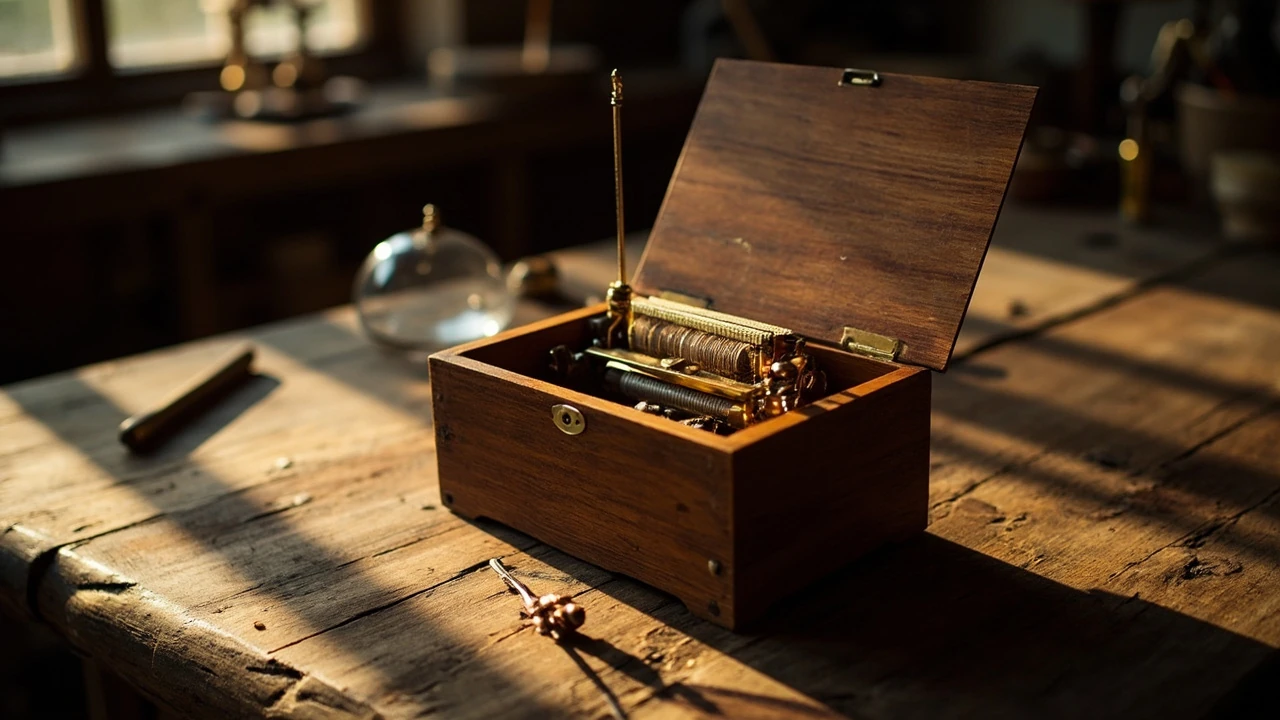
Music box: how the mechanism works and what to know before buying one
A small wooden box on a collector’s shelf, a brass cylinder turning under a comb of tuned teeth, and a familiar melody filling the room. That scene is what most people picture when they hear the words music box, but the object behind those words is older and more mechanical than its gentle sound suggests. A music box is a mechanical instrument that stores a melody on a rotating cylinder or a flat disc and plays it by plucking a tuned metal comb. Understanding that simple idea makes it much easier to choose, tune, and care for one.
Although the modern image of a music box is often associated with jewelry, children’s gifts, and Swiss souvenirs, the device has deep roots in clockwork and horology. Builders borrowed the cylinder and pin concept from striking clocks, then replaced bells with a single tuned comb to make melody practical at small scale. The result is a self-contained instrument that needs no electricity, no speaker, and no player, only a spring and a few seconds of attention.
This article is a practical guide for anyone who is curious about the mechanism, considering a purchase, or trying to understand the difference between a cheap gift-box version and a serious mechanical instrument. Readers who already play or service pipe organs will recognize a few of the same ideas here, because comb teeth behave in a way that is physically close to the way an organ pipe is voiced.
How a music box actually works
The basic idea is older than the toy-shop version that most people imagine. A music box is a clockwork instrument: a wound spring, a gear train, a governor, and a sound-producing element. The interesting part is how the melody is encoded and read.
The spring, gear train, and governor
Turning a key tightens a flat coiled spring inside the box. As the spring unwinds, it drives a small gear train that slows the rotation of the output shaft to a calm, musical speed. A centrifugal governor, often a tiny vane that spins against air resistance, keeps the rotation steady. Without that governor, the melody would slow down as the spring runs down, and the tune would sag toward the end. The governor is one of the most overlooked parts of a music box, yet it is what gives the instrument its even, deliberate tempo.
The cylinder and the pins
The melody lives on a brass cylinder. Around the cylinder, pins are placed in rows, and each row corresponds to one note in the scale. As the cylinder turns, the pins lift the tines of a steel comb one at a time. Each tine is tuned to a single pitch, and a longer tine makes a lower note, while a shorter tine makes a higher one. The position of a pin along the cylinder decides when that tine will sound. So the song is not recorded as audio. It is recorded as a pattern of small bumps, and the comb reads that pattern in the same way a player piano reads punched paper.
The comb and the tine
The comb is the heart of the sound. Each tine is a thin, carefully tempered steel blade fixed at one end. A small downward pull from a pin bends the tine, and when the pin slides off, the tine snaps back. That snap is the note. The note’s pitch depends on the length, thickness, and temper of the steel, and the loudness depends on how hard the pin pulls and how solidly the comb is mounted. This is the part that professional tuners adjust when a music box drifts out of tune, and it is also the part most often damaged if a box is dropped.
The difference between a comb and a disc
Cylinder movements are the oldest and most traditional format. A few makers, especially in the twentieth century, used a flat metal disc with bumps stamped in a spiral instead of a cylinder. A disc movement is cheaper to make for long pieces, and several discs can be swapped on the same comb. Cylinder movements are usually considered more refined, and high-end Swiss and German boxes almost always use cylinders. The mechanism is similar in both cases, only the storage medium changes.
The history of the music box in a few short stops
The lineage of the music box runs through clockwork, watchmaking, and early industrial production. Knowing that lineage helps a buyer tell a serious instrument from a souvenir.
From clock bells to tuned steel
Late medieval and Renaissance clocks struck the hours on bells, and clockmakers gradually learned to play short tunes by selecting bells in sequence. In the eighteenth century, a few watchmakers began replacing bells with a small tuned steel element. The first true music boxes, with a comb read by a pinned cylinder, appeared in the late 1700s in Switzerland. Early examples were often called carillons à musique or Spielwerke and were sold as luxury desk objects for the wealthy.
The Swiss golden age
Geneva and the Jura region became the center of the trade. By the early 1800s, the industry had grown into a coordinated craft with specialized comb makers, cylinder engravers, and case builders. A good music box was treated as a piece of furniture, often housed in a rosewood, walnut, or marquetry case with hand inlay. Some boxes included interchangeable cylinders so the owner could swap melodies, and a few combined a music box with a small clock or a bird cage.
The nineteenth-century spread
Production expanded beyond Switzerland. German makers in Leipzig and the Black Forest produced large quantities, and Bohemia, Austria, and parts of France developed their own schools. The comb remained the heart of the instrument, but case styles, materials, and cylinder sizes varied widely. A large floor-standing cylinder can be more than a meter long and carry enough pins to play a long symphony, while a small snuff-box version may play only sixteen notes.
The twentieth-century decline and revival
Phonographs and radio eventually pushed the music box out of daily life, and the industry shrank to a few specialist makers. In the late twentieth century, mechanical instruments returned to a small luxury market, and modern makers like Reuge, Sankyo, and a handful of independent workshops continue the tradition. Today, the most expensive pieces are still made in much the same way they were a hundred and fifty years ago.
Anatomy of a music box in detail
Even a small, cheap music box contains several parts that matter. Knowing their names and roles makes a buyer or restorer more confident when reading a description or a service guide. Readers who want more background can use the box overview as a reference while reviewing this point.
| Part | Function | What to check |
|---|---|---|
| Mainspring | Stores energy when wound | Smooth wind, even release, no grinding |
| Gear train | Transmits and reduces spring force | No skipping teeth or backlash |
| Governor | Keeps rotation speed steady | Even tempo from start to end of tune |
| Cylinder (or disc) | Stores the melody as pins | Pins straight, not bent, no deep scratches |
| Comb | Plays the notes when tines are plucked | All tines sound, no buzzing, in tune |
| Bed plate | Supports comb, cylinder, and bearings | No cracks at mounting points |
| Winding key and click | Allows winding and prevents backspin | Key fits square, click holds firmly |
| Case | Protects movement and shapes sound | Lid closes flush, hinges solid, no loose panels |
The case matters more than people expect. A music box’s volume and warmth depend on how the comb couples to the wood around it. A solid case amplifies the sound, while a thin or loose case can rattle and muffle it. A trained restorer will often tighten a case or replace felt mounts before touching the comb.
Choosing a music box: a practical decision guide
Choosing a music box is more interesting than it first looks, because the same word covers very different objects. A new buyer usually has to decide between price, size, sound quality, and the way the instrument is made. The questions below help clarify what kind of box a reader actually wants.
Decide what role the music box will play
Before looking at listings, it helps to picture how the box will be used. A small, decorative box that sits on a shelf and plays one tune once a day is a very different object from a serious instrument that will be wound often and listened to closely. Buyers who want the latter are essentially buying a small mechanical musical instrument, and they should plan to spend a bit more for a tuned comb and a properly made movement.
Match the format to the listener
A few simple choices shape the rest of the decision. Listeners who want long classical pieces need either a large cylinder or a disc movement, because small cylinders cannot store enough notes. Listeners who want a single nostalgic melody are often happiest with a small hand-wound box that plays one tune well. Listeners who want to swap melodies benefit from interchangeable cylinders or a disc system.
Listen to the comb before you buy
Audio and video clips online can be misleading because they capture room acoustics and microphone color. A serious seller will record several samples and, where possible, post uncompressed audio. Buyers who can visit a dealer in person should listen for a clean attack, even decay, and no buzzes. Those are the same checks a buyer applies when looking at any mechanical instrument, including a small organ stop list in a pipe organ, where each rank has to be heard, not just described.
Inspect the case, not just the movement
Casework is often where a cheap box shows its price. Look at the joints, the lining, and the finish. Tight dovetails, solid hinges, and a thin, even finish usually mean careful construction. A good case also protects the movement, so it stays in tune longer and resists dust.
Check the warranty and service options
A well-made music box can run for decades, but it can also go out of tune if the comb is knocked or if the pins snag. New boxes from established makers usually carry a multi-year warranty and access to a service center. Vintage boxes should come with a recent service record. A box without any service information is a risk, even if it looks beautiful.
Common materials and what they mean for sound
The choice of material changes a music box’s tone more than most buyers expect. Two boxes with the same comb and cylinder can sound quite different because of the case wood, the comb steel, and the way parts are mounted.
- Comb steel: hard, well-tempered steel gives a clear, ringing note; softer steel gives a duller, shorter note. High-end makers heat-treat the comb so each tine rings for several seconds.
- Case wood: dense hardwoods like walnut, rosewood, and mahogany amplify the lower notes; lighter woods like maple emphasize clarity. Veneered plywood cases tend to be quieter and less warm.
- Bearings and pivots: brass bushings keep the cylinder turning smoothly. Worn bushings cause uneven speed and a wobbly tone.
- Felt mounts: thin felt between the movement and the case prevents buzzes. Too much felt mutes the sound; too little causes sympathetic rattle.
- Finish: a thick lacquered finish can damp high frequencies. Hand-rubbed oil finishes usually let the wood breathe and project more.
These details also explain why a small antique music box can sound richer than a large modern one. The maker spent hours fitting the comb, dressing each tine, and selecting wood for the case.
Buying a vintage or antique music box
Vintage boxes can be a joy, but they also carry risk. A buyer who knows the most common issues can avoid disappointment and can plan a sensible service budget.
What to ask the seller
Before committing, the buyer should ask for the maker’s mark, the approximate year, the number of notes, the number of tunes, and any service history. A clear photo of the comb and the cylinder helps a remote expert judge the condition. Sellers who refuse to share these details are usually hiding something. Another relevant reference is the boxes made how do they work, which adds context without changing the practical guidance here.
Red flags when buying antique pieces
- Bent or missing pins on the cylinder, which change the melody.
- Tines that look polished at the tips, a sign that someone has tried to retune by filing.
- A loose or cracked bed plate, which usually means a fall or impact.
- Movement that grinds, skips, or refuses to run in certain positions.
- Case odor, warped panels, or woodworm in old wooden cases.
If any of these problems show up, the buyer should ask for a discount to cover service, or move on. Some of these issues are easy to fix; others, like a cracked bed plate, can be very expensive.
When professional service is worth it
For a box that has real value, professional service is usually worth the cost. A trained restorer can clean the movement, replace worn bushings, dress the comb, and reset the governor. The result is often a box that sounds better than it did when new, because modern measurement tools make it possible to tune a comb to a precise reference pitch.
Care, cleaning, and simple maintenance
A music box is a delicate mechanism, and good care extends its life. Most problems come from dust, humidity, and rough handling, not from wear. Owners who follow a few simple habits will usually enjoy their boxes for decades.
Winding habits
Wind gently until resistance firms up, then stop. Forcing past that point stresses the spring and can deform it. Letting the spring run down fully between windings also shortens its life. For daily use, a partial wind is often enough.
Humidity and temperature
Wood cases and steel combs both react to humidity. A stable room with moderate humidity keeps the case from swelling or cracking and keeps the comb in tune. Direct sunlight and radiator heat should be avoided because they dry the wood and can warp the case.
Dust and cleaning
A soft brush keeps dust off the cylinder and comb. Compressed air can help in the case, but the pressure should be gentle so the pins and tines are not bent. The case can be wiped with a barely damp cloth and dried immediately. Solvents and polishes should be avoided unless the maker recommends them.
Storage and transport
For long storage, the box should be wound down fully and stored flat. Padding around the box helps during transport, and the movement should be locked or held so it cannot run loose. A box that runs while being carried can damage its own cylinder, the same way a rough handling can upset a set of voiced pipe stops on an organ.
Common problems and what they usually mean
Most music box problems fall into a small set of categories. Recognizing the symptom is the first step toward a sensible fix.
| Symptom | Likely cause | Typical fix |
|---|---|---|
| Slow or uneven tempo | Worn governor or weak spring | Clean and oil governor; replace spring |
| Missing notes | Bent pin or broken tine | Reset pin or replace comb |
| Buzzing or rattle | Loose case or felt mounts | Refit felt, tighten case, re-seat movement |
| Out of tune | Comb dropped or humidity shock | Professional comb tuning |
| Stuck movement | Dried oil or dented gear | Disassemble, clean, re-lube |
| No sound at all | Comb loose from bed plate | Re-bed comb with proper adhesive |
Owners who are not comfortable with mechanical work should take the box to a specialist rather than risk further damage. A simple symptom like a missing note can be caused by something as small as a single bent pin, but a clumsy attempt to fix it can scratch the cylinder and reduce the box’s value.
The wider family: music boxes, organs, and other mechanical instruments
The music box is one of several mechanical instruments that store a melody in a physical pattern and play it through a tuned element. Looking at the wider family helps explain why some music boxes sound so much like a small organ.
Comb-based instruments
Other instruments in the same family include the glockenspiel-style comb and the Aeolian harp, but the most direct cousin is the musical clock. Striking clocks used bells, and a few high-end clocks used a comb instead. A well-made comb produces a tone that is closer to a pipe than to a bell, which is one reason the music box is sometimes described as a tiny pipe organ in a box.
Disc and barrel instruments
Orchestrions, fairground organs, and band organs are larger instruments that read melody from a pinned barrel or a book of punched cardboard. The mechanism is the same idea at a different scale, and the same care rules apply. Players who learn to service a music box can often understand a barrel organ, although barrel organs are far more complex.
How this connects to the pipe organ
The connection is direct in one specific area: the comb. A tuned steel tine is, in a mechanical sense, a cousin of a metal organ pipe. Both store energy and release it at a chosen pitch. Organ builders spend a long time shaping each pipe so it speaks cleanly, and a music box maker spends the same time shaping each tine. Readers who enjoy thinking about how a mechanism shapes tone will probably enjoy reading about organ registration, the art of combining stops so the result has a clear musical shape.
Frequently asked questions
What is a music box and how does it produce sound?
A music box is a mechanical instrument that plays a melody by plucking the tuned steel tines of a comb. The melody is stored as a pattern of pins on a rotating cylinder, and each pin lifts one tine as it passes.
How long does a music box usually play for?
Most small cylinder music boxes play for between one and four minutes per winding, depending on spring size, cylinder length, and governor setting. Large multi-tune cylinders may play for several minutes longer.
Can a music box be tuned?
Yes. A trained restorer can tune a comb by adjusting the mass of each tine at its tip, either by adding a small amount of material or by careful filing. Tuning is delicate work, and it is usually done by specialists rather than by owners.
Why does a music box go out of tune?
Most tuning problems come from physical shock, humidity changes, or wear at the point where a pin lifts a tine. A drop, a strong impact, or long storage in a damp place can each shift the pitch of a tine.
What is the difference between a music box and a musical watch?
Both use a comb and pins, but a musical watch is a very small version worn on the wrist, with a tiny comb and a slower governor. A music box is a larger, usually table-top or floor-standing instrument with a longer cylinder and a more powerful comb.
Are new music boxes worth buying compared to antiques?
Modern boxes from established makers are often the most reliable choice because they use modern materials, hold their tuning well, and come with a warranty. Antique boxes have character and historical value, but they often need service before they play properly.
How should a music box be stored long term?
Store it in a stable, dry room, ideally in a fitted case or wrapped in soft cloth. The spring should be fully unwound, the lid closed, and the box placed flat on a stable shelf away from sunlight and heat.
What does the number of notes mean in a music box?
The number of notes is the size of the comb, expressed in the count of tuned tines. A 12-note comb plays only simple melodies, while a 30- or 50-note comb can play richer arrangements with harmony and ornamental notes.
Can a music box be repaired at home?
Light cleaning and oiling can be done at home, but anything that involves the comb, the cylinder pins, or the governor should usually be left to a trained restorer. A small mistake on the comb can lower the value of a fine box.
How can I tell if an old music box is worth restoring?
The best test is the maker’s mark and the condition of the comb. A box with a clear maker’s mark, an unbroken comb, and a complete set of straight pins is usually a good restoration candidate. A box with a damaged comb, missing pins, or a cracked bed plate may cost more to restore than the result is worth.
If you are weighing one specific box against another, a short comparison test in a quiet room is the most reliable guide. Listen for an even attack, a clear decay, and a stable tempo from the first note to the last. Those three signals capture most of what makes a music box feel right, and they hold true across simple desk models and large cylinder instruments alike.