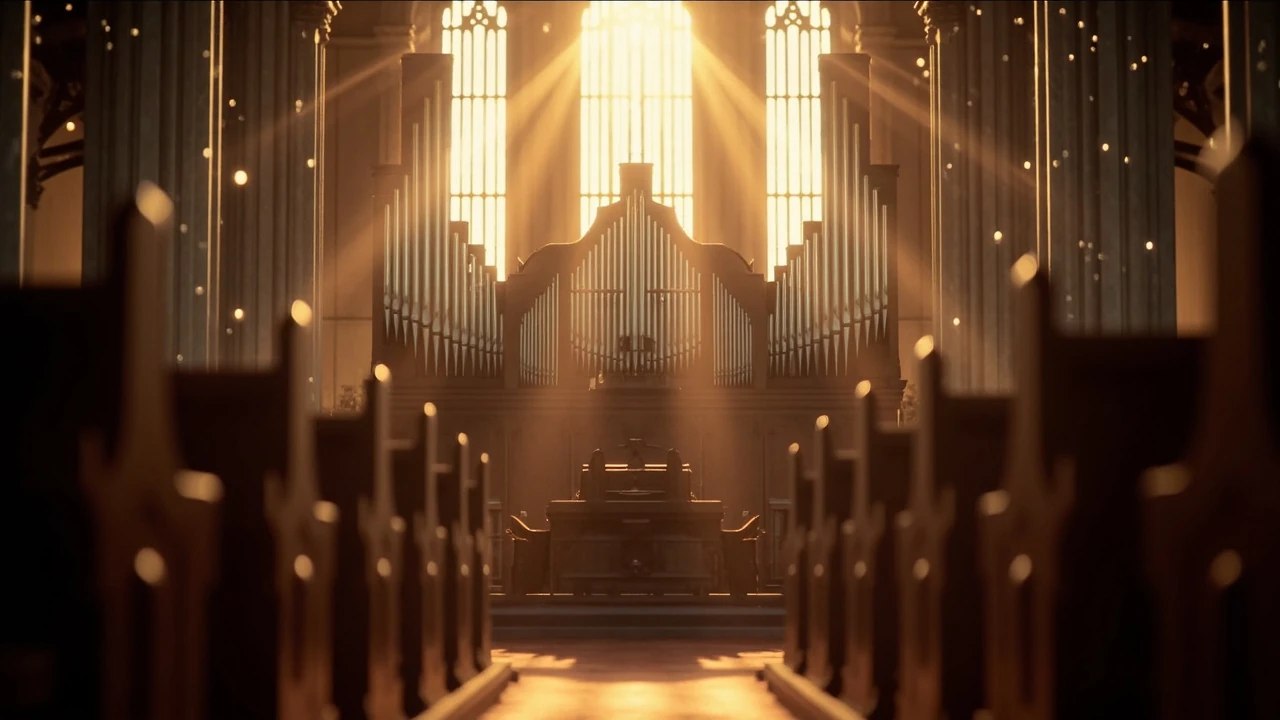
A parish organist opens a hymnal on a Sunday morning, tests one rank of principals against the swell strings, and reaches for a registration that has served the same opening hymn for three generations. That routine decision sits at the heart of how Christian music actually sounds in most congregations. The repertoire, the building, and the organ are not separate subjects; they shape each other every week.
This guide is written for readers who want a working understanding of Christian music as it is performed on the pipe organ: what the repertoire includes, how it is used in worship, what determines its sound, and how to make practical decisions about it. Whether you are a church musician choosing music for next Sunday, a student learning the standard literature, a choir director comparing accompaniment options, or a curious listener trying to follow a service, the material below should help you read the choices behind the music you hear.
Christian music on the pipe organ: how the repertoire and the instrument meet
Christian music on the pipe organ is not a single style. It is a living tradition of vocal and instrumental music used in Christian worship, with the organ serving as the principal accompanying instrument in Western Christianity for several centuries. The repertoire spans plainchant, Lutheran chorales, Anglican hymn tunes, Catholic hymnody, anthems, motets, and organ-only service music such as preludes, postludes, and fugues. Each of these categories carries different expectations about melody, harmony, texture, and length.
For a working definition that matches how practitioners use the term, Christian music is sacred music composed or adapted for use in Christian liturgy, devotion, or religious instruction. The pipe organ is the most common fixed instrument in Western church buildings, and the bulk of its repertoire grew alongside the choral and congregational music it supports. Understanding that pairing, the organ as a partner to voice and congregation, is the most useful starting point for thinking about the field.
Three traditions dominate the organ’s place in Christian music:
- Catholic liturgy, where the organ accompanies the Roman Missal chants, hymnody, and choral Mass settings, and is used for solo music before, during, and after services.
- Lutheran worship, in which the organ carries chorale-based repertoire such as chorale preludes, partitas, and cantata accompaniments central to the German tradition.
- Anglican and Episcopal worship, with a strong emphasis on hymn tunes, service music by composers such as S. S. Wesley, Stanford, and Howells, and voluntary pieces framing the liturgy.
Orthodox, Methodist, Reformed, and other traditions also use the organ, often adopting repertoire from the three traditions above while retaining their own hymnals and chant resources. The organ’s role outside these traditions, including in gospel, contemporary, and charismatic churches, is different: it is often replaced by piano, guitar, or band, and the music is shaped accordingly. That contrast is worth keeping in mind, because “Christian music” as a search term covers all of these contexts, and the pipe organ is relevant to some of them more than others.
What Christian music includes: the core repertoire categories
A practical way to map the repertoire is by function within a service. The same hymn tune can be a congregational song, a choir anthem, or a chorale prelude, and each setting carries different expectations of difficulty, length, and instrumentation.
The major categories of Christian music most often performed on the pipe organ are:
- Hymns and hymn tunes: strophic texts set to fixed tunes, sung by the congregation, often four-part with organ harmonization.
- Service music: settings of the ordinary parts of the Mass (Kyrie, Gloria, Sanctus, Agnus Dei) or the canticles of Morning and Evening Prayer.
- Anthems and motets: choral pieces for choir, with or without organ accompaniment, in English or Latin.
- Chorale preludes and partitas: organ-only pieces based on a hymn tune, central to Lutheran repertoire.
- Plainchant and Anglican chant: monophonic or accompanied chant used for psalms, canticles, and Mass propers.
- Voluntaries: organ solos played before, during, or after a service, including preludes, interludes, postludes, and fugues.
Each category has a different job. Hymns carry the congregation’s voice. Anthems give the choir its featured moment. Voluntaries frame the liturgy and give the organ a voice of its own. A working knowledge of all six is the foundation for most church organist positions.
How the pipe organ shapes the sound of Christian music
No other instrument in the Western tradition is so directly tied to the building in which it sits. The organ’s sound is shaped by three things at once: the instrument itself, the room, and the music being played. Choices in any one of those change the result.
The organ supplies the sustained tone, the dynamic range, and the timbral variety needed to support a congregation of several hundred singers. Without registration, the same hymn can sound like a marching band, a chamber ensemble, or a full cathedral tutti. Learning how to choose stops, balance manuals, and shape phrases is the daily craft of the church organist. For a more detailed look at the stop list itself, the guide on organ stops explained gives a useful foundation.
The room contributes acoustics. A dry worship space with carpet and padded pews absorbs the sound and rewards clear, articulate playing with defined ensembles. A long-reverb stone church carries the sound for several seconds and rewards a slower tempo, broader phrases, and careful pedaling so chords do not blur.
The music sets the target. A unison chant needs a clean 8′ principal with little or no mixture. A four-part hymn benefits from a principal chorus with a swell division added for the final verse. A Bach fugue asks for a brighter, more articulated registration than a Duruflé prelude. The same organ can serve all of these if it has enough stops, and registration is the practical skill of matching stops to repertoire.
A short history of Christian music on the organ
The organ’s association with Christian worship is long but uneven. The instrument existed in Byzantine secular music before it entered the Western church, and its role grew in stages rather than all at once.
| Period | Key development | Effect on repertoire |
|---|---|---|
| 8th–10th century | Organs in Byzantine courts; earliest European church organs appear | Used for royal and ceremonial display rather than congregational singing |
| 13th–14th century | Organ used in liturgical settings in large cathedrals | Plays monophonic plainchant, often alternating with choir |
| 15th–16th century | Independent pedal division, multiple manuals, early stops developed | Florid organ masses, alternatim practice with choir |
| 17th century | Lutheran chorale becomes central; North German organ school flourishes | Chorale preludes, partitas, and large-scale preludes and fugues |
| 18th century | Bach, Handel, and contemporaries set the standard repertoire | Chorale preludes, cantatas, oratorios, concerto-style voluntaries |
| 19th century | Romantic organ building, symphonies and sonatas for organ | Widor, Vierne, Mendelssohn, and the English cathedral school |
| 20th–21st century | Repertoire diversifies; renewal of interest in early music and new composers | Howells, Duruflé, Messiaen, contemporary British and American composers |
Two things stand out from this timeline. First, the pipe organ’s role in Christian music has never been static. It expanded with the instrument’s capabilities and contracted in periods such as the Reformation, when Calvinist churches in particular removed the organ from services. Second, the surviving core of the repertoire comes from a relatively narrow window, roughly 1600 to 1900 in northern and central Europe, and that window still shapes what is heard in most churches today.
Choosing music for a service: a practical framework
Selecting Christian music for a service is part craft, part logistics, and part pastoral judgment. A good working method asks four questions in order:
- What is the liturgical occasion? The liturgy of the day, the season of the church year, and any special feast or commemorations set boundaries on what is appropriate.
- Who is singing? A full choir with strong volunteers can carry an eight-part anthem. A small congregation with limited musical background needs accessible hymn tunes and clear harmonizations.
- What does the organ do well? A two-manual tracker organ in a small chapel cannot carry a Widor toccata convincingly, and a four-manual electropneumatic organ in a 600-seat room is wasted on a single soft hymn verse.
- How long is the service, and where is music placed? Voluntaries at the beginning and end set the frame. Hymns carry congregational moments. Anthems and motets give the choir a featured spot.
These four questions tend to narrow the field quickly. A choir of eight in a small Lutheran church, for example, is most usefully served by a simple anthem for two or three parts, a familiar chorale-based hymn, and a chorale prelude from the manualiter repertoire rather than a large Bach work with pedals. A volunteer organist who reads well at the keyboard can usually prepare a voluntarly by S. S. Wesley or a piece from the Orgelbüchlein within a reasonable practice window.
What to know about hymn playing
Hymn playing on the organ is the single most common task in Christian music. Done well, it is almost invisible: congregations sing, the organ supports, and the result sounds like a unified act of worship. Done poorly, the organ overpowers the singers, the tempo drags, or the harmonization clashes.
Three practical habits matter most:
- Match registration to verse. A common pattern is to start with manuals coupled, then add a 4′ principal for the second verse, a reed for the third, and full organ including mixtures for the final verse. This shape mirrors the theology of many hymn texts, which build from invitation to triumph.
- Lead, do not drive. A slight anticipatory breath before each line helps the congregation enter together. The organ supplies time, not just pitch.
- Keep the harmony in the singers’ range. The melody should sit above the inner parts, not be buried. If the soprano is doubled an octave down or the tenor is too loud, singers fall silent.
Hymn playing is a small skill set with a large effect, and it is worth learning on its own terms before moving on to more complex repertoire.
Voluntaries: the organ’s own voice in worship
The voluntary is the organ’s solo moment, and it carries several distinct functions in Christian music. The prelude welcomes and settles the congregation. The offertory or communion voluntary gives a meditative space during actions that are not sung. The postlude sends the congregation out, often with a brighter, more extrovert piece.
A working voluntary library for a parish organist usually includes pieces at three difficulty levels:
- Easy: hymn tune harmonizations, short chorale preludes, simple pieces in two or three parts. Examples include the eight-part chorale preludes from Bach’s Orgelbüchlein (selected movements), various preludes by Manz, and many of the voluntaries in the Oxford and Novello cathedral series.
- Moderate: Bach chorale preludes from the larger collections, preludes by Mendelssohn, Brahms, and Franck, and a wide range of Romantic and twentieth-century pieces.
- Advanced: Bach’s larger preludes and fugues, Widor and Vierne symphonies, Duruflé’s Prélude et Fugue, and major works by Reubke, Liszt, and Messiaen.
The principle behind voluntary selection is that the music should fit the day, the room, and the listener. A small chapel rarely needs a Widor toccata. A great cathedral rarely makes do with a single soft chorale. The repertoire is large enough to match almost any context if the selection is made carefully.
Registration in practice: shaping the sound of Christian music
Registration is the organist’s principal tool for shaping the sound of Christian music. It is also one of the most studied and least standardized skills, because every organ is different. A complete guide to registration is beyond the scope of a single article, but the working framework is simple.
Start by asking what the music needs. A sixteenth-century chorale prelude with clear counterpoint in the upper voices needs a registration that lets those voices speak, which usually means a clean principal chorus on a single manual with no mixture. A French Romantic piece needs the colors of the swell division, including a few soft flues and a voix céleste, to support the long phrases. A congregational hymn needs a foundation of 8′ and 4′ principals across the manuals, with a reed added only on the strongest verse.
The next step is to read the organ’s stop list and choose stops that match the goal. A well-balanced two-manual organ of about twenty stops can play the bulk of the standard voluntary repertoire. A larger organ of fifty or more stops offers more colors but also more temptation to over-register. A good working principle is to use as few stops as possible, then add one or two at a time until the sound is balanced and the music is supported.
| Music type | Typical registration | Reason |
|---|---|---|
| Unison congregational hymn, verse 1 | Great: 8′ Principal, 4′ Octave, 2′ Super Octave. Swell: 8′ Gedeckt. No mixtures or reeds. | Clear foundation, no overbalance, room for singers |
| Final hymn verse | Add Great mixture, Swell principal, full Swell to Great, possibly a trumpet | Climactic sound for the closing verse |
| Chorale prelude (Bach, Orgelbüchlein style) | Single manual: 8′ and 4′ principals plus 2′, possibly a sesquialtera. No reeds. | Lets the counterpoint speak; avoids obscuring the cantus firmus |
| French Romantic prelude (Vierne, Duruflé) | Multiple manuals, swell box closed, soft 8′ flue foundations with celestes and a quiet reed | Color and dynamic control for long melodic lines |
| Wedding or festive postlude | Full organ with mixtures and reeds, all manuals coupled | Bright, festive sound appropriate to the occasion |
For a fuller treatment of registration as a craft, the practical guide to organ registration takes the topic further from a working musician’s perspective.
Choral repertoire for the church organist
The choral side of Christian music is the part most church organists spend the most time preparing. The organist is often the rehearsal pianist, the continuo player, the accompanist at services, and the page-turner for the director. The repertoire reflects that range.
For a small choir, the working library is usually drawn from three sources: simple Anglican service music (settings in the Stainer, Sumsion, and Howells traditions), accessible anthems by composers such as Stanford, Wood, and Parry, and arrangements of hymn tunes for choir. For a larger choir with a stronger roster of singers, the field opens up to eight-part motets, larger anthems by Howells, Finzi, and Walton, and the major works by Bach, Handel, and Mendelssohn.
Working with a choir is also where the organist’s accompaniment skills matter most. Accompaniment is not the same as accompanying a soloist. The organist must track the conductor or choir director, give cues that singers can read, balance the organ against the choir in real time, and adjust the registration between sections. None of this is taught by the music itself; it is learned by doing.
Where Christian music and the pipe organ meet: the working realities
Outside the three historic traditions, Christian music has moved in a different direction. Contemporary worship music, in genres such as gospel, contemporary Christian, modern hymnody, and charismatic worship, is mostly written for piano, guitar, and band. The pipe organ is not absent, but it is not central. Congregations that have grown up with contemporary music often find the pipe organ alienating, and churches that retain the organ often face the question of how to make it relevant.
Several practical responses have emerged. Some churches commission new organ works that draw on contemporary harmonic vocabulary while remaining playable on the organ. Others schedule organ preludes and postludes in services that are otherwise led by band. A few, more rarely, commission new hymn tunes that can be played either on organ or on piano, allowing the same song to move between styles.
None of these responses is automatic, and the right choice depends on the congregation, the building, and the musicians available. What is clear is that Christian music is not a closed tradition. It has always absorbed new influences, from the introduction of figured bass in the seventeenth century to the use of band instruments in twentieth-century revivalism. The pipe organ’s role will continue to evolve, but the standard repertoire that surrounds it remains the foundation of the tradition.
Common questions about the pipe organ in Christian music
For readers who are new to the field, the questions below come up most often. The answers are working answers, not the last word on the subject.
Why is the organ so closely tied to Christian music in the Western tradition?
The organ was the largest, most sustained, and most controllable instrument available in Western Europe from the medieval period onward. It could support a congregation, accompany a choir, and play a solo, all in the same instrument. That combination of functions made it central to church music for several centuries, and the repertoire grew up around the organ’s strengths.
What is the difference between a hymn and a chorale?
A hymn is a strophic song with a fixed text and tune, sung by a congregation. A chorale is the Lutheran equivalent, especially the four-part chorale settings of the sixteenth and seventeenth centuries. The terms overlap in practice: many modern hymnals include chorale tunes, and many chorales are used as hymns.
Do Catholic and Protestant churches use different organ repertoire?
They use overlapping but distinct repertoires. Catholic organ music includes alternatim Mass settings, where the organ alternates verses with the choir, and a wide range of organ masses and offertory music. Protestant organ music, especially in the Lutheran tradition, centers on the chorale prelude and other chorale-based genres. Anglican music draws on both.
Can the same piece be played on different organs?
Yes, but the registration and tempo may need to change. A piece written for a three-manual organ will not always sit well on a two-manual instrument, and a piece written for a dry chapel will sound different in a long-reverb church. Most standard repertoire can be adapted, and organists do this regularly.
What skills do I need to play Christian music on the organ?
Strong sight-reading, good pedal technique, knowledge of the standard hymnal, the ability to lead a congregation from the console, and a working library of voluntary repertoire. Most church organists develop these skills in stages over several years, often starting with simple service accompaniment and gradually taking on more challenging repertoire.
How is modern Christian music different from the historic organ repertoire?
Modern Christian music, including contemporary worship, gospel, and modern hymnody, is usually written for voice with piano, guitar, or band. The harmony often uses extended chords, the rhythm is more driving, and the vocal style is more conversational. The historic organ repertoire, by contrast, is built around hymn tunes, chorales, plainchant, and through-composed choral works, with the organ as the principal accompanying instrument.
Where can I hear the standard organ repertoire?
Many churches offer weekly services with organ music. Recitals are held in cathedrals, concert halls, and university chapels. Recordings of the standard repertoire are widely available, and a number of organists maintain YouTube channels with both new and historic performances. A good way to begin is to pick one composer and listen through a set of their organ works, starting with the Bach Orgelbüchlein or the Widor symphonies.
How do I choose an organ for a small church?
Begin with the music the church actually plays, not the music it might play in the future. A small two-manual organ of around fifteen to twenty stops, with a clean principal chorus and a small swell division, will serve most congregations well. Larger instruments are useful for cathedrals and recital halls, but in a small church they tend to be underused and harder to maintain.
What is the role of the choirmaster and the organist?
The choirmaster rehearses the choir, selects the choral repertoire, and directs the choir at services. The organist plays the organ, accompanies the choir in rehearsal and at services, and selects voluntaries. In many churches, especially smaller ones, the same person holds both roles, while in larger churches the roles are separated.
Is the pipe organ still being built today?
Yes. New pipe organs are built every year by firms in Europe, North America, and elsewhere. The organ-building trade is small but active, and new instruments continue to be commissioned for churches, concert halls, and universities. The builders behind the standard repertoire of the nineteenth and twentieth centuries, including Cavaillé-Coll, Sauer, Willis, and Aeolian-Skinner, are still represented in the field by successor firms and contemporary builders.
What a new organist can do in the first year
For readers considering a first position as a church organist, the practical path through Christian music is shorter than it looks. The first year is mostly about hymn playing, simple service music, and a small voluntary library. By the end of that year, a beginning organist should be able to lead a small congregation, accompany a volunteer choir on a few anthems, and play a short prelude and postlude. The repertoire grows from there.
A useful first-year routine looks like this:
- Learn the standard forty or fifty hymn tunes used by the congregation. These tunes recur across the hymnal and are the backbone of most services.
- Practice simple harmonizations in all four parts. Most hymnals publish harmonizations, and learning to adjust them lightly is a useful first registration skill.
- Prepare a small library of ten to fifteen voluntaries, drawing on the easier movements of the Bach Orgelbüchlein, the Mendelssohn sonatas, and contemporary voluntary collections.
- Learn to accompany a choir, starting with unison anthems and short two-part pieces.
- Build a working relationship with the choirmaster or music director. A good working relationship is worth more than any single piece of music.
Christian music is a craft that rewards steady, patient work. The repertoire is large enough to spend a lifetime exploring, and the standard works remain satisfying on the hundredth hearing. The pipe organ that plays the music is a partner, not an obstacle, and the work of registration, voicing, and accompanying voice and congregation is part of the same tradition that produced Bach, Franck, and Howells.
Frequently asked questions
What counts as Christian music?
Christian music is music composed or adapted for use in Christian worship, devotion, or religious instruction. It includes hymns, anthems, motets, plainchant, chorale preludes, and organ voluntaries, as well as contemporary forms such as praise and worship songs. The common thread is the Christian context, not a single musical style.
Why is the organ so important in Christian music?
The organ is the largest, most sustained, and most versatile instrument available in Western church buildings. It can support a congregation, accompany a choir, and play a solo, all in the same instrument. That range of functions made it the principal fixed instrument in Western Christianity for several centuries, and most of the standard organ repertoire grew up around its use in worship.
What is the difference between a prelude and a voluntary?
The terms overlap. A voluntary is a piece played on the organ during a service, usually before, during, or after a liturgical action. A prelude is most often the opening voluntary, played as the congregation gathers. Some traditions use “voluntary” as a generic term for any organ solo in a service, while others reserve it for specific moments.
How does an organist choose music for a service?
Start with the liturgy and the season of the church year. Then consider the congregation, the choir, and the organ. The music should fit the occasion, the singers, and the building. A practical sequence is to select the hymns first, then the choral anthem, then the voluntaries that frame the liturgy.
What is a chorale prelude?
A chorale prelude is an organ piece based on a Lutheran chorale tune. The tune may appear in the soprano, tenor, or pedal, often ornamented or treated as a cantus firmus. The Bach Orgelbüchlein and the larger chorale preludes are the best-known examples, and the genre is one of the central pillars of organ repertoire in Christian music.
How is Christian music taught in a church setting?
Most church musicians learn the craft through a combination of private organ study, choir direction, and on-the-job experience in a parish. Degree programs in church music, organ performance, and sacred music exist at many universities and conservatories. A useful first position is usually as an assistant or substitute organist in a small parish, where the music is challenging but the workload is manageable.
What are the best books to start with?
For organ repertoire, the Bach Orgelbüchlein is a useful starting point, even if only a few movements are approachable at first. For hymn playing, the hymnal used by the congregation is the most important resource. For service accompaniment, the Oxford and Novello cathedral series include many useful voluntaries. A reading list tailored to the reader’s level and tradition is the next step beyond these.
Is contemporary Christian music part of the same tradition?
It is part of Christian music in the broad sense, but the repertoire, instrumentation, and style are different from the historic organ-centered tradition. Contemporary Christian music is usually led by voice, piano, guitar, or band, and the organ is often absent. The two traditions share a Christian context but are musically distinct.
How do I know which organ my church should buy or restore?
Begin with the music the church actually plays and the room the organ needs to fill. A small two-manual instrument of around twenty stops is sufficient for most parish worship. A larger instrument is appropriate for a cathedral, a recital hall, or a church with a strong choral tradition. For restoration, an organ builder can assess the existing instrument and recommend work that preserves the original design while updating mechanical reliability.
What is voicing, and why does it matter?
Voicing is the process of shaping each pipe’s tone by adjusting its speech, harmonic development, and volume. Two organs with the same stops can sound very different depending on how each pipe has been voiced. Good voicing is essential to a clear, balanced sound, and it is one of the central skills of the organ builder. For a more detailed account of how voicing shapes tone one pipe at a time, the article on pipe voicing takes the topic further.
Christian music on the pipe organ is a tradition built on patience, craft, and a long memory. The music that sounds through the building on a Sunday morning is the result of choices made by the composer, the organist, the builder, and the congregation over several centuries. Learning to read those choices is a useful and rewarding task, and it is one that the standard repertoire continues to support.