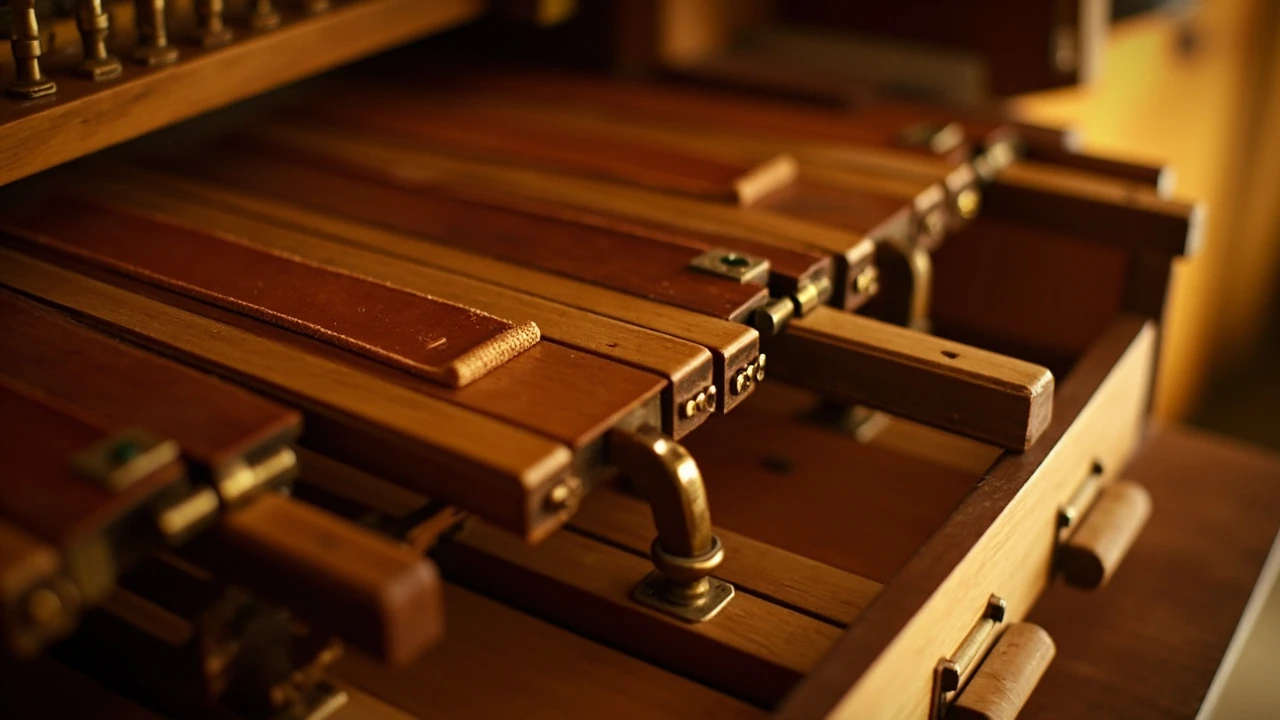
Tracker action
A tracker action is the mechanical link between the keys you press at an organ console and the valves that let wind into the pipes. On many pipe organs, especially smaller instruments and most historical European designs, that link is a chain of wooden levers, thin rods, and pivots rather than cables or electric wires. When the tracker action is well built, the keys feel light, the response is even across the keyboard, and the first note of a phrase speaks at the same instant the finger finishes its travel. When the tracker action is out of adjustment, the same organ feels sluggish, sticky, or unpredictable from key to key.
This guide is written for organ builders, tuners, church organ committees, and serious students who want a working understanding of tracker actions. It explains how a tracker action moves, where the common failure points sit, what to check before calling a technician, and how tracker instruments compare with electric and tubular-pneumatic actions. The goal is practical: by the end of the article you should know what a healthy tracker action should feel like, what to listen for when something is wrong, and which questions to ask during a service visit.
What a tracker action actually does
Every pipe organ has to solve the same problem: a finger presses a key, and somewhere across the organ, often several metres away, a small valve called a pallet has to open at exactly the right moment and close again when the key is released. A tracker action solves this problem with rigid mechanical parts. The key lever is connected through a series of moving arms to the pallet, and the player’s finger supplies all the energy needed to open it. There is no motor, no compressor, and no electrical switch in the path between finger and pipe.
Mechanically, the action is a series of levers in series, each pivoting around a small pin or square. The motion travels from the key, through the tracker itself (the long thin rod that gives the system its name), over the top of the roller board, down through another tracker, and finally into the pallet box where a small lever called the sticker pulls the pallet open. Each joint is either a pinned hinge, a square-on-square fit wrapped in leather, or a small leathered bump that transmits motion by compression.
Why builders still choose tracker actions
Tracker actions are not the only option. Many mid-20th-century organs used tubular-pneumatic or electro-pneumatic actions, and modern digital and hybrid instruments are common. Builders still choose tracker actions for several reasons:
- Direct response. Because the finger provides the force, there is no perceptible delay between key motion and pallet motion. Articulation such as detached chords and short notes is more controllable.
- Mechanical reliability. There are no bellows, magnets, or wiring to fail. A well-made tracker action can last for more than a century with periodic regulation.
- Repairability. Damaged parts can be remade in a small workshop using traditional tools. Leathered components can be replaced on site.
- Tactile feedback. Builders can shape the key resistance to match the player’s hand, the organ’s voicing, and the acoustic of the room.
These reasons are not marketing. They are observable on instruments built in the 18th century that are still in regular service today, and they form the basis of the renewed interest in mechanical action that has shaped much of the 20th- and 21st-century organbuilding revival.
Where tracker actions work well and where they struggle
Tracker actions scale up gracefully to a point. For a two- or three-manual organ of around 20 to 40 stops, a well-designed tracker action remains comfortable for most players. As the instrument grows, the total force required to press a key can rise sharply, because the player’s hand has to overcome the friction of every joint in the chain. A large four-manual organ with 60 or more stops may need a different solution, such as a suspended action, a mechanical key action with pneumatic pallet opening, or a Barker lever intermediate stage. These hybrids still use trackers in the key-to-pallet path but use air pressure to assist the heaviest part of the work.
The parts of a tracker action in order
Understanding a tracker action is easier if you follow the path of motion step by step. The names below are the standard ones used in English-language organbuilding texts, and they appear on most organbuilders’ service reports.
- Key lever. The wooden lever you actually press, pivoting on the key fulcrum (also called the key balance).
- Key tail and tracker. The thin wooden rod (often pine) running horizontally from the back of the key to the roller board.
- Roller board. A horizontal board above the keys carrying a row of rollers, each a long lever that transfers motion sideways or at an angle.
- Backfall tracker and sticker. The vertical rod hanging from the roller, down into the windchest.
- Pallet and pallet box. The leathered valve that opens to admit wind to the pipes controlled by that key.
- Return spring. A thin brass or steel spring, or in older instruments a feather or weight, that pulls the pallet closed when the key is released.
Each of these parts has its own adjustment range. When a service technician talks about “regulating the action,” they are walking through this list, checking each step in turn, and resetting clearances to the values specified by the builder or the workshop standard.
How a tracker action should feel under the hand
A good tracker action has a particular feel that experienced players can identify without looking at the mechanism. The key should move smoothly through its full travel with even resistance, neither grabbing nor floating. The first millimetre of key depression should already start to open the pallet, so the pipe speaks as soon as the finger begins to move. The bottom of the key travel should have a small but definite cushion rather than slamming into a hard stop.
Key resistance for a well-regulated tracker action is usually somewhere between 40 and 80 grams per key for a small instrument, rising as the organ grows in size and complexity. A small 12-stop two-manual organ might sit at the low end of that range; a large four-manual with many couplers can be heavier, though builders aim to keep it playable. If you press a key and it feels spongy, gritty, or suddenly heavy at one point, that is a sign of a problem in the action, not a feature of the instrument.
| Instrument size | Approximate stops | Typical key resistance | Common feel |
|---|---|---|---|
| Small two-manual practice organ | 6 to 12 | 35 to 55 g | Light, very responsive |
| Two-manual church organ | 14 to 25 | 45 to 70 g | Even, controlled |
| Three-manual organ | 25 to 40 | 55 to 85 g | Firm, stable under chords |
| Large four-manual organ with tracker or hybrid action | 40 to 80+ | 70 to 110 g (sometimes higher) | Substantial, often with assist |
These are typical values rather than hard rules. The actual feel of a tracker action depends on the number of couplers drawn, the state of the leathered components, and the building style of the maker. Always compare what you feel with what the same organ felt like when it was last regulated, and with the technician’s report from that visit.
Common problems in a tracker action
Most service calls on tracker instruments come from a small set of recurring issues. Recognizing them early prevents secondary damage to other parts of the organ, such as warped pallets or worn pipe toe holes.
Sticky keys
A key that does not return to its rest position is the most common complaint. The cause is almost always one of three things: a swollen or worn capstan (the small threaded adjuster that sets key dip), a loose or shifted leather bushing on a square joint, or a tracker that has warped slightly and now binds in its guide bushing. The fix is rarely to apply lubricant. Correcting the source of the friction, replacing the leather, or planing the offending face is the proper repair.
Uneven response across the keyboard
If some notes speak instantly while others lag or drop out, look for problems on the roller board. A single loose roller that no longer drives its trackers evenly will affect all the notes passing through it. The same symptom can come from a tracker that has shortened over decades of regulation and no longer reaches its partner with enough engagement.
Ciphering
A cipher is a note that sounds when its key is not pressed. In a tracker action, ciphering usually means a pallet is not closing fully. Common causes include a weak or broken pallet spring, a warped pallet leather, debris under the pallet, or a tracker that has slipped and is holding the pallet slightly open. Because the pallet stays open, wind escapes continuously, and the pipe speaks without the key being touched.
Lost motion
Lost motion is the small amount of key travel that happens before the pallet starts to open. Some lost motion is normal and desirable, because it allows the leathered components to compress and protects the pallet from shock. Too much lost motion, however, makes the action feel mushy and unresponsive, especially for fast repeated notes. Regulation adds or removes motion at specific joints to set the lost motion back into the target range.
Noisy action
A noisy tracker action is not just an annoyance. A squeak or click at one specific pitch points to a specific joint that needs attention. A general creak under the entire keyboard often comes from the keyslip, the fallboard, or the side cheeks of the key frame rather than the action itself. Tracking down a noise requires running the action manually and listening at each joint in turn.
What a regulation visit actually covers
A full regulation of a tracker action is a structured procedure, not a single adjustment. Most organbuilders follow a sequence that goes from the key outward, then from the pallet inward, so that each adjustment does not undo the previous one.
| Step | Part adjusted | What is set | Tool typically used |
|---|---|---|---|
| 1 | Key height and level | Top surface of the keys in a single plane | Key levelling template, shims |
| 2 | Key dip | Total travel of each key | Capstan spanner, dip gauge |
| 3 | Lost motion at key-to-tracker | Small clearance at the joint | Thickness gauge |
| 4 | Roller alignment | Each roller centred and free | Alignment square, light source |
| 5 | Tracker length | Engagement at each joint within spec | Try square, gauge |
| 6 | Sticker adjustment | Pallet opens and closes cleanly | Pallet regulation tool |
| 7 | Pallet spring tension | Closure fast enough to prevent ciphering | Spring hook, balance scale |
| 8 | Touch and overall feel | Even resistance across manuals | Player feedback, gram gauge |
A thorough regulation of a small two-manual tracker organ usually takes a technician a full working day. A large three- or four-manual instrument can take several days of concentrated work, especially if leathered components need replacing. The result, when done well, is a noticeably lighter and more even keyboard that responds reliably for several years before the next visit.
Tools and measurements a technician relies on
Regulation is not a matter of guesswork. Workshops have standard tools and gauges for the common measurements, and the values they target are based on the builder’s own specifications or, for older instruments, on period-correct norms recorded in organbuilding literature.
- Capstan spanner. Used to turn the small brass capstans that set key dip without removing the key.
- Dip gauge. A small instrument that measures the total travel of the key, usually in millimetres.
- Thickness gauges. A set of thin metal feeler strips used to measure the lost motion at each joint.
- Regulation template. A workshop-made jig that holds keys at a specific height during adjustments.
- Pallet spring scale. A small tension gauge used to confirm that each pallet spring closes the pallet with the correct force.
- Leathering tools. Hammers, punches, and a small anvil used to apply or replace leather at the joints and pallet faces.
If you ever watch a tracker regulation in progress, you will notice that the technician rarely uses force. Most adjustments are measured in fractions of a millimetre, and the work is judged by feel and by the player’s reaction as much as by the gauges.
Tracker action versus tubular-pneumatic and electric actions
It is worth understanding how a tracker action differs from the other two common action types, because the choice of action has consequences for builders, players, and congregations. The table below summarises the main practical differences.
| Feature | Tracker action | Tubular-pneumatic action | Electric action |
|---|---|---|---|
| Power source for pallet opening | Player’s finger, transmitted through wood | Wind from the reservoir, controlled by a small pneumatic valve | Magnets, controlled by an electrical switch under the key |
| Time delay between key and pipe | Effectively none | Small but perceptible | Usually negligible, but depends on switching design |
| Typical key resistance | 40 to 80 g for a small organ, higher for large instruments | Light, because player only opens a small primary valve | Light, often adjustable electronically |
| Susceptibility to humidity | High: wood and leather respond to moisture | Moderate: leathered primary valves can be affected | Low for moving parts, but wiring and contacts need protection |
| Susceptibility to dust and debris | Moderate: grit in joints causes binding | Low: tubes are largely sealed | Low, but dust on contacts can cause intermittent faults |
| Failure mode | Gradual: keys get heavy, slow, or sticky | Sudden: a pipe can lose wind if a tube blocks | Sudden: a single switch failure can silence a note |
| Repair skills needed | Woodworking, leathering, traditional tools | Leathering, tube work, some metalwork | Electrical diagnosis, switch and relay replacement |
| Common service interval | 5 to 10 years for full regulation | 5 to 10 years, with attention to leathers | Varies widely depending on switching technology |
The choice of action is rarely a question of one being “better” than the others. A tracker action in a dry, stable building will behave predictably for decades. The same action in a damp church with no heating will need far more frequent attention, and a tubular-pneumatic or electric action may be the more practical choice in that environment. For a fuller background on how pipe organs are voiced and how the action interacts with the wind supply, the Martin Ott Pipe Organ learning pages provide a good starting point.
How humidity and temperature affect a tracker action
Because tracker actions are built from wood and leather, they respond strongly to the conditions in the building. Wood expands across the grain as humidity rises, and shrinks as it falls. Leather becomes softer when damp and harder when dry. Pallet springs are less affected, but the metal they connect to still moves slightly with temperature.
In practice, this means that the same tracker organ can feel quite different from one season to the next. A dry winter with central heating may make some keys feel slightly higher and lighter. A damp autumn may make the action feel heavier and slower. Organbuilders try to keep the building conditions as stable as possible, both for the action and for the pipes. A good target is a relative humidity in the range of 45 to 60 percent, with no rapid swings, and a temperature that does not drop below roughly 12 °C in the building. If the building cannot be kept within those ranges, the action will need more frequent regulation.
What to listen for during a service visit
Before the technician arrives, you can gather useful information simply by playing the organ. A short list of questions, used consistently, makes the service visit more efficient and helps the technician focus on the actual problems rather than guessing what has changed since the last visit.
- Are there any keys that feel heavier or lighter than the keys next to them?
- Are there any notes that do not speak at all, or that cipher intermittently?
- Do repeated notes on the same key speak cleanly, or do they drop out or sound uneven?
- Is the action noticeably different from one manual to another, or from one octave to the next?
- Are there any new noises: clicks, squeaks, scraping sounds, or wind leaks?
Recording a brief description of each issue, ideally with the pitch and manual, gives the technician a baseline. It also gives you a comparison point at the next visit, so you can see whether the regulation has actually solved the problem or whether something has changed in the meantime.
How long a tracker action should last between services
There is no single answer, but organbuilders often quote a five- to ten-year interval for a full regulation of a tracker action in a stable building. A small organ used for a single weekly service may go longer, while a busy recital instrument may need attention every three to five years. New instruments often need an extra visit in their first year, because the wood is still settling and the leathered joints are bedding in.
The most reliable indicator is not the calendar but the action itself. When a player starts to avoid certain notes, or when the organ committee begins to receive comments about heaviness, it is time to plan a regulation visit. Waiting for visible damage, such as a ciphered note, usually means that smaller problems have been developing for some time.
When a tracker action needs more than regulation
Sometimes a regulation visit reveals damage that cannot be solved by adjustment alone. Common examples include a warped roller that no longer aligns with its trackers, a pallet box that has shifted, a chest that has settled and now pulls the action out of square, or woodworm damage to a tracker or sticker. In those cases, the technician will need to remake the affected parts, often using the same wood species and construction methods as the original.
For a detailed look at how the action connects to the rest of the organ, including the stops, families, and ranks that the action has to control, the organ stops overview is a useful reference.
Frequently asked questions
What is a tracker action in a pipe organ?
A tracker action is a mechanical link between the keys of an organ console and the pallets that admit wind to the pipes. It is built from wood and leather and uses a series of levers, thin rods called trackers, and rollers to transmit the player’s finger motion all the way to the pallet. The same finger pressure that presses the key is what opens the pallet, with no motor or electrical switch in the path.
How does a tracker action differ from an electric action?
An electric action uses a switch under each key and a magnet at each pallet, so the key only carries an electrical signal rather than the full mechanical force. A tracker action uses wood and leather throughout, and the player’s hand provides all the energy needed to open the pallet. Electric actions are lighter at the key and less affected by humidity, but tracker actions tend to feel more direct and are usually simpler to repair on site.
Why do organ builders still build tracker actions today?
Builders choose tracker actions because they are direct, durable, and repairable. They give the player immediate control over the start of each note, and they can be serviced with traditional woodworking and leathering tools. Many modern builders also value the continuity with historical organbuilding traditions, which gives tracker instruments a defined place in the literature and repertoire.
How often should a tracker action be regulated?
In a stable building with reasonable humidity control, a tracker action usually benefits from a full regulation every five to ten years. A heavily used recital instrument may need attention more often, while a lightly used organ in a stable church may go longer. The most reliable signal is the player’s experience: when the action starts to feel uneven or heavy, it is time to plan a service visit.
What does tracker action regulation cost?
The cost of regulation depends on the size of the instrument, the number of manuals, the condition of the action, and the labour rates in your region. A full regulation of a small two-manual tracker organ is usually a single-day or two-day visit, while a large three- or four-manual instrument can take a week or more. The best way to budget is to ask the organbuilder for a written estimate after they have inspected the instrument.
Can a tracker action be added to an existing electric organ?
In theory, yes, but it is rarely practical. A tracker action requires precise mechanical alignment from the console to every pallet on every chest, and the existing chests, layouts, and consoles are usually designed for their original action. For a small new instrument or a careful rebuild it is straightforward, but converting a working electric organ to a full mechanical action is a major project and is usually more expensive than a good regulation of the existing system.
What is a roller board in a tracker action?
A roller board is a horizontal panel that sits above the keys and carries a row of long, pivoting levers called rollers. Its job is to redirect the motion of the trackers: a key’s tracker may need to drive a pallet that is not directly above the key, so the roller carries the motion sideways or at an angle to the sticker that opens the pallet. Rollers are one of the parts most carefully aligned during regulation.
What is lost motion in a tracker action?
Lost motion is the small amount the key can move before the pallet starts to open. It exists because the leathered joints in the action compress slightly under load, and because builders deliberately set a small clearance at each joint to protect the pallet from shock. A small amount of lost motion is normal and necessary; too much makes the action feel spongy and delays the start of each note.
Why do some tracker organs feel heavier than others?
Key resistance is the sum of the friction at every joint in the chain, plus the force needed to open the pallet against its spring. A small instrument has fewer joints, so the total friction is lower. A large instrument has more joints and stronger pallet springs, and the total can rise steeply. Builders can offset this with careful choice of pivot materials, smooth leather, and a balanced design, but the player will still feel the difference between a 12-stop practice organ and a 60-stop recital instrument.
How do I know if my organ’s tracker action is in good condition?
A healthy tracker action feels even across the keyboard, returns to rest quickly when a key is released, and produces no noises other than the sound of the pipes and the wind supply. If some keys feel heavy, if certain notes do not speak instantly, or if you hear new squeaks or scrapes, those are signs that the action needs attention. A trained technician can confirm the diagnosis and tell you whether a regulation is enough or whether parts need to be remade.
Practical next steps for organ owners and players
If you are responsible for an organ with a tracker action, the most useful thing you can do this year is to play the whole instrument through, manual by manual, and write down any notes that feel different from the rest. Keep that list with the organ’s service records. When the technician next visits, the list becomes a baseline for what has changed, and the regulation can be focused on the actual issues rather than on a general pass. If you are planning a new instrument or a major rebuild, talk to your organbuilder about the action design before the case and layout are finalised, because a tracker action influences the placement of the console, the height of the roller board, and the routing of the trackers through the organ. For an overview of the larger instrument family that this kind of action serves, the pipe organ instruments page is a useful place to start.