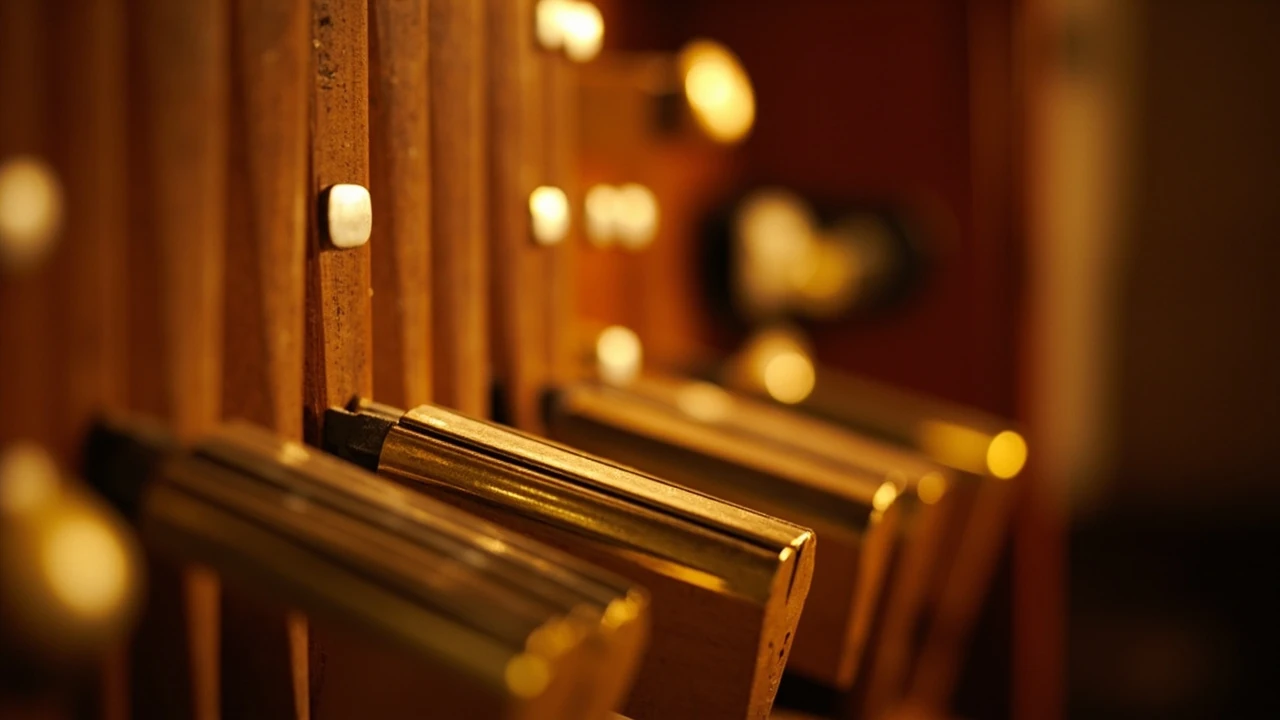
A reed stop is the only family of organ pipes that sings through a vibrating metal tongue rather than a column of air striking a lip. That single mechanical difference is why a full chorus of principals can sit quietly behind a screen while a single Trumpet 8′ cuts through a large nave, and why a rank of Krummhorns can give a quiet chorale prelude its earthy, almost human voice. For organists, builders, and curious listeners, understanding reed stops opens up roughly a third of the tonal palette available on a well-designed instrument.
This guide is written for readers who want a practical working knowledge of reed stops: how the pipe produces its tone, how builders name and scale the family, how to interpret them in a stop list, and what to listen for when comparing instruments. The broader picture of organ stops and families is covered in the article on organ stops explained; here the focus stays on the beating-reed family and the practical decisions that surround it.
Reed stops and how they produce sound
The term reed stop covers any rank of pipes in which the sound is generated by a thin metal tongue, called a tongue or reed, vibrating against a shaped block, called a shallot. Air under pressure passes around the tongue, and the tongue snaps open and closed many times per second. That oscillation, rather than a jet of air against a lip, is the source of tone. Each pipe therefore contains three working parts that a flue pipe does not have: a foot that admits wind, a tongue-and-shallot assembly that generates the oscillation, and a resonator, usually a conical or cylindrical metal body, that reinforces and shapes the sound.
Because the resonator only amplifies what the reed generates, its length is not tied to pitch the way a flue pipe’s length is. Builders can shorten the body, lengthen it, flare it, or cap it with a cylinder, and the reed will still speak at the pitch its tongue is set to vibrate. This is one reason the reed family is so expressive: the same speaking pitch can be wrapped in a long, narrow, trumpet-like pipe or in a short, fat, almost square resonator, and the resulting tone colour changes dramatically. It is also why reed pipes are larger, more expensive, and harder to regulate than flue pipes of equivalent pitch.
Anatomy of a single reed pipe
Open the boot of a typical reed pipe and you will see the wind enters through a small leathered pallet, rises into a wooden or metal block, and reaches the shallot. The shallot is a small half-tube, usually of brass, with a carefully shaped opening. The tongue is a thin, springy strip of brass, anchored at one end so that it lies over the shallot with a precise gap. When air arrives, it pushes the tongue briefly off the shallot, the spring of the tongue pulls it back, and the cycle repeats. The length of the vibrating tongue and the thickness of the metal determine the raw speaking pitch; the resonator shapes what we hear.
A small tuning wire, sometimes called a tuning scroll or tang, sits at the free end of the tongue. The organ builder uses this wire to adjust the speaking pitch in fractions of a semitone during regulation. A heavier wire lowers the pitch slightly and lengthens the attack; a lighter wire raises the pitch and brightens the response. Reeds are usually tuned with the tongue, not with the resonator, which is the opposite of flue pipes. Get used to the phrase “tuning the tongues” if you spend time with an organ technician.
Why reed stops sound so different from flue stops
A flue principal is essentially a flute with a bevel. The air jet, lip, and resonator must be balanced, and the result is a relatively pure tone with a clearly visible formant. A reed pipe adds a square-wave-like, on-and-off excitation from the tongue, and that excitation feeds a much louder, richer, and more harmonically complex signal into the resonator. The upper partials are stronger, the attack is sharper, and the sound carries further. It is also more sensitive to small mechanical problems. A slightly bent tongue, a leaking shallot, or a crooked boot will change a regal from a soft, woody buzz into a thin, hissing whistle.
This is why experienced organists often treat reed stops as solo voices, especially in dry acoustics, and why a full battery of reeds is more common in larger instruments. Reed stops are not louder because they are pushed harder; they are louder because their harmonic content is richer and the ear perceives that richness as projection.
The main families of reed stops
Reed stops are usually grouped by the shape and material of their resonators, because that shape is what the listener actually hears. The names are historical and overlap between traditions, but a few broad families cover most of what you will find on a stop list.
Trumpet family
The trumpet family is the brightest and most projecting. Resonators are cylindrical or only slightly conical, made of polished or burnished metal, and are either half-length or full-length depending on harmonic development. The classic Trumpet 8′ is the reference. It speaks the written pitch and dominates the chorus in a classical French or German disposition. Shorter members of the family, such as the Trompette 4′ or the Clarion 2′, add brilliance on top of a chorus mixture, while 16′ trumpets provide gravity at the bottom. Builders vary the tone colour within the family by changing the diameter of the resonator, the thickness of the tongue, and the boot pressure.
In some traditions the trumpet is called Trompete, Tromba, Trompette, or Trummet, but the underlying pipe geometry is similar. A well-voiced trumpet is even in tone across the compass, has a clear attack, and blends with principals without disappearing.
Posaune and trombone family
The Posaune and trombone family sits an octave below the trumpet in some respects, but the real difference is length and weight. A Posaune 32′, when present, is one of the largest pipes in any organ. The tongue is long, the shallot is large, the resonator is wide, and the pipe may stand in a separate case to keep its weight on the wind system manageable. The tone is round, weighty, and less piercing than a trumpet. In Romantic and symphonic organs the Posaune often functions as a pedal solo voice and as a foundation under a full chorus.
Lower members of this family, such as 16′ and 8′ Posaunen, are often voiced so that they speak clearly at a soft dynamic. A common mistake is to assume a Posaune is just a louder trumpet. In practice it is a separate voice with its own characteristic attack and decay, and it tends to dominate the room rather than the listener.
Choir reeds and harmonic reeds
Choir reeds are smaller, shorter, and more delicate. The Krummhorn, the Rankett, the Cor Anglais, and the Vox Humana belong here. The resonators are often short, sometimes semi-circular, sometimes capped. These stops sit at lower wind pressure and at modest pitch, and they are voiced to combine with flue choir stops rather than to project over the building. A Krummhorn 8′ over a Gedeckt 8′ and a Salicional 8′ is a classic combination for a soft solo voice; the same Krummhorn over a full chorus will simply vanish.
Harmonic reeds use a half-length resonator that sounds an octave above its fundamental. The Clarinet and the Corno di Bassetto, despite their names, are usually flue stops in some traditions and harmonic reeds in others. A true harmonic reed pipe has a small hole near the top of the resonator that shifts its resonance up an octave, giving the pipe a bright, almost stringy quality. These stops are useful as solo voices and as part of a chamber ensemble in the manuals.
Regals and short resonators
The regal family takes the reed concept in the opposite direction. Resonators are extremely short, sometimes folded, sometimes made of wood, and the tone is buzzy, nasal, and full of upper partials. The Vox Humana, the Krummhorn in some voicing styles, the Geigenregal, and the rarer Rankett are all related. Regals are typically soft and do not project far, but they have a distinctively vocal colour that blends well with strings and covered flues. In small organs and continuo organs, a single regal stop can be the expressive heart of the instrument.
How to read reed stops on a stop list
A stop list compresses a great deal of information into a short line. The number is the pitch, the name is the family and voicing style, and any annotation in parentheses tells you how the stop is unified or borrowed. Reading reed stops accurately means parsing each piece in turn.
Consider a line such as “Trompette 8′ (G.O. and Pos.)” on a three-manual organ. The number tells you the stop sounds at written pitch, the name tells you the family, and the parenthetical note tells you it is available on the great, the orchestra, and the pedal. If the same organ lists “Trompette en chamade 8′” the pipe stands horizontally in a separate case, often in the front of the room, and the projection is significantly different from an enclosed swell division. If it lists “Trumpet 8′” the family is the same but the name follows English convention.
Pitch, length, and apparent size
The pitch number follows the same convention as flue stops. A 16′ reed sounds an octave below written, an 8′ reed at written pitch, a 4′ reed an octave above, and a 2′ reed two octaves above. Lower reed stops at 32′ and 64′ are rare outside the largest instruments; they require very long tongues, careful regulation, and a stable wind supply.
Because reed resonators are not length-pitch-locked, a short-bodied reed at 8′ can sound very different from a long-bodied reed at 8′. The body length is sometimes added in the stop list as a secondary annotation, but more often you have to hear the stop to know.
Notation conventions to watch for
| Notation | Meaning | What to listen for |
|---|---|---|
| Trumpet 8′ | Standard 8′ reed, often full length | Bright, projecting solo voice |
| Clarion 4′ or 2′ | Half-length or harmonic trumpet | Brilliance, used in tuttis |
| Trompette en chamade | Horizontal trumpet in a separate case | Strong projection, often Spanish or French |
| Posaune 16′ | Heavy 16′ reed in the pedal | Gravity, foundation |
| Krummhorn 8′ | Short, capped or curved reed | Soft, vocal, choir-like |
| Vox Humana 8′ | Short regal-type reed | Human, slightly nasal, solo |
| Rankett 16′ | Capped, narrow reed | Muted, distant quality |
| Cor Anglais 8′ | Harmonic or orchestral reed | Solo, stringy, expressive |
Different national traditions also use different default names. A Trompette on a French organ and a Trumpet on a British organ usually refer to similar pipes, but a German Trompete 8′ and a German Posaune 16′ will sound noticeably different from a French Trompette 8′ and a French Basson 16′. Knowing the tradition of the builder helps, but the stop list itself rarely says so directly.
How builders voice and regulate reed stops
Voicing a reed is one of the most demanding tasks in organ building. The voicer starts with a fresh tongue and shallot, sets the tongue in the shallot so that the gap is even along its length, and then adjusts the curvature of the tongue with a special tool. The shape of the curve controls how the reed speaks: a flatter curve gives a faster, brighter attack; a deeper curve gives a more languid, rounder attack. The voicer then sets the resonator, typically by sliding the pipe up or down on its boot to find the point where the body reinforces the tongue’s pitch most evenly.
Regulation is the ongoing work of keeping reeds stable. Wood and metal move with humidity and temperature, tongues fatigue, and the wind supply fluctuates. An organ technician returns to a reed stop several times during its first year of life and at intervals afterwards, especially before important services and recordings.
Common voicing problems in reed stops
Listeners can hear some of these issues even without opening the pipe. A reed that hisses at the top of its compass has a tongue that is too open or a resonator that is too short. A reed that speaks late in the attack has a tongue gap that is too tight. A reed that is uneven in tone between the bass and the treble may have tongues of inconsistent thickness, or the resonator may be sitting at the wrong height. Pitch drift over a long service is usually a wind problem rather than a voicing problem, and the fix is upstream at the blower or reservoir.
If you are a player and you suspect a reed problem, note the specific notes where the issue appears. “The Trompette is slow in the tenor” is more useful to a technician than “the reeds sound off today”. That kind of observation also helps when you are trying to decide whether to call the builder or simply leave the stop out for a season.
Reed stops in different musical contexts
The role of reed stops changes a great deal between repertoires. In a Bach chorale prelude, a single Trumpet 8′ against a Gedeckt 8′ and a 4′ flute is often the whole texture. In a French Romantic grand jeu, the reeds carry the climax and the flue chorus fills the harmonic structure underneath. In a 20th-century neo-classical piece, a Krummhorn or a Vox Humana can be the expressive voice that turns a slow movement into something almost vocal.
Baroque and early Romantic practice
Baroque and early Romantic organ music is built on a clear distinction between solo reeds and chorus reeds. The Trompette or Tromba is reserved for climactic lines; the choir reeds accompany softer textures. Reeds were usually used at full pitch, and the swell box, where it existed, was used to colour rather than to swell. When you read Bach’s registration indications, treat each reed stop as a distinct voice with its own role, not as a generic “reed”.
French Romantic and symphonic organs
French Romantic organs often carry large batteries of harmonic reeds in the orchestral style, with names borrowed from orchestral instruments. The Voix Celeste and the Voix Humaine appear side by side, the Basson and the Hautbois serve as solo voices in different manuals, and the Bombarde division may contain a complete chorus of reeds. In this context, reeds are layered, often at different pitches, to produce orchestral colours. Listening becomes as much about the combination as about any single pipe.
20th- and 21st-century repertoire
Modern and contemporary organ music sometimes uses reed stops in ways that are deliberately unidiomatic, treating them as a noise source rather than as a melodic voice. A composer might ask for a single note of a Trumpet 8′ held for a long time, with the swell box almost closed, in order to bring out the breath and instability of the reed. For organists this means a well-regulated reed stop, especially a regal or a short harmonic reed, is as useful for contemporary work as for historical repertoire.
Practical choices when you encounter a new instrument
When you sit down at an unfamiliar organ, spend the first few minutes with the reeds alone. Play a full chromatic scale on the Trumpet 8′ at a moderate dynamic. Listen for evenness of attack, stability of pitch, and any tendency to “blossom” or swell on sustained notes, which often points to a wind problem. Repeat the exercise on a choir reed, this time listening for the moment the pipe speaks: a Krummhorn should respond almost instantly, while a Posaune may take a fraction of a second to settle.
Once you have a sense of the individual stops, combine them with flue stops at the same pitch. A Trumpet 8′ over a Principal 8′ should reinforce, not muddy, the line. A Krummhorn 8′ over a Salicional 8′ should add a vocal edge without losing the string colour. Trust your ear over the stop list; builders describe intent, not always the result.
Choosing reed stops for a service or recital
| Context | Useful reed choices | What to avoid |
|---|---|---|
| Solo Bach prelude | A single 8′ trumpet in the same manual | Stacking the trumpet with a 4′ clarion unless the room is large |
| Chorale prelude with cantus firmus | Trumpet or Posaune at 8′ in a strong manual, flues in the other | Using a 16′ reed as the cantus unless the building is long |
| French grand jeu | Full battery of chorus reeds, 16′, 8′, 4′ | Hesitating to commit; the reeds are the point of the registration |
| Soft anthem accompaniment | Krummhorn or Vox Humana in a swell box | A solo Trumpet in the same dynamic, which will not blend |
| Romantic solo piece | Harmonic reeds at 8′ and 4′ in a romantic division | Mixing English and French reed scales without checking pitch |
Where a stop is part of a chorus, listen for whether it reinforces the chorus or fights it. A Trumpet 8′ that is voiced too bright will stick out of a chorus mixtur work; a Trumpet 8′ that is voiced too soft will disappear behind a strong principal. Builders call this “blending”, and a well-blended reed is the most reusable kind.
Common misunderstandings about reed stops
Because reed stops are described in musical metaphors, a few confusions come up often. Trumpet does not mean orchestral trumpet; it is a name, and a 17th-century German Trumpet may have very little in common with a 19th-century French Trompette. Posaune does not mean trombone in the orchestral sense; the German Posaune is a reed pipe, not a brass instrument. Vox Humana is not a recorded human voice; it is a small reed stop voiced to suggest the human voice. Understanding the names as labels rather than as descriptions helps in working with instruments from different traditions.
Another common confusion is between harmonic reeds and chimney flues. Both can sound an octave above their fundamental length, but only the reed has a moving tongue. The difference is clear on close listening: the harmonic reed has a sharper attack and a more colourful decay. A third confusion is between ranketts and regals. A rankett is usually a long, narrow, capped reed pipe that sounds quiet and distant; a regal is short and buzzy. Both belong to the short-resonator family, but the resulting colours are different.
Looking after reed stops over the life of an organ
Reed stops are more maintenance-intensive than flue stops. Tarnish on metal resonators is largely cosmetic, but corrosion at the tongue or shallot is mechanical and will change the tone. Wooden boots and block assemblies should be checked for cracks, which cause air leaks and unsteady speaking. Tuning wires, scroll springs, and the small leather or felt seals around the boot all need periodic attention.
Humidity control matters more for reeds than for flues. A dry room will make tongues go flat and may even cause them to crack. A very humid room will make tongues sluggish and slow to speak. Many organ builders specify a target humidity range for the organ chamber, and serious institutions log the conditions. If you are responsible for a small organ, a simple hygrometer near the swell box is a low-cost safeguard.
For organs that are not played often, it is worth running the reed stops briefly during regular maintenance visits, even if no one is listening. Stagnant tongues can develop micro-corrosion that changes their flexibility. A few seconds of wind once a month is usually enough to keep the surfaces clean.
A short maintenance checklist for reed stops
- Play each reed stop through its full compass at least once a month to keep tongues active.
- Inspect boots, blocks, and tuning wires for signs of corrosion, especially in older instruments.
- Check that resonator caps and boots are seated and that no pipe rattles against its neighbour.
- Monitor humidity in the organ chamber and keep it within the builder’s recommended range.
- Keep a written log of any note that speaks late, hisses, or drifts, with the date and the conditions.
- Schedule a full regulation with a qualified organ builder every few years, or sooner if a known change has occurred.
A small amount of routine attention is worth more than occasional major repairs. Reed stops that have been neglected for decades are often more expensive to restore than to replace, because individual tongues and shallots can no longer be sourced from the original maker. Where a builder is no longer in business, a careful independent technician can sometimes fabricate replacement parts to match the surviving pipes, but the work is slow.
Reed stops in a broader context
Reed stops are not the whole organ, but they are a large part of what makes an organ an organ rather than a bank of tuned whistles. A tracker organ with a single 8′ Principal and a single 8′ Trumpet can give a satisfying account of itself in a small room, and a large symphonic organ with a full battery of reeds can fill a cathedral in a way that no combination of flue stops can match. Reed stops are also the family in which builders have experimented most over the centuries, from Baroque cornetts to nineteenth-century orchestral imitations to recent reconstructions of historical reeds from earlier centuries.
For organists, learning to use reed stops confidently is partly about repertoire and partly about listening. The repertoire tells you what to expect; the listening tells you what the actual instrument in front of you can deliver. For listeners, recognising the reed family adds a layer of meaning to almost any organ performance, because the same note played on a Principal, a Flute, and a Trumpet is in a real sense three different instruments sharing one keyboard.
If you are planning a visit to an organ, whether to play, to listen, or to commission work, it helps to read the stop list in advance. Many instruments now publish their stop lists online, often with notes on voicing and scaling. Cross-referencing a stop list against the article on organ stops explained is a quick way to understand the full disposition before you arrive. The wider resources at the learn about pipe organs page can also help fill in the background.
Frequently asked questions
What is a reed stop in a pipe organ?
A reed stop is a rank of organ pipes in which the sound is produced by a thin metal tongue vibrating against a shaped shallot, rather than by a jet of air striking a lip. The tone is then shaped by a resonator, usually a metal pipe. Reed stops tend to be louder, brighter, and more harmonically rich than flue stops.
How is a reed pipe different from a flue pipe?
A flue pipe makes sound the way a recorder does, by air striking an edge. A reed pipe makes sound the way a clarinet reed does, by a vibrating tongue against a block. Reed pipes also have a separate resonator that is not strictly tied to pitch, which is why they can take many shapes.
Why are some reed stops louder than others at the same pitch?
Loudness in reed stops depends on the wind pressure, the thickness of the tongue, the size of the shallot, and the geometry of the resonator. A 16′ Posaune voiced at high pressure is much louder than an 8′ Krummhorn voiced at low pressure, even though their pitch numbers would suggest otherwise.
What is the difference between a Trumpet and a Posaune?
A Trumpet is usually a shorter, brighter, more projecting reed. A Posaune is usually a longer, heavier, rounder reed. In a stop list the Trumpet is typically an 8′ manual or pedal stop, while the Posaune is more often a 16′ pedal stop, though both names are used in different ways by different builders.
What does “en chamade” mean for a reed stop?
En chamade means the reed pipes stand horizontally in a separate case, often at the front of the room, with their mouths facing the audience. This position gives the stop a direct, projecting sound that does not depend on the swell box or on the main case. It is a voicing style rather than a separate family of pipes.
How do I read the pitch number on a reed stop?
The pitch number follows the same convention as on flue stops. An 8′ reed sounds at written pitch, a 16′ reed an octave below, a 4′ reed an octave above, and so on. Because reed resonators are not strictly length-pitch-locked, the number reflects the speaking pitch set by the tongue, not the actual length of the pipe.
Are Vox Humana and Krummhorn the same kind of stop?
Both are short-resonator reed stops, but they are voiced for different colours. A Krummhorn is typically a soft, capped reed with a slightly woody tone. A Vox Humana is usually an even shorter, more buzzy reed, often with a slight tremulant, intended to suggest the human voice. Both work as solo voices in quiet combinations.
Why do reed stops need more maintenance than flue stops?
Reed stops have moving metal parts that respond to humidity, corrosion, and mechanical fatigue. The tongue, shallot, and tuning wire all need periodic adjustment. Flue pipes have no moving metal parts and tend to remain stable for long periods, though they still need cleaning and tuning.
Can reed stops be used for soft music?
Yes. Choir reeds such as the Krummhorn, the Vox Humana, and the Rankett are designed for soft combinations and often appear in the enclosed swell division. A full chorus reed at high pressure is less suitable for soft music, but a well-voiced choir reed at low pressure can accompany a solo voice or a small choir.
What is a harmonic reed, and how does it work?
A harmonic reed uses a half-length or two-thirds-length resonator that sounds an octave above the tongue’s fundamental. A small hole near the top of the resonator shifts the resonance upward, giving the pipe a bright, stringy colour. The Clarinet, the Corno di Bassetto, and some orchestral reeds are voiced this way.