What a music store actually sells and how to choose one
A music store is a retail shop that sells instruments, accessories, printed music, and the small parts that keep a player’s setup working. Some stores also rent instruments, offer repairs, run lesson programs, and advise customers on purchases they will live with for years. The reason that range matters is that two stores carrying the same brand of trumpet can deliver very different experiences depending on who is behind the counter, how the stock is set up, and whether the shop will stand behind a sale after the receipt is printed.
Choosing a music store is partly a logistics question and partly a quality question. You need a place that stocks what you want at a price you can justify, but you also need a place that will help you make a good decision in the first place. The sections below walk through what a typical store carries, how physical and online shops differ, what to check before you buy, and how the retail side of music connects to playing, practicing, and looking after an instrument.
What a music store actually sells
Most people picture a row of guitars when they think of a music store, and that picture is roughly accurate for the popular end of the market. Behind those guitars, however, a working shop usually stocks four broad categories: instruments, accessories, printed and digital music, and services such as rentals, repairs, and lessons. A large chain may add recording gear, PA equipment, and DJ supplies, while a small independent often focuses on a narrower range, such as woodwinds, orchestral strings, or acoustic folk instruments. The breadth of a store’s catalogue tells you what kind of customer the owner is trying to serve.
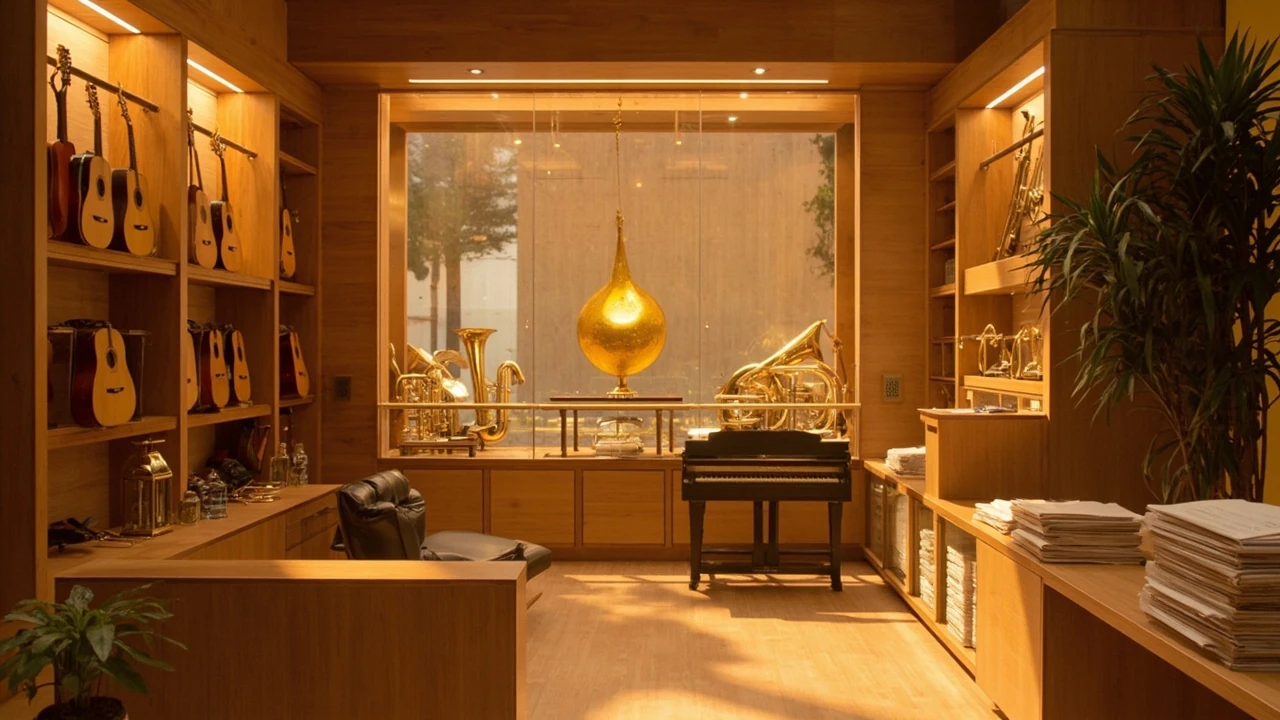
The standard layout reflects this. A wall of guitars and a keyboard display usually face the door because they pull in passing trade. Brass and woodwind instruments sit in glass cases because they are more expensive and more vulnerable to damage. Drums and percussion occupy the back wall, partly because they are bulky and partly because customers who want them rarely need encouragement. Sheet music, stands, cases, strings, reeds, mouthpieces, oils, polishing cloths, tuners, metronomes, and capos fill the aisles and the small-parts drawers near the counter.
That mix is useful because it tells you what the store is set up to support. A shop that carries a deep selection of reeds and woodwind repair parts is telling you that its customers are committed players who return regularly. A shop that mostly stocks entry-level guitars and a single rack of ukuleles is telling you that its customers are often beginners. Neither is better, but the type of store you need depends on the type of player you are.
The core inventory of a working store
The following list covers what a typical general music store stocks day to day. Smaller shops will trim this down, and specialty stores will go much deeper in one direction, but the categories are stable across the retail sector.
- String instruments: acoustic and electric guitars, basses, ukuleles, mandolins, violins, violas, cellos, and the occasional banjo or classical instrument.
- Keyboards: digital pianos, stage pianos, portable keyboards, and occasionally acoustic uprights or grands in larger stores.
- Brass: trumpets, trombones, French horns, tubas, and cornets, plus mouthpieces, lubricants, and valve oils.
- Woodwinds: flutes, clarinets, saxophones, oboes, and bassoons, with reeds, swabs, cork grease, and ligatures.
- Drums and percussion: acoustic drum kits, electronic pads, cymbals, sticks, mallets, and drum heads.
- Accessories: cases, gig bags, stands, cables, strings, straps, tuners, metronomes, and cleaning supplies.
- Printed music: method books, sheet music, songbooks, and theory or exam materials.
- Recorded music and learning media: play-along tracks, instructional DVDs, and method books with audio access.
Stores that do a lot of school-band business tend to carry rental instruments, instrument insurance forms, and a fitting room where a child can try a few sizes of flute or violin. Stores that serve gigging musicians tend to stock a wider range of cables, batteries, in-ear monitors, and PA equipment, because those customers need spares before a show, not a week later.
How a brick-and-mortar music store differs from an online one
An online music store can offer a wider catalogue, often at lower advertised prices, because it does not need a sales floor, a heating bill, or a wall full of stock. A physical store offers the reverse: fewer products, but the ability to hold them, hear them, and ask someone standing next to you what they think. Both models have their place, and many serious players use both, buying consumables online and reserving major purchases for shops they trust.
What a physical store does that an online store cannot
You can feel the neck profile of a guitar before you commit to it, hear a trumpet’s tone in the room, and test whether a keyboard’s action feels right for your hands. You can also ask a staff member to set up an instrument, swap strings, or compare two mouthpieces back to back. None of that translates through a screen, and it is the main reason a good independent store still has a future even when warehouse prices are lower.
Physical stores also help with after-sale problems. If a new cable fails, a customer can walk back in and explain what happened. If a guitar develops a buzz, the same store can usually diagnose it. Online sellers vary widely in how they handle this, and a low price on a website is not always a good trade for a slow or difficult returns process.
What an online store does that a physical store cannot
Online retailers can stock niche instruments, obscure replacement parts, and used gear that a single shop could never justify holding. They are also useful for price comparison, because the same guitar can be advertised at three different numbers within a week. Buyers who already know exactly what they want, and who can judge a product from a specification sheet, often save real money online. Buyers who are choosing between two similar instruments, or who are buying for a child whose hands and interests may change, are usually better served in person.
| Factor | Physical music store | Online music store |
|---|---|---|
| Ability to test the instrument before buying | High. You can hold, play, and compare items on the spot. | Limited. You rely on descriptions, reviews, and return windows. |
| Catalogue breadth | Smaller. Stock is limited by floor space. | Larger. A warehouse can carry many more models and parts. |
| Typical price level | Higher, partly because of fixed costs and partly because of service. | Often lower, especially on consumables and standard models. |
| After-sale support | Usually in person. Setup, repairs, and exchanges are direct. | Varies widely. Some retailers handle returns well, others do not. |
| Best for | Major purchases, beginners, fitting, and instrument trials. | Replacements, spares, niche parts, and known repeat purchases. |
Many customers end up using both. The pattern that tends to work is to test and buy major instruments locally, then reorder consumables like strings, reeds, and cables from a trusted online source once you know what you like.
Choosing a music store for a specific purchase
The right store for a child’s first violin is not the same as the right store for a professional flutist’s upgrade. The decision is usually a stack of smaller questions: whether the shop stocks the item in the first place, whether the staff knows the instrument well enough to advise you, whether the price is fair, and whether the store will still be there if something goes wrong. Working through those questions in order is faster than comparing two shops side by side on every possible factor.
Check the staff before you check the stock
A music store is only as useful as the people behind the counter. You can tell within a few minutes whether a sales assistant actually plays the instruments on the wall, has merely read about them, or is reading a product description off a box for the first time. A staff member who plays will ask you about your level, your budget, and what you already have, because they have lived through those decisions themselves. A staff member who does not play will quote you a feature list.
It is reasonable to ask a store whether their staff includes working musicians, what instruments they specialize in, and whether they can set up what they sell. A shop that answers those questions with confidence is usually a shop that will help you long after the receipt is printed.
Check whether the store offers setup and adjustment
Most instruments leave the factory in a condition that is acceptable for display, not for playing. A guitar needs a setup. A violin needs a bridge fitted and soundpost set. A brass instrument usually needs a mouthpiece chosen to suit the player. A good music store either does this work in-house or has a technician on call. A poor store hands you a sealed box and a warranty card.
Setup matters more than brand at the entry level. A budget instrument set up by a careful technician usually plays better than an expensive instrument that has been pulled off a rack and handed over untouched. The presence of a workshop, even a small one, is one of the strongest signals that a store takes its craft seriously.
Check the small-parts drawer
A useful way to judge a store is to ask for something ordinary and unglamorous, like a single replacement reed, a specific gauge of string, or a small cable. If the staff can produce it from the back room without checking a catalogue, the store is used to looking after real players. If they have to order it in, the store may still be fine, but it is built around one-off sales rather than ongoing service.
What to ask before you buy an instrument
The first few questions you ask at a music store shape the rest of the relationship. Once a shop knows you are a beginner saving for your first horn, a parent fitting a child for school band, or a returning player looking for a serious upgrade, the staff can give useful answers. If you walk in without a clear sense of what you need, the conversation tends to drift toward whatever the store most wants to move that month.
| If you are a… | Key questions to ask the store | What to watch for in the answer |
|---|---|---|
| Complete beginner | Is this instrument suitable for a first player? What does the package include? Do you offer lessons? | Honest answer about what is hard to learn. Willingness to suggest a cheaper model if appropriate. |
| Parent of a school-age player | Which size do you recommend? Do you rent first? What does a full setup cost? | Proper fitting with the child present. Clear rental-to-buy terms. |
| Returning adult player | How does this compare with what I played twenty years ago? What has changed in the range? | Honest comparison, not a sales pitch. A willingness to recommend used gear if it fits better. |
| Working gigging musician | Do you have a backup in stock? How fast is your repair turnaround? Can you special-order? | Specific answer about repair capacity. Evidence of a working tech on site. |
| Advanced student upgrading | What does the next tier give me that this one does not? Is the upgrade worth it now, or in a year? | Willingness to say no, or to suggest waiting. Not every upgrade is worth making on schedule. |
None of these questions is adversarial. They are a way of letting a competent store show you what it can do, and of giving an inexperienced store a chance to either step up or reveal that it cannot help you.
Music store services you should know about
Most stores make the bulk of their margin on instrument sales, but a surprising amount of real service happens around those sales. Rentals, repairs, lessons, and trade-ins keep a store in touch with its customers between major purchases, and they are often a better measure of the store’s quality than the size of its front window.
Rentals
Rentals are how most school-age players get their first serious instrument. A good rental program offers a monthly fee that can be credited against a future purchase, a range of sizes so the instrument can be swapped as the player grows, and a maintenance plan that covers normal wear. The detail to read is what the maintenance covers, because some programs replace broken parts for free and others charge for each repair.
Repairs
Repair capacity is one of the strongest signals of a real music store. A shop with a full-time technician can usually turn around a string change, a minor guitar setup, or a sticky trumpet valve in a day or two. A shop that ships repairs out may take weeks and add shipping costs. For working musicians, that difference can decide which store they buy from in the first place.
Lessons
Many stores run lesson studios in the back, with teachers who are also working players. The arrangement is convenient because students can try instruments in the same building where they take lessons, and parents can handle multiple errands at once. Quality varies, so it is worth asking how long a teacher has been at the store, what they specialize in, and whether you can take a trial lesson before committing.
Trade-ins and used gear
A store that takes trade-ins gives you a way to move on from an instrument you have outgrown without losing all of its value. Trade-in values are usually below what the same instrument would fetch privately, but the convenience and certainty are real. Used gear sections are worth browsing even if you came in for something new, because a careful used instrument can be better value than a new budget one.
How music stores set prices
The price tag on a guitar in a music store is not just the cost of the guitar. It includes the manufacturer’s margin, the wholesaler’s margin, the store’s rent and staff, the cost of the warranty, and a small amount for the fact that someone will help you if something goes wrong. Comparing a shop price to an online price without accounting for those layers is not a fair comparison, and it is one reason that the cheapest price on a website does not always produce the cheapest total cost of ownership.
Stores that sell at very thin margins often compensate by cutting service, which is why the cheapest new-in-box price in town sometimes belongs to a shop that will not adjust the action on your new guitar or help you with a return. The honest comparison is between two stores that offer a similar level of service, not between a full-service shop and a discount warehouse.
When price really does matter
For consumables like strings, reeds, cables, and polishing cloths, price is usually the right question, because the items are interchangeable and the service cost is low. For major instruments, a slightly higher price at a store that will set the instrument up, support it, and stand behind it is often the better deal over the life of the instrument. The cheapest saxophone is not the cheapest saxophone if it spends two months in a repair shop in its first year.
Specialty music stores and what they offer
A general music store is the right place for everyday purchases, but specialty stores exist for a reason. They go deeper in a single area, carry brands the general store does not, and their staff often include players who specialize in that one family of instruments. If you are buying something you will play for a decade, the trip to a specialty store is often worth it.
- Classical string shops: violins, violas, cellos, and basses, with bows, cases, rosin, and strings chosen for orchestral and chamber players.
- Guitar boutiques: high-end acoustics, electrics, and amps, often with custom setup and a deep bench of used gear.
- Brass and woodwind specialists: a deeper range of mouthpieces, reeds, ligatures, and professional-grade instruments.
- Drum shops: kit building, cymbal selection, and a workshop that can re-head and tune drums in person.
- Pro audio and DJ stores: mixers, interfaces, microphones, PA systems, and lighting for gigging musicians and small venues.
- Keyboard and piano showrooms: acoustic pianos, digital pianos, stage pianos, and the action comparisons that go with them.
For organ-specific instruments and advice, a specialist is almost always the right call, because the combination of mechanical action, wind supply, and tonal finishing is too specific for a general store. If you are choosing pipes, voicing, or registration, you want someone who works in that world daily. The practical guides at Martin Ott Pipe Organ on pipe voicing and organ registration cover the kind of decisions a specialist helps you make.
Common mistakes when buying from a music store
Most bad purchases at a music store come from a small set of predictable mistakes. They are not signs of bad faith from the store, although that happens too. They are signs of the buyer skipping a step that would have made the decision clearer.
- Buying for a player who is not in the room. A guitar that fits your hand may not fit your child’s, and a violin sized for a ten-year-old will not work for a six-year-old.
- Choosing the most expensive model because it feels safer. The most expensive model is not always the best fit, and the next model down often has the same build quality with fewer features you will not use.
- Choosing the cheapest model on the wall because the price looks good. Entry-level instruments vary widely in setup, and the cheapest one usually skips the workshop time that makes a budget instrument playable.
- Skipping the setup conversation. A new instrument that has not been adjusted to the player is a common source of frustration, especially for beginners who do not know what to expect.
- Ignoring the small-parts cost. A budget clarinet with expensive private-brand reeds, or a guitar that needs a case, stand, tuner, and capo on day one, can end up costing more than a slightly more expensive package.
- Forgetting to ask about trade-in. A store that knows it will see your trade-in later is often more useful than a store that knows it will not.
A good store will not let you make all of these mistakes, because a good store knows that a customer who feels sold to is a customer who will not return. A poor store will, because a poor store is built around moving units rather than building a long-term relationship.
How music stores support music education
Music stores are usually the first retail contact a young player has with the wider music world, and many of them take that role seriously. Beyond the cash register, a working store often hosts recitals, sponsors school band programs, offers instrument petting zoos for younger children, and runs clinics with visiting artists. Those activities are not charity. They are the reason a new player walks into that store, instead of the one down the street, when they are ready to buy a real instrument.
If you want to support a local music economy, the practical version of that is to buy at a store that supports the scene. The store that sends a technician to the school band night, hosts the end-of-term recital, and stocks a back room of music for the community choir is the one that is helping the next generation stay in music. Price still matters, but it is not the only thing that matters.
Quick checklist for choosing a music store
Before you commit to a purchase, run through the points below. A store that answers them well is almost always a store worth supporting, and a store that cannot answer them is almost always a store that will not support you once the sale is done.
- The store stocks what you actually want, or can get it in a reasonable time.
- The staff includes working players, not just salespeople.
- The store offers setup and adjustment, either in-house or through a known technician.
- The store can service what it sells, with a turnaround you can live with.
- Trade-in, rental, and used options are available if you need them.
- The small-parts drawer is well stocked, which means the store is used to looking after real players.
- The price is fair for the service level, even if it is not the absolute lowest in town.
Frequently asked questions
What is the difference between a music store and a music shop?
There is no real difference in English. “Music store” and “music shop” refer to the same kind of retail business. “Store” is more common in North American English, and “shop” is more common in British and Australian English, but the products and services are the same in either case.
Do music stores still matter now that so much is sold online?
Yes, but their role has shifted. Customers who know exactly what they want often buy online for price and convenience. Customers who are choosing between instruments, fitting a child, or setting up a new purchase still get a lot of value from a physical store. The best stores combine both, with a strong shop floor and a usable website for reorders.
How do I know if a music store is reputable?
Look for signs of a working business: staff who play, a workshop on site, a well-stocked parts drawer, a clear return policy, and a track record with local schools or musicians. A store that is still in business after several years is usually a store that has earned that longevity, although there are exceptions.
Should I rent or buy my first instrument?
Renting is usually the right move for a child’s first instrument, because the player is still growing and the instrument is still likely to change. Renting is also a reasonable move for an adult beginner who is not sure whether they will keep playing. Buying is usually better once you know the player, the size, and the commitment level.
What does a basic music store setup include?
For most instruments, a basic setup includes adjusting the action, intonation, and tuning to the player’s needs, fitting any necessary parts like bridges or mouthpieces, and checking that the instrument plays cleanly across its range. The exact contents of a setup vary by instrument, and a good store will explain what they do before they do it.
Can a music store help me choose the right size for a child?
Yes, and this is one of the main reasons to visit a store in person rather than order online. Sizing for string and wind instruments depends on the player’s body, and a good store will measure the child, try two or three sizes, and pick the one that fits now rather than the one that will fit in two years. The wrong size is one of the most common reasons a beginner quits.
Are music store prices negotiable?
Sometimes. Independent stores have more room to negotiate on big-ticket items, on packages, and on floor models. Chain stores usually have fixed pricing. The most effective negotiation is usually a polite question about whether a package price is available, especially when you are buying more than one item at once.
What should I do if my new instrument has a problem?
Bring it back to the store you bought it from as soon as you can. Most reputable stores will either repair the problem under warranty, replace the instrument, or refund you, depending on the issue. A store that refuses to engage with a clear manufacturing problem is a store you should not have bought from in the first place, and a good reason to choose carefully before you spend.
Do music stores buy used instruments?
Many do, especially for instruments that are still in production and in good condition. Trade-in values are usually lower than private sale values, but the convenience is real, and a trade-in can often be applied directly to a new purchase. If you are upgrading, this is one of the first things to ask the store before you start shopping.
How do I find a good music store in my area?
Ask local players, school band directors, and private teachers which store they use and why. Those people buy instruments regularly and they have strong opinions. Online reviews are useful as a secondary check, but a recommendation from a working player is usually the more reliable signal.