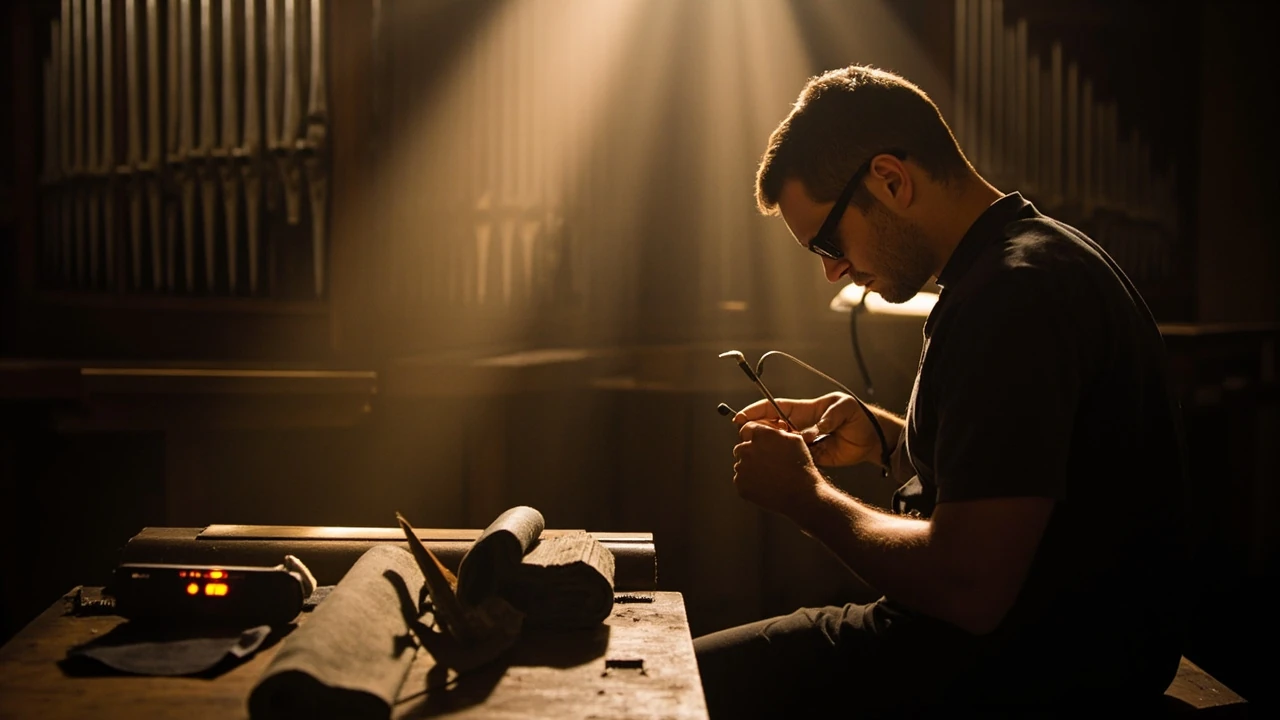
Two weeks before a wedding, a parish organist noticed the opening chord of the processional sounded sour. A few ranks were flat, the mixture was sharp, and the trumpet was sticking at the top of its speech. The organ had been moved a year earlier and had not been touched since. That visit, a single afternoon with a technician, a tuning mallet, a small roll of paper, and a digital strobe tuner, brought the instrument back into the same reference pitch and gave the congregation something most listeners never think about: a stable foundation under every chord, solo, and silence.
That afternoon is what most people mean when they talk about organ tuning. It is the regular maintenance that brings the pipes back to a single chosen reference pitch, balances the loud and soft voices against each other, and corrects the small mechanical faults that make an organ feel out of sorts. This guide explains how the process works, why pipes drift away from pitch, how often it should happen, and what a church, concert hall, or home owner should expect when scheduling a visit.
Organ tuning: what the process actually is
Organ tuning is the craft of adjusting the speaking pitch of every pipe in an instrument so that the whole ranks, stops, and chorus agree on a single reference pitch and temperament. The tuner works pipe by pipe, listening to each one against a reference and changing its effective length or its wind pressure until the beating between the two tones slows to a known rate.
In a well-tuned organ, a unison rank sounds as a single, still tone rather than a shimmering cluster. A rank tuned slightly sharp or flat against the rest of the chorus produces a slow, regular pulsation called beating. Tuners use the speed of that beating as their main measurement. A clean unison sounds still. A rank a few cents sharp against the reference beats slowly; a rank further away beats quickly and roughly.
The process covers more than pitch alone. A visit usually includes:
- Stabilising the temperature and humidity around the instrument before work begins.
- Checking the wind supply, including the blower, reservoir, and winding, for stable pressure.
- Retuning every pipe in the affected stops against a reference.
- Adjusting the tremulants so their rate is consistent.
- Repairing minor speech faults such as ciphers, languid leaks, and stuck pallet springs.
- Balancing the loud and soft stops so that registration feels even.
The result is not a piano-style absolute tuning. Pipe organs are tuned to a temperament that suits the music the instrument will play. A baroque organ in meantone will sound very different at the sharp keys from a nineteenth-century equal-tempered concert organ, even though both organs have been “tuned” in the fullest sense of the word.
Why pipe organs drift out of tune
Pipes are surprisingly sensitive to their environment. Wood swells and shrinks, metal expands and contracts, leather and felt dry out, and dust changes the way a pipe speaks. A pipe organ drifts continuously between visits. The question is never whether it will go out of tune, but how fast and how unevenly.
The main reasons pipes go out of tune are:
- Temperature change. Most pipes are built so that they sit slightly sharp at normal room temperature. When the building cools in winter, the pipes go flat. When the building warms in summer, the pipes come up. Tuning at one temperature does not survive a different temperature.
- Humidity change. Humid air is heavier and slower for sound to travel through, so an organ in a damp building sounds flat relative to the same organ in a dry building. Wood pipes are more sensitive than metal pipes because the wood itself absorbs and releases moisture.
- Wind instability. If the blower or reservoir is not delivering steady pressure, the pipes can speak flat, sharp, or in a wavy way that is hard to correct until the wind is fixed.
- Material movement. Wooden pipes warp. Metal caps on wooden pipes shift. Tuning scrolls on metal flue pipes slip. Reed tongues bend. Each of these moves the pitch a few cents in one direction.
- Use and traffic. Heavy repertoire, long services, and frequent practice sessions put more demand on the action and the wind, which can expose small faults that a lightly used organ would hide.
An organ that has just been tuned will sound noticeably better for the first week or two and then gradually settle into a new stable state. After a few months, the slow drift begins to matter again. That is why tuning is a recurring service, not a one-time fix.
How often an organ needs tuning
How often an organ needs tuning depends on the building, the instrument, and the use. There is no single answer, but there are well-established working patterns used by church musicians, conservatories, and concert halls.
| Setting | Typical tuning cycle | Reason |
|---|---|---|
| Working parish church, one service a week | One to two tunings per year, often timed before major seasons | Drift is slow and use is moderate; a tune-up before Christmas and Easter is a common minimum |
| Active church with multiple services and choir rehearsals | Two to four tunings per year | Heavy use exposes small faults; temperature swing between winter and summer is more obvious |
| Concert hall or recording venue | Before each series or recording session, often monthly during a season | Audiences and microphones hear small pitch problems that a congregation may forgive |
| Conservatory practice organ | At least once per term | Students need reliable pitch to develop ear training; a stable instrument saves teaching time |
| Historical organ in a museum or heritage building | Twice a year, with a conservation plan | Stability and minimal intervention matter more than absolute pitch precision |
Most tuners will recommend one thorough service a year, with a smaller check before any major event such as a wedding, funeral, concert, or recording. Tuning the day of a performance is a small adjustment, not a full service. The heavy lifting of bringing every rank back to pitch takes several hours, and a tired tuner at midnight will not produce the same result as a focused tuner in a quiet morning.
What happens during a tuning visit
A tuning visit looks unhurried from the outside, but it follows a clear sequence. Knowing the order helps organists, clergy, and building managers understand what they are paying for and what to expect from a technician on site.
- Arrival and assessment. The tuner walks the organ, talks to the organist about recent issues, and confirms the reference pitch and temperament the organ will be tuned to.
- Environment check. Temperature, humidity, and any drafts near the pipework are noted. An organ in a 12 degree Celsius building cannot be tuned as if it were 21.
- Wind check. The blower, reservoir, and wind trunks are run and listened to. Any unstable pressure is fixed before pitch work begins.
- Reference pitch. A single pipe in the Great principal chorus is brought to the agreed reference. Every other pipe in the organ will be tuned against that starting point or against another stop already at pitch.
- Ranking. Each rank is tuned in sequence. The tuner moves up the keyboard, listening to the beating between the pipe and the reference, and adjusts the pipe until the beat rate is correct.
- Regulating speech. During the same visit, the tuner may adjust languid felt, straighten a bent reed tongue, or correct a slow-speaking pipe. Speech and tuning are closely linked.
- Balancing stops. Loud and soft stops are compared at the console so that registration feels even across the whole instrument.
- Final check. The tuner returns to the original reference pipe and checks that it has not drifted during the work, and plays a few chords across the manuals to confirm the result.
For a small two-manual tracker organ in a stable building, a full service may take two to four hours. For a large three or four-manual electro-pneumatic organ with many ranks, a tuning visit can run one to two full working days, especially if minor repairs are made at the same time.
Reference pitch, equal temperament, and meantone
The reference pitch of an organ is the frequency of the A above middle C. Concert pitch in most of the world today sits at A=440 Hz, but historical pitch levels varied widely. Eighteenth-century German organs were often built around A=415. Nineteenth-century English organs were commonly tuned to A=435 or A=439. Choosing the right reference matters because the pipes of a historical organ were cut to a specific pitch level, and moving too far away from it changes the tone colour and the response.
Once the reference is set, the temperament decides how the intervals between pitches are distributed. The two most common choices today are:
- Equal temperament. Every semitone is exactly the same size. The organ sounds consistent in every key, but no key is purely in tune. This is the standard for most modern repertoire and for most concert organs.
- Meantone temperament. The thirds are pure, which makes early music glow, but the sharper keys sound sour. Many historical organs were built to be tuned in a specific meantone system and lose their character if pulled into equal temperament.
An organist preparing a recital of Bach on a modern organ will usually want equal temperament at A=440. A player of Sweelinck or the Gabrielis on a well-restored historical organ will usually want a meantone temperament at a lower reference pitch. Tuning a pipe organ well means choosing the system that fits both the instrument and the music. For a wider look at the families of stops a tuner is balancing, the site’s organ stops explained guide is a useful companion read.
Flue pipes, reed pipes, and how each one is tuned
Different families of pipes are tuned in different ways, and a tuner has to know each method by touch and ear.
| Pipe family | Main tuning method | Typical drift behaviour |
|---|---|---|
| Metal flue pipes (Principal, Flute, String) | Move the tuning slide at the top of the pipe, or roll a tuning collar near the mouth | Slides slip with vibration; collars hold better but still move a few cents over a year |
| Wooden flue pipes | Add or remove paper at the top of the pipe, or fit a tuning slide | Wood absorbs and releases moisture, so pitch follows seasonal humidity |
| Reed pipes (Trumpet, Krummhorn, Posaune) | Tongues fatigue and warp over years; the speech of the pipe can be unstable before the pitch even shifts | |
| Mixture ranks | Tune each rank of the mixture independently, then check the chorus against the foundation | Small high-pitched ranks drift faster than low foundations because their length changes more in absolute terms |
| Bourdon and other stopped wooden pipes | Add or remove material at the stopper, sometimes with a stopper cap | Stoppers dry and shrink; pitch rises steadily over the first years of an organ’s life |
The reed pipes deserve a special note. Tuning a reed is partly about pitch and partly about speech. A reed can be brought to the right frequency and still refuse to speak cleanly at the beginning of a note or the top of its range. A skilled tuner will spend more time on a few troublesome reed pipes than on a complete rank of principals.
What an organist can do between tunings
An organist cannot retune a pipe organ, but small habits at the console make a real difference to how long an instrument stays stable between professional visits.
- Keep the building as stable as possible. Avoid opening the organ chamber directly to outdoor air. Small leaks around chamber doors cause large pitch changes in a cold snap.
- Use the swell boxes thoughtfully. Cracked swell shades let cold air in and put the pipes out of tune faster.
- Report small faults early. A sluggish pallet, a cipher that only appears in cold weather, or a slow-speaking top note are easier to correct during a routine tuning than during an emergency visit.
- Allow the organ to warm up. A cold organ that has just been lit does not speak at the same pitch as a warm one. Give the building and the instrument at least an hour to settle before judging the tuning.
- Keep a tuning diary. A few notes on pitch, temperature, and the stops that are most often used help the next visit go more smoothly.
These are habits, not substitutes for professional service. They extend the life of a good tuning, but they do not replace it.
Choosing and working with a tuner
Not every piano technician is an organ tuner. The skills overlap but the instruments are different, and a tuner who has never worked on a particular kind of organ should not be hired as if they had. The choice of technician is one of the most important decisions a parish, venue, or home owner will make for the life of the instrument.
| Question to ask | Why it matters |
|---|---|
| Which builders and types of organ have you worked on? | A tuner who knows your builder and your type of action will work faster and make fewer risky adjustments |
| How do you decide on reference pitch and temperament? | A thoughtful answer shows that the tuner understands the instrument and the music, not just the pipes |
| What is your policy on minor repairs during a tuning visit? | Many tuners will fix small faults at the same time, but it is good to know the hourly rate and the limits in advance |
| How do you document a visit? | A short report after each visit, with notes on what was done, helps the next technician and the building’s records |
| Can you provide references from similar institutions? | Other churches or halls with comparable organs are the best guide to a tuner’s day-to-day reliability |
A good working relationship is built over years, not over a single visit. The first visit is a chance to see how the tuner works, how they treat the instrument, and how clearly they communicate. A clear, written report after each visit is more useful than a long conversation at the console.
What organ tuning costs and what affects the price
Tuning fees vary widely by country, by region, and by the size of the organ. A small one-manual organ in a private home may be tuned in a couple of hours for a relatively modest fee. A four-manual concert organ in a city centre may need a full day for two tuners and cost several times that amount. Travel, building access, and the need to remove and replace pipe shades all add to the bill.
Some of the main factors that change the price of a tuning visit are:
- Size of the instrument. More stops and more pipes mean more time on site.
- Accessibility. An organ in a tight chamber with narrow ladders takes longer to work on than an organ with a generous space and easy access.
- State of the instrument. An organ that has been neglected for years will take several visits to stabilise. The first visit costs more than the second or third.
- Repair work. Small adjustments are usually included; larger repairs such as releathering a reservoir or rebuilding a bellows are billed separately.
- Time of day. Evening, weekend, and emergency visits often cost more than a routine daytime appointment.
A reasonable rule of thumb is to budget for a full annual service plus at least one minor check per year, on top of any emergency calls. A pipe organ is a long-term investment, and a steady maintenance budget keeps the instrument reliable and the fees predictable.
Tuning, voicing, and regulation: what is the difference
Three words are often used together, but they describe different work.
- Tuning is setting the pitch of each pipe so it agrees with the rest of the instrument.
- Voicing is shaping the tone of each pipe so it has the right volume, harmonic colour, and speech for its place in the chorus.
- Regulation is adjusting the mechanical and pneumatic action so the keys, stops, and combinations respond evenly and predictably.
A tuner who also voices and regulates the organ is offering a fuller service. A tuner who only retunes without checking the action is doing half the job. The best results come from someone who treats the organ as a whole system, not as a collection of separate parts. Readers interested in how an instrument is put together before any of this work is needed can look at the site’s pipe organ instruments page for a broader introduction.
Common myths about organ tuning
Several ideas about organ tuning keep coming back, even though they do not match how the work is actually done.
- “The organ is tuned once and stays in tune.” No pipe organ stays in tune for long. Drift is part of how the instrument works, and a maintenance plan is normal.
- “A tuner is just turning screws.” Most flue pipes are tuned by moving slides or adding paper, and reed pipes are tuned by hand. The physical work is small; the listening and judgement are the main skill.
- “A digital organ never needs tuning.” Digital and electronic organs do not drift in pitch, but they still need maintenance, software updates, and occasional calibration of their audio system.
- “Tuning is just for big organs.” A small one-manual positive has just as much need of regular attention as a large concert organ. The pipes are smaller and more delicate, and they often live in buildings that are harder to keep stable.
Each of these ideas has a long history, and each one tends to be repeated by people who have never stood next to a tuner at work. The reality is more interesting, and more useful to know.
How tuning fits into a long-term care plan
A pipe organ can last for a century or more if it is cared for, and a long-term care plan is the simplest way to make that possible. Tuning is the most visible part of that plan, but it is one part among several.
- Annual service. A full visit that includes tuning, minor repairs, and a written report on the state of the instrument.
- Seasonal checks. A short visit before a major season such as Christmas, Easter, or a summer concert series.
- Five-year review. A longer look at the wind supply, the action, the pipework, and any parts that may be nearing the end of their service life.
- Ten-year plan. A forecast of larger maintenance tasks such as releathering the reservoir, restoring the case, or cleaning the pipework.
- Conservation. For historical instruments, a written conservation plan that respects the original design and the work of the original builder.
An organ that follows this kind of plan rarely surprises its owners with sudden failures. The costs are spread over time, the instrument is always close to its best, and the people who play and hear it are more likely to feel that the organ is a reliable part of the building rather than a constant worry.
A short checklist before scheduling a tuning visit
Before calling a tuner, it helps to gather a few pieces of information. The visit will go more smoothly and the result will last longer.
- The make, builder, year, and approximate size of the organ, including the number of manuals and stops.
- Any recent changes to the building’s heating, ventilation, or humidity.
- Notes on the most pressing problems, from the perspective of the organist and from the perspective of the congregation or audience.
- A confirmed reference pitch and temperament, decided in conversation with the organist.
- Access information for the organ chamber, the console, and any storage areas.
- A quiet hour after the visit during which the organ can settle before being played again.
These notes do not need to be long. A single page is enough for a small organ, and a few paragraphs will do for a large one. The point is to give the tuner a clear starting point so the first hour of the visit is not spent gathering basic information.
Frequently asked questions
How long does an organ tuning take?
A small two-manual tracker organ usually takes two to four hours for a full tuning. A large three or four-manual organ with many ranks often needs a full day or a day and a half, and may benefit from a second visit a few weeks later to check that the tuning has settled.
How often should a pipe organ be tuned?
Most working organs are tuned once or twice a year, with at least one of those visits before a major season such as Christmas or Easter. Concert organs and recording instruments are usually tuned before each series or session, and conservatory practice organs are typically tuned once per term.
Why does the organ sound out of tune in the middle of winter?
Metal and wood contract as the building cools, and wooden pipes also lose moisture. The whole instrument drops slightly in pitch, and not all stops drop by the same amount, so the chorus no longer agrees with itself. Heating the building to a stable temperature several hours before the service allows the pipes to settle closer to their working pitch.
Can an organ be tuned in equal temperament if it was built for meantone?
Modern equal temperament can be applied to almost any organ, but a historical instrument built for meantone will lose the character of its sharper keys. A tuner and organist together should decide whether equal temperament is appropriate for the repertoire the organ is expected to play.
What is the difference between tuning and voicing?
Tuning sets the pitch of each pipe. Voicing shapes the tone of each pipe, including its volume, harmonic colour, and the way it speaks at the beginning of a note. A complete service usually touches both, and the two together define how the instrument sounds.
Can a piano technician tune an organ?
Some piano technicians also tune organs, but the skills are not the same. Pipe organs use a different reference system, different tools, and a different approach to temperament. A technician who has trained specifically on organs will usually produce a more stable result.
Why do some ranks beat more than others after a tuning?
Slight beating is normal in a pipe organ chorus and gives the sound its life. A clean unison rank should still beat very slowly against itself, and mixture ranks often beat more quickly by design. What is undesirable is a fast, rough, or uneven beat, which usually points to wind instability or a pipe that has slipped out of tune.
Is it safe to tune a reed pipe myself?
No. Reed tuning is a skilled craft. A small change in the tongue or the shallot can ruin a pipe’s speech, and restoring it requires tools and experience. Reed work should always be left to a trained technician.
How does humidity affect organ tuning?
Humid air is slightly heavier, so an organ in a damp room will sound flat compared to the same organ in a dry room. Wood pipes are more sensitive than metal pipes. A stable humidity level across the year is one of the most useful gifts a building can give to its organ.
What should I do between tunings to keep the organ stable?
Keep the building’s temperature and humidity as steady as possible, close the swell boxes when not in use, and report small faults early. A short tuning diary with the date, the temperature, and any issues is a great help to the next visit.
For readers who want to explore the wider world of pipe organ work, the Martin Ott Pipe Organ blog and the pipe organ archive are useful next stops.