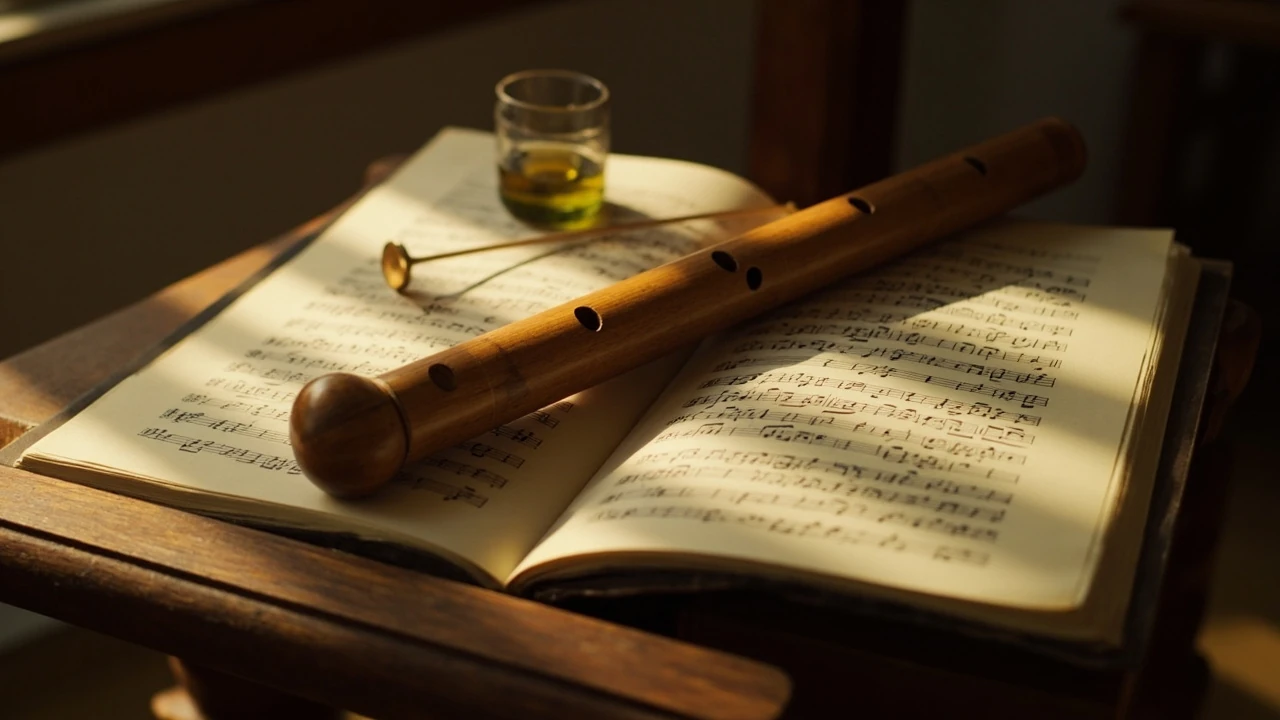
Recorder instrument: a practical guide to the wooden end-blown flute
A school music teacher hands a seven-year-old a pale wooden tube with seven finger holes and a beak-shaped mouthpiece. Within a minute the child produces a recognisable tune. That small moment explains most of the appeal of the recorder instrument: it is one of the few Western woodwinds a beginner can sound cleanly in a first lesson, yet the same family of instruments sustained serious consort music for two centuries and still anchors a living early-music culture. This guide explains how the recorder instrument works, how the family is laid out from sopranino to great bass, what to listen for when judging tone, and how to choose and care for a recorder that will actually play in tune.
What kind of instrument is a recorder
The recorder is a family of internal duct whistles, usually built from wood or quality plastic. Sound is produced when the player blows into the mouthpiece, or “windway,” and a carefully shaped block, called the fipple, splits the air against a sharp edge called the labium. That edge tone is then shaped by a cylindrical bore that flares at the foot and by seven front finger holes plus a thumb hole on the back. Unlike a transverse flute, the recorder is held vertically and blown into end-first, which is why it is sometimes described as a vertical flute or a beaked flute.
Because the air column inside a recorder is essentially cylindrical and open at both ends, the instrument behaves as an open pipe. That geometry gives recorders their characteristic mellow, flute-like tone with relatively little harmonic edge, especially in the lower register. It also makes the recorder more forgiving of breathy or imperfect embouchure than the orchestral flute, which is one practical reason it is so widely used in schools.
Where the recorder sits in music history
Recorder-like instruments appear in medieval European iconography from the twelfth century onward, and by the late fifteenth century the family was well established across Europe under names such as flauto dolce, Blockflöte, and flageol. The instrument reached its most refined form during the Baroque period, roughly 1600 to 1750, when makers in Nuremberg, London, and Paris produced finely turned boxwood, maple, and ebony recorders in a full consort from sopranino to great bass. The transposing flute of the Baroque, designed by the Hotteterres and later players, gradually displaced the recorder in solo and orchestral use, and the recorder largely receded from professional music-making by around 1800.
From the early twentieth century onward, a small group of players and makers, notably Arnold Dolmetsch in England and a wider network of European and American builders, began to revive the instrument using historical measurements and surviving examples. That revival produced the modern “Baroque” recorder, which is the most common professional model today. A separate “German” fingering system also exists and is still common in many school programs, although it is generally less suited to advanced repertoire. The recorder instrument is therefore both a living educational tool and a serious concert instrument in its own right.
How a recorder actually produces sound
Three mechanical elements work together. The player blows a thin, focused stream of air into the windway, a narrow channel cut into the head joint. The air strikes the upper edge of a rectangular window cut into the pipe, where the fipple has shaped it into a ribbon. As that ribbon of air oscillates above and below the labium edge, the pipe’s air column is set into vibration. The pitch depends on the effective length of the air column, which is changed by covering and uncovering the seven front holes and the thumb hole. The same holes can be shaded or “half-holed” to produce notes that do not sit on the basic scale.
The bore of a recorder is narrowest at the head, widens slightly through the middle, and then opens out at the foot in a flared shape called the bell. That flared end is one of the key differences between a recorder and a simple whistle: it suppresses the upper harmonics of the basic tone, giving the instrument its softer, more vocal quality and making the low register sound surprisingly full for such a small pipe.
The recorder family at a glance
Recorders are built in a range of sizes that sound an octave apart, a little like violins and cellos, except that the family runs from sopranino at the top to great bass at the bottom. Most players encounter three of these sizes in a school or early-music setting: the soprano in C, the alto in F, and the tenor in C. Larger and smaller sizes appear in consorts and in some modern repertoire.
The table below shows the common members of the family, their sounding pitch, and the typical role each plays. Pitch names use the standard recorder convention where the alto is treated as the reference “in F.”
| Size | Common name | Sounding pitch | Lowest written note (Baroque fingering) | Typical use |
|---|---|---|---|---|
| Sopranino | Sopranino in F | One octave above the alto | F5 | Bright top voice in Renaissance consorts; rare in modern beginner use |
| Soprano | Soprano in C | One octave above the alto | C5 | School instrument, folk and popular use |
| Alto | Alto (treble) in F | Reference instrument | F4 | Most common solo and consort instrument; first choice for adult beginners |
| Tenor | Tenor in C | One octave below the alto | C4 | Consorts; solo cantata and chamber music |
| Bass | Bass in F | One octave below the tenor | F3 | Consort bass line; solo sonatas |
| Great bass | Great bass in C | One octave below the bass | C3 | Large Renaissance consorts and selected modern works |
Two practical points follow from this layout. First, the alto in F is not a non-transposing instrument; when a player reads a C on the staff, the sounding pitch is a perfect fifth lower. Sheet music for alto recorder is therefore usually written one fifth higher than it sounds, while soprano and tenor music is written at sounding pitch. Second, the same written fingerings appear on every size, so a player who learns the alto can transfer fingering patterns directly to a tenor or bass, although the breath, pressure, and embouchure need to be retuned for each size.
Inside the bore: what shapes recorder tone
Tone on a recorder is the result of a small set of interacting variables: the player’s air pressure, the angle of the air, the shape of the windway, the voicing of the block and window, the taper of the bore, and the material of the pipe. Builders spend years learning to “voice” an instrument, which means adjusting these elements by shaving wood from the block, reshaping the window, or reaming the bore until the instrument speaks cleanly across its range.
For the player, three habits make the largest difference to tone:
- Air speed, not force. Recorder tone suffers when players push with the diaphragm. The instrument wants a steady, focused column of air at modest pressure, supported from the stomach and shaped by the lips and tongue.
- Articulation at the tip of the tongue. Most Baroque tutors describe a “tu” or “du” syllable that lets the tongue start and stop each note cleanly without interrupting the air.
- Hand position that does not strangle the tone. Beginners often grip too tightly or cover too much of the thumb hole, which can drag the top register flat and make the bottom register muffled. A relaxed, slightly rounded hand shape, with thumbs pointed toward the player, leaves the instrument free to speak.
These habits are also why a good recorder, like a good organ pipe, rewards a careful player. A poorly made recorder is hard to voice from the breath alone, just as a poorly voiced pipe will never quite “speak,” no matter how hard the player pushes. If you are interested in the parallel world of voicing, the practice described in pipe voicing for organ builders shows how similar the underlying craft really is. To place this section in context, the Recorder musical offers a concise background reference.
Fingering systems: Baroque and German
Most quality recorders use “Baroque” fingering, which is the historical system derived from seventeenth- and eighteenth-century instruments. A handful of notes that lie outside the basic diatonic scale require one or more “forked” or “cross” fingerings, in which some lower holes are opened while the upper holes remain covered. These fingerings look awkward on paper but give the player real control over tuning, tone colour, and intonation, especially in the upper register.
German-fingered recorders simplify many of these notes using additional keywork, often a thumb-operated key for F natural and a series of small keys for low C and other accidentals. The system is widely used in German-speaking school programs because it lets beginners play in many keys sooner, and it can be built cheaply because the keys compensate for less precise bore work. The trade-off is that German recorders are usually harder to control in the upper register, less even in tone across the range, and less suited to the wider literature.
| Feature | Baroque fingering | German fingering |
|---|---|---|
| Origin | Historical, based on 17th–18th century practice | 20th-century simplification for schools |
| Extra keys | None or minimal on student models | Thumb key for F, keys for low C and D |
| Chromatic notes | Use forked and cross fingerings | Use keys, fewer cross fingerings |
| Upper register control | Detailed; full dynamic and tonal nuance | More limited; harder to fine-tune upper notes |
| Tone colour | Generally fuller and more even | Often brighter at the top, less even through the range |
| Typical use | Consort, solo, advanced study, historical performance | Classroom and beginner programs in several European countries |
A student who plans to play in a school ensemble that uses German fingering can still progress quickly, but anyone planning to play solo Baroque or modern repertoire is usually better served by a Baroque-fingered instrument from the start, because re-learning a fingering system later is harder than learning either one alone.
Choosing a first recorder
The cheapest recorders on the market are often so poorly voiced that they make a beginner’s job nearly impossible. The window is cut at the wrong height, the windway is too wide, or the bore is roughly reamed, so the instrument sounds breathy in the low register and shrill in the high register, with a small dead zone in the middle. A new player who is told to “blow harder” usually makes the problem worse.
For a first instrument, a few rules of thumb help:
- Choose the alto first. The alto in F is the standard solo and consort instrument in modern practice, and its size and finger spacing suit older children, teenagers, and most adult hands. The soprano is fine for younger children or for music that uses its bright, leading tone, but it is harder to control because its finger holes are smaller and closer together.
- Pick a reputable maker. Names such as Mollenhauer, Moeck, Küng, Yamaha, and Aulos are widely available and offer reliable student and intermediate models. For a first instrument, an “intermediate” or “student plus” model in maple or pearwood is a better long-term value than a colourful plastic beginner instrument.
- Wood, plastic, or resin. Plastic recorders are robust, stable in changing humidity, and inexpensive. Wooden recorders, especially in maple, pearwood, or grenadilla, give a warmer, more complex tone but need careful conditioning to humidity and temperature. Many players keep a good plastic instrument for outdoor or school use and a wooden one for serious practice.
- Try before you buy if possible. Recorder tone is highly individual. A well-made instrument that suits one player’s breath may feel stuffy in another player’s hands. A short play test on three or four models in a shop, or a well-run “play-in” event at a music school, is worth the trip.
It also helps to look at the wider context. The recorder belongs to the same family of internal duct flutes as the organ’s flue pipe ranks, where the same relationship between wind pressure, voicing, and pipe geometry shapes the sound. A reader who wants to understand how a given sound is produced from a column of air can compare the two: an explanation of organ stops walks through the same physics in much larger pipes.
Care, cleaning, and basic maintenance
A recorder that is handled cleanly and kept dry will play for decades. A recorder that is left wet, dropped, or stored near a radiator will go out of tune within a season. The habits below are enough for almost any player.
- Disassemble after playing. Pull the head, middle, and foot joints apart and let them dry on a soft cloth. Moisture that sits inside the bore encourages mould and can swell the windway, which makes the instrument play flat and stuffy.
- Use a cleaning rod and cloth. A small swab made from a wooden dowel and a strip of cotton or microfibre is enough. Pull it gently through each section. Avoid dishcloths, paper towels, and anything that can leave fibres behind.
- Oil wooden recorders occasionally. A drop of pale almond or paraffin oil on a cloth, wiped along the outside of the bore once or twice a year, helps the wood resist humidity changes. Avoid olive oil and cooking oils, which turn rancid.
- Watch the window edge. The labium is delicate. A nick or a bent edge changes how the air strikes the pipe and will require a maker to revoice the head. Never try to “tune” a recorder by scraping the window yourself.
- Store in a case. A padded case or bag protects against temperature swings and the small dents that come from being knocked against a chair leg.
Common playing problems and what to check
Even on a good instrument, beginners run into a small set of recurring issues. The list below matches each symptom to the most likely cause and to the first thing to try before assuming the instrument is faulty.
- Top register is flat or refuses to speak. Usually a thumb hole problem. Make sure the thumb covers the hole completely and the air is directed slightly down into the windway, not straight across.
- Low register is muffled or airy. Often a finger that is not sealing a hole, especially the lowest pair. Check that fingers sit flat and that nails are trimmed short.
- The instrument squeaks when changing notes. A common sign of an unsteady air column. Keep the air moving continuously through the change and articulate lightly with the tongue.
- Notes are out of tune with a piano or organ. Recorders do not play at A=440 by default. Many quality instruments are voiced at A=415 (Baroque pitch) or A=442. Confirm the design pitch before tuning up or down.
- Condensation drips back into the windway. Pause, blow the water out through the foot, and let the head joint dry for a minute. Persistent condensation in a wooden recorder can mean the windway is too open or the room is too humid.
When a recorder refuses to behave despite good habits, the cause is often the same one an organ technician looks for: a voicing problem that the player cannot fix from the breath alone. The same diagnostic logic, separating “the player” from “the instrument” from “the room,” is at the heart of any serious approach to woodwind playing. Readers who already think about sound in these terms will find a useful parallel in the discussion of organ registration, where small changes in pressure and voicing reshape the same kind of air column.
Reading recorder music and pitch conventions
Recorder music uses the same treble clef as most other woodwinds, but the size of the instrument shifts the sounding pitch. Soprano, tenor, and great bass are non-transposing instruments in C: a written C sounds as a C. Alto and bass are transposing instruments in F: a written C sounds a perfect fifth lower. Modern editions usually print a small note at the top of the part, such as “sounds an octave higher” for sopranino or “sounds a fifth lower” for alto, to make the convention clear. Readers can also consult the go-to musical instrument for kids npr for an independent source related to this section.
Two other conventions appear often enough to be worth recognising:
- Figure-eight or “8va” markings. When a part climbs above the top line of the staff, the editor may indicate a written octave shift with a small “8” above the staff. This is purely a notational convenience; the player still uses standard Baroque fingerings.
- Ornament signs. A small trill mark above a note means a quick alternation with the note above, using the upper auxiliary finger that fits the key. The exact auxiliary depends on the key, which is one reason printed ornamentation on recorder is a study in its own right.
The recorder in modern and contemporary music
Although the recorder is most associated with Renaissance and Baroque repertoire, a healthy modern literature exists. Twentieth-century composers such as Benjamin Britten, Paul Hindemith, and Heitor Villa-Lobos wrote solo and chamber works that treat the recorder as a serious voice. A growing body of contemporary music, including works by Michael Nyman, Luciano Berio, and a wide range of present-day composers, uses the alto recorder alongside electronics and in cross-genre ensembles. The instrument’s ability to shade dynamics and speak cleanly in the upper register has made it a natural partner for composers exploring extended techniques, such as tongue rams, whistle tones, and microtonal fingerings.
For a player who is curious about where the recorder fits in the wider landscape of sound, the most useful advice is to listen across the full family. A solo piece on the great bass and a Renaissance canzone on a sopranino consort sound like almost different instruments, even though the underlying mechanism is identical. That range, more than any single technical feature, is what makes the recorder instrument worth knowing in some depth.
Frequently asked questions
Is the recorder instrument hard to learn?
The recorder is one of the easier Western instruments to start on. The fingerings follow a clear diatonic pattern, the breath requirements are modest, and the instrument is relatively tolerant of small embouchure mistakes. Like any woodwind, however, the recorder rewards long, slow practice. A beginner can sound a recognisable tune in the first lesson, but producing a clean, even tone across the full range usually takes several months of focused work.
What age is a good age to start the recorder?
Most school programs introduce the soprano or descant recorder from about age six or seven, because the finger spacing is small enough for small hands and the instrument is cheap enough for a class set. For private study, many teachers prefer to start children on the alto at around age nine or ten, when the hands are large enough to cover the holes cleanly. Adult beginners almost always start on the alto.
What is the difference between a recorder and a flute?
Both instruments produce sound from a column of air, but the mechanism is different. A recorder is an internal duct whistle blown through a beak-shaped mouthpiece with a fipple. A Western concert flute, also called the transverse flute, is held sideways, and the player aims a thin stream of air across a hole in the head joint against a sharp edge. Recorders are usually built with seven front holes and a thumb hole, while transverse flutes use an elaborate system of keys. The recorder’s cylindrical bore gives it a softer, more vocal tone; the flute’s cylindrical bore with a larger embouchure hole gives it a brighter, more projecting sound.
Are plastic recorders good enough to start on?
A well-made plastic recorder is genuinely good enough for the first years of study and for school ensemble playing. A poorly made plastic recorder, however, is usually worse than a cheap wooden one. The difference is voicing: a good plastic head is moulded with a precise window and windway, while a bad one is roughly finished and will not speak cleanly. Reputable brands are reliable. Once a student is comfortable on the instrument, a wooden alto in maple or pearwood is a worthwhile upgrade in tone and responsiveness.
How do I tune a recorder to a piano or organ?
Recorders built for modern use are usually voiced at A=440 or A=442, which matches a piano tuned to modern pitch. Baroque-style recorders are often voiced at A=415, which matches the lower pitch standard used for Baroque music. You cannot change a recorder’s pitch by stretching or compressing the instrument. To play with an instrument at a different pitch, you need a recorder built for that pitch, or you can use a digital tuner to confirm which notes on your instrument are flat or sharp and adjust your breath and finger shading slightly to bring them into tune.
Can a recorder be played outside or in cold weather?
Plastic recorders handle outdoor and cold-weather playing reasonably well, although very cold air makes the upper register flatter and harder to control. Wooden recorders should be protected from sudden temperature changes, which can crack the bore. For outdoor or marching use, a sturdy plastic soprano is the most common choice. For a serious concert, players generally prefer an indoor space with stable temperature and humidity.
What is a consort of recorders?
A consort is an ensemble of recorders of different sizes playing together, usually one player per part. The standard Renaissance consort is SATB, scored for soprano, alto, tenor, and bass. A “great consort” adds a sopranino on top and a great bass at the bottom, giving a six-voice ensemble that can span more than three octaves. Playing in a consort is one of the best ways to develop listening skills, because the players must tune to each other rather than to a fixed-pitch instrument.
How long does a good recorder last?
A well-made wooden recorder, properly cared for, can last for generations. Many modern makers can revoice or replace a damaged head joint. Plastic recorders are effectively indestructible under normal use, although the windway can deform if the instrument is left in a hot car. The most common reasons a recorder “dies” are not age but a damaged labium edge, a warped head joint from a long-ago drop, or a windway that has been scraped by an over-eager owner.
Do recorders use reeds?
No. The recorder is a fipple, or duct, flute, which means the air is shaped inside the instrument by the windway and the block. There is no reed that wears out, no reed to soak before playing, and no reed to replace. This is one of the reasons the recorder is so easy to maintain compared with a clarinet or oboe, and why it is the first woodwind introduced in many school programs.
Is the recorder a serious concert instrument?
Yes. The recorder has had a continuous professional performance tradition since the early twentieth century revival, and there are now recorder soloists, chamber ensembles, and consort groups who perform in major concert halls. The modern professional repertoire runs from the sixteenth century to the present day, and several contemporary composers write new works for the instrument each year. The recorder instrument is also central to many early-music ensembles, which perform with organs and other historical instruments in the same concert programmes.