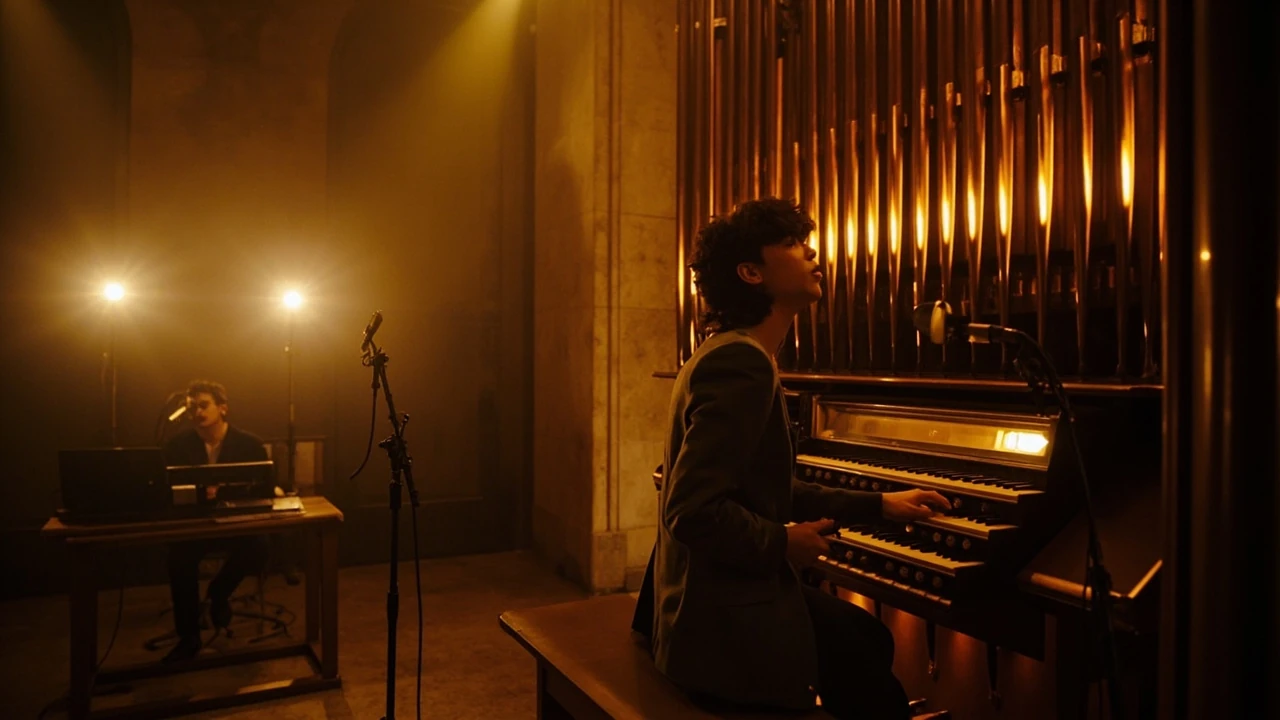
A pop hook does not need a Hammond, a synth, or a string section to land. From Procol Harum’s A Whiter Shade of Pale in 1967 to indie records of the last decade, pop artists have kept returning to the same instrument: the pipe organ. That persistence is worth treating as a real phenomenon, not a curiosity, because each generation of producers discovers the same thing about pipes — they fill space, they sit forward in a mix, and they carry a melodic line that vocals do not have to fight.
This article looks at the relationship between pop artists and the pipe organ from a practical, listening-oriented angle. It covers the historical pattern, the musical reasons the pairing keeps working, the kinds of organ stops and registrations that producers tend to favour, and the limits of the instrument in a modern session context. If you work at the console or you simply want to understand why a centuries-old instrument keeps showing up on records, the sections below build a useful map.
Pop artists and the pipe organ: a working relationship
The shorthand “pop artists” covers a wide range of singers, bands, and producers, but a surprising number of them share one unusual habit: they put a pipe organ on a track. The list is long enough to be more than coincidence. Procol Harum built an entire identity around Matthew Fisher’s organ parts. The Animals used it as a lead voice on The House of the Rising Sun. More recently, indie and alternative acts such as Arcade Fire, Vampire Weekend, and the producers behind film and television scores have brought the instrument into rooms where it is not expected.
For most of these recordings, the instrument is a real pipe organ in a church, hall, or chapel. The choice is deliberate: a sampled organ can carry harmony, but it cannot reproduce the way real pipes interact with a room, or the way a rank of principals blooms in a chorus. Engineers who have recorded both usually notice the difference on the first playback, especially in the low frequencies and the way a tutti settles into a long note.
There is also a structural reason. Pop songs are short, repetitive, and centred on a clear melody. The pipe organ is one of the few instruments that can hold a chord for as long as a producer wants without losing definition, then add a countermelody a second later, then drop out cleanly. In a typical pop arrangement, that flexibility is more useful than a piano, a synth pad, or a string wash, because none of those choices change character as quickly from one beat to the next.
Why the pairing keeps working
The relationship between pop artists and the pipe organ rests on a small number of musical and acoustic factors. Understanding them is the easiest way to predict whether a new track will benefit from the instrument.
Long sustain without sustain pedals
A piano note fades the instant the hammer returns. A synth pad can be made to hold, but it has a static spectral profile. A pipe organ holds a note as long as the key is depressed, and the note changes character slowly as the wind supply fluctuates and the room absorbs high frequencies. For a verse that needs to breathe, or a chorus that needs weight, that slow evolution is more flattering than a flat pad.
A wide dynamic range without a knob
Boxing a pipe organ into a 4 dB window is genuinely difficult. Draw the lightest stops and the instrument whispers. Add a 16-foot reed and the room shakes. Pop artists use that range the same way they use a vocal compressor: not to flatten the song, but to mark the difference between a verse and a chorus. A quiet verse on a choir organ, then a full chorus on a trumpet-and-reed combination, does the structural work of a level change without anyone touching a fader.
A built-in reverb
Most organs live in stone rooms with long reverb times. The instrument and the space are part of the same sound. For a producer, that is a shortcut: put a single close mic on the pipework, a pair of room mics at a sensible distance, and the spatial image is already finished. A synth pad recorded dry in a bedroom studio cannot compete without a great impulse response and a patient engineer.
A recognisable colour
Audiences hear a pipe organ and place the song. It reads as solemn, dramatic, or sacred, even on a pop record. That association is a tool, not a constraint. Used on a chorus, it lifts a love song into something weightier. Used on a bridge, it undercuts a verse that has been too bright. Pop artists who understand this often place the organ at the emotional peak of the form, not at the beginning.
A short history of the organ in pop and rock
Most organ tracks in popular music trace back to a few specific moments. The pattern repeats because the same recording conditions, the same kinds of organs, and the same kinds of rooms keep coming up.
| Era | Representative recording | Why the organ worked in the arrangement |
|---|---|---|
| Mid 1960s | The Animals, The House of the Rising Sun | Organ carried the descending bass line and the slow harmonic rhythm in place of a guitar. |
| Late 1960s | Procol Harum, A Whiter Shade of Pale | Hammond-style registration on a chamber organ, doubled and mixed wide, supported a vocal-led ballad. |
| Early 1970s | Yes, Close to the Edge and related tracks | Organ and synthesizer ran in parallel, with the organ handling sustained harmonic blocks under Rick Wakeman’s keyboard work. |
| 1990s | Various film and television scores | Organ re-entered popular listening through orchestral-adjacent projects, often played by a small group of session specialists. |
| 2010s onward | Arcade Fire, Vampire Weekend, and other indie acts | Organ used as a textural anchor in larger ensembles, often with the pipes recorded on location in churches. |
Two threads run through this list. The first is the chamber or church organ used as a harmony instrument, replacing a guitar or a piano. The second is the larger concert or symphonic organ used as a colour, with specific stops mixed into a wider arrangement. Pop artists tend to move between the two depending on the song. The first thread is more common in verse work; the second is more common in choruses and codas.
What pop artists actually ask the organ to do
It helps to drop the romantic idea of the organ as a “church instrument” and treat it as a tool with three core jobs on a pop record. The great recordings all sit in one of those jobs, or move between them.
1. Carry the bass line
An 8-foot principal or a 16-foot bourdon on the pedal division can replace an electric bass on a ballad or a mid-tempo number. The sound is darker and more sustained, but it locks with a kick drum in a way a synth bass does not. Producers who have used this trick report that the organ bass forces them to slow the tempo slightly, which usually helps the song. The trade is a small loss in punch for a real gain in harmonic weight.
2. Hold a chord pad
A set of 8-foot strings, a flute, and a celeste on the same manual will hold a chord for eight bars without sounding static. The natural chorus effect of multiple ranks slightly out of tune, plus the slow attack of wind into pipes, makes the chord feel alive. Pop artists use this pad as a verse anchor, often leaving it alone while the vocal and a small rhythm section move around it.
3. Mark a chorus or a final chorus
Pulling the full organ on the last chorus is the oldest trick in the book, and it still works. The difference between a quiet verse and a tutti chorus is large enough to substitute for a level change, a key change, or an extra instrumental layer. Listeners perceive the chorus as a peak without any of the usual pop production tools having been used.
Stops and registrations that travel well on a record
Not every organ stop works in a pop context. The stop list on a real instrument can run to eighty or more names, and the wrong choice turns a track into a church recording rather than a pop recording. The selections below are the ones session players and engineers reach for first.
| Stop family | Typical footings | Role in a pop arrangement | Common pitfalls |
|---|---|---|---|
| Principal / diapason | 8′, 4′, 2′ | Clear melodic line, good for a hook or a countermelody above the vocal. | Too many principals at once can sound glassy and thin in a small room. |
| Flute (harmonic, orchestral) | 8′, 4′ | Soft pad, blends with strings and a vocal, useful on a verse. | May disappear under a busy drum mix; needs a sympathetic room. |
| String (salicional, viola) | 8′ | Warm pad that sits between a synth string and a real string section. | Solo string at 8′ can sound reedy on its own; usually needs a celeste or a flute with it. |
| Celeste / unda maris | 8′ | Adds shimmer to a string or a flute, gives a chorus its lift. | Loses effect at low monitoring levels. |
| Reed (trumpet, krummhorn) | 8′, 4′ | Solo colour for a bridge or a hook, very present in a mix. | Can dominate a small speaker; needs sidechain or a careful level. |
| Mixture / fourniture | 2′ and higher | Brightens a chorus registration, adds a metallic edge to a principal chorus. | Quickly turns harsh at close range; usually needs room sound to soften it. |
| Bourdon / stopped diapason (pedal) | 16′, 8′ | Substitute for a bass guitar on a slow song, anchors a low chorus. | 16′ bourdon alone is woolly; usually paired with an 8′ and a principal. |
| Positiv or solo division (swell) | Variable | Contrast on a second verse, easy to swell in and out via a box. | Requires a well-planned crescendo pedal or a box that the engineer can ride. |
The simplest way to read this table is in three columns: which stop carries a line, which stop fills harmony, and which stop colours a peak. A typical pop arrangement uses one stop for the line, two or three for the harmony, and one solo stop for the chorus. The rest stays off.
Recording the organ for a pop track
Recording a pipe organ for pop is less about microphone choice and more about room choice. A dry organ in a treated booth sounds like a keyboard. The instrument wants a room with a meaningful reverb time, hard surfaces near the pipes, and enough volume that the sound can build. Churches, town halls, and a few surviving chapel organs usually work. Concert halls with movable acoustic can also work, but the acoustic needs to be adjusted before the takes.
Once the room is right, the microphone plan is usually small. A spaced pair at ten to fifteen metres from the case gives a usable room image. A single close mic on the most important rank gives definition for the mix. A second close mic on the swell box, or a separate mic on the pedal division, can be added if the producer wants control. More than four mics on a pipe organ is rarely a good idea: the room is doing the work, and the close mics are just anchors.
Engineers who record pop artists with pipe organs often make one decision in advance: whether the organ is the lead or a layer. If it is the lead, the room pair carries the song and the close mics are gentle support. If it is a layer, the close mic on the principal or reed is brought up, and the room pair is reduced to a touch of air.
Common problems and how to handle them
The same issues come up on most organ sessions. Working through them in advance saves a long day in the church.
- Tuning drift between takes. Pipes move with temperature and humidity. A 20-minute warm-up before the first take and a 10-minute retune between long sets is normal. Pop artists who know this build it into the schedule.
- Wind noise and blower hum. A 50 Hz or 60 Hz hum from the blower can sit underneath the whole track. Checking the room for noise before the session, and sometimes running the blower from a separate circuit, prevents a problem that cannot be fixed in the mix.
- Key noise and tracker action. Older mechanical-action organs make a clear thump when a key is pressed. It is charming in a solo recording and a problem in a layered one. Pop arrangements with a quiet verse usually need either a different organ or a careful microphone placement that does not face the keydesk.
- Speaker spill on a film or live recording. When the organ is part of a wider ensemble, mics on other instruments will pick up the organ, and vice versa. Closed lids on the drums, careful positioning of the vocal mic, and a clear sightline to the organ help.
- Reverb tails that clash with the arrangement. A three-second reverb in a hall may be too long for a 110 BPM pop song. Either change the room or pull the room mic back further until the tail sits behind the snare.
- Licensing and access. Recording in a working church is not always straightforward. Many churches require a donation, a brief service interruption, or written permission. Booking early avoids a wasted trip.
How the role of the organ has changed since sampling
Software samplers of pipe organs are now very good. A trained ear can hear the difference between a sampled organ at high velocity layers and a real one in a good room, but a casual listener may not. The shift matters for pop artists, because it changes the cost of using an “organ” on a track.
- Speed of writing. A producer can sketch an organ part at home, choose a stop, and hear the arrangement in context within an hour. With a real organ, the same step requires travel, booking, and a session player.
- Cost per track. A real pipe organ session involves the venue, a session player, an engineer, and a half-day or a full day of setup. A sampled organ costs a one-off software licence and the time to programme it.
- Sound quality.
- Audience expectation. Many pop artists now use both. The home setup uses a sampled organ for sketching; the final recording uses the real instrument, often in a different room from the original sketch.
A real organ wins on three things that are difficult to fake: room sound, dynamic range, and the way the sound arrives at the listener’s ears. A sampled organ wins on flexibility: edits are non-destructive, the take is repeatable, and any stop is available on demand.
The result is not a replacement of the real instrument but a layering. Pop artists often start with a sampled organ to build the arrangement, then re-record the part on a real organ once the form is settled. The sampled version may stay in the mix as a support layer, or it may be replaced entirely depending on the budget and the producer’s preference.
Listening checklist for organ tracks
If you want to hear the techniques above on real records, a short listening checklist is more useful than a long list of names. The five items below are the most reliable signals that an organ has been recorded and arranged with the pop conventions described in this article.
- The verse uses a small registration — usually a flute, a string, or a celeste — and the chorus uses a larger one. The change is audible without watching the producer’s hand.
- There is a clear moment where the organ enters alone, often at the top of the song or at the start of a bridge. The instrument is given its own line rather than blended into a generic pad.
- The low frequencies are reinforced by either a pedal stop or a bass guitar that follows the organ. The two are not fighting.
- The room sound is preserved. There is a sense of space around the organ that headphones reveal more clearly than speakers.
- There is a final chorus where the full organ appears. Whether the song needs a key change or not, the organ change gives the chorus its peak.
Any track that meets three of these five is using the organ as a serious part of the arrangement. Tracks that meet all five are usually the records that other producers point to when they want to learn how the instrument works in a pop context.
Limits of the pipe organ in a pop track
The instrument has limits, and the producers who use it well know where they are. A pop record that ignores these limits usually ends up sounding more like a soundtrack than a song.
- Tempo. Pipe organs sound best between roughly 60 and 120 BPM. Above 120 BPM, the long sustain begins to blur the snare and the vocal, and the harmonic rhythm of the song outpaces what the organ can articulate.
- Harmonic complexity. A four-note chord with extensions is the practical limit on most instruments. Anything beyond that begins to clog the chorus, especially on a small recording.
- Key. Some keys are easier to manage than others on a specific organ. An organ with a tracker action and old pipework may not speak reliably in sharp keys, and a sharp-key song that has to be re-recorded in flat is a familiar story.
- Stereo spread. The organ is a mono source in a stereo room. Wide-stereo mixes that rely on hard-panned tracks do not always suit a real organ. The room mics carry the image, and the close mics should be kept narrow.
- Session time. Recording a pipe organ is not a 15-minute job. A half-day per song is realistic. A pop artist who is used to working in a software sampler needs to plan for this.
What to look for when booking an organ session
For pop artists who have not booked a pipe organ session before, the practical decisions are fewer than they look. Most of the work is in finding the right room and the right player. The list below is what a careful producer checks before confirming a date.
- Action type. Tracker-action organs are expressive and quiet, but the key noise may show on close mics. Electric-action organs are reliable and quiet in the keydesk, but lose some of the mechanical feel. Choose based on the song, not the prestige of the instrument.
- Number of manuals. Two manuals are enough for most pop arrangements. Three manuals help when the producer wants a separate solo division for a bridge.
- Swell boxes. At least one enclosed division is useful. Without it, the only dynamic control is the stop knob, which is not enough for a verse-chorus arrangement.
- Room acoustics. A medium-sized stone room with a 1.5 to 2.5 second reverb is the most flexible. Larger halls can work, but the producer should be ready to close mics more aggressively to control the tail.
- Access and noise. Check for traffic noise outside, HVAC noise, and adjacent rooms. A quiet weekday is usually easier than a weekend.
- Player. A session organist who has worked with pop artists before will read a chart, follow a click, and adapt a registration on the fly. That skill is rarer than it sounds, and worth travelling for.
How this relates to the wider world of pipe instruments
The pipe organ is one of several pipe instruments that pop artists have brought back into the studio. Pipe cymbals, tubular bells, and rank whistles have had their own quiet revivals in the last twenty years. The pattern is similar: a real acoustic source that software cannot quite replicate, brought into a pop arrangement for the specific thing it does best. For producers who already work with the instrument family, the practical questions are familiar: how to record it, how to mic it, how to mix it, and how to keep it in its lane.
The organ is the most complex of these because it is the largest, the most variable, and the most dependent on the room. A useful next step for any pop artist who wants to explore it further is to spend a single afternoon with a session organist, no recording, just running arrangements. That hour will teach more about the instrument than a year of reading about it.
Internal links for further reading
Frequently asked questions
Which pop artists first put a pipe organ on a hit record?
The most cited early example is The Animals’ 1964 recording of The House of the Rising Sun, where the organ carries the descending bass line in place of a guitar. Procol Harum’s A Whiter Shade of Pale followed in 1967 and turned the chamber organ into a permanent part of the British pop vocabulary. Both records are still the reference points for producers who want to hear the instrument in a pop context.
Do pop artists use a real pipe organ or a sample?
Most use both. A sampled organ is used at the writing and demo stage because it is fast, cheap, and editable. The final recording, when budget and time allow, often uses a real pipe organ in a real room because the sound is more present, the dynamic range is wider, and the room itself becomes part of the track. Software has improved, but the real instrument still wins on three things: room, dynamics, and arrival.
What kind of organ suits a pop song best?
A two-manual chamber or church organ with at least one enclosed division is the most flexible starting point. A tracker-action instrument gives a more direct connection between player and pipework; an electric-action instrument is usually more reliable in a session and quieter at the keydesk. The choice depends on the song, the player, and the room. A producer who is undecided should book an instrument with a familiar session player who can adapt on the day.
How do you stop a pipe organ from drowning the vocal?
The standard approach is to keep the registration small during the vocal passages and to add stops only when the vocal is at rest. A light 8-foot flute or string on the swell, with the box closed partway, sits behind a vocal without competing. The chorus can take a fuller registration if the vocal is in its upper range, where the organ is less likely to clash. Sidechain compression on the room mics is a last resort and rarely needed if the registration is planned.
What tempos work best with a pipe organ on a pop track?
Between roughly 60 and 120 BPM is where most successful organ-led pop records sit. Below 60 BPM, the long sustain of the pipes can blur the harmony and the drum pattern. Above 120 BPM, the harmonic rhythm of the song outpaces the way a pipe rank articulates a new note. Mid-tempo ballads and slow rock numbers are the most reliable settings.
How long does a typical pipe organ session take?
Plan on a half-day per song, including setup, warm-up, takes, and listening. The instrument itself is usually ready to play in 20 to 30 minutes if the building is already at a reasonable temperature; older pipework can take longer. A full day is enough for two or three songs with overdubs. Sessions that try to do more than that in a single day usually run out of tuning before they run out of ideas.
Can a pop artist work with a pipe organ in a home studio?
Not in any practical sense. A real pipe organ is too large, too expensive, and too dependent on a specific room. Most producers who work from home use a sampled organ on a controller keyboard, sometimes with a separate manual unit to mimic a two-manual layout. The sampled version is good enough for writing, sketching, and a surprising number of releases; it is not a substitute for a real instrument on a final mix.
What is the difference between a chamber organ and a concert organ for pop?
A chamber organ is smaller, has fewer stops, and is usually in a small room with a short reverb. It works for a verse, a pad, and a quiet chorus. A concert or symphonic organ is larger, has more divisions, and sits in a hall with a longer reverb. It is the right choice for a full chorus, a final chorus, or any moment where the producer wants the instrument to fill the space on its own. The two are not interchangeable, and a session player will usually ask which one the song needs before agreeing to a date.
Do pop artists who use the pipe organ read music?
Many do, and many do not. A session organist who has worked with pop artists for years can play a pop chart on sight, follow a click track, and adapt a registration on the fly. The skill is a specific one and is not the same as playing a church service. Producers who want a smooth session should send the chart in advance and confirm that the player is comfortable with the key, the time signature, and any structural changes that are not yet locked.
Is the pipe organ a fad in pop music?
No. The instrument has been on pop records since the mid 1960s and has appeared in every decade since, including the 2020s. Each generation of producers finds a new reason to use it, but the underlying reasons have not changed: long sustain, wide dynamic range, built-in room sound, and a colour that listeners recognise immediately. As long as those four things remain useful, the pipe organ will keep appearing on pop records.