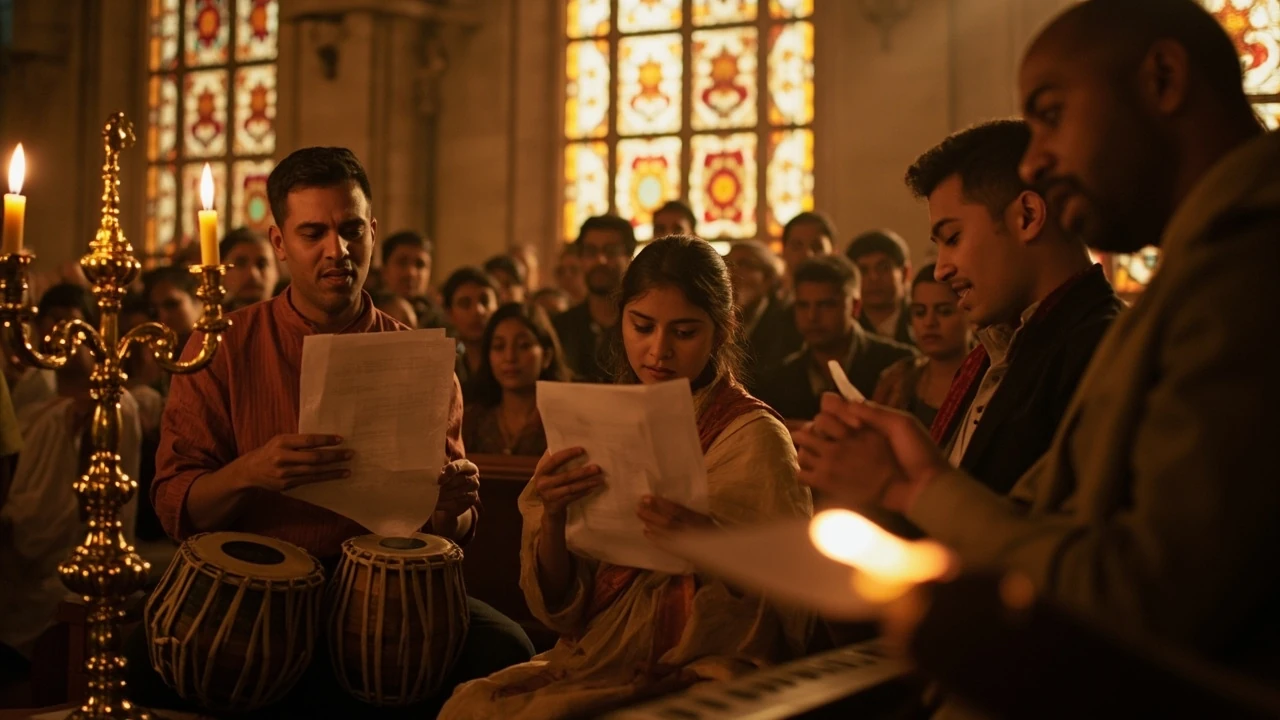
A church choir in Mumbai rehearses a Konkani carol in October while a tabla quietly marks the pulse underneath the melody. A family in Kochi tunes a portable harmonium to play “Yesu Namam” for midnight Mass. In Shillong, a gospel band rearranges an Assamese hymn in a major-key pop style for a Christmas Eve service. None of these moments look like a European nativity scene, yet each one is a real expression of Indian Christmas music, shaped by local language, local instruments, and local listening habits.
This guide walks through what the term actually covers, which musical traditions feed into it, which instruments appear most often, and how to build a useful listening plan. It is written for curious listeners, church musicians, and anyone planning a service or program that blends Christian repertoire with South Asian musical colour.
Indian Christmas music: what the term really means
Indian Christmas music is not one single style. It is a layered set of practices that combines Christian liturgy, Indian languages, and Indian instruments. The result ranges from quiet Konkani carols sung in Goan Catholic homes to large Hindi-language worship recordings produced in Mumbai studios, from Khasi gospel choirs in Meghalaya to Tamil devotional songs for parish celebrations in Chennai.
For practical purposes, the term covers four overlapping streams:
- Goan and Konkani Catholic carols with Portuguese and Latin roots, adapted into local language over four centuries.
- North Indian Hindi and Urdu worship songs written in the twentieth and twenty-first centuries by Catholic, Protestant, and charismatic composers.
- South Indian Tamil, Malayalam, and Kannada Christian devotional songs that draw on Carnatic melodic patterns.
- Northeast Indian gospel and hymn traditions, especially in Khasi, Assamese, Mizo, and Naga languages, where Christianity is a major presence and choral singing is strong.
Understanding which stream you are hearing makes it easier to choose repertoire, pick the right accompanists, and explain the music to listeners who may expect a European sound.
Historical roots of Indian Christmas music
The story starts with the arrival of Christianity on the subcontinent, which long predates British rule. The earliest sustained Christian community was the St Thomas Christians of Kerala, traditionally dated to the first century. Their music drew on Syriac chant and local melodic practice, and many of those patterns still surface in modern Malayalam Christmas songs.
Portuguese colonial rule from 1510 onward transformed Christian musical life along the western coast. Goa, Bassein (Vasai), Daman, and Diu became centres of Catholic worship with strong European musical influence. Missionaries trained local choirs, organs were imported, and a distinctive Konkani devotional repertoire grew up around the liturgy. This is the deep root of what most people now call Goan Christmas music. Several of the same tunes and texts were carried by Goan emigrants to Mumbai, Karachi (before 1947), and later to the Gulf and Europe, so the style has a wide diaspora footprint.
British rule brought Anglican and Protestant missions in the nineteenth and twentieth centuries. Missionaries set up schools, pressed for translations of hymns into local languages, and trained Indian musicians to lead choirs. In many regions the British organ and harmonium traditions met Indian melodic systems. The harmonium, ironically, became one of the most recognisable Indian Christmas instruments because it was portable, affordable, and well suited to hymn-singing in small congregations.
After Indian independence in 1947, Christian communities continued to grow slowly as a share of the population, but their cultural visibility remained high, especially in education, medicine, and the arts. New Hindi, Marathi, and Tamil Christmas compositions appeared in parish songbooks. In the 1970s and 1980s, the Jesus Movement and charismatic renewal brought popular music styles into churches, and cassette tape culture spread these recordings far beyond the original congregations.
From the 1990s onward, television channels, gospel albums, and YouTube broadened the audience. A 2010s wave of indie and folk musicians, several of them from Northeast India, added fresh arrangements while keeping traditional lyrics. Today Indian Christmas music is a working category on streaming platforms, with both devotional releases and seasonal pop covers.
Languages and regional flavours
India is a country of roughly 22 scheduled languages and hundreds of living languages, and Christian communities use many of them for worship. The most common languages in Indian Christmas music are listed below, along with the kind of sound most listeners associate with each.
| Language / region | Common Christian community | Musical character | Typical accompaniment |
|---|---|---|---|
| Konkani (Goa, Mangalore) | Goan Catholic | Melodic, often in major keys; verse-refrain carols with Portuguese rhythmic feel | Guitar, keyboard, mandolin, light percussion |
| Malayalam (Kerala) | Syro-Malabar, Latin Catholic, Mar Thoma, CSI | Longer devotional songs with Carnatic-style ornamentation | Harmonium, violin, mridangam, chenda |
| Tamil (Tamil Nadu, diaspora) | Catholic, CSI, Pentecostal | Strong rhythmic patterns; tunes often descend stepwise | Keyboard, guitar, tabla, group claps |
| Hindi (north and central India) | Catholic, Protestant, charismatic | Direct, singable melodies suited to group worship | Harmonium, dholak, keyboard, guitar |
| Marathi (Maharashtra) | Maharashtrian Catholic and CSI | Blend of classical and folk phrasing; often minor modes | Harmonium, tabla, tanpura drone |
| Khasi (Meghalaya) | Presbyterian and Catholic | Four-part choral harmony with strong soprano lines | Piano, guitar, sometimes full band |
| Assamese (Assam) | CSI, Baptist, Catholic | Soft melodic lines, often in waltz or ballad feel | Harmonium, guitar, light percussion |
| Naga languages (Nagaland) | Baptist and Catholic majority | Powerful group singing, sometimes with Western pop production | Keyboard, drums, electric guitar, bass |
This table is not exhaustive. Telugu, Kannada, Odiya, Bengali, and tribal languages such as Santali and Munda also have their own Christmas repertoires, though recordings can be harder to find outside the region.
Instruments you will hear in Indian Christmas music
Instrumentation is one of the clearest ways to recognise a piece as Indian rather than imported. Even when the melody is recognisably based on a European carol, the backing instruments give away the local tradition. The list below covers the most common choices and what each one contributes. Readers who want more background can use the music overview as a reference while reviewing this point.
- Harmonium: The signature instrument of Indian Christian hymnody, especially in Hindi, Marathi, and North Indian services. It carries the melody and a sustained drone, and it pairs easily with both group singing and soloists.
- Tabla and dholak: Used for rhythmic drive in upbeat songs. Tabla suits slower devotional pieces, while dholak is common at celebrations and children’s events.
- Guitar (acoustic and electric): A staple in Goan carols, Northeast choirs, and contemporary Hindi worship. It carries harmony in small groups and provides rhythm in larger bands.
- Keyboard and digital piano: Fills the role of the organ or harmonium in urban churches and on recordings. Many Indian Christmas albums rely on a keyboard layer with a synth pad underneath.
- Violin: Common in Kerala and Tamil songs, where it plays ornamental lines that echo Carnatic practice.
- Flute (bansuri): Used in gentle intros and interludes, especially in Hindi and Marathi recordings that lean toward a devotional, contemplative mood.
- Mridangam and other South Indian percussion: Appears in Tamil and Malayalam Christian songs with strong rhythmic identity.
- Mandolin and ukulele: Strongly associated with Goan and Mangalorean Catholic bands, where mandolin clubs have a long tradition.
- Choir and group vocals: Four-part harmony is characteristic of Khasi and many Anglo-Indian arrangements. Layered group vocals are also a feature of recorded Hindi worship.
Western pipe organs, where they exist in India, are mostly found in larger cathedrals in Mumbai, Chennai, Bengaluru, and Goa, and in institutions with a colonial history. For an overview of how organ registration shapes sound, the page on organ registration explains the principles behind the kind of stops a church organist might select for a Christmas service.
Voices, ensembles, and typical formats
Indian Christmas music uses a wide spread of vocal formats, and the choice of ensemble often tells you the audience and the occasion.
Parish choirs are the everyday backbone. They usually sing in unison or simple harmony, supported by harmonium or keyboard, and they aim for clarity of text over vocal display. The repertoire is drawn from printed songbooks passed between churches and dioceses.
Family carol groups are common in Goan and Mangalorean Catholic homes during the Advent season, with the “kollwado” or carol round tradition. Small groups move from house to house singing, accepting sweets and small gifts, and adding new verses on the spot. The music is informal and participatory.
School and college ensembles play a large role in cities. Many Indian schools, even non-religious ones, mark the season with a Christmas programme. These performances mix Western carols translated into local languages with original compositions and short skits.
Professional studio recordings for cassette, CD, and now streaming usually feature named soloists, session players, and layered backing vocals. They are polished, often four or five minutes long, and shaped for radio play and church use alike.
Choirs of the Northeast deserve separate mention. Khasi, Mizo, and Naga choral traditions are technically demanding and emotionally direct. Several choirs from Shillong and Kohima have attracted international attention for their discipline and blend, and Christmas is one of their peak seasons.
How Indian Christmas music differs from European carols
Listeners often ask what actually changes when a familiar carol is set in Indian style. The differences are real but not random. The table below compares the two traditions across a few practical dimensions.
| Aspect | European carol tradition (Anglican, Catholic, Lutheran) | Indian Christmas music |
|---|---|---|
| Language | Latin, English, German, French, Polish, and other European languages | Konkani, Hindi, Tamil, Malayalam, Marathi, Khasi, Assamese, English, and many others |
| Modal feel | Often church modes (Dorian, Mixolydian) and major-minor common practice | Often draws on Indian ragas and folk scales; Phrygian and Mixolydian influence persists in Konkani |
| Rhythm | Simple duple or triple metres; lilting carol patterns | Includes keherwa, dadra, and other Hindustani tal patterns in Hindi songs; complex talams in South Indian pieces |
| Harmony | Full four-part harmony is standard | Unison or simple harmony is common; four-part harmony is strong in Khasi, Mizo, and Anglo-Indian settings |
| Lead instrument | Organ, choir, sometimes brass | Harmonium, keyboard, guitar, mandolin, violin |
| Drone | Rare | Tanpura or harmonium drone in many Hindi and Marathi songs |
| Ornamentation | Limited to choir discipline and soloist vibrato | Meend, gamak, and murki appear in devotional solos, especially in South Indian songs |
| Context | Tightly bound to liturgy and Advent calendar | Tied to liturgy but also to community parties, school events, and family gatherings |
The result is not a watered-down version of the European tradition. Indian Christmas music has its own melodic instincts, rhythmic cycles, and performance etiquette. The simplest way to hear the difference is to compare two recordings of the same event, such as “Silent Night” sung in a Bavarian church and sung by a Khasi choir in Shillong. Both are reverent, but the texture is unmistakable. Another relevant reference is the joy to sing handel's classic every, which adds context without changing the practical guidance here.
Notable composers, performers, and recordings
Indian Christmas music has a long list of contributors across regions and languages. Rather than a comprehensive directory, the following list highlights figures whose work is widely available and stylistically influential.
- Fr. Michael (Mascarenhas) and the Konkani carol tradition: Konkani carol writers in Goa and Mangalore shaped the modern sound of Goan Christmas music, often credited collectively rather than by single composer.
- The Rev. Dr. D. G. S. Dinakaran and Tamil Christian hymn writers: Helped formalise Tamil Protestant and Catholic hymnody in the twentieth century, and several of their texts are still sung.
- Freddy Fernandes and other Goan musicians: Active in the Konkani pop and devotional scene, with Christmas releases that are staples in Goan homes.
- The Shillong Chamber Choir and the NE Choir scene: Northeast Indian ensembles have brought regional repertoire to national attention through televised performances and online virality.
- Contemporary Hindi worship leaders: Independent artists and small labels release seasonal albums each year, blending Western pop production with Hindi and English lyrics.
For a useful background on the technical and acoustic side of the instruments sometimes used in these services, organ stops explained is a helpful orientation, especially for listeners who want to understand the role of the pipe organ in the larger Indian cathedral tradition.
Listening recommendations for newcomers
Building a first listening list is easier than it looks. The aim is to cover the four main streams in a way that is enjoyable rather than exhaustive. A practical starter set might look like this.
- One Goan Konkani carol album. Look for recordings that feature guitar and mandolin rather than synthesised brass. The sound is intimate, often recorded in homes or small halls.
- One Hindi worship album. Choose a release that uses harmonium and acoustic guitar, and listen for the drone underneath the melody.
- One Tamil or Malayalam devotional collection. Pay attention to the rhythm patterns and the way the violin answers the voice.
- One Khasi or Mizo choir recording. These usually come from a church or a choral festival. The harmony is the main attraction.
- One classic Western carol performed by an Indian artist or ensemble. This is a useful bridge piece, because the melody is familiar even when the arrangement is not.
Most of these recordings are available on major streaming platforms. A few are still distributed mainly through parish bookshops and small Christian bookstores, especially older Konkani and Tamil collections. Independent record shops in Bandra, Byculla, Goa, Kochi, and Shillong often stock seasonal titles that never make it to digital charts.
Using Indian Christmas music in a service or programme
For church musicians, choir directors, and event organisers, the practical questions tend to be about blending, not repertoire. The following checklist covers the issues that come up most often when Western and Indian elements meet in one service.
- Pick a tonal centre and stay in it. A harmonium tuned to C will not match a piano tuned to A without a brief tuning break. Choose one reference instrument and tune the others to it.
- Decide the role of the drone. If the song is in a raga-influenced mode, keep a tanpura or harmonium drone. If the piece is closer to a Western major, the drone can muddy the harmony and should be removed.
- Watch the rhythm section. Indian percussion players often follow a spoken or unspoken theka. Brief the drummer or tabla player on the structure of each song before the rehearsal so the tempo changes are predictable.
- Plan the transitions. Going straight from a Bach chorale into a Hindi chorus can be jarring. A short organ voluntary, a candle-lighting, or a spoken reading usually smooths the shift.
- Mind the text. A translation that scans well in English may not scan in Hindi or Konkani. Sing in the language the song was written for, and provide printed translations for the congregation.
For organists working in a church that owns a pipe organ, the registration choices for a mixed programme are particularly worth thinking through. A quiet foundation stop with a fluty treble works well for a Konkani carol with guitar, while a fuller principal chorus with a reed supports a stronger choral number. The detailed approach is covered in organ registration, which is a useful reference during the planning stage.
Indian Christmas music in popular culture
Beyond the church, Indian Christmas music shows up in several other places. Bollywood films occasionally feature a Christmas-styled song, often used for the surprise of a Christian character in a largely Hindu setting. Television advertisements for bakeries, chocolate brands, and e-commerce sales peak in December, and many of them license Christmas carols in Hindi or English for short jingles.
School and college festivals in December almost always include at least one Christmas piece, regardless of the religious composition of the student body. The choice is often a Hindi or English carol that everyone can sing along to. This is one reason a small canon of pieces, such as “Jingle Bells” in Hindi, has become widely known across the country.
Independent musicians have used the season to experiment. In the past decade, several indie and folk releases have paired Christmas texts with regional folk sounds, from Rajasthani wedding drums to Manipuri pena. The result is not always reverent, but it is a healthy sign that the tradition is still absorbing new influences.
Common questions and how to answer them
Listeners new to the genre tend to ask the same handful of questions. Brief answers are below; the full explanations are in the sections above.
- Is Indian Christmas music only Catholic? No. Catholic, Protestant, Syrian Christian, and independent charismatic traditions all contribute. The sound differs by denomination and region.
- Do people in India actually celebrate Christmas with music? Yes, especially in states with large Christian populations such as Goa, Kerala, Tamil Nadu, Karnataka, and the Northeast. In other states, Christmas is widely observed in schools, offices, and public spaces.
- What is the most popular Indian Christmas song? There is no single answer, but “Jingle Bells” in Hindi, the Konkani carol “Sukhak Sor” patterns, and various Hindi worship songs circulate widely every December.
- Can Indian Christmas music be used in non-religious settings? Yes. Many recordings are simply seasonal or cultural and work well in retail, hospitality, and educational contexts.
Limitations and things this guide does not cover
This article focuses on listening, instrumentation, and practical use. It does not cover the theological or pastoral side of Christmas, the history of Christianity in India, or detailed ethnomusicological analysis. The repertoire of any single region is much larger than what is listed here, and many important recordings are only available locally. Where claims are made about specific communities, they are general patterns rather than hard rules, and individual churches and families will often have their own variations.
Streaming availability changes often, and specific albums or platforms mentioned in conversation may not be accessible in every country. Where a particular recording matters, it is worth checking the local library or parish resource before relying on it for a service or programme.
Frequently asked questions
What is Indian Christmas music?
Indian Christmas music is the body of Christian seasonal songs in Indian languages, played with Indian and Western instruments. It includes Konkani carols from Goa, Hindi and Marathi worship songs, Tamil and Malayalam devotional pieces, and Northeast Indian choral repertoire, among many other regional traditions.
Which Indian state has the strongest Christmas music tradition?
Goa is often cited first because of its long Catholic history and Konkani carol culture. Kerala, Tamil Nadu, and the Northeast, especially Meghalaya and Nagaland, also have very strong Christmas music traditions, and Mumbai has long been a centre for Hindi and Marathi Christian music.
Which instruments are most common in Indian Christmas music?
The harmonium is the most widely used, followed by acoustic and electric guitar, keyboard or digital piano, tabla, dholak, and violin. In Goan and Mangalorean music the mandolin is also typical, and in the Northeast full band lineups including drums and bass are common.
Are there Indian versions of well-known Western carols?
Yes. Many Western carols, including “Silent Night,” “Joy to the World,” and “Jingle Bells,” have been translated into Hindi, Konkani, Tamil, Malayalam, and other Indian languages. The melodies are often kept close to the original while the accompaniment is rewritten in local style.
Where can I find Indian Christmas music online?
Major streaming services carry both devotional and contemporary Indian Christmas albums. YouTube is useful for live performances and choir recordings. Local Christian bookshops and parish offices in cities with large Christian populations often stock regional titles that are not widely digitised.
Is Indian Christmas music suitable for a non-religious event?
Often yes. Many pieces are cultural as well as devotional, and instrumental arrangements work well in retail, hospitality, and educational settings. For corporate or public events, instrumental or light vocal versions tend to be the safest choice.
How is Konkani Christmas music different from Hindi Christmas music?
Konkani Christmas music is shaped by the Goan Catholic tradition with Portuguese influence, often featuring guitar, mandolin, and major-key melodies. Hindi Christmas music draws on Hindustani melodic and rhythmic patterns, often with harmonium, dholak, and a tanpura-style drone. The two overlap in some urban contexts but remain recognisably distinct.
Do Northeast Indian choirs sing Christmas music?
Yes. Christmas is one of the most important seasons for choirs in Meghalaya, Nagaland, Mizoram, and Manipur. Khasi, Mizo, and Naga choral traditions are noted for tight four-part harmony and a strong emotional delivery, and several ensembles have gained national audiences through televised performances.
Can a pipe organ be used in Indian Christmas music?
Yes, in churches that own one. The pipe organ is most common in larger cathedrals, historic mission churches, and institutions with a colonial past. For background on how stops and registration shape the sound, organ stops explained and the related organ registration guide are useful starting points.
How do I plan a mixed Indian and Western Christmas programme?
Start by choosing a small set of pieces from each tradition and a few bridge pieces that sit between the two. Agree on a single tuning reference, decide which pieces use a drone, plan transitions with a short reading or voluntary, and rehearse the rhythm section on tempo changes. A printed programme with translations helps the audience follow along.