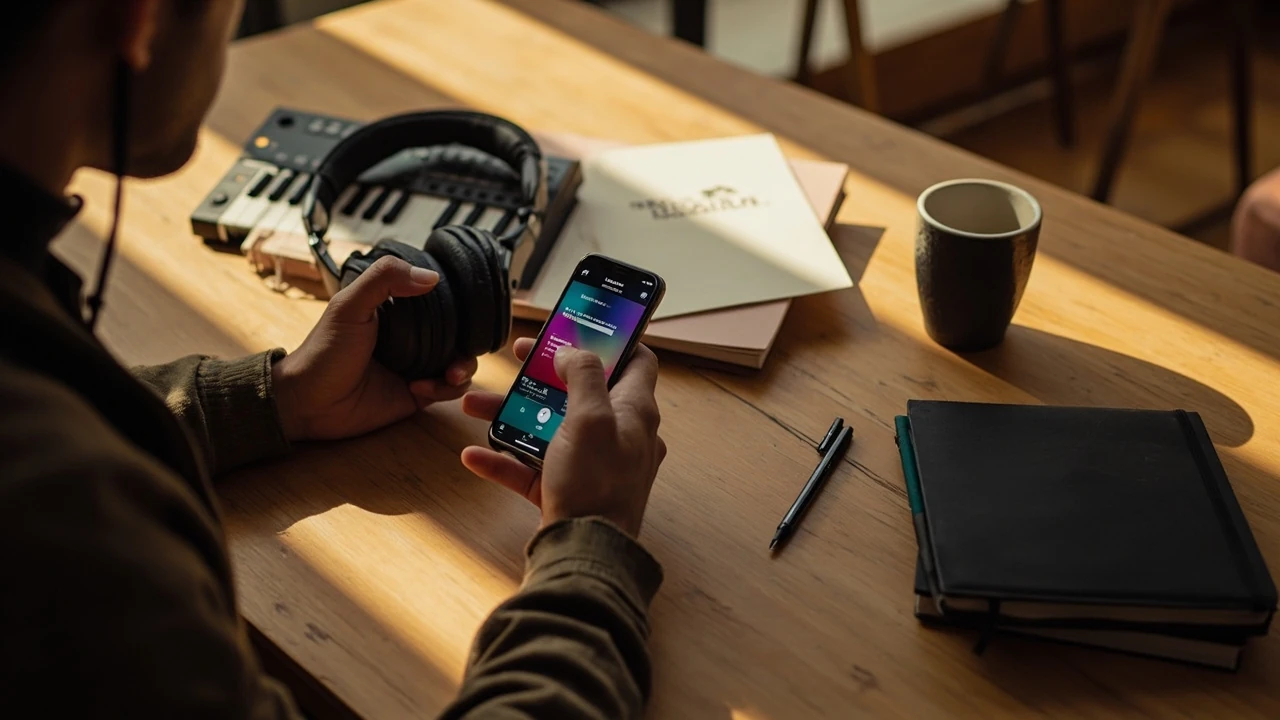
Best music apps for listening, learning, and playing
A new piano student wants a practice companion that listens and corrects rhythm. A commuter wants cleaner sound than the default phone speaker. A producer needs a portable sketchpad for ideas on a train. Each of these situations leads to a different answer, which is why the phrase “best music apps” works less like a single ranking and more like a doorway into three distinct needs: listening, learning, and making music.
This guide sorts the most useful apps into those three jobs, then adds a fourth group for people who use music as background focus, sleep aid, or radio. The aim is not to crown a single winner. It is to help you match an app to the way you actually use music, so the time you spend choosing turns into a faster, more enjoyable decision.
What people actually want from the best music apps
Searches for the best music apps fall into a few predictable patterns. Someone searching from a phone on a train is rarely looking for a deep studio review; they want a quick answer about which streaming service gives them the catalogue they like, at a fair price, on the connection they have. A parent searching for their child is usually looking for a learning app that holds attention without screens full of ads. A hobbyist producer is comparing mobile DAWs and synth apps for weekend sketching.
Because those readers want different things, the most useful framework is a set of decision filters that you can apply to any app in any category.
- Job to be done. Listening, learning, playing, or background use.
- Device reality. Phone only, tablet, laptop, or a mix. Some apps are excellent on a tablet and frustrating on a phone.
- Offline need. Subway commutes, flights, and rural travel make offline support a hard requirement, not a nice extra.
- Catalogue fit. Genre, era, or specialty content. Jazz, classical, metal, podcasts, and audiobooks each have their own strong services.
- Cost shape. Free with ads, subscription tiers, or one-time purchase. The same app can be priced three different ways.
- Data and battery. Background audio, screen-on behaviour, and how much mobile data a typical hour uses.
Run any candidate app through those six filters and the shortlist becomes obvious within a minute or two.
Best music apps for streaming and discovery
Streaming is the most crowded corner of the market, and the differences between the leading services are smaller than the marketing pages suggest. Most subscribers end up paying for the catalogue their favourite artists prioritise, the algorithm that suits their taste, and the device ecosystem they already own.
Spotify
Spotify remains the most widely used streaming service in many markets, and its strength is the depth of its recommendation system. Daily Mix, Discover Weekly, and Release Radar playlists give listeners a steady stream of new material based on what they actually save. For a casual listener who wants the radio to feel personal, this is the most obvious choice. Offline downloads are supported on the paid tier, and the app works well on phones, tablets, watches, and most car systems.
Where Spotify loses points is in catalogue gaps. Some artists and labels hold exclusives elsewhere, and classical listeners often find the metadata weak: composer names, work titles, and movement headings get jumbled. The free tier is also heavily ad-driven and limited on mobile, which can be a deal-breaker for people who listen at work or on the go.
Apple Music
Apple Music pairs a large general catalogue with one of the better classical spin-offs in the industry, which it acquired through the Primephonic purchase. For an iPhone or Mac household, the integration with the system player, Siri, and AirPods is hard to beat. Lossless and spatial audio are available at no extra cost on supported hardware, which is a meaningful upgrade for listeners with good headphones or a proper hi-fi.
The interface is dense at first, especially for users who arrive from Spotify. Discovery leans heavily on editor-curated playlists, and the algorithm takes a few weeks of saving and skipping before it really feels accurate.
YouTube Music
YouTube Music’s strongest card is its long tail. Live recordings, covers, remixes, and rare concert clips are often available here long before they appear anywhere else. For listeners who treat music as a research task as much as a pleasure, that matters. The app folds neatly into a Google account, and the family plan is reasonably priced for large households.
The trade-off is sound quality at the standard tier and a recommendation engine that occasionally leans too far into the obscure. Background playback on mobile also requires a paid subscription, which is no longer unusual but worth knowing before you commit.
Tidal
Tidal targets listeners who care about audio quality. Its HiRes and Dolby Atmos catalogues are larger than most competitors, and the artist-payout model has historically been more favourable to musicians. For someone with a good DAC, decent headphones, and a taste for contemporary production, the quality step is real.
Outside of that audiophile lane, Tidal’s discovery tools are less refined than Spotify’s, and the app has gone through several ownership changes that affected some features. If you are paying for it, you are paying mainly for the sound.
| Streaming app | Strongest reason to choose it | Main limitation | Offline on paid tier |
|---|---|---|---|
| Spotify | Best general recommendation engine | Free mobile tier is restrictive | Yes |
| Apple Music | Lossless, spatial audio, strong classical | Dense interface, slower algorithm | Yes |
| YouTube Music | Long tail of live, cover, and rare tracks | Sound quality at standard tier | Yes |
| Tidal | HiRes and Atmos catalogue | Less mature discovery tools | Yes |
For most people reading this section, the practical answer is simple: pick the service whose catalogue already contains the artists you care about and whose app runs smoothly on the device you use most. Switching costs are real, because saved libraries, downloaded playlists, and trained algorithms do not move with you.
Best music apps for learning an instrument
Learning apps have matured into a serious category. The strongest ones now use the device microphone to listen to your playing, slow passages down without changing pitch, and structure practice into small daily sessions. They are not a replacement for a teacher, but they do something a teacher cannot: they are always there.
Simply Piano
Simply Piano is one of the most approachable piano apps for adult beginners. It listens through the phone microphone, recognises what you play, and walks you through songs in small pieces. The course path is gentle, the visual design is calm, and the sense of progress is steady. It is well suited to people returning to the piano after years away.
It assumes an acoustic or digital piano at home, and the microphone tracking is more accurate on a real instrument than through speakers. The subscription is a recurring cost, and the song library outside the structured path is smaller than the headline numbers suggest.
Yousician
Yousician covers piano, guitar, ukulele, and bass in one subscription, with the same microphone-driven approach. The lesson quality is consistent across instruments, and the practice routines are easy to fit into a fifteen-minute window. The gamified streaks help with habit formation, though some learners find the constant scoring distracting once they reach intermediate level.
Forte for violin and other strings
String players have fewer mainstream options. The market has shifted toward specialist apps and teacher-led video libraries, with a smaller selection of true “listens and corrects” tools. For violinists and cellists, the best workflow is usually a combination of a tuner and metronome app, a focused practice journal, and one-on-one lessons.
For a quick comparison across learners, the table below summarises the fit of the most common apps.
| Learning app | Instruments | Best for | Key trade-off |
|---|---|---|---|
| Simply Piano | Piano | Adult beginners, returners | Subscription cost, needs a real piano |
| Yousician | Piano, guitar, ukulele, bass | Multi-instrument households | Gamification can distract at higher levels |
| Simply Guitar | Acoustic guitar | Beginner guitarists | Limited depth for advanced players |
| SmartMusic | Many, school-focused | Students following graded repertoire | Best with a teacher, interface less consumer-friendly |
For a full picture of how practice tools can support real skill-building, the organ registration guide walks through a similar idea of layering skills and decisions, even though it is written for organists. The habit loop is the same: small, repeated, attentive practice beats occasional long sessions.
Best music apps for making music
Making music on a phone or tablet is no longer a curiosity. It is a real workflow for sketching, beat-making, and finishing demos. The best apps in this category differ mainly in how they treat the gap between idea and track.
GarageBand
GarageBand remains the friendliest end-to-end sketchpad for casual producers. It costs nothing on Apple devices, includes a deep set of instruments and loops, and exports to Logic Pro for finishing on a Mac. For songwriters who want to capture an idea before it disappears, it is the lowest-friction option in the category.
BandLab
BandLab is a free, cross-platform DAW with a strong social layer. Users can collaborate in real time, drop a verse into a shared project, and bounce a stereo file in minutes. The mobile app is surprisingly capable, and the price is hard to argue with. Limitations show up at the mastering and mixing stage, where the stock effects are not as deep as a desktop DAW.
AUM and AudioBus on iOS
For users who want a modular iOS rig, AUM and AudioBus are the routing layer that holds everything else together. They let you chain synths, effects, and recorders in ways the stock apps cannot, and they remain the toolkit of choice for serious iOS producers. The learning curve is steeper, and the cost adds up across the small utilities they integrate, but the result is a portable studio that fits in a coat pocket.
FL Studio Mobile and Cubasis
FL Studio Mobile and Cubasis are full-featured mobile DAWs that try to bring the desktop experience to a touchscreen. Pattern sequencing, automation, and arrangement tools are all present, and projects can move between the mobile and desktop versions of the same product. For producers who already use FL Studio or Cubase on a computer, the continuity is the selling point.
The making-music category rewards a clear plan. A useful starting kit looks like this:
- One recording app, such as GarageBand, BandLab, or Cubasis.
- One drum or beat tool, such as a groovebox or sample pack.
- One tuning and pitch tool for vocals and instruments.
- One metronome that can run complex time signatures and click patterns.
- One safe cloud sync, so a lost phone does not lose a half-finished track.
Best music apps for focus, sleep, and radio
Not everyone uses music to listen closely. Many listeners use it as a tool: a focus aid, a sleep aid, or a familiar voice in the background. The apps in this category are designed to fade into the day rather than demand attention.
Focus and work apps
Apps such as Endel, Brain.fm, and Focus@Will generate or curate audio designed to support concentration. The science behind some of these tools is debated, but the practical effect for many listeners is real: a long enough stretch of non-distracting sound helps sustain attention. For a desk worker who finds silence oppressive and playlists too engaging, this middle ground is often the answer.
Sleep and ambient apps
Calm, Headspace, and dedicated sleep apps such as Sleep Cycle and Pzizz include structured soundscapes, breathing exercises, and short stories designed to ease the transition into sleep. Battery and data use matter more here than in any other category, because the app may run for hours. Offline mode and a screen that actually turns off are worth checking before subscribing.
Radio and live apps
For listeners who want a presenter, a schedule, and the feeling of shared time, radio apps still earn their place. BBC Sounds, TuneIn Radio, and iHeartRadio cover a wide range of stations, talk content, and live music. They are also the easiest way to hear local stations while travelling, and many include podcasts without needing a separate app.
How to choose between similar apps
When two apps look almost identical on paper, the decision usually comes down to a handful of practical tests. Running through them honestly takes about fifteen minutes and saves months of mild frustration.
- Trial the full path. Sign up, save five songs, build one playlist, then close the app for three days. Theorising about an interface is easy. Living with it for a week is what tells you whether the small frictions are tolerable.
- Check offline behaviour. Switch the phone to airplane mode, open the app, and try to play a saved track. If this fails, the app is not ready for your commute.
- Measure battery and data. Let the app play in your pocket for an hour, then check the settings for the data and battery it used. A streaming app that drains 20 percent of a full charge per hour is not a streaming app; it is a space heater.
- Look at cancellation. A clean, one-tap cancel is a small detail that becomes a big one the day you change your mind.
- Check device limits. Some family plans limit how many devices can stream at once, which matters in a household with several people working or studying from home.
Privacy, data, and the cost of “free” music apps
Free tiers are funded by ads, by data, or by the hope that you will eventually convert to a paid plan. None of those models is a problem in itself, but the details differ more than the price tag suggests.
Ad-supported tiers vary widely in how aggressive the ads are, when they appear, and whether the app still functions in the background. Some services interrupt a track with a spoken ad. Others show a banner that the user can dismiss. A few rely on video ads that play before the music. The same word, “free”, can describe three very different experiences.
Data collection is the second quiet cost. Listening history is some of the most revealing data a phone can produce, and several apps use it to build advertising profiles that extend well beyond music recommendations. Reading the privacy settings once is tedious, but it lets you switch off the more intrusive options, such as sharing with third-party advertisers, in a few minutes.
Setting up your phone so music apps actually work well
Most complaints about music apps come from the phone, not the app. A short setup routine solves the common ones.
- Allow the app to run in the background for audio. On most phones, this is a per-app permission that defaults off for battery saving.
- Disable battery optimisations for the apps you use to listen while the screen is off.
- Set a sensible data limit for streaming, and switch to Wi-Fi for long sessions at home.
- Pair a reliable set of Bluetooth headphones and check the codec in use. The difference between a basic codec and a higher-quality one is audible on most modern phones.
- Keep at least a few gigabytes free on the device so downloaded music and offline caches can be refreshed without filling the storage.
Where organ and classical music fit in
Listeners who enjoy organ and classical repertoire have a few specific needs that the general streaming apps do not always meet. Score-aligned recordings, conductor-level browsing, and accurate composer and work metadata all matter, because a symphony is harder to navigate than an album. The organ stops explained guide offers a different kind of map, but the underlying idea is the same: knowing the vocabulary makes every listening session more rewarding.
If your taste leans toward organ repertoire in particular, the practical workflow is to use a streaming app with a strong classical catalogue for general listening, a dedicated label or channel app for solo organ and choral recordings, and a free resource such as the English-language Wikipedia page on the pipe organ for orientation when you want to dig into the instrument itself.
Common mistakes when comparing the best music apps
It is easy to optimise for the wrong thing when the marketing pages all sound the same. A few patterns are worth resisting.
- Picking by catalogue size. The number with the most commas is rarely the one with the recordings you actually want.
- Picking by feature list. A feature you will never use costs nothing at the marketing stage and a real amount when it confuses the interface.
- Chasing lossless without the hardware to hear it. A HiRes stream played through cheap earbuds is a billing decision, not a sound decision.
- Underestimating the algorithm. The system that learns your taste over time is often the most valuable part of a paid subscription.
- Ignoring family plans. Several services are dramatically cheaper per person when bought as a household plan, even for a couple of users.
Frequently asked questions
Which music app is best for free listening?
For most listeners, the best free streaming experience is Spotify’s free tier on desktop, where on-demand playback and sound quality are reasonable, or YouTube Music’s free tier for users who care more about catalogue depth than offline use. The right choice depends on how much advertising you can tolerate and whether you need the app to work without Wi-Fi.
What is the best music app for offline playback?
All the major streaming services support offline downloads on their paid tiers, and the differences come down to how many devices can hold downloaded music, how long the cache lasts, and how cleanly the app handles going online and offline. Spotify, Apple Music, and YouTube Music all do this well, and Tidal is a strong choice if you want offline HiRes files.
Are music learning apps a good substitute for a teacher?
For beginners and returners, a good learning app can build habits, structure practice, and provide feedback on timing and pitch that a teacher cannot deliver at every moment. For intermediate and advanced players, the apps are a supplement rather than a substitute, because the feedback on interpretation, technique, and musical style still comes best from a human teacher.
Do the best music apps use a lot of mobile data?
Streaming at standard quality uses roughly half a gigabyte to one gigabyte per hour, while high-quality streaming can use two to three times that. Downloading over Wi-Fi for offline use is the simplest way to keep mobile data usage low, and almost every paid app supports it.
Is it worth paying for a music app subscription?
If you listen for more than an hour or two a week, the paid tier almost always pays for itself in saved time, better sound, and fewer ads. The free tiers are designed to convert, and they are tuned to remind you of that fact several times per session.
Which music app is best for kids?
For younger children, a tightly curated service with a kids mode is safer than the main streaming app, because it removes explicit content, filters search, and limits purchases. Spotify Kids, Apple Music for Kids, and YouTube Kids with a music focus all work well, and they pair with parental controls on the device itself.
Can I use the best music apps on more than one device?
Yes, and most paid plans allow several simultaneous streams. A standard individual plan typically allows one stream at a time, a duo plan covers two, and a family plan covers five or six. This is often the cheapest way to get good sound across a household.
What is the best music app for podcasts?
For podcasts specifically, a dedicated podcast app such as Pocket Casts, Overcast, or Apple Podcasts is usually better than a music streaming app, because the discovery, queueing, and playback-speed features are more developed. Several music services, including Spotify and Apple Music, also host podcasts, and they are convenient if you already pay for them.
How do I move my library between music apps?
Several third-party services, such as Soundiiz and TuneMyMusic, can transfer playlists and saved tracks between most major streaming platforms. The process takes a few minutes, and the success rate is high for well-formed playlists, although some specialist content such as local files or exclusive recordings may not transfer.
Which music app has the best sound quality?
For raw sound quality, Tidal, Apple Music, and Amazon Music Unlimited all offer lossless or HiRes tiers that beat the standard compressed streams. The audible difference depends on the headphones or speakers, the source recording, and the listener’s ear. For most everyday listening, a well-mastered standard stream is already more than good enough.
Putting it all together
Choosing among the best music apps is easier when you stop looking for a single winner and start looking for the right app for the right job. A streaming service for daily listening, a learning app for structured practice, a production app for capturing ideas, and a focus or sleep app for the rest of the day is a realistic and affordable kit for most households. The work is in matching each app to a specific need, setting up the phone so the app can do its job, and revisiting the choice once a year when prices and catalogues change.
If you want a single, practical next step, pick the listening app that best matches the artists you already love, install one learning or production app that supports a real habit you want to build, and leave the focus and sleep apps for the week when you actually need them. The rest is a matter of taste, and taste is the part no app can decide for you.