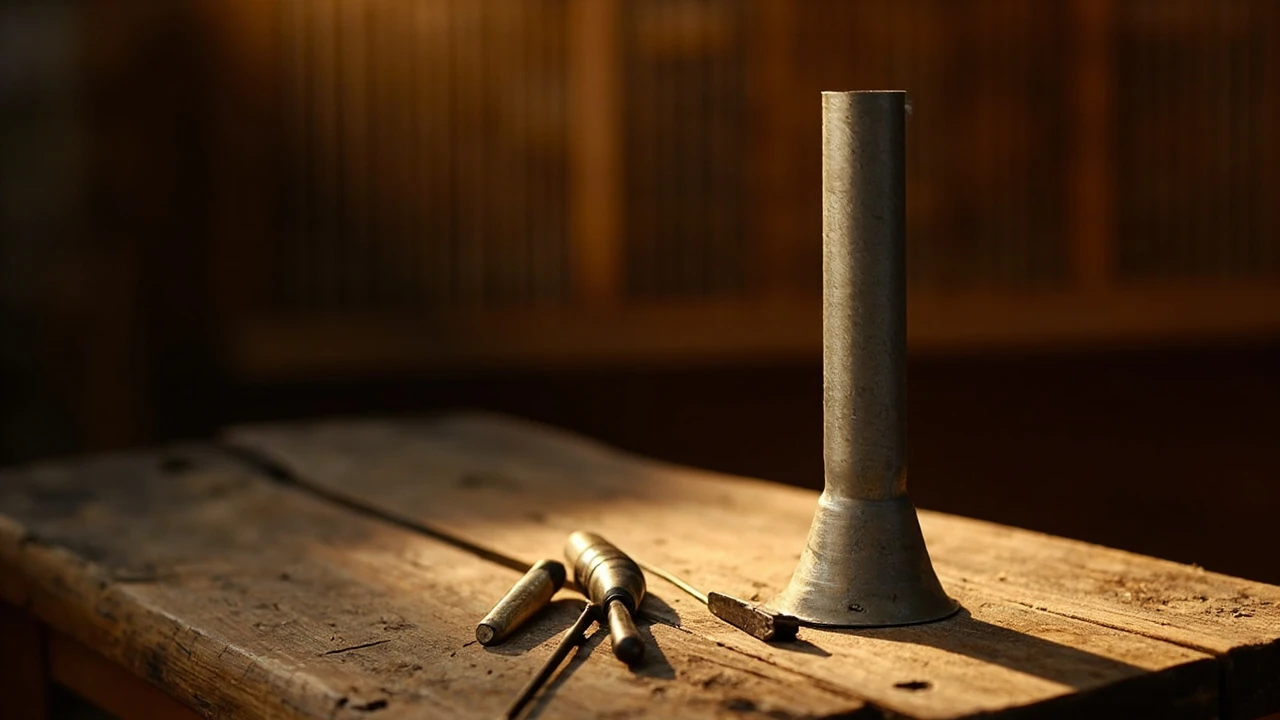
Flue pipe toe hole adjustment explained for working organbuilders and curious players
A pipe that speaks cleanly when the wind is on and stays silent when the pallet is closed is the result of dozens of small, deliberate decisions. One of the least visible of those decisions lives near the bottom of the pipe: the toe hole. On metal flue pipes of moderate and larger scale, the toe hole quietly controls how the air column couples to the language, how the speech forms, and how stable the note is at different wind pressures. A change of a millimetre or two in its diameter, or a shift in its height above the languid, can move a rank from slightly sluggish to confidently responsive, and it can also push a well-behaved pipe into a roughness that no amount of upper-lip work will cure. Because it sits low on the pipe, often partly hidden by the foot, it is the kind of detail that is easy to forget when the speech is already good and easy to blame when it is not.
This article walks through flue pipe toe hole adjustment as a working practice rather than a single trick. It covers what the toe hole is for, how its size and position interact with the rest of the pipe, the typical adjustments made during voicing, the faults that point to a toe hole problem rather than an upper-lip problem, and the limits of what adjustment alone can fix. The aim is to give a reader who has never opened a pipe organ a clear sense of what is happening inside the boot, and to give a reader who has done some voicing a structured way to think about changes at the foot of the pipe.
Where the toe hole sits and what it actually does
The toe hole is a small round opening cut into the wall of the flue pipe just above the languid and below the body of the pipe. In most open metal flue pipes it is drilled or punched through the side of the pipe at the lower end, near the toe of the boot. On stopped wooden pipes the same function is often served by a small hole in the side of the block, but for the purposes of this article the focus is on the metal flue pipe, where the adjustment is most often described and most often needed.
Functionally, the toe hole is a controlled leak. A small amount of wind escapes through it whenever the pallet is open, and a small amount also escapes around the languid into the boot. Together, those leaks regulate the pressure that the jet of air sees at the languid and the way the air column inside the pipe couples to the wind supply. The toe hole is the part of that system that the organbuilder can shape, position, and partially close during voicing.
Three things change as the toe hole is adjusted:
- The effective pressure at the languid, because a larger opening lets more air escape at the foot instead of being forced through the narrow flue.
- The coupling between the air column in the body of the pipe and the boot, which affects how the lower partials behave and how the pipe releases when the key is released.
- The behaviour of the jet itself, because a small change in the local pressure field at the foot shifts how the air curls around the languid and presents itself to the upper lip.
None of those effects is dramatic in isolation, but together they decide whether a pipe speaks at the right moment, holds its tune under small pressure changes, and stops cleanly when the note is released.
How toe hole size and position interact with the rest of the pipe
Toe hole adjustment is rarely a single variable. The size of the hole, its vertical position relative to the languid, its distance from the flue, and the overall scale of the pipe all interact. The same hole that sounds crisp in a diapason of moderate scale may leave a principals-rank octave feeling thin or underpowered.
Two general rules describe most of what an organbuilder watches when changing a toe hole:
- Larger toe holes lower the effective pressure at the languid and tend to slow the speech, soften the attack, and slightly lower the harmonic development of the note. They also make the pipe more tolerant of small wind fluctuations.
- Smaller toe holes raise the effective pressure at the languid and tend to quicken the speech, sharpen the attack, and increase harmonic content. They also make the pipe more sensitive to wind instability and to small changes elsewhere in the voicing.
Position matters as much as size. A toe hole drilled at the same height as the centre of the languid, or slightly above it, behaves differently from one drilled low, near the toe of the pipe. A higher position tends to vent the air column just where it meets the flue, while a lower position bleeds pressure off the boot itself. In practice, organbuilders who adjust toe holes often move them in small steps while listening for changes in the release of the note as much as for changes in the attack.
Reading the pipe before you change anything
The first rule of flue pipe toe hole adjustment is that it is rarely the first thing to change. By the time a pipe is in a state where the toe hole is the obvious answer, the upper lip, languid, and wind have usually been checked. A useful order of observation is:
- Listen to the attack. Is the pipe late to speak, rough on the first tenth of a second, or clean and immediate?
- Listen to the body. Is the tone fluty, stringy, or principal-like, and does it match the rank around it?
- Listen to the release. Does the pipe stop cleanly, or does it huff, drop its pitch, or hang on with a soft chiff after the key is released?
- Listen under changing wind. Does the pipe wander in pitch or tone when the reservoir is pushed harder or softer?
Toe hole adjustment is most useful when the pipe is fundamentally the right scale and the right material but feels either slightly under-responsive, slightly unstable, or slightly slow to release. It is the wrong tool when the pipe is fundamentally too narrow, too wide, cut to the wrong length, or voiced with an upper lip that does not match the languid.
Typical adjustments in a working voicing session
During voicing, toe hole adjustment usually happens in three phases. The first phase is rough setting, where the hole is opened to a size that the organbuilder expects to be near correct for the scale and wind. The second phase is fine adjustment, where the hole is enlarged or partially closed while the pipe is played against its neighbours. The third phase is sealing and stabilisation, where the final size is fixed and any partial closure is made permanent.
| Phase | Typical change | What the organbuilder is listening for |
|---|---|---|
| Rough setting | Drill or punch to a starting size for the scale | Whether the pipe speaks at all and roughly where the pitch and tone land |
| Fine adjustment | Enlarge in small steps, or partially close with a soft solder patch or felt | Match of attack, body, and release against neighbouring pipes in the rank |
| Stabilisation | Final sizing, permanent closure of any test openings, cleaning of the boot | Stable behaviour under normal wind variation, no audible huff or chirp on release |
Fine adjustment is the part of the work where flue pipe toe hole adjustment becomes a real listening exercise. A small change in diameter can move the attack from lazy to crisp, or move the release from a soft huff to a clean stop. A small change in height can change the way the pipe behaves when the wind is pressed, especially in the bass octaves of a rank where the lower partials are closer in frequency to the fundamental.
Common toe hole faults and the symptoms they produce
Most toe hole problems show up as one of a small set of symptoms. Recognising the symptom is the first step to choosing the right change.
| Symptom | Likely toe hole condition | Direction of correction |
|---|---|---|
| Pipe is slow to speak, tone is soft and fluty | Toe hole too large or too low | Reduce size, or raise position closer to languid centre |
| Pipe is edgy, rough on attack, unstable in pitch | Toe hole too small or missing | Enlarge opening, or lower position slightly |
| Pipe huffs or chirps on release | Toe hole too small to vent the boot quickly | Enlarge opening, or check for partial blockage |
| Pipe drops in pitch under harder wind | Toe hole too large, pressure at languid varies with reservoir | Reduce size, or rebalance with upper lip |
| Pipe is flat in the bass, sharp in the treble of the same rank | Inconsistent toe hole sizing across the rank | Standardise the relationship between hole size and scale |
These patterns are useful as a starting point, not as a fixed rule. The same symptom can have more than one cause, and a competent voicing decision always checks the upper lip and languid before settling on a toe hole change. A pipe that is rough on attack might need more languid-to-lip distance, or a slightly higher upper lip, or both, before it needs a change at the foot.
Tools and materials used for toe hole adjustment
Toe hole work is done with a small set of tools. The hole is usually made with a stepped drill, a reamer, or a broaching tool sized for the scale of the pipe. Fine adjustment is done with the same tools in small steps, or with a small file if the change is in the hundredths of a millimetre range. Partial closure, when needed, is done with a patch of soft solder, a small piece of leather or felt, or a purpose-made slide.
- Stepped drills or reamers in a small range of sizes, matched to the scales being voiced.
- A small broach or round file for incremental enlargement.
- Soft solder and a fine iron for permanent partial closure on metal pipes.
- Felt, leather, or a slide for temporary partial closure while testing.
- A light source and a magnifier to read the position of the hole relative to the languid and flue.
The choice between enlarging and partially closing depends on how the pipe is built. A pipe that has been drilled from the outside is easy to enlarge and easy to close with a patch on the inside. A pipe whose hole was punched at manufacture may be harder to enlarge cleanly and may respond better to a partial closure as the final adjustment.
Why toe hole adjustment is different from upper lip work
It is easy to confuse the toe hole with the upper lip because both are small, both are adjusted during voicing, and both influence the attack of the note. The difference is where they act. The upper lip and languid shape the jet of air as it leaves the flue and curls toward the pipe. The toe hole shapes the pressure that the jet sees before it leaves the flue. A pipe with a perfect upper lip and languid but the wrong toe hole will still feel wrong, because the jet is being asked to form under the wrong conditions.
This is also why toe hole work is usually done after the upper lip and languid have been set. Changing the upper lip while the toe hole is wrong tends to produce small, fragile improvements that disappear when the wind changes. Changing the toe hole while the upper lip is wrong tends to move the problem around rather than fix it. The two are partners, not substitutes, and a good voicing session will move between them with the ear rather than treating either as a single setting.
The role of wind supply in toe hole behaviour
Toe hole adjustment does not happen in a vacuum. The same hole behaves differently under a steady, generous wind supply than under a tight, fluctuating one. In organs with large reservoirs and slow blowers, the pressure at the languid is nearly constant, and a moderately small toe hole can be enough to keep the pipe stable. In organs with smaller reservoirs or older bellows systems, the pressure at the languid moves with every key pressed, and a slightly larger toe hole can make the difference between a stable rank and a rank that wavers as chords change.
This is one reason that flue pipe toe hole adjustment is often more visible in older instruments, where the wind system is part of the voicing problem, and in instruments with divided chests, where each pipe sees its own pallet and a small amount of wind loss at the foot has a larger effect on what reaches the languid.
Toe hole adjustment in the bass octaves
The bass octaves of a rank are where toe hole adjustment becomes most delicate. In the bass, the air column is long, the lower partials are close to the fundamental, and the pipe is more sensitive to small changes in pressure at the languid. A toe hole that is only slightly too large can leave a bass pipe flabby, and a hole that is only slightly too small can make it chirp on release.
Common practice in bass voicing is to start with a smaller toe hole than would be used for the same scale in the tenor, and to listen specifically for the release of the note under held chords. The release is the cleanest indicator of whether the boot is venting correctly, because a bass pipe that releases cleanly is almost always venting well at the foot.
Toe hole adjustment in the treble
In the treble, the air column is short and the upper partials are close together, so the pipe is less sensitive to small changes in pressure at the languid. Toe holes can be a little larger, and a little more variation between pipes is acceptable. The dominant voicing work in the treble is usually at the upper lip, where the small scales demand precise control of the jet.
One thing to watch in the treble is the relationship between the toe hole and the pipe’s response to high wind. A treble pipe that is voiced with a small toe hole under generous wind can become sharp and edgy when the organ is played with full organ, because the effective pressure at the languid rises with the rest of the supply. A slightly larger toe hole in the treble is a common answer to this kind of sharpness under full organ.
Limits of what toe hole adjustment can do
There are real limits. Toe hole adjustment cannot fix a pipe that is cut to the wrong length, a pipe whose upper lip and languid are fundamentally mismatched, or a pipe whose foot is too narrow or too wide for its scale. It cannot compensate for a wind supply that is well outside the range the rank was voiced for, and it cannot rescue a pipe whose metal is too thin to hold a stable shape. In those cases the right answer is a different kind of repair, not more careful toe hole work.
It is also worth being honest that flue pipe toe hole adjustment is part of a tradition, and organbuilders disagree about details. Some prefer a fixed relationship between hole size and scale, others adjust the position as well as the size, and a small number prefer to rely on the upper lip and languid for almost all voicing, treating the toe hole as a coarse control that should be set once and left alone. None of these positions is wrong, and a useful approach is to learn one method well before borrowing pieces of another.
A short checklist for the workshop
For a reader who wants a single page to take to the bench, the following list summarises the practical steps most organbuilders follow when toe hole work is on the table.
- Confirm that the upper lip, languid, and wind are set before changing the toe hole.
- Identify the dominant symptom: attack, body, release, or stability under wind.
- Decide whether the change should be a small enlargement, a small closure, or a change of position.
- Make the change in one direction, then re-listen before changing further.
- Match the changed pipe against its neighbours in the rank, not in isolation.
- Stabilise the change before moving to the next pipe: solder closed any test openings, clean the boot, and check for swarf or filings near the languid.
Where toe hole work sits in the wider voicing picture
Toe hole adjustment is one part of a larger system. It sits between the wind supply, which sets the pressure that arrives at the pipe, and the upper lip, which shapes the jet that produces the sound. It also sits between the boot, which controls how the air enters the pipe, and the body, which controls how the air column resonates. For a broader view of how the pipe organ uses these moving parts, the site’s organ acoustics page gives the surrounding picture, and the organ registration page shows how voicing decisions reach the player in real time.
Frequently asked questions
What does the toe hole on a flue pipe actually do?
The toe hole is a small opening near the bottom of a metal flue pipe that controls the pressure at the languid and the way the boot vents. By letting a small, controlled amount of air escape, it shapes how quickly the pipe speaks, how the attack feels, and how cleanly the note releases when the key is let go.
Is flue pipe toe hole adjustment only for metal pipes?
The principle of a small vent near the foot applies to wooden stopped pipes as well, where the equivalent is often a small hole in the side of the block. The metal flue pipe is the most common case where the adjustment is described as a separate step, because the hole is accessible and can be resized during voicing.
How does a toe hole differ from an upper lip or languid adjustment?
The upper lip and languid shape the jet of air as it leaves the flue. The toe hole shapes the pressure that the jet sees before it leaves. Changing the lip without checking the foot can produce fragile improvements, and changing the foot without checking the lip can move the problem around rather than fix it.
Can a toe hole that is too large make a pipe flat?
Yes. A large toe hole lowers the effective pressure at the languid, which can make the pipe feel under-responsive and can also pull the pitch down slightly. The effect is most noticeable in bass pipes and in ranks that are voiced under generous wind.
How is a toe hole enlarged during voicing?
Toe holes are usually enlarged with a stepped drill, a reamer, or a small broach. The change is made in small steps, with the pipe played and listened to after each step, rather than as a single large change.
How is a toe hole partially closed?
Partial closure is done with a patch of soft solder on the inside of the pipe, a small piece of leather or felt held in place for testing, or a purpose-made slide. Permanent closure is soldered; temporary closure with felt is useful while the organbuilder is still deciding on the final size.
Does every flue pipe need a toe hole?
Most flue pipes of moderate and larger scale have a toe hole as a standard feature. Small-scale pipes in the highest octaves of a rank are often voiced with the toe hole as a minor or absent detail, because the air column is short and the pressure at the languid is less sensitive to small leaks at the foot.
What symptom most clearly points to a toe hole problem?
A release problem, such as a soft huff or a chirp after the key is let go, is often the clearest sign of a toe hole issue, because the release is directly affected by how the boot vents. Attack and body problems can also be toe hole related, but they have more possible causes and usually need the upper lip and languid checked first.
Is toe hole work a voicing change or a repair?
It can be either. In a new rank it is part of the original voicing, where the hole is sized to match the scale and the rank. In an existing rank it is often a repair, where a hole has been blocked, enlarged by accident, or never properly sized in the first place.
Can flue pipe toe hole adjustment fix an unstable rank on its own?
Only within limits. A consistent toe hole policy across a rank can do a lot to make the rank stable under changing wind, but it cannot fix a wind supply that is outside the range the rank was designed for, and it cannot fix a rank whose pipes are inconsistently cut or voiced at the upper lip. Toe hole work is one of several tools, and it is most effective when the rest of the voicing is consistent.