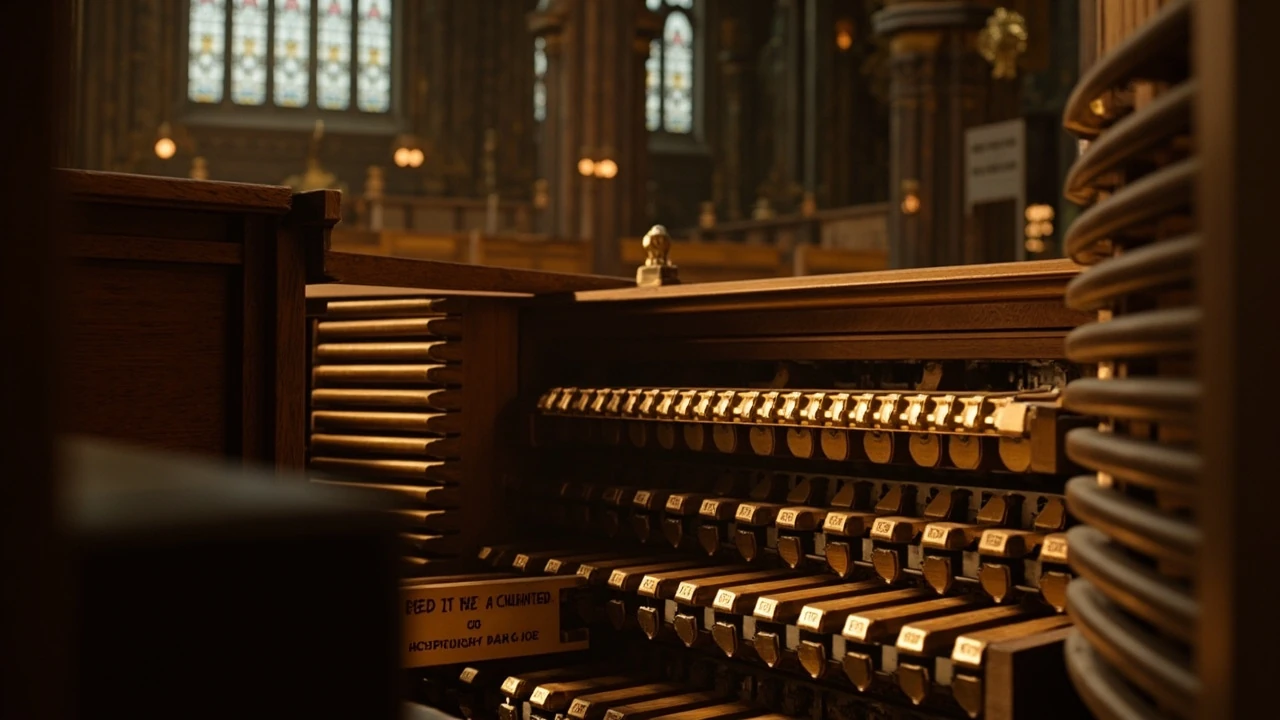
How organ swell shutters change volume on a pipe organ
A swell shutter is a louvered wooden blind, usually hung in a vertical frame, that sits in front of a group of pipes inside a case. When the shutters close, the pipes keep speaking but the sound has to escape through narrow slots between the blades. That restriction is what reduces the sound reaching the room. When the shutters open, the same pipes radiate far more freely, and the audible level rises by several decibels. The expressive effect that organists call the swell is created almost entirely by this mechanical opening and closing, not by any change in wind pressure or pipe length.
This is also why the term “swell” can be confusing. In ordinary English, a swell is a rising shape, but on a pipe organ the word originally described the rising and falling volume produced by a set of louvered blinds. The shutters are driven by a motor, pneumatic, or electric actuator that is linked to a foot pedal or a piston at the console. The player is not changing the pipes themselves. They are opening and closing a wooden “window” that lets a controlled amount of sound out of a sealed box.
The mechanism is older than many players realize. The idea of enclosing an organ division and controlling it with shutters first appeared in England in the early eighteenth century, and the design was refined by builders such as Abraham Jordan, Samuel Green, and later by the firm of William Hill and the English-speaking organ-building tradition that spread through America. By the time of the Victorian era, the swell had become a standard division on most church and concert-hall organs, and it is now almost universal on instruments of three manuals or more.
What a swell box actually is
A swell box is a small wooden room, often built into the upper part of the organ case, that contains a complete set of pipes belonging to the swell manual. The box is lined, the pipes are arranged on a chest, and the only path out of the box is through the front wall of louvered shutters. The box itself behaves like a giant variable attenuator: it does not stop the pipes from sounding, it only controls how much of that sound escapes.
There is one important acoustic reason for putting the pipes in a box rather than placing them in the open case with the rest of the organ. Some pipes in the swell division are reeds, and some are high-pressure flue pipes that can be strident. If they stood in the open, the player would have no way to soften them on a quiet verse, no way to shade the entrance of a solo line, and no way to build a crescendo. The box is the builder’s answer to the problem of how to make a powerful division expressive.
Parts of a typical swell box
- Frame: a rigid timber structure that mounts to the organ case and carries the weight of the shutters.
- Louvered shutters: between 6 and 20 horizontal blades, often veneered with mahogany or another dense wood, hung on pivots.
- Operating rod or cable: connects all blades so they move as a single louvered curtain.
- Actuator: a pneumatic, electric, or direct mechanical drive that opens and closes the curtain in response to the player.
- Conduit for wind: the pipes inside still receive wind from the same windchest that supplies the rest of the division.
- Front cloth or expression indicator: a visible scale on the console that shows the player how far the shutters are open.
How the volume actually changes
The volume change is created by a combination of three things: the geometric area of the opening, the diffraction of sound around the edges of the blades, and the absorption inside the lined box. When the shutters are fully closed, the gaps between the blades are only millimeters wide. High-frequency content leaks through more easily than low-frequency content, so the sound that escapes is darker and softer, almost as if the player had rolled off the treble. As the blades open, more of the front face is exposed, the inside of the box is less enclosed, and the full spectrum of the pipes reaches the room.
Most modern mechanical-action organs fit the shutter frame so that it can move from fully closed to fully open in a sweep of about 70 to 90 degrees. The pedal that controls the swell, sometimes called the “swell pedal” or “expression pedal”, is usually a balanced rocker. Pressing forward opens the shutters, drawing the toe back closes them. The motion is geared so that small foot movements produce large acoustic changes, which is one of the reasons organists can shade a phrase the way a string player does with a bow.
Where the decibels come from
It is common to hear that a fully open swell adds about 10 dB of level. That is a useful rule of thumb, but the real number depends on the box. Builders have measured differences ranging from about 6 dB on a small, tightly built Romantic swell to 14 dB or more on a large mid-twentieth-century box with thick blades and a deep interior. The variables that change the number include:
- the number of blades and the angle of overlap when closed;
- the thickness of the blades, because thicker blades block more acoustic transmission;
- whether the back of the box is lined with absorbing material;
- the size of the pipes inside, because a box full of large reeds will gain more apparent volume than a box of small flues.
What the swell pedal actually moves
The foot pedal does not connect directly to the shutters on most modern instruments. It moves a small lever or a potentiometer at the console, and that signal is sent to a separate actuator near the box. On older instruments, the linkage is a chain or rod that runs back through the organ case. On newer instruments, especially those with solid-state switching, a small stepper motor or linear actuator does the work, and the player’s pedal only generates a control voltage.
The actuator matters because the shutters have weight. A swell box for a full division can easily contain a hundred kilograms of louvered wood, and a player cannot move that with a foot. The swell pedal is therefore a control input, not a direct mechanical handle. This is one reason the response of a swell can feel very different between two otherwise similar organs: the actuator, the linkage, and the balance of the pedal all change the way the volume responds to a foot movement.
Inside the actuator
| Era | Common actuator | How the player feels it |
|---|---|---|
| Late 19th century | Pneumatic motor driven by a small bellows on the pedal | Smooth, slightly delayed, with a soft attack |
| Early-to-mid 20th century | Direct mechanical linkage to a balanced swell pedal | Immediate, with resistance that mirrors shutter weight |
| Late 20th century | Electric motor with chain or cable drive | Firm and consistent, with adjustable response curves |
| 21st century | Stepper motor with position feedback to the console | Programmable, repeatable, and capable of memory sequencing |
Why builders chose shutters instead of doors or curtains
A single large door would only offer two states, open or closed, with nothing in between. A fabric curtain would absorb too much high-frequency energy, leaving the closed position too muffled and the open position too thin. Louvered shutters, by contrast, give a continuous range of intermediate positions, and they do it without absorbing much of the spectrum. The geometry of the blades is the key: when closed, the blades overlap and the air path is restricted; when open, they fold back against the frame and almost disappear from the acoustic path.
Most shutters are also tilted forward slightly when fully open. That small detail reduces the chance of sound reflecting off the inside of the blades and back into the box. It also moves the acoustic center of the opening closer to the plane of the case, which is important when the organ is fitted into a shallow chamber or a low ceiling.
Geometry of a louvered shutter
| Feature | Typical range | Why it matters |
|---|---|---|
| Blade width | 80 to 140 mm | Wider blades reduce the number of gaps but increase weight |
| Number of blades | 6 to 20 | More blades mean finer control and a smoother gradient |
| Blade thickness | 12 to 25 mm | Thicker blades block more sound but require more force to move |
| Overlap when closed | 15 to 30 mm per side | More overlap means a darker, quieter closed sound |
| Open angle | 70 to 90 degrees | A flatter open angle reduces reflection back into the box |
How a swell differs from a crescendo pedal
Many larger organs also have a general crescendo pedal that adds stops across all divisions. A crescendo pedal is a sequential switch: it brings on more stops in a fixed order, and the volume rises because more pipes are sounding at once. A swell pedal is different. The same set of pipes plays in both the closed and open positions. The crescendo pedal changes what is playing; the swell pedal changes how loudly what is already playing can be heard.
For the player, that distinction is the whole point. A swell pedal is an expression tool, used to shape individual phrases. A crescendo pedal is a registration tool, used to move from one dynamic level to another. On a Bach-style organ with a single manual, neither is present, and the player relies on changing manuals, changing stops, and adjusting the touch of the keys. On a Romantic or symphonic organ, the swell pedal is the most-used expressive control, and many registrations are designed around what it can do.
How swell boxes affect the sound character
Even when the shutters are fully open, a swell box changes the character of the sound. The wood of the box, the lining inside, the shape of the opening, and the proximity of the pipes to the shutter frame all color the tone. This is why the same rank of pipes can sound different when placed in a swell division instead of in the great or pedal division. A string-toned rank in the open great tends to project clearly into the room. The same rank in a swell tends to sound slightly more distant, even with the shutters wide open, because the box always adds a small amount of boundary reflection.
Some builders use a felt or fabric lining on the inside of the box to reduce that effect. Others use a hard, reflective lining on the back wall and a soft, absorbing lining on the side walls, so the box acts as a controlled acoustic space rather than a hard chamber. Both approaches are valid, and the choice depends on the voicing of the division and the room in which the organ sits.
What changes in a swell box
- Direct sound from the pipes: partially blocked when closed, fully radiating when open.
- Reflected sound from the back of the case: partly absorbed or controlled by the lining.
- High-frequency content: more reduced than low-frequency content when closed, which is why a closed swell sounds warmer.
- Room response: the player hears less of the room and more of the box when the shutters are closed, which is why a swell can feel intimate even in a large space.
Designing a swell registration
When a player designs a registration that uses the swell, they are choosing which pipes will be enclosed and which expressive effects are possible. A solo melody on the swell might be voiced on a single open flue stop and a single reed, with no other ranks added. That registration gives the player the widest possible dynamic range on the swell pedal. If the same melody is placed on the great with the swell boxes left open, the player can still shape the phrase, but the dynamic range is smaller because there is no enclosed box to control.
This is one reason that organ music from the Romantic era often marks the swell pedal as carefully as it marks the notes. A line that is just marked piano can be played on almost any organ. A line marked crescendo, diminuendo, or with explicit swell indications expects a swell box, and the marking only makes sense if the box is present.
Common swell registrations and their use
| Registration | Typical use | How the swell pedal is used |
|---|---|---|
| Solo reed on the swell | Cornet or trumpet solo lines in Baroque and Romantic music | Pedal opens from a soft accompaniment to a bright solo entry |
| String celeste on the swell | Accompaniment figures under a great or pedal solo | Pedal stays nearly closed, giving a soft, shimmering texture |
| Full swell chorus | Climactic passages in symphonic literature | Pedal moves quickly to full open, then closes for a sudden piano |
| Swell flute on a quiet verse | Intros, interludes, and narrative passages | Pedal is used in very small steps, like a violin’s bow |
| Swell oboe with great pleno | Obbligato lines over a full chorus | Pedal shapes the obbligato against the chorus without changing the stops |
How organists listen to the swell
Most organists learn to listen to the swell not as a single volume control but as a second dimension on top of the registration. A common practice is to set the stops first, then to find the position of the swell pedal that gives a neutral, “medium” dynamic level. From there, small movements up or down the pedal are expressive. Big movements are reserved for structural changes, like the entrance of a solo line or the approach of a cadence.
Some instruments also include a second expression control on the same division, often a separate enclosure for the choir or the solo division. In those cases, the player is not just shaping one swell but balancing two or three. Larger instruments with enclosed solo and enclosed choir divisions effectively give the organist three independent volumes, each controlled by its own pedal, and the music of composers like Widor, Vierne, and Duruflé is written with that three-dimensional dynamic space in mind.
What a swell does not change
It is worth being clear about what a swell box does not do. It does not change the wind pressure going to the pipes, so the pipes do not change pitch when the shutters move. It does not change the voicing of the pipes, so the tone color stays the same in both open and closed positions. It does not add stops or remove them, so the registration is constant while the player works the pedal. It also does not change the tuning, although a very heavy swell can briefly flex the case if the actuator is mounted to the same structure, and on a few poorly built instruments this flex can change the pitch of the largest pipes by a fraction of a cent.
The swell is, in other words, a passive acoustic control. The pipes do the work of producing sound, and the box simply lets more or less of that sound out into the room. This is part of why the organ’s expressive capability is so different from a piano’s. On a piano, the player changes the force of the hammer strike. On an organ, the player changes only how much of the already-produced sound reaches the listener.
Common swell problems and what causes them
When a swell stops working as it should, the cause is almost always in the actuator, the linkage, or the blades themselves. The most common issues are listed below.
- The shutters move unevenly because one or more blades have warped over time. Warping usually comes from humidity cycles in the building, especially in churches that are unheated in winter.
- The shutters no longer close fully because the linkage has slipped or the actuator has lost its end-stop adjustment. The result is a swell that never goes completely quiet, which is most obvious on soft solos.
- The shutters move in the wrong direction because the actuator has been rewired or the control voltage has been reversed after a service.
- The shutters make a creaking or scraping sound in operation because the pivots are dry. The blades do not need to be silent in motion, but a sudden loud creak is usually a sign that the pivots need lubrication.
- The shutters have visible daylight between them when closed, which suggests the frame has moved or the blades have been over-adjusted. A small amount of light leakage is normal; large gaps let sound through and reduce the dynamic range.
- The swell pedal feels “dead” or unresponsive, which is often a sign that the actuator’s drive chain has stretched or that the position sensor needs recalibration.
How shutters interact with case design
Not every organ can fit a swell box. The shutters need a clear front, they need space for the blades to fold back when open, and they need to be positioned so that the sound from the swell division has a reasonable path into the room. In a chamber organ, the swell shutters often face directly out into the nave. In a chamber organ fitted into a low alcove, the shutters can be placed high in the case and angled downward, so the sound reflects off the floor in front of the organ.
Some modern builders place the swell shutters in a slot that runs the full width of the case, rather than in a single framed opening. This design is sometimes called a “Venetian blind” front, and it gives a larger geometric opening for a given closed-state attenuation. It is also harder to build and more sensitive to humidity, because the longer blades are more likely to warp.
Reading swell indications in printed music
Many scores from the nineteenth and twentieth centuries include swell indications that look like hairpins. A hairpin opening to the right is a crescendo, and a hairpin closing is a diminuendo. Where those marks are placed in the music, the player is expected to move the swell pedal in a smooth, controlled motion. Some scores also include explicit text instructions, like “swell” or “cresc.”, while others leave the player to decide the rate of change. The convention is to treat the hairpin as a guide, not a fixed requirement, and to use the pedal in a way that is musically appropriate for the room and the instrument.
One practical habit is to plan the swell motion before a difficult passage. If the player arrives at a passage and only then decides to move the pedal, the music tends to lose its shape. A better approach is to decide the start and end points of the swell motion in advance, then to connect them with a smooth, even movement of the foot. This is also why many organ teachers insist on practicing the feet as much as the hands: the swell pedal is a part of the instrument, and the player who ignores it can only play a fraction of the repertoire.
How a swell behaves in a small room
A swell that is effective in a large church can feel awkward in a small practice room. The reason is that the room itself contributes a great deal of the final volume, and a swell box changes the direct sound more than the reverberant sound. In a small, dry room, closing the shutters can drop the perceived volume by a much larger amount than the same shutter motion would in a cathedral. The player can compensate by using smaller pedal movements, and the builder can compensate by reducing the depth of the box or by using a less aggressive blade design.
Some practice instruments therefore use a single hinged panel rather than a full set of louvered blades. The hinged panel gives a similar dynamic effect at much lower cost and with a much smaller box, and it is common on two-manual practice organs. The musical effect is not identical to a full swell, but it gives the player a usable expressive control in a room that cannot physically accommodate a large shutter assembly.
What a swell does for the listener
From the listener’s point of view, the swell box does something that no other part of the organ can do. It lets the music breathe. A line played on a fully open swell is bright and direct. A line played on the same stops with the swell nearly closed is warm and distant. The combination of the two, in the hands of a player who understands the pedal, gives a phrase the same rise and fall that a singer or a string player would produce. That is the expressive ideal of the Romantic organ, and the swell box is the mechanism that makes it possible.
For listeners who are new to the instrument, the easiest way to hear the swell working is to sit near the organ and watch the shutters during a recital. A skilled player will move the pedal in continuous small adjustments throughout a piece, and the shutters will move in time with the music. Watching the blades open and close is also a useful way to understand how the volume changes, because the motion of the blades is exactly proportional to the change in sound level.
How this connects to the rest of the organ
A swell is just one part of a complete instrument, and the effect of the swell depends on what is happening in the other divisions. A swell solo over a quiet pedal will feel more dramatic than the same solo over a full great chorus, because the contrast between the divisions is greater. A swell that is used to shade a single line in a contrapuntal texture will be felt as a contour, while a swell that is used across a whole section will be felt as a structural change. Understanding the swell is therefore part of understanding the whole instrument, and the player’s choice of when to move the pedal is a choice about the architecture of the music.
For more on how stops interact with the swell, see the practical guide to organ registration, which explains how the same set of pipes can be used in different dynamic settings. To see how the swell box fits into the wider organ action, the article on organ stops explained describes how a complete division is built around an enclosed rank of pipes.
Frequently asked questions
Do swell shutters change the pitch of the pipes?
No. The shutters only control how much sound leaves the box. The pipes continue to speak at the same wind pressure and at the same pitch in both the open and closed positions. Any audible change in pitch when the swell moves is almost always a sign of a problem elsewhere, such as wind leaking inside the case or a heavy shutter assembly flexing the pipework.
How much louder is a fully open swell compared with a fully closed swell?
On a well-built mid-size swell, the difference is usually between about 6 dB and 12 dB. On a large Romantic swell with thick blades, the difference can reach 14 dB or more. The exact number depends on the box, the blades, the lining, and the pipes inside. A useful practical test is to play the same chord on the same stops with the swell closed and then fully open, and to listen to how the level changes at the listening position.
Why does a closed swell sound warmer than an open swell?
When the shutters are closed, the gaps between the blades are narrow, and they pass high frequencies less efficiently than low frequencies. The sound that escapes is therefore slightly darker, just as a small hole in a wall lets through less of the high end of a spectrum than a large hole. The room also reflects less high-frequency energy back from a closed box, which adds to the warming effect.
Can an organ have more than one swell box?
Yes. Larger instruments often have a separate enclosed choir division and a separate enclosed solo division, in addition to the main swell. Each has its own shutters and its own pedal. Some modern builders also offer a fully enclosed pedal division, although this is rarer because the pedal usually has its own dynamic shading through the stops themselves.
Are swell boxes ever used on tracker-action organs?
Yes. Tracker organs can and do have swell boxes. The tracker action only controls the keys, stops, and couplers, not the shutters. The shutters are still driven by a separate actuator, which on a tracker organ is often a small pneumatic motor. Many tracker builders keep the swell mechanism simple, with a direct mechanical linkage from the pedal, because the dynamic range needed for the repertoire is smaller than on a Romantic organ.
What is the difference between a Venetian-blind swell and a framed swell?
A framed swell has a single rectangular opening with the blades stacked inside the frame. A Venetian-blind swell runs the blades across the full width of the case, often without a heavy frame. The Venetian-blind design gives a larger geometric opening and a smoother gradient, but it is more sensitive to warping and harder to seal when closed. The framed design is more common and easier to maintain.
Do all organs have a swell pedal?
No. Many small organs, especially one-manual and two-manual instruments, do not have a swell box. The dynamic range is provided instead by choosing different stops and by changing manuals. Organs of three manuals or more usually have at least one swell, and most concert and church organs of that size have a full swell division.
What causes a swell to creak in operation?
Most swell creaks come from the pivot points of the blades. Wood moving against wood, especially wood that has dried and shrunk, produces a sharp creak. The fix is usually to lubricate the pivots with a small amount of graphite or with a non-staining oil. A creak that is louder than usual, or that is paired with a sticky feel on the pedal, often points to a blade that has warped and is binding against its neighbour.
Why does a swell box change the sound even when fully open?
The box is still there, and the wood of the box absorbs a small amount of high-frequency energy. The geometry of the opening also changes how the pipes couple to the room. The result is that the same rank of pipes sounds slightly more distant in a swell than in the open great, even with the shutters wide open. The difference is small, but it is real, and it is one reason that builders voice the swell ranks with that coloration in mind.
Can a swell box be retrofitted to an older organ?
Yes, in many cases, but the work is significant. The builder must enclose an existing division, fit a shutter assembly, and connect it to the console. Older mechanical organs that were not designed for a swell can be difficult to convert because the linkage, the case, and the action all need to be modified. Many builders will advise against a retrofit if the case would be visually compromised or if the swell division is too small to justify the work.
A practical summary of how organ swell shutters change volume
Organ swell shutters change volume by mechanically opening and closing a set of louvered blades in front of an enclosed pipe division. The pipes do not change: their wind, their voicing, and their pitch are constant. The shutters control only how much of the already-produced sound is allowed to reach the room. Closed shutters leave only narrow gaps, which reduces the level and slightly darkens the tone. Open shutters expose most of the front of the box, which raises the level and restores the full spectrum. The actuator, the linkage, and the player’s foot pedal translate small, continuous movements into the smooth dynamic shaping that defines the Romantic and symphonic organ.