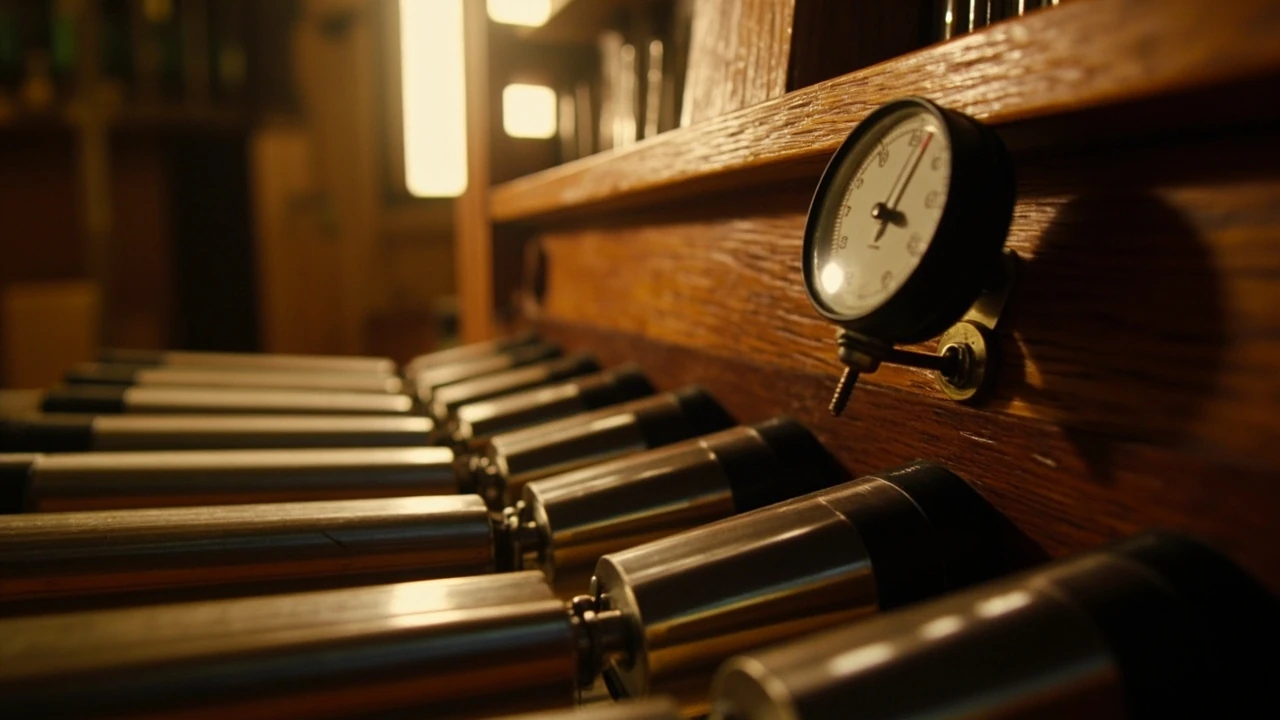
Why organ pipes go out of tune with temperature
A church organ can sound perfectly in tune on a Sunday morning and noticeably flat by the Wednesday evening choir practice, and the organist is not imagining things. The most common reason is the one a tuner is usually asked about first: temperature. Heating systems cycle on and off, sunlight warms one side of the case, and cold draughts move through the building, so the air and the pipes themselves rarely sit at one stable value. Because pitch in a pipe organ is a physical measurement of air column length and of how fast the air column vibrates, anything that changes the dimensions of the pipe or the speed of sound inside it moves the pitch. Understanding why organ pipes go out of tune with temperature is partly about metal, partly about air, and partly about how an organist listens to a long, sustained sound.
Before going further, it helps to separate two ideas that often get blurred. An organ can sound “out of tune” in the musical sense, where intervals are not quite where the ear expects, and an organ can sound “out of tune” in the literal sense, where the reference pitch has moved up or down. The first is usually about voicing, temperament, or simply which rank the organist has drawn. The second is what this article is about, and temperature is its single biggest physical cause.
The short version
- Metal pipes get slightly longer when warm and slightly shorter when cold, which lowers or raises their pitch.
- Cool air is denser than warm air, so the speed of sound in a cold church is slower and pipes sound flat.
- The room itself changes temperature through the day, and the pipes slowly follow it.
- Tuners compensate by setting pipes slightly sharp in cold conditions and slightly flat in warm conditions.
- Some materials and pipe types are more stable than others, which is why old wooden pipes often behave better than cheap modern metal ones.
A quick example: a 25 degree day, a 10 degree night
Consider a 16 foot open metal diapason in a stone church with no heating. On a sunny afternoon the chamber might reach 25 degrees Celsius. By midnight it could fall to 10 degrees, a swing of 15 degrees. The pitch shift that an experienced organist notices, and that a tuner can measure, is more than large enough to be a real problem during a hymn, especially in a choir accompaniment where singers and organ are trying to lock together.
The physics of pitch in a single pipe
To understand why temperature matters, it helps to look at what sets the pitch of a single pipe in the first place. In a flue pipe, air is blown through a narrow windway and strikes a sharp lip, much like a recorder or a whistle. The frequency at which the air column inside the pipe resonates depends on the length of the column, on the speed of sound in the air inside it, and on small corrections for the lip and the open end. The relationship is usually written in textbooks as a simple proportion: frequency is roughly proportional to the speed of sound divided by the effective length of the air column. The speed of sound in air is itself a function of temperature, and that is the entry point for almost every thermal effect in an organ.
Two physical effects therefore combine:
- Thermal expansion changes the effective length of the pipe, including any small openings and the tuning slide or ear.
- The speed of sound in the air inside the pipe changes with the temperature, humidity, and to a much smaller extent, the pressure of that air.
For most organs, the air effect is larger than the metal effect, but the metal effect is the one that organ builders can actually do something about, so it gets most of the attention in tuning practice.
What temperature actually does to a metal pipe
Most organ pipes are made from an alloy that is mostly tin and lead, with small amounts of copper, antimony, or zinc depending on tradition. The exact mixture matters less than the general point: metals expand when warmed and contract when cooled. A pipe that is made to a specific length at a specific temperature will be a fraction of a millimetre longer when warm and shorter when cold. Because pitch in a flue pipe is roughly inversely proportional to the effective length, even a tiny change in length moves the pitch.
For a rough sense of the numbers, the linear expansion of typical organ pipe metal is around 0.00002 per degree Celsius, also known as a coefficient of thermal expansion of about 20 parts per million per degree. A two metre pipe that warms up by 10 degrees will lengthen by about 0.4 millimetres. That does not sound like much, but the human ear is extremely good at noticing small pitch changes in sustained tones, especially in a quiet church. Combined with the air effect, that small length change is enough to be clearly audible in ensemble work.
Tuning slides, ears, and the tuner’s adjustment
Builders do not leave this to chance. Most metal flue pipes have a sliding section at the top, sometimes called a tuning slide, or a flared lip that can be pulled outwards, sometimes called an ear. Both let the tuner change the effective length of the air column. The slide is pushed in to make the pipe sound sharper, and pulled out to make it sound flatter. When the organ is tuned cold, the tuner will set the slide so that the pipe sounds a little sharp at that temperature, knowing that the pipe will warm up over the next few hours. The opposite is done on a warm day. This is one of the reasons an organ that was tuned perfectly on Monday can sound a touch off by Friday.
Wooden pipes behave differently. Wood expands and contracts much more across the grain than along it, and the relevant direction for a pipe is mostly along the grain, so wooden pipes are often more stable in pitch than their metal counterparts. They are also affected by humidity, which causes swelling and shrinkage of the body, but for pure temperature stability wood is generally the better material.
What temperature does to the air inside the pipe
The pitch of a flue pipe also depends on how fast sound travels in the air inside it, and that is set by the air’s temperature, by how much water vapour is mixed in with it, and very slightly by the static pressure pushing on the pipe. For a typical organ problem, only temperature and humidity matter in a practical sense.
The speed of sound in dry air is roughly proportional to the square root of the absolute temperature, expressed in kelvin. Converting that into more familiar numbers, the speed of sound rises from about 337 metres per second at 10 degrees Celsius to about 346 metres per second at 25 degrees Celsius. That is about a 2.6 percent change, and pitch is directly proportional to the speed of sound for a fixed pipe length. A 2.6 percent change in frequency is about 44 cents, which is a clearly audible difference in a sustained chord.
Humidity’s quiet contribution
Water vapour is lighter than the nitrogen and oxygen it displaces, so very humid air carries sound slightly faster than dry air at the same temperature. The effect is small for most indoor conditions, but it can add up. A change from 20 percent relative humidity to 80 percent at 20 degrees Celsius shifts the speed of sound by less than one metre per second, or roughly a few cents. It is rarely the dominant effect, but a tuner who is chasing the last little bit of pitch on a problem pipe will sometimes watch a hygrometer as well as a thermometer.
Comparing the two effects side by side
It is useful to put the two main mechanisms in the same table, because they act at the same time and an organ is responding to both whenever the room changes. The numbers below are typical for a mid-sized metal flue pipe in a moderate climate.
| Effect | What changes | Direction when the pipe warms up | Approximate size for a 10 C rise |
|---|---|---|---|
| Thermal expansion of the pipe body | Effective air column length | Pitch falls (pipe gets longer) | Around 3 to 4 cents, depending on alloy |
| Speed of sound in the air inside the pipe | Resonant frequency of the same air column | Pitch rises (air carries sound faster) | Around 30 cents, about ten times the metal effect |
| Humidity change that often comes with temperature | Speed of sound in the air | Small and usually negative | A few cents at most |
| Static pressure change in the wind supply | Effective pressure on the lip | Pitch may rise slightly with more pressure | Variable, usually a few cents |
The table shows the most important practical point: for a metal flue pipe, the air effect is roughly ten times the metal effect. The pipe is mainly going flat because the air inside is warmer, not because the metal is longer. This is why simply pulling the tuning slide out further does not fully fix a warm pipe, and why organ builders spend a lot of time thinking about the temperature the pipe will live in, not just the dimensions of the metal.
Why some pipes drift more than others
Two organs in the same city can behave very differently on the same day. A few reasons come up again and again in tuning reports and builder’s notes.
Material of the pipe
Lead-rich alloys expand more than tin-rich ones, and zinc-based pipes expand less than traditional spotted metal. Wooden pipes change very little in length along the grain. A wooden flute in a dry, steady church is often more stable than a metal principal across a big temperature swing, all other things being equal.
Size of the pipe
A long pipe has more metal to expand, so the absolute length change is larger. A small change in length on a short 2 foot pipe matters less in cents than the same change on a 16 foot bourdon, because cents are a ratio. In practice, the largest pipes in the building are the ones that move the most noticeably across a day.
Position in the case
A pipe on the outside of a swell box, near a hot pipe motor or under a roof that gets strong sun, will see bigger swings than a pipe tucked deep inside the organ. A north facing chamber that never sees direct sun is a tuner’s friend.
Air movement
When a pipe is speaking, the air inside is moving and a small amount of heat is generated by friction. The pipe is also exposed to room air on its outside. Both of these mean that a pipe can sit a degree or two above the room temperature when it is sounding, which is why the pitch can shift a little as the organ warms up at the start of a service.
Humidity buffering
Some materials, like wood in the case and the leather in the wind reservoir, soak up and release water. As they do so, the local humidity changes, and the speed of sound inside the pipes moves with it. Heavy timber cases tend to buffer humidity swings, which is one reason old organs in old buildings often feel more stable than new organs in modern, dry, well heated ones.
What a tuner actually does on site
An organ tuner is part physicist, part carpenter, and part detective. On a routine visit, the visit itself is shaped by an understanding of why organ pipes go out of tune with temperature, because the tuner is trying to set the instrument for the conditions the organist is most likely to face.
Reading the building before opening the tool kit
A good tuner will look at the room before touching a pipe. Where is the heating? Is the blower pulling air from a warm attic or a cold outside wall? Is the sun hitting one side of the case? Has anyone changed the thermostat in the last week? All of these affect how the pipes will sit when the organ is used.
Choosing a target temperature
Most tuners pick a temperature that is realistic for the kind of service or concert the organ is most often used for. A church that holds 9 a.m. communion in a cold building will have its organ set slightly sharp, knowing the pipes will warm up during the service. A concert hall with reliable climate control will be set closer to the room’s steady state.
Tuning in stages
Large pipes respond slowly. A tuner will start with the largest pipes, give them time to settle, and then move on to the smaller ranks. The smaller pipes come into tune quickly and the tuner uses them as a reference for the bigger ones. This is the opposite of the way a piano tuner works, because the thermal mass of a large pipe is much higher than that of a piano string.
Listening for stability, not just pitch
The tuner is also listening for pipes that are still drifting. A pipe that has just been pulled up or pushed in will sometimes take a few minutes to settle to its new pitch, especially in a metal principal. A tuner who rushes this step will set the organ to a pitch that no longer exists by the end of the service.
Practical signs for organists
Most organists are not expected to tune their own instruments, but a working sense of why organ pipes go out of tune with temperature helps in everyday playing. A few patterns are worth recognising.
- If the organ sounds flat at the start of a cold service, give it twenty minutes. The pipes will warm up and the pitch will rise. A good organist will ease the choir in gently rather than starting at full organ.
- If the organ is in a different building, expect it to behave differently. A portable organ moved from a cold van into a warm church will drift noticeably during the first few minutes of playing.
- If the building has just had its heating system serviced, the temperature curve may have changed. A visit from a tuner may be needed earlier than usual.
- If the room is very dry, wooden pipes may shrink slightly, which can also affect pitch. A humidifier is sometimes a cheaper solution than a tuner visit.
What organ builders do to reduce the problem
Builders who know that temperature is a constant companion to a pipe organ make several choices during construction that reduce the day to day drift. They are worth listing because they explain why two organs in similar rooms can feel very different to the player.
- They use low expansion alloys for the larger pipes, so the metal effect is small.
- They oversize tuning slides and ears, so the tuner has plenty of room to set the pipe for cold and warm conditions.
- They mount the largest pipes on wooden racks with air space around them, so they can respond to room temperature without being trapped against warm or cold surfaces.
- They insulate the windchest and the trunking, so the air that reaches the pipe is closer to room temperature, not to whatever is happening in the blower room.
- They add swell louvres and case ventilation that let the chamber equalise with the room, rather than baking in its own microclimate.
None of these remove the problem, but together they cut the pitch swing across a normal day from something an organist would notice to something only the tuner would notice with a tuning app.
Special cases that confuse the picture
A few situations look like temperature problems but have a different cause, or have temperature on top of a different problem. Knowing these helps a tuner get to the right answer faster.
Direct radiation from sunlight
Sunlight on a metal pipe can warm it well above room temperature in a few minutes. The pipe will sound sharp while the sun is on it, then drop back as the sun moves. This is a common cause of mysterious pitch wobble in west facing chambers in the late afternoon.
Blower intake temperature
If the blower draws air from an attic, the air reaching the windchest can be much warmer or colder than the air in the chamber. The pitch will then drift as the blower cycles, even if the room is steady. A simple fix is to move the blower intake into the room, or to add a short run of trunking that lets the air come to room temperature before reaching the chest.
Underrated power supply
If the wind pressure drops, the pitch of a flue pipe falls very slightly, and if the pressure rises, the pitch rises. Many temperature related complaints turn out to be pressure complaints, especially in organs with a small or ageing blower.
Reeds and temperature
Reed pipes have a vibrating metal tongue against a resonator, and the tongue is tuned with a small wire called a tuning scroll. The resonator is also affected by temperature, but the tongue is much more sensitive. Reed pipes often drift faster than flue pipes during a service, and a tuner will usually return to them at the end of a tuning session.
New organs that have not settled
A new organ often needs a settling period of a year or two, during which the pipes, leather, and wood adjust to the room. A new organ that seems to need tuning every month is not necessarily a problem organ, it may simply be finishing its settling period.
A simple decision guide for organists and church teams
The table below sums up the most common situations that show up in tuner reports. It is a starting point, not a full diagnosis, but it is what a good organist or churchwarden can use before booking a service visit.
| Symptom | Likely main cause | First check | Realistic fix |
|---|---|---|---|
| Whole organ sounds flat in cold weather | Air inside pipes is cooler, speed of sound lower | Thermometer in the chamber at pipe height | Tune in cold conditions, let pipes warm up during the service |
| Pitch rises during a service | Pipes and air are warming up together | Record pitch at start and end of a service | Tune slightly flat at the start, accept the rise |
| One or two ranks drift more than the rest | Position in case, sun exposure, or alloy differences | Watch for sun or draught at that spot | Move a heat source, add a shade, or have the rank realloyed |
| Pitch wobbles during a piece | Sun on the case, or wind pressure cycling | Watch the swell box and the blower gauge | Add blinds, or service the blower |
| Pitch steady for years, then suddenly off | Heating system change, building works, or a leak | Compare with previous tuning notes | Arrange a tuning visit once conditions stabilise |
How this fits into the wider subject of organ care
Temperature is the most common reason for pitch drift, but it is one item on a longer list that includes humidity, wind pressure, structural movement of the building, and simple wear. Reading the related material in the organ acoustics guide and the tracker action article will help connect the physics in this piece to the way an organ actually feels under the hands.
Frequently asked questions
Why do metal pipes go out of tune faster than wooden pipes?
Metal pipes are more sensitive to temperature changes because both the metal itself and the air column inside the pipe change quickly with room temperature. Wooden pipes change very little along the grain, so their length is more stable. They are affected more by humidity, but for pure temperature stability wood is usually the steadier material.
Does the speed of sound really change enough to matter?
Yes. Across a 15 degree Celsius swing, which is normal between a cold morning and a sunny afternoon in a stone church, the speed of sound in air changes by about 2 to 3 percent. That is roughly 40 to 60 cents, which is clearly audible in a sustained chord and very obvious in choir accompaniment.
How long does an organ take to warm up after a cold night?
There is no single answer, because it depends on the size of the case, the heating system, and the mass of the largest pipes. Small metal ranks can be stable within 15 to 30 minutes, while the very largest wooden bourdons in a big instrument may still be moving after two or three hours. Tuners usually arrive an hour or more before a service to give the largest pipes time to settle.
Can a church fix the problem by installing better heating?
Better heating helps if it reduces the swing between cold and warm conditions, but it cannot remove the problem entirely. Modern climate control with a stable set point is the most effective way to keep an organ in tune, which is why concert halls with proper HVAC usually have much steadier organs than the average parish church.
Why does the organ sound out of tune at the start of a service but fine later?
The most common cause is that the organ was tuned for a different temperature than the one in the building when the service started. The pipes warm up during the first hymns, and the pitch rises to meet the tuning. A good organist knows this and uses the opening voluntary to let the choir settle in.
Are digital organs affected by temperature at all?
Digital organs generate pitch electronically, so temperature does not change the pitch of the tone itself. They are still affected by temperature in other ways, such as the stability of the loudspeakers and the tuning of the analog reference circuits inside the console, but the effect on the music is much smaller and more predictable.
What is a tuning slide, and why is it not enough on its own?
A tuning slide is a small telescopic section at the top of a flue pipe that lets the tuner change the effective length of the air column. It is enough to compensate for the metal effect and a small air effect, but it cannot fully correct for a large temperature swing, which is why a tuner may need to return after a major weather change.
Do reed pipes behave the same way as flue pipes?
Reed pipes also drift with temperature, but the tuning scroll on the tongue is more sensitive than a flue pipe’s tuning slide, so reed ranks often need more attention during a tuning session. The resonator is also affected by temperature, in the same direction as a flue pipe, so the two effects usually add up rather than cancelling.
How often should a church organ be tuned?
For a working parish church, once a year is the usual minimum, and many tuners recommend a second light visit in the autumn after the heating is turned on. Concert instruments and recording organs are usually tuned before every significant use, because the public ear is unforgiving.
Will global climate change make this problem worse?
There is no widely cited study that links climate change directly to organ tuning intervals, and it would be misleading to claim one. What can be said is that older buildings in temperate climates are now sometimes exposed to larger seasonal swings and more humid summers, which is putting more demand on tuners and on the tuning slides that were not designed for the new range of conditions.
A practical next step
If the organ in your building is going flat at the start of a service and sharp by the end, the cheapest first move is to log the temperature at the start and end of two or three services in a row, alongside a short note about how the organ sounds. That small record will tell a tuner more than a verbal description, and it will frame the problem in the same language as the physics above. If the organ is instead drifting unpredictably through the day, a single visit from a tuner, ideally at the time of day when the organ is most often used, will usually point to one of the special cases in this article and save a great deal of speculation in the meantime.