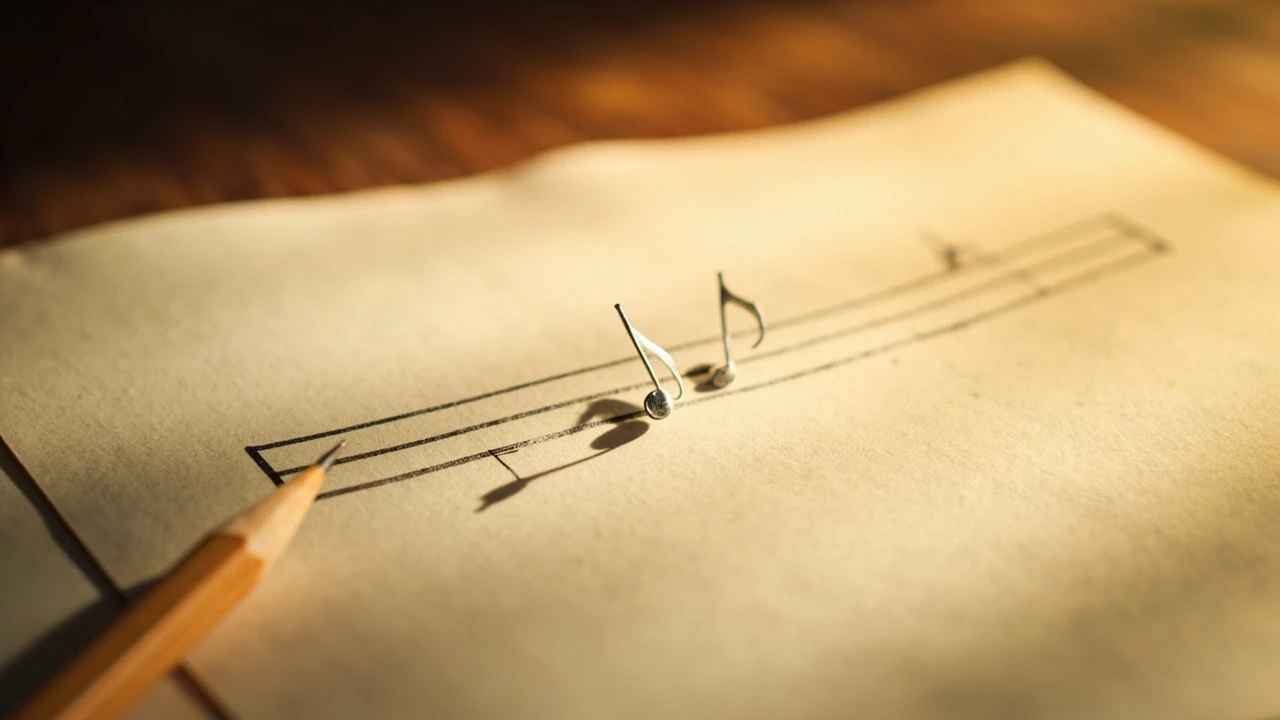
Music note: how pitch, duration, and staff position are written
A music note is the smallest written instruction a performer follows: a single symbol that tells the player which pitch to sound, how long to hold it, and how strongly to attack it. Every melody, harmony, and rhythmic pattern in Western notation is built from a chain of these symbols arranged on a five-line staff. Before any theory, harmony, or sight-reading vocabulary makes sense, the individual note on the page has to feel familiar, the way letters feel familiar before a word does.
This guide treats a music note as a working object rather than an abstract symbol. It explains how the head, stem, and flag of a note encode pitch and time, how the staff and clef decide which lines and spaces those notes occupy, and how accidentals change pitch by a half step. It also covers the durations a performer actually plays, the way rests mirror those durations, and the small conventions of notation that organists, pianists, singers, and instrumentalists meet at the beginning of almost every piece.
The shape of a single music note
Every written music note has the same three optional parts. Together they answer the three questions any performer needs answered before a note sounds.
- Notehead: the oval that marks the pitch and sits on a line or in a space of the staff.
- Stem: a thin vertical line attached to the notehead that controls how the duration is read and, together with flags or beams, indicates faster values.
- Flag or beam: a curved or straight mark on the stem that shortens the duration, with more flags or more beams meaning a shorter note.
A music note without a stem is treated as a whole note in modern notation, regardless of where it sits on the staff. Once a stem is added, the note can be read as a half, quarter, eighth, sixteenth, and so on, depending on the flags, beams, and any dots or ties that follow it. The position of the notehead never changes because of duration: middle C is still middle C whether it is written as a whole note, a quarter note, or a thirty-second note.
How the staff decides the pitch of a music note
The staff is the five horizontal lines that give a music note its vertical address. Lines and spaces are counted from the bottom up, so a note in the bottom space has a different pitch from a note on the second line, and so on. The clef placed at the start of the staff tells the reader which pitches those lines and spaces stand for.
| Clef | Center reference | Common use | What a beginner notices first |
|---|---|---|---|
| Treble clef (G clef) | The curl wraps the second line from the bottom (G4) | Right-hand piano, most vocal lines, violin, flute, many other instruments | Middle C sits on the first ledger line below the staff |
| Bass clef (F clef) | The two dots surround the second line from the top (F3) | Left-hand piano, low strings, bass voice, organ pedals | Middle C sits on the first ledger line above the staff |
| Alto clef (C clef on the middle line) | The center of the clef marks middle C on the middle line | Viola, sometimes trombone | Middle C lives in the middle of the staff, not above or below it |
| Tenor clef (C clef on the fourth line) | The center of the clef marks middle C on the fourth line | Upper ranges of cello, bassoon, trombone | Middle C sits on the fourth line, which moves the rest of the staff up by a third |
For a beginner, the most useful habit is to memorize where middle C sits in each clef. Once that one reference is fixed, the rest of the staff unfolds in regular steps, because each line and space is a diatonic step (a step within the key signature) away from its neighbors.
Ledger lines: notes above and below the staff
When a music note climbs above the top line of the staff or drops below the bottom line, the writer adds short extra lines called ledger lines. The notehead can sit on a ledger line or in the space just above or below one. Middle C is the classic example: in treble clef it is written on a single ledger line below the staff, and in bass clef it sits on a single ledger line above the staff.
- One ledger line above the staff in treble clef = A5.
- One ledger line below the staff in treble clef = middle C (C4).
- One ledger line above the staff in bass clef = middle C (C4).
- One ledger line below the staff in bass clef = E2.
Ledger lines are not a different kind of music note. They are simply an extension of the staff that lets a note sit in a regular line-and-space pattern no matter how high or low the pitch travels.
Accidentals: sharps, flats, naturals, and double accidentals
A music note on a line or space is a letter name. Accidentals tell the performer to alter that letter by a half step for the rest of the measure (unless a key signature or a natural sign says otherwise).
| Symbol | Name | Effect on pitch | Typical reason it appears |
|---|---|---|---|
| # | Sharp | Raise by a half step | Key signature, chromatic passing tone, leading tone |
| b | Flat | Lower by a half step | Key signature, chromatic color, modal line |
| n | Natural | Cancel a previous sharp or flat for the rest of the measure | Return to the diatonic pitch after a chromatic alteration |
| x or double sharp | Double sharp | Raise by a whole step from the written note | Notes that need to be raised a half step above an already-sharpened pitch in the key |
| bb or double flat | Double flat | Lower by a whole step from the written note | Notes that need to sit a half step below an already-flattened pitch in the key |
A flat or sharp written into the key signature applies to every music note with that letter name in every octave for the rest of the piece, unless a natural sign changes it locally. This is why a player who knows the key signature can read most notes without counting accidentals for each one.
Durations: how a music note tells time
The vertical position of a music note decides its pitch. Its shape and any attached marks decide how long it sounds. Modern Western notation expresses duration in a simple doubling system: each faster note is half the value of the slower one above it.
| Symbol name | Shape | Value in 4/4 | How many per whole note |
|---|---|---|---|
| Whole note | Open notehead, no stem | 4 beats | 1 |
| Half note | Open notehead with a stem | 2 beats | 2 |
| Quarter note | Filled notehead with a stem | 1 beat | 4 |
| Eighth note | Filled notehead, stem, one flag or beam | 1/2 beat | 8 |
| Sixteenth note | Filled notehead, stem, two flags or two beams | 1/4 beat | 16 |
| Thirty-second note | Filled notehead, stem, three flags or three beams | 1/8 beat | 32 |
A flag on a single note is shorthand for one beam. When two or more music notes sit next to each other on the same beat, the beams are usually drawn as a thick or doubled horizontal bar that connects the stems. Beaming keeps the page readable and groups notes by beat, which is how performers see where the pulse falls.
Dots, ties, and other duration modifiers
Bare note values cover most situations, but a few small marks change a note’s length without changing its pitch.
- Augmentation dot: a dot placed to the right of a notehead adds half of that note’s value. A dotted quarter in 4/4 lasts a quarter plus an eighth, or one and a half beats. A second dot adds another quarter of the original value, so a double-dotted note totals 1.75 times its base value.
- Tie: a curved line connecting two notes of the same pitch. The first note is held for the combined value, and the second note is not re-articulated. Ties connect notes across a bar line when the composer wants a long sustain.
- Slur: a curved line over notes of different pitches. The notes are played smoothly, but each one is articulated. Ties and slurs look similar but mean different things.
- Triplet: a small 3 above or below a beamed group. Three notes share the time normally given to two of the same value, which is how a composer writes an uneven subdivision inside a regular meter.
When a piece uses these marks consistently, the rhythm on the page becomes a story of where the weight falls, not just a list of numbers.
Rests: silence written as a music note for time
Music notation treats silence as the equal partner of sound. Each main note value has a matching rest, drawn as its own symbol so a performer can count time without playing anything.
| Rest name | Value in 4/4 | Visual cue |
|---|---|---|
| Whole rest | 4 beats | Small filled rectangle hanging from the fourth line |
| Half rest | 2 beats | Small filled rectangle sitting on the third line |
| Quarter rest | 1 beat | Z-shaped squiggle |
| Eighth rest | 1/2 beat | Quarter rest with one flag |
| Sixteenth rest | 1/4 beat | Quarter rest with two flags |
A useful first exercise is to clap the rhythm of a line using only the rests, then add the notes. The phrasing of a melody often comes from the silences around the notes, not only from the notes themselves.
How a music note is read in context
Outside the practice room, a music note is rarely looked at in isolation. It sits inside a time signature, a key signature, a clef, and a tempo marking, and the meaning of a single symbol depends on all of those. A note written as a quarter in 4/4 is a quarter of a whole note, but the same shape in 6/8 is a quarter of a dotted-quarter beat, which changes how it feels in performance.
For most readers, the practical sequence is to read the clef and key signature first, then the time signature and tempo, then the direction of stems and beams to find the beat, and only after that to think about individual pitches. Once this order is automatic, a busy page of notes stops looking like a wall of symbols and starts reading like a line of text with a pulse.
Common habits that confuse new readers
A few small visual habits are responsible for a large share of reading errors among beginners. Working through them in advance saves a lot of slow counting later.
- Stem direction changes with the staff position. Notes on the middle line and above usually have stems down on the left; notes below the middle line usually have stems up on the right. Following the stem direction helps the eye track the beat.
- Beams group notes inside a beat, not across beats. A long beamed run is actually several short beats joined by a single beam, and the visual breaks in the beam show where the pulse falls.
- A note with a flag is always a fast value that has not been joined to a neighbor. As soon as two fast notes sit together, the flag becomes a beam.
- Accidentals placed before a note affect only that pitch, that octave, and that measure. A new accidental is needed to repeat the same alteration later.
- A natural sign does not just mean “no accidental” in a key that has none. Inside a key signature, the natural sign is what cancels the key.
Why organists pay special attention to single notes
On a pipe organ, a single music note can call up an entire layer of sound. Unlike a piano, where a key controls one or two strings, an organ key can draw on any number of stops, and each stop is a rank of pipes tuned to a different timbre, pitch level, and loudness. Reading a single note well therefore involves reading its position in the chord, its duration, and the registration the organist has chosen for that exact moment.
Two internal pages on this site are useful companions when a music note is being read in an organ context. The first explains how to read a stop list and the families of sound a builder offers, which shapes how a single pitch is voiced in a room. The second walks through the practical decisions behind combining those stops so each note sits in a balanced texture. Reading either of them next deepens the connection between the written symbol and the air the pipes move.
A related craft page covers how a voicer tunes and shapes individual pipes, which is what makes a written note sound like a particular instrument rather than a generic tone. Taken together, those three pages turn the abstract idea of a music note into a chain of physical choices the organist and builder make in real time.
Reading a music note by ear as well as by eye
Notation is a map, not the territory. The most reliable way to confirm that a music note on the page is the same note the ear expects is to sing or play it without looking. A few practical exercises work well for beginners and remain useful for experienced players.
- Sing a familiar melody while pointing to each note on a blank staff, then check whether the noteheads land on the lines and spaces the song actually uses.
- Clap the rhythm of a line by reading the note shapes alone, ignoring pitch, and then play the same line on a single pitch to lock the time in.
- Read a phrase in solfège syllables while tapping the beat, so the eye, the voice, and the inner pulse line up.
- Mark each note with a finger position on the instrument before the first rehearsal, so the eye, the hand, and the score are all synchronized.
After a few weeks of this kind of cross-checking, the music note stops being a small abstract picture and becomes a sound the body already expects to produce.
Digital scores and the modern look of a music note
Engraving software has changed how a music note looks on a page. Modern programs apply consistent stem directions, beam groupings, and spacing rules, which is helpful for sight-reading. The trade-off is that a computer-drawn note is sometimes geometrically perfect in a way that a hand-engraved page is not. For most learners this is a gain, because the eye no longer has to interpret irregular shapes. The only real adjustment is to learn the small extra symbols the software uses to express things older hand engraving used to leave to the performer, such as a literal “8” above or below a note for octave displacement, or small articulations that were once assumed.
A short glossary of useful terms
The vocabulary around a music note is small once the basics are in place. A few extra words appear often in beginner method books and reference pages.
- Step: the distance from one line or space to the next, which in a diatonic key is a tone or a semitone depending on the key signature.
- Interval: the distance between two notes, named by counting the lines and spaces between them (a third, a fifth, an octave, and so on).
- Octave: the distance of eight diatonic steps, which sounds like the same pitch class in a higher or lower register.
- Chord: two or more notes sounded at the same time, read as a vertical stack of noteheads on the staff.
- Measure: a segment of music bounded by bar lines, which contains a number of beats decided by the time signature.
- Bar line: the vertical line that separates one measure from the next.
- Articulation: the way a note is attacked or released, marked by symbols such as staccato dots, tenuto lines, or accent marks.
Frequently asked questions
What is the difference between a whole note and a half note?
Both have open noteheads, but a whole note has no stem and lasts four quarter-note beats in 4/4, while a half note has a stem and lasts two beats. The notehead shape alone does not decide duration; the stem is what changes the value.
Where does middle C sit in treble and bass clef?
In treble clef, middle C is on the first ledger line below the staff. In bass clef, middle C is on the first ledger line above the staff. The two clefs place the same pitch on opposite sides of their own five lines.
What is the difference between a tie and a slur?
A tie is a curved line that connects two notes of the same pitch and tells the performer to hold them as one longer note. A slur is a curved line over notes of different pitches that tells the performer to play or sing them smoothly. The visual shape is similar; the meaning depends on whether the pitches are the same.
How long does a dotted note last?
A single augmentation dot adds half of the base note’s value. A dotted quarter in 4/4 lasts a quarter plus an eighth, or one and a half beats. A double dot adds another quarter of the base value, so a double-dotted quarter lasts one and three-quarter beats.
Why does the same music note look different on different clefs?
The clef changes the meaning of the lines and spaces, not the shape of the note. A note on the bottom line of the treble staff is E4, while a note on the bottom line of the bass staff is G2. The notehead, stem, and any flag or beam look the same; the position on the staff decides the pitch.
What is a triplet?
A triplet is a group of three notes marked with a small 3 that share the time normally given to two notes of the same value. A triplet of eighth notes in 4/4 fits into the time of one quarter note, which gives the line an uneven, lilting feel inside a regular meter.
How do I read ledger lines quickly?
The simplest method is to count lines and spaces from the nearest staff line as if the staff simply continued. Middle C is one line below the treble staff, two spaces above the bass staff, and so on. With a little practice, the eye stops seeing each ledger line as a separate object and sees a continuous line-and-space pattern.
Can a rest ever be longer than a whole rest?
Yes. A whole rest is also used as a general placeholder for a full measure of silence, regardless of the time signature, when the composer wants the player to rest for the entire bar. Longer silences are written as multi-measure rests, which are drawn as a thick bar across the staff with a number above it.
Do accidentals carry over across bar lines?
No. An accidental affects the same pitch in the same octave for the rest of the measure in which it appears. The next measure returns to the key signature unless a new accidental is added, and a natural sign can be used inside the measure to cancel the key signature on the same pitch.
What is the first thing a beginner should memorize on the staff?
The two most useful anchors are the position of middle C in the clef the player uses most, and the line-and-space pattern of the C major scale on that staff. Once those two references are automatic, every other note can be reached by counting diatonic steps from a known starting point.
A practical next step
Pick one short piece you already know by ear. Write down the first four bars by humming them onto a blank staff, starting from middle C in the clef you read most often. Then play the same four bars back from what you have written. The exercise exposes which note shapes and rhythms your eye recognizes quickly and which still need a slow count, which is exactly the information a focused practice session needs.