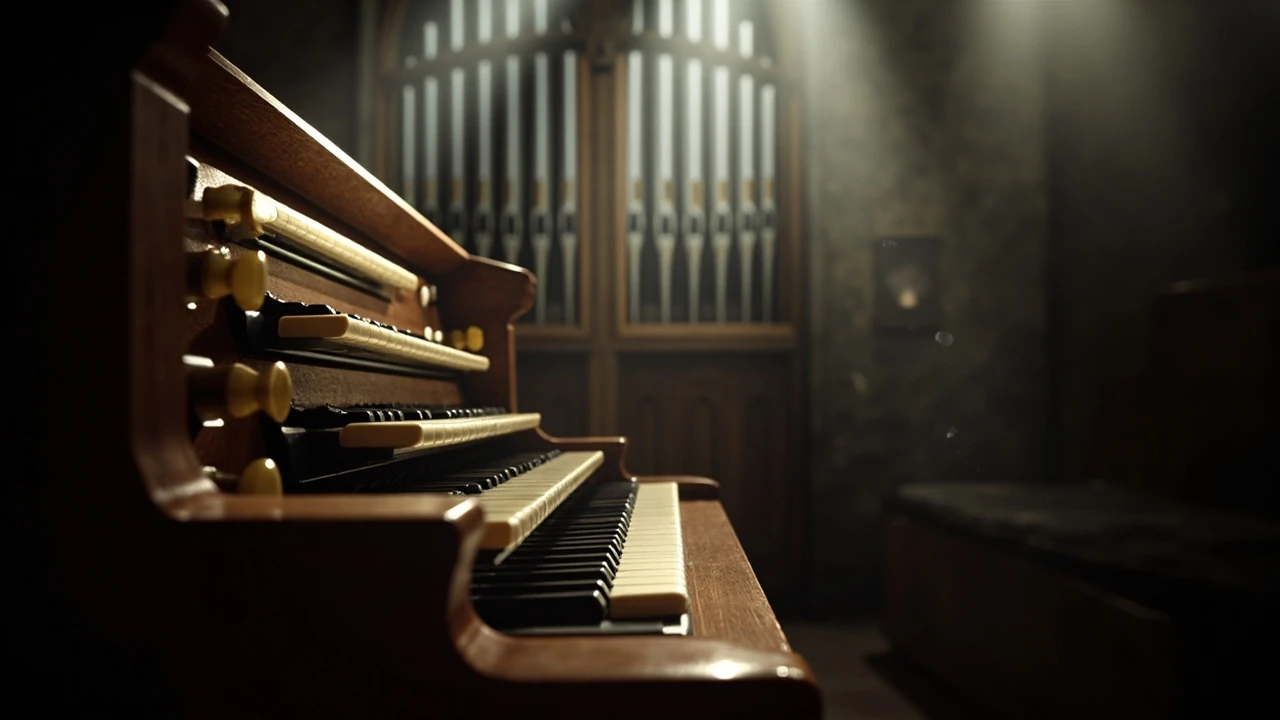
Calming music and what makes a pipe organ feel restful
A 32-foot wooden pipe takes about one full second to speak and another second to decay. That simple physical fact sits behind most of the calming music listeners describe as restful in a pipe organ loft. Slow attack, slow release, and a held tone that does not demand attention are acoustic properties, not taste preferences, and a pipe organ produces them in a way few other instruments can reproduce. The instrument has been used for centuries to mark slow public moments such as prayer, reflection, and the close of a long day, and the same properties are now studied in healthcare, education, and workplace settings where measured sound is part of the environment rather than the focus of it.
This article looks at the acoustic mechanism that produces calming music on a pipe organ, the registration choices that bring that mechanism out, and the room conditions that decide whether a listener actually hears the slow state. It also covers the practical questions a listener, player, or buyer can ask before assuming a recording or a live setting will deliver the same effect on a different day. The pipe organ is not the only source of calming music, but it is one of the few whose physical design was shaped for sustained, low-tempo sound over many minutes, so it is a useful starting point.
The acoustic state behind a restful response
Restful listening has a measurable acoustic profile. Slow tempo, narrow frequency range, low spectral variation over time, and a long reverberation tail all correlate with lower heart rate and reduced skin conductance in published studies of slow music. The pipe organ reaches several of these conditions through the physics of its pipes, not through the player, which is why two organists can produce very different restful effects on the same instrument using different registration choices.
Why slow attack matters
Wind enters a flue pipe through a narrow channel called a flue and strikes a shelf called the upper lip. The pipe takes a measurable time to build up its full tone. Short, narrow pipes speak in a few milliseconds, which is why a Principal chorus can sound bright and articulate. Long, wide wooden pipes speak much more slowly, which is why a Subbass or a Bourdon produces the soft, swelling entrance most listeners associate with calming music. The organist cannot shorten that attack, only the registration can move toward faster or slower speech.
Why long decay matters
When the key is released, the pipe continues to sound until the air column loses energy. A 32-foot pipe can keep moving air for more than a second after the key is released, and the note fades into the room rather than stopping cleanly. This long decay overlaps the next note the player takes, and the overlap is the source of the smooth, connected texture the listener hears as continuous rather than metronomic.
Why a narrow frequency range helps
Restful music rarely fills the full 20 Hz to 20 kHz hearing range. Pipe organs produce their strongest output in the 30 Hz to 4 kHz band, and the deepest stops concentrate energy below 200 Hz. The narrow bandwidth is one reason the same melody on a full orchestra can feel busy while a string registration on the same organ feels restful. The body is not asked to track rapid changes across many frequency bands at once.
Why a steady loudness contour helps
Calming music tends to avoid sudden dynamic jumps. The pipe organ produces a fairly flat dynamic contour because the pipe speaks at a fixed loudness once wind is supplied. The swell pedal can shade the level, but the change is smooth. The player can hold a note for several seconds at one level, which removes the startle effect that sudden loud changes produce.
What a pipe organ does that other calming sources do not
Streaming services, white-noise machines, and ambient recordings all use the same general recipe, but they reach it through different means. A pipe organ reaches the restful state without electronic processing, without a loop point, and without a recorded room. The listener hears live air moving through wood and metal in a real space, and the sound is therefore slightly different every time the room temperature or the humidity changes.
| Source | Slow attack | Long decay | Narrow bandwidth | Live room response |
|---|
The live room column matters because the listener’s perception of restful sound depends on early reflections and reverb time, not only the dry signal. A pipe organ responds to the room in real time, so the same registration feels different in a small chapel and in a cathedral. Electronic sources cannot adjust to the room, which is one reason a well-recorded organ piece can still feel less restful than a moderate live performance in a friendly space.
Registration choices that move a piece toward calm
Registration is the act of choosing which ranks of pipes speak when a key is pressed. The organ builder decides what ranks are available and the organist decides which combination is drawn. The same melody becomes bright, assertive, or restful depending on the stops pulled. A small set of practical rules covers most of the choices that produce calming music on a pipe organ.
- Use flues rather than reeds for the foundation. Flue pipes produce the smooth tone most listeners describe as restful. Reed pipes add a buzz that draws attention, which is useful for accents but not for sustained calm.
- Choose one or two 8-foot stops rather than a full chorus. A single 8-foot rank and a soft 4-foot rank produce a narrower bandwidth than a Principal chorus. The narrow range reads as restful in most rooms.
- Add a 16-foot or 32-foot stop only if the room can carry it. A deep stop adds slow attack and long decay, but it also adds energy below 60 Hz that small rooms cannot dissipate cleanly. In a small room the deep stop can feel heavy rather than calming.
- Avoid mixture stops. Mixtures add several high partials at once, which broadens the bandwidth and removes the narrow-band effect listeners respond to.
- Use the swell pedal in slow, shallow movements. Large or fast swell changes draw attention, while small and slow shading lets the listener settle.
For a listener who is choosing a recording rather than a registration, the same rules translate. A piece performed on a small number of soft flues with a slow tempo and a long reverberation tail will usually read as more restful than the same melody performed on a full chorus at a similar tempo, because the bandwidth and the spectral variation are the dominant variables.
How the room decides what the listener hears
The instrument is only half of the chain. The room sets the reverberation time, the early reflection pattern, and the background noise floor, and a pipe organ will only deliver a restful effect when those three match the registration. A registration that works in a stone cathedral can feel flat and lifeless in a dry practice room, and a registration that works in a small chapel can feel washed out in a large hall.
Reverberation time and the restful range
Reverberation time, usually written as RT60, is the time the sound takes to decay by 60 dB after the source stops. Pipe organ literature usually describes a useful range of about 1.8 to 4.5 seconds for calm repertoire, with shorter times for solo playing and longer times for choral accompaniment. Below 1.5 seconds the long decay of the deep stops is cut off before it can overlap the next note, which removes the connected texture. Above 5 seconds individual notes can blur into the next phrase, which the listener can read as confusion rather than calm.
| Room type | Typical RT60 | Restful registration tendency | Common risk |
|---|---|---|---|
| Dry practice room | 0.4 to 1.0 s | Add 16-foot and 4-foot flues to fill the room | Sound feels too close |
| Small chapel | 1.2 to 2.0 s | 8-foot and 4-foot flues, light swell | Reverb is too short for deep stops |
| Parish church | 2.0 to 3.5 s | Single 8-foot with 4-foot and 16-foot when supported | Mixtures can become harsh |
| Cathedral | 3.5 to 6.0 s | String and soft flue ranks, slow tempo | Notes blur, registration must stay simple |
Background noise floor
The organ’s slow state is only audible if the background noise floor is low. A 40 dB ambient level masks the soft attack of a Bourdon, and the listener hears a steady hum rather than a slow swell. Most church spaces sit between 25 and 35 dB when empty, which is a useful range. A space at 45 dB or higher will struggle to deliver the same restful effect, even with the same instrument, because the soft content is buried.
Early reflections and listener position
Early reflections are the first sound to reach the listener from surfaces near the source. In a pipe organ setting they come from the ceiling, the front wall, and the floor under the organ. A listener seated in the front of the nave hears strong early reflections, which add presence. A listener at the back of the nave hears the reflections arrive later, which adds reverb tail and reduces presence. Both positions can be restful, but they require different registration choices to balance the same effect.
Why the same piece can feel different on different days
Pipe organs are sensitive to weather. The pitch of a pipe depends on the temperature of the air column, and humidity changes the density. A 16-foot pipe in a cold church reads sharper than the same pipe on a warm day, and the slow attack of a wooden pipe changes when the wood swells. A listener who hears the same registration in winter and summer can describe two different musical experiences from the same instrument.
Wind supply is the second variable. A small organ with a single-blower wind supply will deliver slightly steadier pressure in still air, and a large organ with a regulated reservoir will deliver pressure that holds during loud passages. The loudness contour of a phrase depends on this stability, and a soft phrase that swells or dips in pressure will read as a different musical gesture even when the notes are correct.
Choosing between live listening and recorded listening
Live listening and recorded listening deliver different versions of the same calming music, and the choice between them is a practical one rather than a quality judgment. A live performance adds the room response in real time and the slight uncertainty of a human performance, which many listeners find easier to settle into. A recording offers a fixed balance, a fixed reverb, and the ability to repeat a passage at a chosen volume. The decision depends on what the listener needs the sound to do.
- Live listening suits listeners who want the room response and the slow tempo at a moderate level. It also suits listeners who want the visual cue of a performer, which is part of the restful state for some audiences.
- Recorded listening suits listeners who want a fixed sound and a known duration. It also suits listeners who cannot reach a suitable space, or who need the option to pause and resume.
- Headphone listening is a third option. It removes the room response and adds the room response baked into the recording, so the result depends on the recording engineer rather than the listener’s space.
For a listener who has only a recording, the practical question is whether the recording was made in a room with a long enough RT60. A dry recording can still deliver the restful state, but the slow state is produced by the recording engineer’s choice of reverb, not by the instrument, and the effect depends on the engineer’s ear.
How organ builders design for a restful sound
Organ builders plan the restful state into the instrument from the specification stage. The number of stops, the voicing of each rank, the wind pressure, and the case placement are all decisions that affect the slow state. A chamber organ designed for a small chapel will carry a different stop list from a concert organ designed for a city hall, and the difference reflects the room the builder expects.
Wind pressure and the slow state
Lower wind pressure produces slower speech. A tracker organ with 60 mm of water column pressure will speak more slowly than a unit organ with 120 mm of pressure, and the slow speech is part of the restful state. High-pressure chorus instruments can still produce restful registration using a small number of low-pressure stops, but the builder has to plan those stops into the design.
Scale and voicing
Scale is the cross-sectional width of a pipe, and voicing is the act of adjusting the pipe’s mouth, languid, and upper lip to control its tone. A wider scale produces a fuller tone, and a narrower scale produces a more string-like tone. The organ builder’s choice of scale and voicing is what determines whether a string stop is bright or warm, and the warm scale is what the restful registration usually calls for. Voicing is part of the build process, not the registration process, and the result is fixed when the instrument is completed.
More on how voicing shapes tone is described in the guide to pipe voicing on this site, which covers the practical adjustments builders make to control attack and decay.
Case placement and the listener’s seat
The case is the wooden enclosure that holds the pipes, and its position in the room affects what the listener hears. A case placed against a hard wall produces strong early reflections, which can add presence but can also blur the slow attack. A case placed on a raised loft with open space below allows the sound to develop more evenly, which suits restful repertoire. The builder’s choice of case placement is part of the acoustic design and is fixed before the instrument is voiced.
Practical questions to ask before assuming a calming effect
Calming music is a real acoustic state, but it is not automatic. The same instrument in the same room can deliver a restful effect on one occasion and a busy or harsh effect on another, and the listener can ask a small set of practical questions before assuming the result.
- What is the room’s RT60, and does it match the registration? A dry room needs a fuller registration; a long room needs a simpler one.
- How many stops are pulled? More than four or five ranks at once usually broadens the bandwidth and reduces the restful state.
- Are any reeds or mixtures drawn? A single reed in the chorus is enough to remove the calm from many pieces.
- What is the background noise floor? A loud room buries the slow content and replaces it with a hum.
- Is the listener in a seat with strong early reflections, or in a seat where the reverb tail dominates? Both can work, but they suit different registrations.
Asking these questions turns a subjective impression into a small set of measurable variables, and the variables are the same ones organ builders and acousticians use when they design a space for sustained listening.
What the research literature agrees on
Published studies of slow music and restful listening have produced a fairly consistent set of findings, although the studies use different repertoires and different participant groups. Slow tempo, low spectral variation, and a narrow frequency range tend to lower heart rate and reduce skin conductance, while loudness jumps and high-frequency content tend to reverse those effects. The mechanism is not fully understood, but the pattern is stable enough that hospital and clinic music programs use a small set of guidelines rather than a single prescription.
The pipe organ fits these guidelines through physical design rather than through performance practice. The slow speech and long decay of the largest pipes, the narrow bandwidth of string and flute stops, and the flat loudness contour of a held phrase are all present without any electronic processing. That is part of why organ repertoire is often chosen for environments where the listener needs to settle into the sound rather than focus on it.
What the research literature does not yet answer
Several questions remain open. The optimal RT60 for sustained restful listening is not pinned to a single number, and listeners appear to respond to a combination of tempo, bandwidth, and reverb rather than to any one variable in isolation. The role of visual cues, including the presence of a performer, is also still debated. Some studies report a stronger restful response when a listener can see the performer, and others report no difference. The pipe organ is a useful test case because the visual cue is usually present, but the listening response appears to depend on the same acoustic variables regardless of the visual input.
There is also no agreed method for translating a recording made in one room into a listening experience in another room. Headphone listening removes the room, and loudspeaker listening adds a new room. The listener is hearing the recording engineer’s ear as much as the instrument, and the comparison between a recording and a live performance is not a clean one. A practical approach is to choose recordings that match the listening environment rather than to assume a single recording will deliver the same effect everywhere.
How to listen to a pipe organ for the restful effect
Calming music on a pipe organ is a skill on the listener’s side as well as on the performer’s side. A listener who arrives during a long swell, who settles into a seat in the front third of the nave, and who lets the phrases run their full length will hear a different effect from a listener who enters between pieces and sits in the back of the hall. The first listener hears the slow attack, the held tone, and the long decay as a continuous texture. The second listener hears the same notes as discrete events and reads them as busy.
- Arrive a few minutes before the program starts. The room settles into its ambient state, and the listener’s hearing adjusts to the noise floor.
- Choose a seat in the front third of the nave. Early reflections are present, and the long decay of the deep stops is audible without being washed out.
- Listen for the registration at the start of each piece. A piece that begins on a single 8-foot stop is more likely to settle than a piece that begins on a full chorus.
- Let phrases run their full length. A held note is part of the restful effect, and the listener who fills the held note with movement misses the slow state.
- Notice the change between pieces. A registration change is a reset, and the restful state has to be rebuilt at the start of the next piece.
These are listening habits rather than rules, and the same habits apply to recorded listening with adjustments. A listener who is using a recording to settle in can treat each track as a piece, can let the recording’s reverb tail fill the room, and can let the held notes run their full length before moving on.
Choosing a piece for a restful state
Not every organ piece is suited to a restful state. A piece that calls for a full chorus, a long pedal solo, and frequent registration changes is built for a concert program, not for sustained listening. A piece that calls for a single 8-foot stop with a 4-foot and a soft 16-foot, played at a slow tempo, is built for the restful state. The choice of piece is a separate variable from the registration, and the two have to match.
| Repertoire type | Typical registration | Typical tempo | Restful tendency |
|---|---|---|---|
| Chorale prelude on a single line | 8-foot and 4-foot flues | Slow to moderate | Strong |
| Trio sonata, slow movement | Two 8-foot stops, light swell | Slow | Strong |
| Romantic symphony, slow movement | Strings and soft flues | Slow to moderate | Moderate |
| Plenum chorale prelude | Full chorus | Moderate | Weak |
| Reed solo with accompaniment | Reed and full chorus | Moderate | Weak |
For a listener choosing a recording, the registration is part of the recording’s character, and the choice of piece matters as much as the choice of recording engineer. A well-recorded chorale prelude on a small instrument will deliver a stronger restful effect than a poorly recorded slow symphony on a large instrument, because the registration is the dominant variable.
What pipe organ repertoire can teach other sources of calming music
Calming music is not a genre limited to the pipe organ. The instrument is one of the older sources of the restful state, and its repertoire is a useful reference for other sources that want to reach the same effect. The same slow attack, long decay, narrow bandwidth, and flat loudness contour can be approximated on other instruments and in electronic production. The approximation is rarely as physically grounded as a pipe organ, but the same general recipe applies.
- Long, sustained tones rather than short notes. A held note gives the listener time to settle, and a short note demands attention.
- Narrow frequency range. A track that sits in the 100 Hz to 2 kHz range reads as more restful than a track that fills the full hearing band.
- Slow tempo, with phrases that run for several seconds. A tempo below 60 BPM is a useful guideline, although the listener’s response varies.
- Limited dynamic range. A track that holds a steady level reads as more restful than a track with frequent loudness changes.
- Long reverb tail, matched to the tempo. A reverb that is too long blurs the phrases, and a reverb that is too short removes the connected texture.
These guidelines are not the only recipe for calming music, and different listeners respond to different combinations. The pipe organ’s contribution is to show that the restful state is a physical effect that can be reached through instrument design, not just through production choices.
Why the pipe organ has stayed in the restful repertoire
The pipe organ has been used for sustained listening for several centuries, and it is still the instrument of choice for many environments where measured sound is part of the design. Hospitals, chapels, university halls, and civic buildings often have a pipe organ for exactly this reason. Electronic sources can reach the same effect, but the pipe organ reaches it through physical design and without a power supply, which is a useful property for spaces that need to deliver the restful state every day without depending on a recording or a playback system.
The instrument is also adaptable. A pipe organ can deliver a bright, articulate sound for a concert program, and a slow, sustained sound for a restful program, using the same pipes and the same wind supply. The adaptability is part of why the instrument is still specified for new buildings, even in an era of recorded sound. The same specification can serve several different listening states, and the restful state is one of them.
How to start exploring calming organ music
A useful first step is to listen to a single chorale prelude on a small instrument, recorded in a room with a moderate RT60, and to notice the registration at the start. The same chorale on a large instrument in a long room will deliver a different effect, and the comparison is part of the listening skill. A second step is to listen to a slow movement of a trio sonata, which uses a smaller registration and a more conversational texture. A third step is to listen to a piece that uses a 16-foot stop, which adds the slow attack and long decay. The three pieces together give the listener a sense of the range of the restful state on a pipe organ.
For listeners who want to go further, a visit to a local organ loft or a livestreamed recital can add the visual cue and the room response. Many recital programs are now published online, and the registration choices for each piece are sometimes listed. A listener who follows the registration on the printed program can hear the slow state being built and released, which is a different experience from the listener who arrives without a printed program.
For readers who want to understand more about how an organist builds the sound, the guide to organ registration on this site covers the practical combinations that produce the slow state, and a broader reference to how organ stops are named and grouped explains the families of stops that the restful registration usually draws from.
Frequently asked questions
What makes a pipe organ produce calming music?
The slow attack and long decay of the largest pipes, the narrow frequency range of string and flute stops, and the flat loudness contour of a held phrase. These are physical properties of the instrument, not performance choices, and they are the reason pipe organ repertoire is often chosen for sustained listening.
Is calming music the same as ambient music?
No. Ambient music is a genre that uses slow tempo, narrow bandwidth, and long reverb as deliberate production choices. Calming music is a broader description of music that produces a restful state, and the term covers live performances, recordings, and electronic production. A pipe organ can produce both, and the difference is in the production, not the listening effect.
How long does a calming effect last after the music stops?
Published studies report a range of a few minutes for short pieces and up to an hour for sustained listening, depending on the participant, the room, and the prior activity. The restful effect is not a fixed duration, and the listener’s response varies. A useful guideline is to allow at least ten minutes of sustained listening before expecting a measurable change in heart rate or skin conductance.
Can a recording deliver the same effect as a live performance?
It can, but the result depends on the recording engineer and the playback system. A recording made in a room with a long RT60 will deliver a stronger restful effect than a recording made in a dry room, even on the same instrument. Headphone listening removes the room response and adds the engineer’s reverb, so the comparison between live and recorded is not a clean one.
What registration is best for calming music on a pipe organ?
A single 8-foot flue stop with a soft 4-foot and a 16-foot when the room can carry it. Mixtures and reeds are best left out. The narrow bandwidth and the slow attack are the dominant variables, and the registration should be kept simple.
Does the room matter more than the instrument?
Often yes. A small instrument in a well-shaped room can deliver a stronger restful effect than a large instrument in a dry room, because the room sets the reverb time and the early reflections. The instrument produces the source signal, and the room decides how the listener hears it.
Can calming music be used in healthcare settings?
Yes, and several published studies report reduced anxiety and lower heart rate in patients who listen to slow music during procedures. The pipe organ is one of several sources, and the choice depends on the patient’s preference, the room, and the duration. A practical guideline is to use music that the patient has heard before, rather than music chosen by the clinician, because familiarity is part of the restful state.
Is there a tempo that always works?
No. Published studies suggest that tempos below 60 BPM tend to be more restful than tempos above 80 BPM, but the listener’s response varies, and the restful effect depends on tempo, bandwidth, and reverb together rather than on tempo alone. A useful approach is to choose a piece that combines slow tempo with narrow bandwidth and a long reverb tail.
What is the difference between calming music and sleep music?
Calming music is designed for a restful state during waking hours. Sleep music is designed to support the transition to sleep, and it tends to have a lower dynamic range, a longer reverb tail, and fewer melodic events. A pipe organ can deliver both, but the registration and the tempo are different.
Do I need a pipe organ in my home to listen to calming music?
No. Recordings, streaming services, and live recitals are widely available, and the same general recipe applies. A useful first step is to choose a recording made in a room with a moderate RT60, performed on a small instrument, and to listen at a moderate volume through speakers rather than headphones. The room the listener is in will add its own reverb, and the combined effect is often more restful than either the recording or the room alone.