The largest pipe organ in the world by its official pipe count is the Midmer-Losh Auditorium Organ at Jim Whelan Boardwalk Hall in Atlantic City, New Jersey. Its published total is 33,112 pipes. Philadelphia’s Wanamaker Organ enters the same conversation for a different reason: its 464 ranks exceed the Midmer-Losh’s 449, even though its total of 28,750 pipes is lower.
Those figures describe two extraordinary instruments, built for different spaces and maintained through continuing restoration work. Understanding the distinction makes the comparison more interesting than a simple first-and-second ranking. It also prevents a record for installed pipework from being mistaken for a promise that every part is available to hear on a particular day.
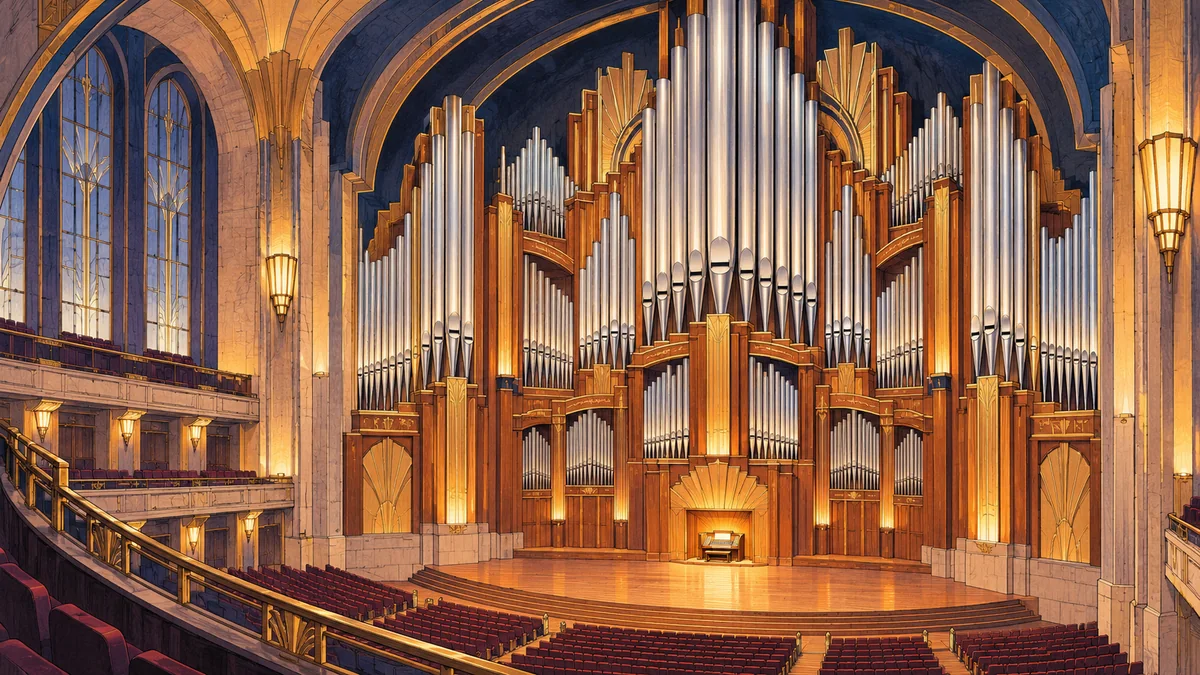
What counts as the largest pipe organ?
The answer changes with the measurement. A pipe count totals individual pipes. A rank count describes sets of related pipes. Manuals are the keyboards played by the hands, while stop controls allow the performer to select resources. These quantities are connected, but none is a direct substitute for another.
The Historic Organ Restoration Committee addresses the Atlantic City–Philadelphia comparison in its official questions and answers. It explains that the Wanamaker has more ranks, while the Midmer-Losh has more pipes. A rank can extend over a different range of notes, so two ranks need not contain the same number of pipes. Multiplying every rank by one assumed keyboard length will not reliably reproduce an organ’s total.
| Measurement | What it describes | What it does not establish |
|---|---|---|
| Pipe count | The number of individual pipes | How many are currently playable |
| Rank count | Sets of related pipework | A fixed number of pipes in each set |
| Manual count | Keyboards operated by the hands | The complete tonal resources |
| Stop-control count | Controls available at a console | The number of independent ranks |
| Operational condition | What is working at a given time | Whether a public performance is scheduled |
Other comparisons involve weight, dimensions or unusually powerful individual voices. Each needs its own definition and evidence. A room-filling instrument can contain delicate solo colors, and an enormous console does not imply that the player uses every resource together. The most useful first question is which property a particular record is measuring.
The Midmer-Losh at Boardwalk Hall
The Atlantic City instrument was designed for the Main Auditorium of the building formerly known as Convention Hall. The restoration committee’s history of the Midmer-Losh identifies the builder as Midmer-Losh of Merrick, New York, and dates construction from May 1929 to December 1932. Its design was developed by Emerson L. Richards.
The instrument’s main console has seven manuals. Its pipework occupies eight chambers arranged around the auditorium. That layout is a reminder that a giant organ is a building-scale installation: the visible console is a control point for equipment spread through substantial architectural spaces. A photograph of the keyboards cannot show the entire instrument.
Guinness World Records lists the Auditorium Organ with 33,112 pipes and describes it as only partially functional. Its entry uses 1930 as the completion year, whereas the restoration committee gives the longer construction period ending in 1932. The agreed pipe-count figure is the useful basis for this comparison; the historical dates should retain their source context.
Even the word “console” needs care in descriptions of an instrument this large. A main console, a secondary control position and a complete installation are different things. Likewise, a count of console controls can include items that perform functions other than selecting an independent pipe rank. A spectacular number on its own tells less than the specification beside it.
Why a huge auditorium needed a distributed instrument
Boardwalk Hall is a multipurpose auditorium rather than a small room with an organ case at one end. Locating pipework in several chambers gives the instrument a physical relationship with the hall. The sound that reaches an audience depends on those locations, the room and the resources selected by the performer.
The venue’s description of the restoration project notes that the organs are not necessarily visually obvious to visitors because they are enclosed within the building. That helps explain a common surprise: an audience can hear a very large acoustic instrument without seeing a corresponding wall of exposed pipes directly in front of it.
Scale also creates opportunities for contrast. A player can combine colors or use a particular division to give a passage a distinct character. The musical interest lies in how these resources are organized over time. Hearing a restrained solo against an accompaniment can reveal as much about a large organ as hearing its fuller combinations.
When watching a performance, follow the player’s changes of keyboard and registration. A move at the console may bring a different group of pipes into the musical foreground. It is helpful to listen for which line has become prominent, whether the bass has changed and how the new color sits in the room. Those observations connect the instrument’s size to its actual musical use.
The Wanamaker Organ’s different claim to scale
The Wanamaker Organ stands in the Grand Court of the John Wanamaker Building in Philadelphia. According to the Friends of the Wanamaker Organ’s history and specification, it originated at the 1904 St. Louis World’s Fair and was first heard in the Philadelphia store in 1911. It was enlarged substantially after that move.
The Friends list 28,750 pipes and 464 ranks, controlled from a six-manual console. The pipe total is smaller than Atlantic City’s, but the rank total is larger. That combination is entirely possible because a rank count measures sets of pipework, not a uniform package containing a standard number of pipes.
The Grand Court setting gives the instrument a different cultural history from a civic auditorium organ. It became associated with music heard within a great retail building and with performances that drew dedicated audiences into that setting. Its history shows how an organ can become part of a city’s public identity beyond a conventional concert-hall program.
The phrase “largest fully functioning organ” has long been associated with the Wanamaker. It is important to separate that description from the current public-access situation. An instrument’s condition, a building’s redevelopment and a concert calendar are related practical matters, but they are not the same measurement. A historical superlative should not be used as an up-to-date visitor timetable.
Boardwalk Hall and Wanamaker side by side
The core figures make the difference clear without forcing both instruments into one undifferentiated ranking. These are the published specification totals used by their custodians; they should not be read as a count of pipes guaranteed to sound in a particular performance.
| Feature | Midmer-Losh Auditorium Organ | Wanamaker Grand Court Organ |
|---|---|---|
| City | Atlantic City, New Jersey | Philadelphia, Pennsylvania |
| Building | Jim Whelan Boardwalk Hall | John Wanamaker Building |
| Published pipe count | 33,112 | 28,750 |
| Published rank count | 449 | 464 |
| Main-console manuals | Seven | Six |
| Point to remember | Higher total pipe count | Higher total rank count |
Pipe counts and rank counts are especially easy to confuse in a short caption. A photograph might mention the number of ranks while an accompanying headline uses “largest” without qualification. Once the measurement is supplied, the apparent contradiction disappears. Both instruments can lead a discussion of size while illustrating different aspects of it.
This also changes how one reads a specification for a smaller organ. More pipework does not automatically mean a better instrument for every room or repertoire. A coherent design, appropriate resources and the building’s acoustics matter to a listener. The two American giants are fascinating achievements, rather than templates that every local organ ought to imitate.
Playable, restored and maintained mean different things
An installed pipe count is relatively straightforward to quote. The working condition of a large historic instrument requires more explanation. The restoration committee distinguishes pipework that can be played from components that have been removed, comprehensively restored and returned to service. A temporary repair and a complete rebuilding of a mechanism are not equivalent milestones.
That distinction makes a single restoration percentage difficult to use without its date and definition. An update may describe a whole instrument, one chamber or one phase of work. Repeating it years later as a present-day figure can mislead readers. For that reason, this comparison uses the published overall specifications and leaves changing progress figures to the custodians’ updates.
The Wanamaker restoration overview describes work section by section, including pipe cleaning, windchests and action mechanisms. It explains the practical value of completing a coherent section rather than repeatedly making isolated repairs in remote parts of the instrument. The scale of the installation makes access and the order of work significant parts of the project.
For listeners, the result is an instrument with a continuing maintenance history. Historic pipework, control equipment and the surrounding building all need care. A recital can demonstrate remarkable resources while other work continues elsewhere. Understanding that process allows an audience to appreciate both the performance and the skilled work that keeps it possible.
Can you hear or visit the world’s largest organs?
For Atlantic City, start with the Historic Organ Restoration Committee’s calendar and the particular event description. A concert, an organ demonstration and a behind-the-scenes tour offer different experiences. Access to chambers or a console should be treated as an organized activity, with the permissions and arrangements specified by the custodian.
The committee’s FAQ also explains that use of the organs depends on the hall’s schedule. A listing on an organ website is not a complete schedule of every activity in the building. Before travelling, confirm the event date, the relevant organ and what the advertised visit actually includes. This matters particularly in a busy multipurpose venue.
For Philadelphia, there is a specific current qualification. On 9 November 2026, the Friends’ concert information page carries a notice that concerts are suspended during renovation of the retail portion of the Wanamaker Building. It tells readers to disregard older concert information retained on the page and to consult the homepage for developments. Do not plan a trip around the historic twice-daily recital pattern without a new confirmation.
Recordings provide another way into the instruments. The committee publishes a Midmer-Losh recordings page, while the Friends offer Wanamaker music samples. These resources allow a first comparison of musical colors before any travel plans are made. A recording remains a particular performance captured from a particular microphone position, rather than a complete survey of every sound the organ possesses.
What to listen for beyond the headline numbers
Begin with a piece that has clear changes of color. Listen for the melody, the supporting harmony and the bass as separate parts. Notice whether a change brings a new tonal character or simply adds another layer. A giant organ’s quieter combinations can make the structure of a performance easier to hear than a continuously full registration.
Then listen to the room. A sustained chord, a short pause and the start of the next phrase reveal how sound lingers. A close recording can emphasize detail, while a more distant recording captures more of the building. Apparent loudness on a phone or laptop is not a reliable measurement of the acoustic power of an organ in its hall.
The terms in a specification become more useful once they are connected to those sounds. Ranks describe resources, manuals help organize the player’s access to them and registration selects combinations for the music. Our guide to reed stops introduces one important family of colors; the same listening approach can be applied to flutes, principals and strings.
Finally, compare musical passages rather than relying on a single dramatic chord. Different instruments, rooms and performers create different results. A pipe-count record answers a factual question about scale. Hearing how an organ supports a melody, changes texture and shapes a whole piece answers the more interesting musical question of what its resources can do.
Frequently asked questions about the largest pipe organ
Which pipe organ has the most pipes?
The Midmer-Losh Auditorium Organ at Boardwalk Hall in Atlantic City has the higher official total in this comparison: 33,112 pipes. Its specification and restoration status are documented by the Historic Organ Restoration Committee.
Why do people also call the Wanamaker Organ the largest?
The Wanamaker has more ranks: 464 compared with the Midmer-Losh’s 449. It has also long been associated with the description “largest fully functioning organ.” The measurement and the practical condition need to be stated alongside the claim.
How many keyboards does the Boardwalk Hall organ have?
Its main console has seven manuals. A manual is a keyboard played with the hands; the pedalboard is a separate control. The main-console layout does not describe the entire installation by itself.
Do more ranks always mean more pipes?
No. Ranks can cover different ranges and contain different totals of pipes. That is how the Wanamaker can have the larger rank count while the Midmer-Losh has the larger pipe count.
Is every pipe in the Midmer-Losh currently working?
The instrument is undergoing restoration and should not be described as wholly operational. Its custodians distinguish playable resources from fully restored components. Consult their updates for changing details rather than treating the installed total as a performance guarantee.
Are the Wanamaker’s historic daily recitals still a safe travel plan?
Not without confirmation. The Friends’ concert page carried a renovation-related suspension notice when checked on 9 November 2026. Older daily-recital descriptions remain online for historical purposes.
Does “largest” mean every stop is always played loudly?
No. The organist chooses registrations for the music, including quieter solo and accompaniment combinations. A specification describes available resources; it does not prescribe a constant level of volume.
Where should a first-time listener begin?
Start with the custodians’ recordings and music samples, then choose a confirmed demonstration or concert if available. Listen for changes of tonal color, the balance of musical lines and the response of the room.