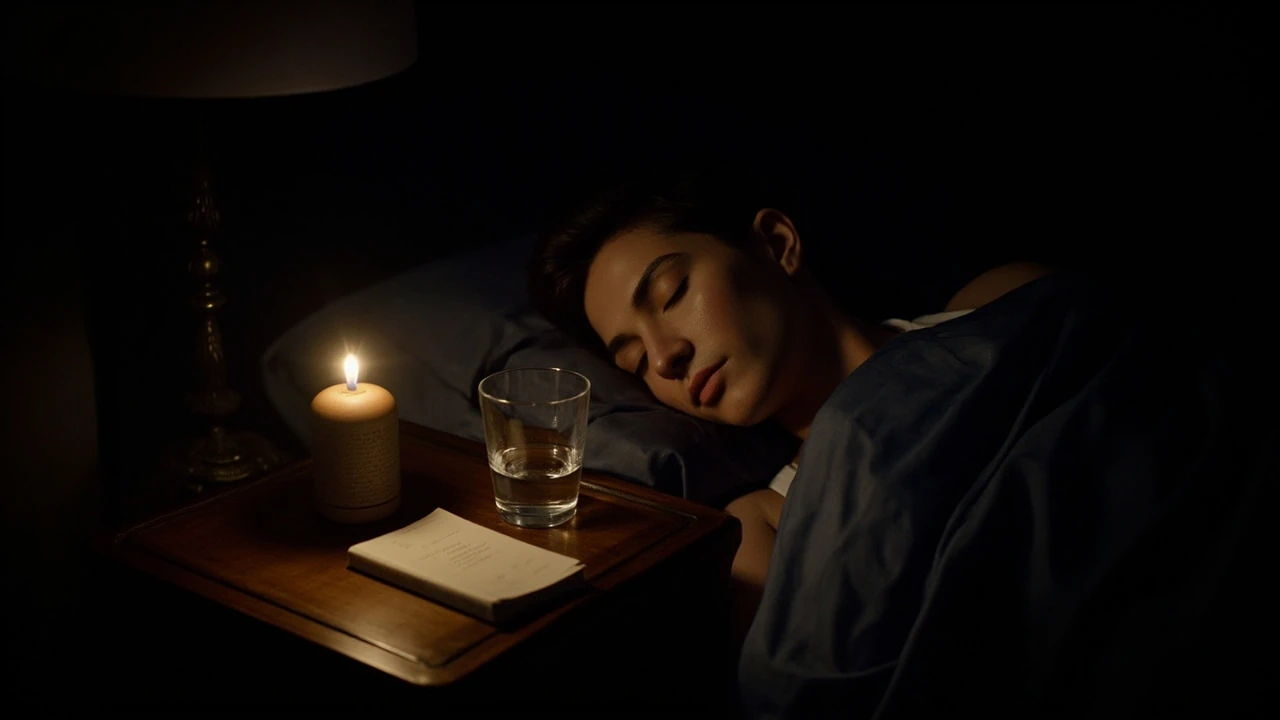
Sleep music explained: how sound helps the body rest
A person lies in bed at 1:14 a.m., phone brightness on its lowest setting, headphones in, waiting for the slow, steady pulse in their ears to do the work their thoughts refuse to do. The track is a simple piano loop, a flat dynamic shape, and almost no melodic surprise. Within roughly fifteen minutes, breathing has slowed and the room feels smaller. This is the everyday experience that drives the search for sleep music: a tool that lowers the body’s alert state so sleep can begin.
Sleep music is a broad label that covers slow instrumental music, ambient textures, binaural-style recordings, nature soundscapes, and gentle rhythmic pulses designed for bedtime or rest. It is used by shift workers, students, parents, people with tinnitus, and listeners who simply want a calmer transition from wake to sleep. The article below explains what sleep music actually does, where its benefits come from, where the limits are, and how to build a reliable routine around it.
What sleep music is and what it is not
Sleep music is a category of recorded sound built around three practical goals: reduce mental chatter, soften the acoustic environment, and cue the nervous system toward rest. In practice, the term covers several distinct formats that are often mixed together in playlists and apps.
- Slow instrumental music: piano, guitar, strings, or pads at a tempo of roughly 50 to 70 beats per minute, with simple harmonic motion and limited dynamic change.
- Ambient and drone music: long, slowly evolving textures, often without a clear beat, designed to fade into the background of a room.
- Nature soundscapes: recordings of rain, waves, wind, or forest layers, sometimes mixed with soft instrumentation.
- Binaural and isochronic recordings: tracks that present two slightly different frequencies in each ear, marketed for entrainment effects.
- Guided relaxation and spoken tracks: voice-led material that combines breathing cues, body scans, or short stories with a quiet musical bed.
What sleep music is not, in the strict sense, is a medical treatment. It is a sleep hygiene tool, a structured use of sound, that supports a routine rather than replacing care for conditions such as insomnia disorder, sleep apnea, or chronic anxiety. Treating it as a clinical intervention can lead to disappointment and may delay a useful conversation with a clinician.
How sleep music affects the body
The effects of sleep music operate through three main pathways: the masking of disruptive sounds, the entrainment of physiological rhythms, and the conditioning of a bedtime routine. Each pathway has a different strength and a different limit.
Masking the room
A quiet bedroom is rarely as quiet as it seems. Neighbors close doors, refrigerators cycle, dogs bark, traffic passes, and a partner shifts in bed. Each of these small sounds can briefly raise alertness because the brain is tuned to detect change. Sleep music raises the floor of the room’s sound level, so small disruptions no longer stand out as events. The result is fewer micro-arousals and a more stable sleep environment, especially in apartments and shared rooms.
Masking is the most reliable and least controversial effect of sleep music. It does not require any specific genre, tempo, or instrument. A consistent low-level sound that the listener finds non-irritating will usually work.
Entrainment of breath and heart rate
When a piece of music has a clear pulse, the body tends to align with it. A track at 60 beats per minute gives the brain a steady reference, and over several minutes breathing and heart rate can drift in the same direction. Slow tempos in the 50 to 70 BPM range are popular for sleep music because they sit close to a relaxed adult heart rate and a slow breathing cadence.
This effect is real but modest. It is most useful in the first twenty minutes of trying to fall asleep, when the body’s alert signals are still active. Once sleep begins, the conscious response to rhythm fades, and the track’s role shifts back to masking.
Conditioning a routine
When the same track or playlist is played at the same point in a bedtime routine, the brain begins to associate that sound with sleep. Over days and weeks, the opening bars of a familiar piece can act as a cue that the day is ending. This is the same learning process that makes a bathroom routine signal morning and a kitchen routine signal work. Sleep music becomes a contextual signal, not just a sound.
Conditioning explains why some listeners return to a specific track for years, even when newer or “better” recordings are available. The value is in the association, not the audio quality.
What a useful sleep music track has in common
Across genres and formats, tracks that reliably support sleep share a small set of audio characteristics. They are not mysterious, and they can be evaluated by ear with a little practice.
| Characteristic | Why it matters | What to listen for |
|---|---|---|
| Tempo of 50 to 70 BPM | Sits close to a relaxed heart rate | A pulse that feels like slow walking |
| Limited dynamic range | Avoids sudden loud peaks that startle | No sudden volume jumps or swells |
| Simple, predictable harmony | Reduces the brain’s prediction load | Few chord changes, long held notes |
| Soft mid-range and high-end | Less perceptually tiring over time | No bright cymbals, sharp transients |
| Absence of lyrics | Reduces language processing | Instrumental or vocal-free textures |
| Long, non-repetitive structure | Avoids alerting on loop points | Evolving pads, slow-moving layers |
None of these characteristics is a rule. Listeners vary, and some people fall asleep to jazz or to soft vocal music. The table describes the center of gravity of what works for most people, most of the time, and provides a checklist for evaluating new tracks.
Choosing a format that fits the situation
Different formats of sleep music are suited to different parts of the night and different sleeping arrangements. Choosing by situation is more useful than choosing by genre label.
| Situation | Better format | Why | Watch out for |
|---|---|---|---|
| Noisy apartment or shared wall | Nature soundscapes or pink noise | Broad masking of variable sounds | Tracks that include animal calls or thunder |
| Light sleeper, partner snores | Ambient drone or slow instrumental | Even masking without rhythmic draw | Loops that are too short and repeat audibly |
| Anxious or racing thoughts | Guided relaxation with a music bed | Attention is given a task to follow | Voice styles that feel too energetic |
| Waking at 3 a.m. | Familiar personal track or short loop | Conditioned cue triggers return to sleep | Anything new that demands attention |
| Shift worker sleeping in daytime | Blackout plus low ambient sound | Reduces contrast between day and sleep | Sunlight leaking past curtains |
| Tinnitus at night | Broad-spectrum sound at low level | Reduces the contrast of tinnitus tones | Very narrow-frequency tones that compete |
The table is a starting point, not a prescription. Personal preference is strong in this area, and a track that fails one night can work the next, because body state changes the response to sound. Recording several “go-to” tracks for different states is a practical hedge.
Setting up a reliable sleep music routine
A sleep music routine is a small set of repeatable steps that move the body and the room from wake to rest. The exact steps matter less than the fact that they are consistent.
- Pick a wind-down window of 30 to 60 minutes. Lower room lighting, close screens, and stop problem-solving conversations.
- Start the same track or playlist at the same point in the routine. The track is the cue that the body is about to sleep.
- Keep volume low. A good level is just below conversational speech, around 35 to 45 dB at the ear.
- Use a timer or a long track. A 30 to 60 minute timer covers the fall-asleep window without running all night, which can shape dreams for sensitive listeners.
- Repeat the same setup for at least two weeks. Conditioning takes time, and the effect often becomes noticeable only after a stretch of consistent use.
Sleep music routines work best when they are simple enough to follow on a bad day. A long list of conditions is harder to maintain than a short one, and consistency is the active ingredient.
The limits of sleep music
Sleep music is a useful tool, but it has real limits. Setting expectations honestly is part of using it well.
- It does not treat insomnia disorder. Cognitive behavioral therapy for insomnia and clinical care remain the evidence-based responses for chronic sleep problems.
- It does not replace a dark, cool room. Light and temperature have a larger effect on sleep architecture than any audio choice.
- It cannot fix a caffeine or alcohol pattern. Both substances change sleep structure in ways that no playlist can offset.
- It is not neutral for everyone. Some listeners find any music alerting, and for them, plain white or pink noise may work better.
- Smartphone speakers and earbuds vary. A buzzing earbud or a tinny phone speaker can undo the benefits of a good track.
Where sleep music helps most is at the boundary between wake and sleep, and during brief night wakings. Its role inside deep sleep is mostly protective, by keeping the room stable.
How to evaluate a new track quickly
With thousands of sleep music options available, a fast way to test a new track is useful. The checklist below takes about three minutes and predicts most failures.
- Listen at low volume for one minute. Any sound that is perceptually “sharp” or “bright” will become annoying over an hour.
- Wait for a dynamic peak. If a track has a sudden loud section, it is a poor sleep music candidate.
- Notice the loop point. Short loops that repeat audibly can train the brain to wake at the loop.
- Check for vocals. Any spoken or sung words will engage language processing, even at low volume.
- Run it for ten minutes with eyes closed. The body’s reaction over ten minutes is a better test than the first impression.
Five checks are enough. If a track fails any of them, it is worth moving on rather than forcing it into a routine.
Where pipe organ music fits in
Pipe organ music is a small but interesting corner of the sleep music world. The instrument is well suited to long, slow-moving pieces with limited dynamic change, and the acoustic of a resonant room adds a natural reverb that softens the sound. Sustained pedal notes and gentle voice changes produce the kind of slow harmonic motion that many listeners find restful. For readers who already follow pipe organ topics, an organ playlist at low volume can be a useful alternative to standard ambient tracks.
For broader context on how organ sound is shaped, the article on organ registration explains how builders and players control the families of pipes that produce these textures. The piece on organ stops explained covers the ranks and voices that give an organ its range of soft and sustained sounds. These two pages are useful orientation for readers who want to understand why organ music can sound so different from synthesized versions of the same pieces.
Building a small library of go-to tracks
A personal sleep music library is more useful than a long subscription queue. Keeping the list short and familiar is part of the conditioning effect.
- One slow instrumental track for normal nights, around 8 to 12 minutes long, with a clear but soft pulse.
- One ambient or drone track for nights with high ambient noise, around 20 to 30 minutes long, with no clear beat.
- One nature soundscape for travel, hotels, and apartments, around 60 minutes long, with no animal or weather peaks.
- One familiar piece with personal meaning, used as a return-to-sleep cue after a 3 a.m. waking.
Four tracks are enough for most listeners. A larger library tends to dilute the conditioning effect, because the brain stops associating any one sound with sleep.
Practical notes on playback hardware
The hardware that delivers sleep music matters as much as the track. A poor playback chain can ruin a good recording.
- Small dedicated speaker: A simple bedside speaker on low volume produces a room-filling sound without ear fatigue.
- Comfortable headphones: Soft sleep headbands with thin drivers are good for side sleepers, but any pressure on the ear becomes noticeable over an hour.
- No phone in the bed: A phone screen lighting up at 2 a.m. is more alerting than the loudest track.
- Stable streaming or local files: A buffering pause or a dropped connection at the wrong moment can wake a light sleeper.
- Simple timer: A 30 to 60 minute sleep timer is usually enough. Running music all night can change dream content for sensitive listeners.
For most sleepers, a single small speaker on a nightstand is the simplest reliable option. Headphones are useful when a partner is present, but the comfort trade-off is real.
What the research generally supports
Research on music for sleep is small in scale but consistent in direction. Studies in older adults, adults with insomnia symptoms, and ICU patients have found that slow, quiet music is associated with shorter self-reported sleep onset latency and better self-reported sleep quality. The strongest effects appear in the subjective measures rather than in objective sleep architecture measured by polysomnography, which is a useful reminder that perceived sleep quality and measured sleep stages are not the same thing.
For listeners, the practical reading is that sleep music is a low-cost, low-risk addition to a sleep routine, with benefits that are real but modest. It is best understood as a support to good sleep hygiene, not as a substitute for it.
A short checklist for tonight
- Pick a track that passes the five checks above.
- Set a 30 to 60 minute sleep timer.
- Keep the volume just below conversational level.
- Run the same setup for the next two weeks.
- Adjust the choice of track if the routine stops working.
Sleep music is at its best when it is boring, predictable, and quietly present. The aim is to step out of the way of the body’s own sleep mechanisms, not to entertain the listener awake. Used that way, a simple playlist can become one of the more reliable tools in a personal sleep routine.
Frequently asked questions
What tempo is best for sleep music?
Slower tempos in the range of roughly 50 to 70 beats per minute tend to work well, because they sit close to a relaxed heart rate. The exact tempo matters less than the absence of sudden changes in speed or volume.
Is sleep music the same as white noise?
No. White noise is a steady signal that contains all audible frequencies at equal level, designed to mask other sounds. Sleep music is structured sound with melody, harmony, or texture, designed both to mask and to provide a calming signal. Some listeners prefer one, some the other, and some use both at different times.
Can sleep music help with insomnia?
Sleep music can help with mild sleep difficulties and with falling asleep faster for some listeners. For chronic insomnia, it is best used as a support to evidence-based treatments such as cognitive behavioral therapy for insomnia, rather than as a stand-alone solution.
How loud should sleep music be?
A useful reference is just below conversational speech, around 35 to 45 dB at the ear. The track should be clearly audible but not so loud that it requires effort to listen. If a partner can hear it clearly from across the room, it is too loud for comfortable long-term use.
Should sleep music run all night or on a timer?
A timer of 30 to 60 minutes is usually enough to cover the fall-asleep window, and many listeners find that the absence of sound later in the night improves sleep depth. Sensitive listeners also report that music running all night can shape dream content, which is another reason to use a timer.
Is it okay to use the same track every night?
Yes. Repeating a small set of tracks strengthens the conditioning effect, where the brain associates that sound with sleep. Variety is less useful than consistency for most listeners, and a small library of three or four tracks is plenty.
Can sleep music help with tinnitus at night?
Broad-spectrum low-level sound, including soft nature recordings or pink noise, can reduce the contrast of tinnitus tones and make them less noticeable. Narrow, simple tones are less helpful because they can compete with the tinnitus signal rather than mask it.
Are binaural beats useful for sleep?
The evidence for binaural beats is weaker than for slow instrumental music. Some listeners report a calming effect, but the differences between individuals are large. Slow instrumental music or nature soundscapes are a more reliable starting point for most people.
What if sleep music keeps me awake instead?
Some listeners are more sound-sensitive than others, and any new stimulus can be alerting. Switching to plain pink noise, lowering the volume, or removing the music entirely is a reasonable response. The goal is a quieter nervous system, and silence is sometimes the best way to reach it.
How long before bed should I start sleep music?
Starting the music as part of a 30 to 60 minute wind-down routine is a practical approach. The sound becomes a cue that the day is ending, and by the time the listener is in bed, the body is already moving toward sleep.