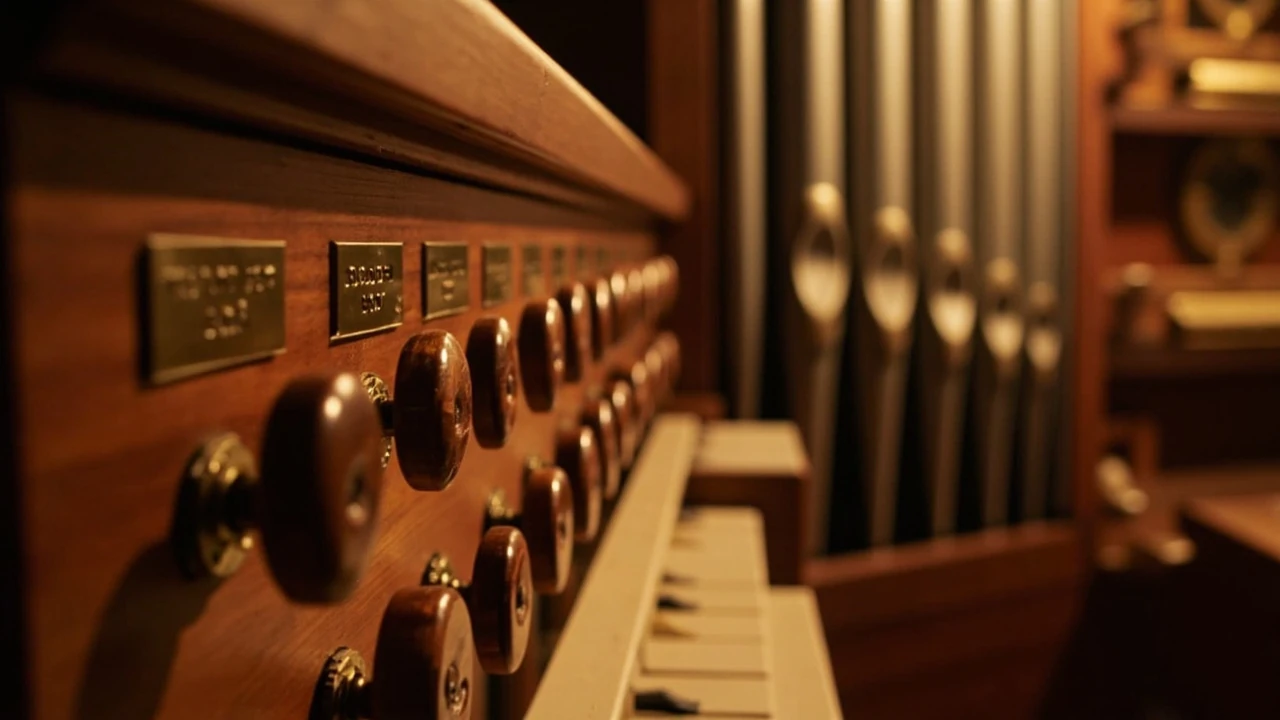
The bass instrument on a pipe organ
When an organist pulls a single stop labelled Subbass, Bombarde, or Violone, the listener often hears one clear line sitting at the bottom of the texture. That line is the work of the bass instrument, the lowest functional voice in a pipe organ’s design. Understanding what the bass instrument does, how it is voiced, and how it differs from a generic 16-foot chorus helps an organist, a student, or a curious listener hear the instrument with more precision rather than as an indistinct rumble under the pedals.
This article is written for readers of the Martin Ott Pipe Organ site, so it focuses on the classical pipe organ rather than electronic organs or synthesizers. The term bass instrument here is used in the sense that European organ builders and registration teachers have used for centuries: not a brand name, but a functional role for stops, pipes, and pedal divisions that carry the lowest musical line.
What a pipe organ bass instrument actually is
In a pipe organ, the word instrument is often used in two ways. A casual visitor may speak of “the organ” as one instrument. A builder or a registration teacher, however, treats each division and each stop as a smaller instrument with its own character, scale, and purpose. The bass instrument is the latter: a working role for the pipes and stops responsible for the lowest pitches, usually in the pedal division but sometimes borrowed into the manuals when a short passage needs extra foundation.
Three features define the role:
- Pitch range. The bass instrument covers the lowest octave or two of the keyboard, typically 16-foot and 32-foot pitches in the pedal and 16-foot pitches in the manuals.
- Function. It supports harmonic structure, anchors solo lines, and doubles the lowest manual voice when registration calls for weight.
- Voicing character. Bass pipes are built for clarity at low frequency. They are wider in scale, longer in length, and tuned with more attention to upper partials than the same pitches would receive in a chorus mixture.
The bass instrument is not automatically the loudest stop. A well-designed 16-foot Violone can speak softly yet still define the bass line, while a 32-foot resultant may sit quietly under a slow hymn without drawing attention to itself.
How the bass instrument differs from chorus basses
A common source of confusion is the difference between the bass instrument and the lowest voices of a Principal chorus. Both sound at 16-foot pitch in many organs, yet they are designed for different jobs. The table below summarizes the main contrasts in a way that an organist can use during registration planning.
| Feature | Bass instrument (e.g. Subbass, Violone, Bourdon) | Chorus bass (e.g. Principal 16′, Octavebass) |
|---|---|---|
| Primary role | Foundational, often solo or with one partner | Top of a Principal chorus, blended with mixtures |
| Voicing aim | Clear pitch, defined attack, individual line | Blend with upperwork, supply the fundamental |
| Typical pipe material | Wood, stopped metal, or large-scaled open metal | Open metal, often polished and high-cut |
| Common pitch | 32′, 16′, sometimes 21′ or 10⅔’ | 16′ (and 8′ in the bass octave extension) |
| Registration pairing | Solo melody, cantus firmus, pedal solo | Full chorus, fugal writing, hockets |
The distinction matters because choosing the wrong stop at the wrong moment can blur a solo line or thicken a chorus unnecessarily. An organist preparing a Bach trio sonata, for example, will treat the 16-foot Violone as a bass instrument and leave the 16-foot Principal silent; in a Bach Prelude and Fugue in a major key, the same 16-foot Principal will be the bass of a full chorus, not a solo foundation.
The main families of bass stops
Although there are dozens of historical stop names, almost every bass stop belongs to one of four working families. The family tells you how the pipe is built and, more importantly, how it will behave once wind enters it.
Stopped wooden and stopped metal basses
Stopped pipes produce a pitch an octave lower than their physical length would suggest. A stopped wooden pipe of, say, 8 feet sounds 16-foot pitch. This is the principle behind the Bourdon and the Subbass families. Stopped pipes are economical on space, which is why a small organ can still offer a full 16-foot bass without filling the lower chambers with long open pipes.
The trade-off is tone color. Stopped metal pipes can sound a little covered or hooty, and very small stopped wooden pipes lose definition. Builders respond by scaling the pipes generously, by voicing the mouths carefully, and by tuning the upper partials with the same care they give to the fundamental. A good stopped bass is full but articulate; a poor one simply growls.
Open wooden basses
The Violone and the open wooden Subbass are usually built of large, open pine or oak pipes. Because they are open at the top, they speak the pitch their length implies. A 16-foot open wooden pipe is, quite literally, about 16 feet long in a 16-foot sounding rank. The advantage is a clean, singing tone with strong upper partials. The disadvantage is the physical room required and the cost of seasoning wood of that size.
Open wooden basses are particularly valued in French Romantic and Germanic Baroque organs, where the pedal line is expected to carry solo counterpoint rather than just supply a foundation.
Open metal basses
Large-scaled open metal pipes produce the characteristic Violone or Principal 16′ sound. They are often the loudest stops in the pedal when the chorus is built up, and they are also the bass of a full Principal chorus. Builders such as Aristide Cavaillé-Coll and his followers were masters of the large-scaled metal bass, designing ranks that could both anchor a plenum and sing a solo.
Resultant and acoustic basses
On smaller organs, builders often offer 32-foot pitch through a resultant stop. A resultant does not contain 32-foot pipes; it borrows a 16-foot and a 10⅔’ rank, and the lowest notes appear when the two ranks sound together and the ear perceives the difference tone. Resultants are a pragmatic solution, and on a well-built organ they can be surprisingly effective. They are a true bass instrument, even though they are not a true 32-foot rank.
How the bass instrument is voiced
Voicing is the craft of adjusting each pipe so that it speaks cleanly, in tune, and with the tone the designer intended. For bass pipes, voicing is more demanding than for upperwork, because any small flaw is amplified by the long wavelength of low sound.
- Scale choice. The builder selects the diameter of the pipe relative to its length. Wider scales give a rounder, more fundamental tone; narrower scales give a more pungent, more articulate tone. The bass instrument scale is usually wider than the corresponding treble scale to preserve the fundamental.
- Mouth height and cut-up. The cut-up is the height of the mouth opening relative to the pipe diameter. A higher cut-up gives more upper partials, which helps the pitch speak. For bass pipes, a careful balance is needed so that the fundamental is still strong.
- Ear and languid adjustment. The position of the languid relative to the lower lip and the ears (the small metal tabs at the mouth) sets the chiff, the onset noise. A clean chiff helps the bass line speak on the beat. A heavy chiff blurs the line.
- Regulation of wind. Bass pipes use more wind than treble pipes. If the wind supply is not stable, bass notes will sag in pitch or fail to speak. Voicing includes confirming that every bass pipe receives enough wind under load.
- Tuning the upper partials. Even at 16-foot pitch, the ear hears more than the fundamental. Voicers shape the harmonics so that the pitch is clear and the tone carries through the acoustic of the room.
For a more detailed look at how voicing works, the site’s explanation of pipe voicing describes the same process across the whole organ. The same principles apply to a 2-foot Principal in the treble and to a 16-foot Violone in the bass, but the consequences of a small error are very different.
Where the bass instrument sits on a stop list
A stop list is the catalogue of stops on an organ, and its order is not random. Builders group stops by division, then by family, then by pitch. Reading a stop list from the bottom up often shows the bass stops of each family at the lowest pitches, and the treble stops at the highest pitches.
| Division | Common bass stop names (16′ and 32′) | Typical use |
|---|---|---|
| Pedal | Subbass, Violone, Principalbass, Bourdon, Bombarde (32′) | Anchors pedal line; supports chorus; provides solo voice |
| Great / Manuals (borrowed) | 16′ Bourdon, 16′ Violone, 16′ Quintaton | Reinforces the left hand at low pitch, doubles pedal |
| Swell (borrowed or own) | 16′ Bassoon, 16′ Fagotto, 16′ Violone | Solo reed line in the box; expressive bass voice |
If you are new to reading a stop list, the article on organ stops explained is a useful companion. It walks through how families and ranks are organized, which is the same logic that places the bass instrument at the foundation of each division.
Registering the bass instrument in real music
Registration is the art of choosing which stops to draw for a particular piece. The bass instrument is a key decision in almost every registration, because the pedal is the structural floor of the music. Three practical patterns cover most situations.
Solo pedal line with manual accompaniment
When the pedal carries a chorale tune or a slow solo line, the bass instrument should be clear enough to follow the melody but not so loud that it overpowers the manuals. A 16-foot wooden Violone paired with an 8-foot Principal in the pedal often does the job. A 32-foot Subbass can be added in larger rooms or for slow hymns, but it should be tested at the actual dynamic the piece will use.
Fugal or contrapuntal writing
In a fugue, the subject may enter in the pedals at 16-foot pitch. The bass instrument must speak on the beat with a clean attack. A stopped 16-foot Bourdon is usually too soft; a Principalbass or an open Violone carries the line. Mixtures in the pedal can be added when the subject returns at a louder dynamic, but they should never blur the statement of the theme.
Plenum or full chorus
For a full Plenum, the bass instrument is not heard as a solo. It is the bottom of the chorus, blending with mixtures, reeds, and principals. Here the 16-foot Principal is the right choice, often paired with a mixture and a Tierce. Adding a separate 16-foot Violone on top of the Principalbass will muddy the texture unless the room is very large.
For a step-by-step approach to shaping these combinations, the site’s practical registration guide gives a sequence that an organist can apply before each piece.
Common mistakes when choosing the bass instrument
Even experienced players make predictable errors with the bass stops. Recognizing them in advance saves rehearsal time and protects the music.
- Drawing two 16-foot stops at once in a small room. A 16-foot Subbass and a 16-foot Violone together can produce a powerful but unclear foundation. One stop is usually enough; choose the one whose tone color suits the piece.
- Leaving the 32-foot on for fast music. Resultant and true 32-foot stops need time to speak. In a fast passage they can blur the line instead of supporting it.
- Forgetting to balance the manual 16-foot with the pedal. A 16-foot Bourdon in the Great will fight a 16-foot pedal stop unless the two are intentionally doubled. A common rule is to draw a manual 16′ only when the pedal does not already carry a 16′, or to mute the manual 16′ for solo pedal moments.
- Using the bass instrument as a volume control. The bass stops are functional voices, not volume pedals. Adding a 32-foot Subbass to make a piece sound bigger can destroy the clarity of the pedal line.
- Trusting the name, not the room. A Subbass in a dry studio behaves differently from the same stop in a resonant stone church. The room is part of the bass instrument.
Acoustics and the bass instrument
Low frequencies interact with rooms in ways that high frequencies do not. Bass sound has long wavelengths, so it bends around pews, screens, and people rather than being absorbed. A 16-foot note at about 32 Hz has a wavelength of roughly 10 meters. Reflections from walls and ceiling arrive almost in time with the direct sound, which reinforces the bass instrument but can also create standing waves and unevenness across the room.
Practical implications for organists and listeners:
- Position matters. The bass line is usually clearest in the middle of the nave, not under the gallery. If you cannot hear a 16-foot stop, move a few rows forward before deciding it is too soft.
- Reverberation helps. A room with about two seconds of reverberation at mid frequencies will let the bass instrument bloom without losing definition. A dead room will expose every weakness in the voicing.
- Standing waves are normal. Some seats will hear a particular bass note strongly while another seat hears it weakly. This is a property of the room, not a fault of the organ.
- Climate affects bass tuning. Wooden bass pipes respond to humidity more than metal pipes. A cold winter morning can leave a 16-foot wooden Subbass slightly flat until the building warms up.
Historical and stylistic notes
Different national schools treat the bass instrument differently. A short survey helps the player place the stops they meet in context.
North German Baroque. Pedal division is large and independent. The 16-foot Principalbass is the foundation of the chorus. The 32-foot Untersatz is often a resultant rather than a true rank. Posaune and other pedal reeds are common and can carry the bass line alone.
French Classic and Romantic. Pedal is smaller and borrows heavily from the manuals. The bass instrument is often a 16-foot Soubasse or Flûte and an 8-foot Flûte. Cavaillé-Coll’s later instruments added 16-foot Violoncelle stops that function as a true solo bass voice.
English cathedral and chapel organs. Pedal is often a separate division with its own 16-foot Open Diapason, 16-foot Bourdon, and a 16-foot Trombone or Ophicleide reed. The bass instrument in this school is robust and often louder than its continental counterparts.
Italian. Historically light on independent pedal, Italian organs often borrow the 16-foot manual bass for pedal work. A modern Italian-inspired organ may offer a small but well-voiced 16-foot Violone as the principal bass stop.
American eclectic and symphonic. Pedal divisions are large, with both chorus and solo bass stops. A typical symphonic organ may offer a 32-foot Diaphone or Bombarde, an independent 16-foot Violone, a 16-foot Bourdon, a 16-foot Ophicleide, and a 16-foot Tuba in the pedal alone.
Listening exercises to train the ear
Reading about the bass instrument is useful, but training the ear is what changes how you register. Three short exercises work well in almost any church or hall with a pipe organ.
- Solo stop listening. Draw only the 16-foot Subbass. Play a slow scale in the pedal from low C upward. Notice which notes speak cleanly and which seem to hesitate. Then draw only the 16-foot Violone and repeat. Compare the two tone colors at the same pitch.
- Manual doubling test. Draw a 16-foot Bourdon in the Great and play a hymn in the left hand. Then add the pedal 16-foot Violone under the same hymn. Listen to whether the manual 16′ still helps or whether it now muddies the texture.
- Chorus versus solo registration. Play a chorale prelude twice. First registration: full principal chorus with mixtures and reeds. Second registration: solo 8-foot in the right hand, 4-foot in the left, 16-foot Violone in the pedal, no mixtures. Notice how the same piece changes character when the bass instrument carries the structure instead of the chorus.
Frequently asked questions
What is a bass instrument on a pipe organ?
A bass instrument on a pipe organ is the functional role played by stops and pipes that carry the lowest pitches of the instrument. In practice, this usually means the 16-foot and 32-foot stops of the pedal division, plus any 16-foot manual stops used to reinforce the bass line. It is a job description, not a single stop.
Is the bass instrument always in the pedal division?
Most of the time, yes. The pedal division is built around the bass instrument. However, a manual 16-foot Bourdon or Violone can also act as a bass instrument, especially on organs with a small or borrowed pedal. Solo reeds in the bass octave, such as a 16-foot Fagotto in the Swell, can also take on the bass instrument role for a specific piece.
What is the difference between a Subbass and a Violone?
A Subbass is usually a stopped wooden or stopped metal stop that produces 16-foot pitch from shorter physical pipes. A Violone is typically an open wooden or large-scaled open metal stop that produces the same pitch from full-length open pipes. The Subbass tends to be rounder and more covered, while the Violone tends to be more singing and string-like.
Why does a 32-foot stop sometimes sound weak?
32-foot pitch is about 16 Hz, which is at the lower limit of human hearing. The fundamental may be felt rather than heard, and the upper partials have to do the work of defining the pitch. In a small or dry room the 32-foot rank can sound incomplete. A well-tuned resultant 32′ or a true 32′ in a resonant room will sound much more solid than a 32′ in a dry acoustic.
Can a bass instrument be a reed stop?
Yes. Reeds at 16-foot or 32-foot pitch in the pedal, such as a Posaune, Bombarde, or Ophicleide, are often the loudest bass stops on the organ. They are usually reserved for full chorus or for moments that need real weight, because reeds can dominate the texture quickly.
How do I know which 16-foot stop to draw for a given piece?
Start with the style period and the texture. For a solo pedal line, draw an open Violone or Principalbass. For a cantus firmus in the pedals during a chorale, draw a stopped Bourdon or Subbass for a rounder sound. For a fugal entry, draw a Principalbass so the line speaks with the chorus. Always test the registration at performance volume before the service or concert.
Do all pipe organs have a 32-foot stop?
No. Many smaller organs stop at 16-foot pitch, and some modern organs omit 32-foot stops entirely. A 32-foot stop is expensive in pipe material and wind, and a small organ may serve the music better with a well-voiced 16-foot bass and a strong 8-foot pedal than with a weak 32-foot resultant.
What is a resultant bass?
A resultant bass is a stop that produces 32-foot pitch by combining a 16-foot rank and a 10⅔’ rank. The ear hears the difference tone, which is at 32-foot pitch. Resultants are common in organs with limited space or budget. When they are well designed, they can be very effective; when they are poorly designed, they can sound indistinct.
How does the bass instrument interact with the room?
Low pitches need time and space to develop. A long reverberation will let a 16-foot line bloom and become clear. A short, dry room will expose any weakness in the voicing. Standing waves can make some seats louder than others for the same note. The bass instrument is shaped by the room as much as by the pipework.
Where can I learn more about stops and registration?
Two articles on this site are useful next steps. The organ stops explained guide introduces families, ranks, and how to read a stop list, while the registration guide shows how to combine stops in practice. Together they cover the context the bass instrument sits inside.