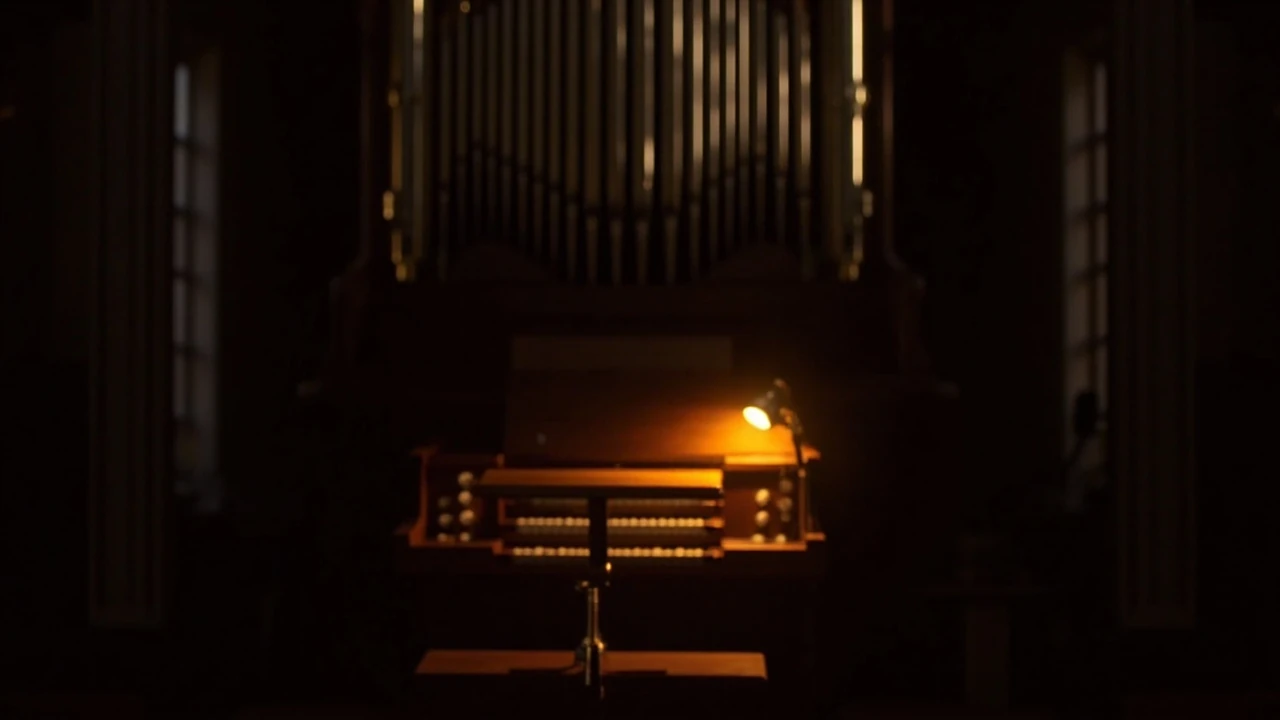
Calm music and the slow power of the pipe organ
A parent dims the kitchen lights at the end of a long day and starts a quiet playlist. A hospital chaplain walks down a corridor and notices that a small chapel is open. A student sits in an empty chapel between lectures and lets the room do the work. In each case the listener is not searching for entertainment. They are searching for calm music, and the sounds that meet them share the same basic features: a slow pulse, a soft attack, a long sustain, and very few notes at any one moment.
The pipe organ sits naturally inside that world. Its tones can rise from below the threshold of conversation and hang in the air long after the key is released. That combination of soft attack, long decay, and wide harmonic reach is what most listeners describe as calming. The rest of this article looks at what calm music really is, why certain instruments and sounds sit inside it, and how a pipe organ is voiced and registered to produce that effect. The goal is practical: by the end you should know which sounds to look for, which choices organ builders make to shape them, and how a player draws them on the instrument.
What calm music actually is
Calm music is a working category rather than a single genre. It groups pieces and sounds that reduce physiological arousal and help a listener settle. The umbrella covers ambient works, slow classical pieces, soft jazz, certain folk airs, and modern streaming playlists tagged for sleep, study, or relaxation. Across those styles a few features repeat.
- A pulse between roughly 40 and 70 beats per minute, close to a resting heart rate.
- A narrow dynamic range, with few loud peaks and a low overall level.
- Long sustains, so notes overlap and the texture feels continuous rather than chopped.
- Few simultaneous voices, often one or two lines plus a slow harmonic frame.
- Predictable harmonic motion, with common chords resolving in familiar ways.
- Soft timbres that lack sharp attack transients, such as flutes, strings played with a mute, and stopped or wooden organ pipes.
Those features are not arbitrary. They line up with how the ear and the nervous system respond to sound. Studies of slow tempo and low volume have measured reductions in heart rate and reported anxiety, and gentle music before surgery has been linked to lower reported pain and lower use of sedative drugs. The body of evidence is not uniform, but the direction is consistent enough that calm music has a place in clinical waiting rooms, palliative care, and pediatric units as well as in personal playlists.
Why the pipe organ is so well suited to calm music
The pipe organ has three physical features that match the recipe above almost by default. First, the attack of a pipe is shaped by the wind passing the languid and upper lip, which produces a soft onset rather than a hammer strike. Second, the pipe continues to sound as long as the pallet is open, so a held note can sustain for many seconds without effort. Third, the organ uses steady wind rather than bow or breath, so a long held chord stays stable in pitch and in tone color, without vibrato or breath noise that the ear reads as motion.
Those three traits make the organ a natural source of calm music when it is voiced gently. The same instrument, voiced at high pressure with bright principals and loud reeds, can sound triumphant or even threatening. The difference is the choice of stops, the pressure in the bellows, and the way the player fingers the keys. A single keyboard can sound bright and full of motion in one piece and hushed in the next, simply because the player draws a different set of stops.
The stops and families that shape a calm organ sound
An organ stop is a rank or partial rank of pipes that produces a particular tone color. Stop lists read like recipes, and the stops chosen for calm music form a recognizable set. The table below shows the families most often used for slow, soft repertoire, and what each contributes to the sound.
| Family | Typical tone | Role in calm music |
|---|---|---|
| Stopped diapason (Stopped flute) | Soft, hollow, narrow | Quiet foundation for solo lines and slow hymn verses |
| Wooden flute (Harmonic flute, Flûte harmonique) | Round, warm, gentle | Singing melody without edge; very common in slow solos |
| Bourdon | Dark, broad, low | Deep pedal or left-hand tone that supports the harmony |
| Salicional | Thin, string-like, prominent | Slow melodic line that sits clearly above a soft accompaniment |
| Vox celeste | Soft, gently wavering | Light shimmer when used in a duo with another soft stop |
| Soft reed (Krummhorn, Cromorne, Trichter Regal) | Nasal or veiled, with little edge | Color for a solo line in a quiet movement |
| String (Viola da gamba, Gamba, Violon) | Smooth, sustained, bowed in character | Background texture in a soft ensemble |
Stops that usually sit outside a calm palette include the full Principal chorus, the Mixture ranks, the louder Trumpet and Posaune, and high-pitched Zimbelstern effects. They are excellent tools, but their job is brilliance and projection, not quiet. The interesting decisions happen at the boundary: a single quiet Principal at low pitch, paired with a stopped flute, can sit inside a calm texture because its edge is reduced by the rest of the registration.
Voicing decisions that change the character of a pipe
Voicing is the craft of shaping a single pipe so that it speaks the way the builder wants. The same pipe can be made to sound bright or dark, quick or lazy, present or distant, all by small changes in the upper lip, the languid cut-up, the wind pressure, and the amount of ear-wood. For calm music, voicing tends to move in a few clear directions.
- The cut-up is lowered so the pipe speaks later and with less edge.
- The upper lip is rolled inward slightly to soften the initial transient.
- The ears are opened to reduce the volume of high harmonics.
- The pipe is nicked on the languid to slow the speech of the tone.
- Wind pressure is reduced below the stop’s normal level for a slower attack.
Those are not theoretical moves. Voicers spend hours at the console adjusting each pipe by ear. The result, when it is well done, is a pipe that begins to sing before the listener is aware it has started. That soft entry is one of the strongest cues the ear uses to read a sound as calm. A pipe that bites on its attack feels event-like, and the body responds to events even when the volume is low.
Registration: how a player builds a calm sound at the console
Registration is the act of choosing which stops to draw, on which manual, and at which pitch level. A calm registration usually follows three rules. First, it keeps the chorus work small or absent, because mixtures add brilliance that the ear reads as activity. Second, it uses flutes and strings rather than principal tone for the foundation. Third, it avoids very high pitch content above the upper line, because that content carries alertness more than warmth.
The practical choices that organists make for slow movements look like the table below. The exact combinations vary by instrument, but the pattern is stable across most schools of building.
| Repertoire | Suggested manual | Typical stops | Pedal |
|---|---|---|---|
| Slow hymn verse in a small church | Great or Positiv | Stopped diapason 8, Flute 4 | Bourdon 16, Flute 8 |
| Soft Bach trio sonata | Positiv or second manual | Flute 8, Salicional 8, Vox celeste 8 | Subbass 16, Flute 8 |
| French Romantic slow movement | Recit or third manual | Flûte harmonique 8, Bourdon 8, Voix céleste 8 | Contrebasse 16, Flûte 8 |
| Taizé chant or simple meditation | Any quiet manual | Stopped flute 8, Nazard (if available) | Soft Bourdon 16 |
| Funeral or memorial slow music | Positiv or Choir | Stopped diapason 8, Salicional 8, Flute 4 | Bourdon 16, Gedeckt 8 |
The pedal line matters more than beginners expect. A soft melody on the manuals with a loud 16-foot reed in the pedal can undo the whole effect, because the low brass edge of the reed will dominate the room. Pedal tone for calm music almost always means a stopped or wooden Bourdon and a soft 8-foot Flute, and very rarely a 32-foot result that adds sub-bass rumble to a small space.
Tempo, articulation, and touch
Even with the right stops, a fast or choppy performance will not read as calm. The slow pulse that defines this kind of music has to come from the player. A few practical points help.
- Keep the tempo between roughly 40 and 60 beats per minute for slow material, with steady counting and no accelerando at cadence points.
- Use overlapping legato fingering, holding each note until the next is speaking and listening for the swell of resonance in the room.
- Avoid repeated chords in the same hand, which create a stutter effect that the ear reads as motion.
- Use the swell pedal with long, slow changes rather than quick crescendos.
- Match the length of the silence after a phrase to the length of the phrase itself, so the breathing of the music stays even.
Touch on a tracker organ differs from touch on an electronic instrument. The organ has no dynamics per key, so the player creates shape through stop changes, swell pedal, and the spacing of notes. For calm music, that means choosing one or two soft registrations and changing them very rarely, so the listener’s attention stays on the line rather than on the sound itself.
The acoustic of the room
Calm music is partly a property of the room. A dry room with hard walls returns almost nothing, so each note ends quickly and the next note arrives in silence. That dryness can feel restless because the ear has to rebuild the sound at every onset. A live room with a long reverberation tail overlaps the notes into a continuous wash, which the ear reads as continuous and therefore restful. Most historical organs were built for live rooms because the builder could tune the room’s behavior into the design. Modern practice often adds electronic reverberation in dry spaces, which works in calm music only when the reverb time is long and the level is moderate.
The useful numbers for a small church or chapel that wants to support calm music sit roughly in the ranges below.
| Room type | Recommended reverberation time at mid frequencies | Notes for calm repertoire |
|---|---|---|
| Dry living room | 0.4 to 0.7 seconds | Acceptable with a slow piece; consider adding soft furnishings |
| Small chapel | 1.0 to 1.6 seconds | Very good for solo organ and unaccompanied singing |
| Mid-sized church | 1.8 to 2.4 seconds | Excellent for slow Romantic and French repertoire |
| Large cathedral | 3.0 seconds and above | Beautiful for sustained pedal points, but phrases need to be long to fill the space |
These are not strict limits. They are the ranges in which listeners tend to describe the same music as calm rather than as exposed or boomy. Short of about 0.5 seconds, organ tone begins to feel percussive. Beyond about 4 seconds on a single note, the room can swallow a slow melody so completely that the line becomes a wash of color, which is a different aesthetic but still a calm one.
Choosing repertoire that fits the calm palette
Repertoire choice is often more powerful than stop choice. A bright voluntary played on a soft registration will still feel bright, because the music itself drives the ear forward. The pieces that work best for calm listening share a few traits. They are slow in their notated tempo, they hold long notes, and they resolve harmonies in predictable ways.
A small working list, none of it prescriptive, can give a starting point.
- Plainchant and its slow harmonizations, including the simpler Taizé chants sung without accompaniment.
- Slow Bach chorale preludes, especially the quieter ones from the Orgelbüchlein and the Schübler set.
- Late French Romantic slow movements, where the composer writes soft flute and bourdon combinations by hand.
- Contemporary slow pieces written for stopped flutes and bourdons, including many published for small organs.
- Sustained drone pieces where the interest is in overtone motion rather than harmonic motion.
The common thread is restraint. Pieces that work well for calm music tend to ask the player to do less, not more, and they trust the room to fill the silence between events.
Building a personal calm music practice
For a listener, calm music is easier to use well if it is approached as a small practice rather than as a long background stream. The first habit is to choose a short piece, about three to six minutes, and to listen once through with attention. The second is to notice the breath of the music, the moment where the room takes over from the player, and the decay of the final chord. The third is to set the volume low enough that the listener can hear their own breathing alongside the music, which signals to the nervous system that the environment is safe.
For an organist, the same structure applies. A daily slow practice of fifteen minutes on a single soft registration, played at a strict tempo with no swell changes, can reset both the ear and the body. The exercise is more useful than it sounds: it forces the player to listen for the moment when the pipe speaks, the moment when the room begins to sing, and the moment when the note finally dies. Those three moments are the core experience of calm music on the organ.
When calm music is not the right tool
It is worth saying plainly that calm music is not a treatment for any medical condition. Slow, soft music can support sleep, reduce reported anxiety before a procedure, and make a difficult conversation easier, but it is not a substitute for medical care, mental health support, or medication where a clinician has prescribed one. Listeners who use calm music to manage a serious symptom should treat it as one tool among several, and should speak to a clinician if the symptom persists. The organ is a powerful instrument, and the rest of this article assumes the listener and player are well and are choosing calm music for the simple pleasure of listening.
A short checklist for a calm organ moment
- Pick one quiet manual, ideally a Positiv or Choir division.
- Draw a stopped or wooden flute at 8-foot pitch, paired with a soft 4-foot if the line needs a little body.
- Add a Salicional or a Vox celeste only if the texture needs a line that floats above the rest.
- Set the pedal to a stopped 16-foot and a soft 8-foot flute. Avoid reeds in the pedal for slow music.
- Choose a piece of about three to six minutes, with a slow pulse and long held notes.
- Set the room volume low. The listener should hear the building as much as the pipes.
- Let the last chord decay fully before standing or speaking. The decay is part of the music.
That list is enough for a usable result in most settings. Each of the choices can be refined as the player learns how their own instrument and room respond to a quiet registration.
Why the organ will keep its place in this tradition
Calm music has always drawn on instruments and voices that the ear trusts. A flute, a slow string, a held human voice, a soft pipe. The pipe organ sits inside that group because it is the loudest instrument in the Western canon that can also play the softest sound in a given room. When it is voiced and registered with care, the organ produces the long, overlapping tone that listeners describe as calm. When it is voiced for brilliance, the same instrument does something else. The choice belongs to the builder and the player, and the listener experiences the result.
For anyone who wants to use calm music well, the practical path is short. Pick a quiet space. Pick a slow piece. Pick a soft registration. Then listen for the moment when the room begins to sing, because that moment is the center of the experience.
Frequently asked questions
What tempo is best for calm music?
A pulse between roughly 40 and 70 beats per minute works well. This range sits close to a resting heart rate, and the ear reads the slow motion as restful. Pieces far below 40 BPM can feel suspended and very still, but they need a long reverb to keep the texture from feeling sparse.
Why does the pipe organ suit calm music so well?
The organ has a soft attack, a long sustain, and stable wind, so a held chord can last many seconds without changing. Those three traits match the physical recipe for calm listening better than most instruments can, and a competent organist can shape the tone from a soft background to a sustained climax without changing keyboards.
Which organ stops are best for calm music?
Stopped diapasons, wooden flutes, Bourdons, Salicionals, Vox celeste ranks, and soft string-toned stops are the core of a quiet palette. Avoid the Principal chorus, mixtures, and loud reeds when the goal is calm. A single 8-foot flute on a quiet manual is often enough on its own.
How does voicing change the character of a pipe?
Voicers adjust the cut-up, the upper lip, the languid, the ears, and the wind pressure to change how a pipe speaks. For calm music, voicing lowers the cut-up, rolls the lip inward, opens the ears, and reduces wind pressure. The result is a soft entry and a rounded tone with less edge.
Can calm music help with sleep or anxiety?
Slow, soft music has been shown in clinical studies to lower reported anxiety before procedures, reduce reported pain in some settings, and support sleep in listeners who use a regular routine. It is not a treatment for a medical condition, but it is a useful support for a healthy routine. Anyone with a serious sleep or anxiety problem should speak to a clinician.
How long should a piece of calm music be?
About three to six minutes is a useful length for one sitting. Shorter pieces are fine when the listener has a short window. Longer ambient works can run fifteen minutes or more, but the listener should plan to commit the time rather than letting the music drift into the background.
What room works best for calm organ music?
A room with a reverberation time of about 1.5 to 2.5 seconds at mid frequencies works very well. Small chapels and quiet churches tend to sit in that range naturally. Living rooms and bedrooms can be improved with soft furnishings, rugs, and bookshelves, which add a little reverb without electronic processing.
Do I need a swell box to play calm music on the organ?
No. Calm music is possible on a two-manual tracker organ without a swell, by choosing the quieter manual and the softer stops. A swell is useful for shape, but shape is not required for this kind of repertoire. A clean, slow line on a stopped flute can sit on its own.
What pieces of organ music fit the calm style?
Plainchant harmonizations, slow Bach chorale preludes, late French Romantic slow movements, and contemporary works for stopped flutes and bourdons are reliable choices. A simple slow hymn verse played on a soft 8-foot flute also works well, even for a beginning listener.
Is the organ louder than other instruments in calm music?
Only at full organ. On a soft registration, the organ can play below the level of a quiet conversation, and the long sustain of the pipes carries the sound across a room in a way that no other acoustic instrument can match at the same dynamic. That is why the organ has a special place in this tradition.