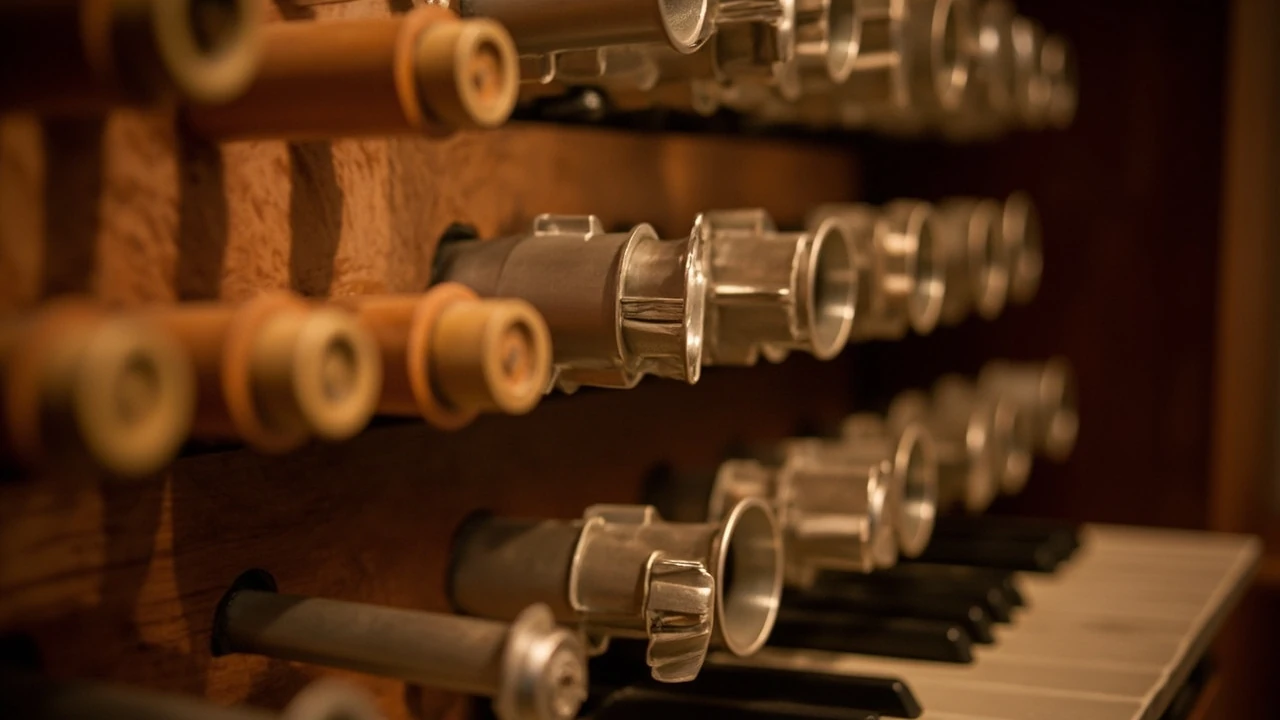
Chimney flute vs stopped flute organ stops
Place a stopped wooden pipe and a small pierced chimney pipe next to each other on the same organ and the listener hears two voices that feel related but never quite the same. Both are flue stops that refuse to behave like an open principal, and both rely on a closed or partially closed pipe to bend the harmonic series downward, but the chimney flute and the stopped flute use that closure in different ways. The chimney adds a small open hole at the top, the stopped flute keeps the cap solid, and that single decision changes timbre, wind consumption, voicing tolerance, and the kind of music each stop flatters.
What follows is a working comparison aimed at players, students, and attentive listeners: how each pipe actually produces sound, how builders voice them, how they sit inside a registration, and how to choose between them when both names appear on a stop list.
How a stopped pipe makes sound in the first place
Before the comparison gets specific, it helps to remember what a closed pipe does to the air column inside it. An open flue pipe behaves like a tube that is open at both ends, and its lowest mode is a half-wavelength inside the pipe. Closing the top end pushes the air column into a quarter-wavelength mode, so the same pipe length speaks roughly an octave lower than an open pipe of the same length. That is why stopped ranks are the standard way to get a low bass on a small organ without filling the case with sixteen-foot metal.
The trade-off is timbre. A stopped pipe develops a slightly stronger first odd harmonic and a weaker set of upper partials compared with an open pipe, so the tone is darker, narrower, and a little more vocal. The cap also shifts the place where the upper partials cluster, which gives the stopped flute its characteristic hollow, recorder-like colour. Builders tune stopped pipes by moving the cap up or down slightly, by adjusting the mouth height, and by ear against the open flue ranks that surround them.
For a wider look at the families a stop belongs to, the site’s guide to organ stops explained: families, ranks, and how to read a stop list gives the bigger map of principals, flutes, strings, and reeds.
What turns a stopped pipe into a chimney flute
The chimney flute is a stopped pipe with a deliberate, well-defined hole in the top of its cap. A short tube, the chimney itself, rises out of the closed stopper and is left open to the air. The pipe is still acoustically a quarter-wavelength at its fundamental, but air can move through that small chimney, and the upper harmonics change because of it.
Three things follow from the open chimney:
- The strong, hollow stopped-pipe tone is softened, and a small amount of higher partial energy is allowed back into the spectrum.
- The pipe becomes a little more responsive to changes in wind pressure, because air can escape through the chimney as well as the mouth.
- The voicing window narrows: the chimney diameter, its height, and the exact position of the cap all matter, and a builder can ruin the stop by getting any of them wrong.
Chimney flutes are usually small-scale wooden stopped pipes in the upper manual, sometimes metal in the treble. They are common on English and continental Romantic organs, and they often appear at 4 ft or 2 ft pitch as a soft solo voice rather than as a foundation stop.
Side-by-side comparison: chimney flute vs stopped flute organ stops
The table below lines up the practical differences a player feels at the console. The numbers describe typical examples, not universal law, because a bold English nineteenth-century stopped diapason and a small continental gedackt behave like distant cousins.
| Attribute | Stopped flute (gedackt, stopped diapason) | Chimney flute |
|---|---|---|
| Top of the pipe | Solid wooden cap, or tightly stopped metal cap | Cap with a small open chimney tube projecting upward |
| Acoustic behaviour | Pure quarter-wave stopped pipe, strong fundamental, narrow spectrum | Stopped pipe with controlled leakage at the top, slightly richer upper partials |
| Typical tone colour | Dark, hollow, recorder-like, slightly nasal | Rounder, more singing, more “flute” in the open-pipe sense, a touch brighter than a gedackt |
| Common materials | Wood for bass and middle, tin-lead alloy for treble | Usually wood, sometimes spotted metal in the top octaves |
| Common pitches | 16 ft, 8 ft, 4 ft, sometimes 2 ft as a bass extension | 8 ft, 4 ft, 2 ft, often used as a small solo rank |
| Wind sensitivity | Forgiving, easy to keep stable across the keyboard | Less forgiving, sensitive to cap fit, chimney diameter, and pressure |
| Typical role in registration | Foundation in a chorus, solo voice in slow movements, bass reinforcement in small organs | Solo flute in melodic lines, delicate accompaniment, colour stop in quiet combinations |
| Voicing difficulty | Moderate; cap depth, mouth, and languid all interact in a known way | Higher; chimney geometry adds another variable that must be tuned with the rest |
Pitch and scaling reference for common stopped ranks
The numbers below come from a handful of representative builders and are useful as orientation rather than as fixed standards. Pipe scales vary with the room, the case pressure, and the musical taste of the builder, so two 8 ft stopped diapasons from the same period can differ in diameter by a comfortable margin. For broader context, the stop overview provides a concise reference for this section.
| Stop | Typical pitch | Pipe material | Approximate mouth diameter at 8 ft | Approximate scaling at middle C |
|---|---|---|---|---|
| Stopped Diapason (English) | 16 ft, 8 ft | Wood (bass and middle), spotted metal (treble) | 95-110 mm at 8 ft | 1:18 to 1:22 |
| Gedackt (North German) | 8 ft, 4 ft | Wood, sometimes metal in the top two octaves | 75-90 mm at 8 ft | 1:20 to 1:24 |
| Bourdon (French) | 16 ft, 8 ft | Wood, often in separate expression box | 100-120 mm at 8 ft | 1:16 to 1:20 |
| Chimney Flute (English Romantic) | 4 ft, 2 ft | Wood, sometimes metal above tenor C | 35-45 mm at 4 ft | 1:18 to 1:22 |
| Cheminard (French) | 8 ft, 4 ft | Wood with metal chimney tube | 55-70 mm at 8 ft | 1:20 to 1:24 |
A wider scale tends to give a rounder, more foundational tone, while a narrower scale leans toward a more pointed, solo-ready voice. The chimney flute almost always uses a narrower scale than the equivalent stopped diapason at the same pitch, because the open chimney already adds some brightness.
Where each stop tends to appear on a real stop list
Looking at historic and modern stop lists, the chimney flute and the stopped flute rarely sit in the same drawer of stops. Builders tend to choose one approach for a given voice in a given division, not both. A typical three-manual English organ might offer a Stopped Diapason on the Great, a Chimney Flute on the Swell, an Open Flute on the Choir, and a Gemba somewhere else, with a Hohlfloete or Spitzfloete filling the brighter flue slot.
A small two-manual organ often uses a stopped flute at 8 ft on the Great as a soft foundation, and a chimney flute at 4 ft on the Swell as a solo voice. When a budget allows only one, the choice usually follows the kind of music the organ is expected to play. Liturgical organs built to support a congregation tend to favour the deeper, more solid stopped flute. Recital organs and organs built to play Romantic solo literature tend to favour the more singing chimney flute.
If you want to understand how these solo stops combine with the rest of a registration, the site’s organ registration: a practical guide to shaping pipe organ sound walks through how builders and players think about combinations.
How voicing shapes the difference
Two stopped pipes from different builders at the same pitch can sound more unlike each other than a stopped pipe and a chimney pipe from the same builder. That is the heart of organ acoustics: voicing decisions sit on top of the acoustic type, and the type alone does not tell you what the stop will sound like in the room.
For a stopped flute, the voicer shapes the tone by adjusting:
- The cap depth, which changes harmonic development and tuning.
- The mouth height and cut-up, which set the balance of harmonics and the speaking behaviour.
- The languid, which controls how the air hits the upper lip.
- The ears, which are small leather or metal tabs that fine-tune the upper partials.
For a chimney flute, every one of those variables is present, plus:
- The chimney diameter, which changes how much higher partial energy leaks through.
- The chimney height, which changes how strongly the top of the pipe couples with the room.
- The cap fit around the chimney, which has to be airtight at the wood-metal joint.
For a deeper look at the labour that goes into all of this, the article on pipe voicing: how organ builders shape tone one pipe at a time covers the broader craft. As a separate reference, the dictionary of the most frequently used adds source-specific context to this discussion.
Registration in practice: choosing one over the other
The decision usually comes down to three questions: what solo line you want to sing, what foundation the chorus needs, and how much wind you can spare.
If the music is a slow Bach chorale prelude and you need a solo voice that floats over a quiet left-hand accompaniment, a chimney flute on a manual division works beautifully. It is round, it carries a melody, and it does not have the heavy, vocal weight of a deep stopped diapason. If instead you need a serious bass line under a full chorus, the stopped flute at 16 ft or 8 ft gives you that solid, low foundation without the cost of an open wooden bourdon.
A practical checklist at the console looks like this:
- Listen to the piece on a recording on a similar organ, and note which solo stop the player uses.
- Read the stop list, and check whether the stop is described as Stopped, Gedackt, Chimney, or some hybrid name such as Flute à cheminée.
- Pull the stop at half wind first, then full wind, and notice whether the timbre tightens or opens up.
- Combine it with a soft 8 ft principal and a string, then with a 16 ft subbass, to see how it behaves in context.
- Use the chimney flute for a singing line and the stopped flute for a foundation, and resist the temptation to double both against the same melody.
Wind consumption is a small but real consideration. A stopped pipe is a closed system, so it leaks less air to the room than an open pipe of the same length, which is partly why organ builders love them in cramped cases. A chimney flute is a stopped pipe with a deliberate leak, so it loses a little more air than a gedackt. In a large chorus on a small wind chest, that small extra loss can matter, especially on older mechanical-action organs. For an overview of how that wind reaches the pipe in the first place, the site’s tracker action in pipe organs: what it does and how to tune it page covers the mechanical side of the system.
Common confusions and how to read the name
Stop lists are full of names that look similar and behave differently. A few quick rules of thumb help when you are standing in front of an unfamiliar organ:
- Stopped Diapason, Gedackt, Bourdon, Rohrgedackt, and Coppel are all stopped flutes of one sort or another. The “Rohr” prefix usually means the top is a rolled tube rather than a flat cap, which is a different voicing trick from a chimney.
- Chimney Flute, Flauto a camino, and Cheminard all describe the same idea: a stopped pipe with an open chimney. Some builders write Flute à cheminée in full on the stop knob.
- Open Flute, Flute ouverte, and Flöte are open metal flue pipes, and they are not what this comparison is about.
- Hohlfloete, Spitzflöte, and Waldflöte are open flutes with specific shapes, not stopped pipes, and they belong in a different comparison.
When in doubt, ask the organist who plays the instrument regularly, or look for the builder’s own description in the console. Most historic English organ builders list chimney flutes explicitly because they wanted the player to know what was under the knob.
Listening tests you can do on a real organ
Reading about timbre is a poor substitute for sitting at a console. A few simple tests bring the difference alive on most organs of two manuals or more.
- Pull the stopped flute at 8 ft alone, play a slow scale in the tenor range, and listen for the hollow, recorder-like colour and the slight “oo” in the vowel of the tone.
- Add the chimney flute at 4 ft, play the same scale an octave higher, and notice how the tone opens up compared with a 4 ft stopped flute.
- Combine the stopped flute at 8 ft with a soft 8 ft principal on the same manual, and listen to how the two ranks lock together in the chorus. Repeat with the chimney flute and a 4 ft principal to hear how the chimney behaves in a small chorus.
- Play a slow hymn tune on the chimney flute with a soft string in the left hand, and notice how the melody carries without becoming nasal.
- Switch the melody to the stopped flute and repeat the same registration, and notice how the heavier fundamental changes the line.
Why builders still build both in the modern era
New organs still include stopped flutes and chimney flutes, even though modern wind systems and case design have removed some of the old constraints. The reason is musical, not technical. A stopped flute gives a kind of foundation that no open pipe can match in a small case, and a chimney flute gives a kind of singing solo line that no open pipe quite replaces. They are different tools for different jobs, and organ builders still need both.
It is also worth noting that taste changes over time. Early twentieth-century English builders sometimes wrote off chimney flutes as a Victorian curiosity, while twenty-first-century builders often return to them because the singing quality suits a lot of contemporary choral accompaniment. Stopped flutes have a steadier reputation, in part because they are so useful as a bass.
Frequently asked questions
What is the main acoustic difference between a chimney flute and a stopped flute?
A stopped flute is a fully closed pipe that sounds at a quarter wavelength, which gives it a dark, narrow spectrum. A chimney flute is a stopped pipe with a small open tube in the cap, which lets a controlled amount of higher partial energy back into the tone and produces a rounder, more singing sound.
Is a chimney flute always a solo stop?
In most stop lists, yes. The chimney flute is usually drawn at 8 ft, 4 ft, or 2 ft and is used as a singing solo or a delicate accompaniment stop. It is not normally a foundation stop in a chorus.
Is a stopped diapason the same as a stopped flute?
Yes. Stopped Diapason, Gedackt, Bourdon, and Coppel are all names for the same basic idea: a stopped flue pipe voiced to sit inside a chorus. The name on the stop knob is a regional and historical choice rather than a different kind of pipe.
Why are stopped pipes so common in organ bass sections?
Because closing the top of the pipe makes it sound an octave lower than an open pipe of the same length, builders can produce a 16 ft bass in a small space using stopped wooden pipes rather than long open metal ones.
Can a chimney flute replace a stopped flute in a registration?
Not really, because they do different musical jobs. A chimney flute is brighter and more vocal, while a stopped flute is darker and more solid. Replacing one with the other changes the balance of the chorus and the character of the solo line.
Does the chimney flute use more wind than a stopped flute?
Slightly, because the open chimney lets a small amount of air escape that a solid cap would not. On a small mechanical-action organ with a modest blower, that extra consumption is a real consideration in a large chorus.
Are chimney flutes harder to maintain than stopped flutes?
They are a little more sensitive to changes in temperature, humidity, and cap fit, because the chimney geometry is part of the voicing. A well-built chimney flute holds its character for many years, but a poorly built one goes out of character quickly.
How can I tell from a stop list which kind of flute I am reading about?
Look for the words Stopped, Gedackt, Bourdon, Coppel, or Rohrgedackt on one side, and Chimney, Cheminard, or Flauto a camino on the other. If the list is in English, the builder will usually write Chimney Flute in full when that is what the rank is.
Do tracker action organs treat chimney flutes differently from stopped flutes?
Mechanically, no: the action only has to open the pallet under the pipe. Acoustically, a tracker organ’s wind delivery can be less steady than a well-regulated electric-action organ, which can make the chimney flute’s voicing more noticeable. For the broader context of how the action shapes the sound, the site’s guide to tracker action in pipe organs is a useful reference.
Where can I hear both stops on the same organ?
Many two-manual and three-manual Romantic and modern organs include both, often on different divisions. Visiting a few local organs and asking to hear the chimney flute next to the stopped flute is the fastest way to lock the difference into your ear.