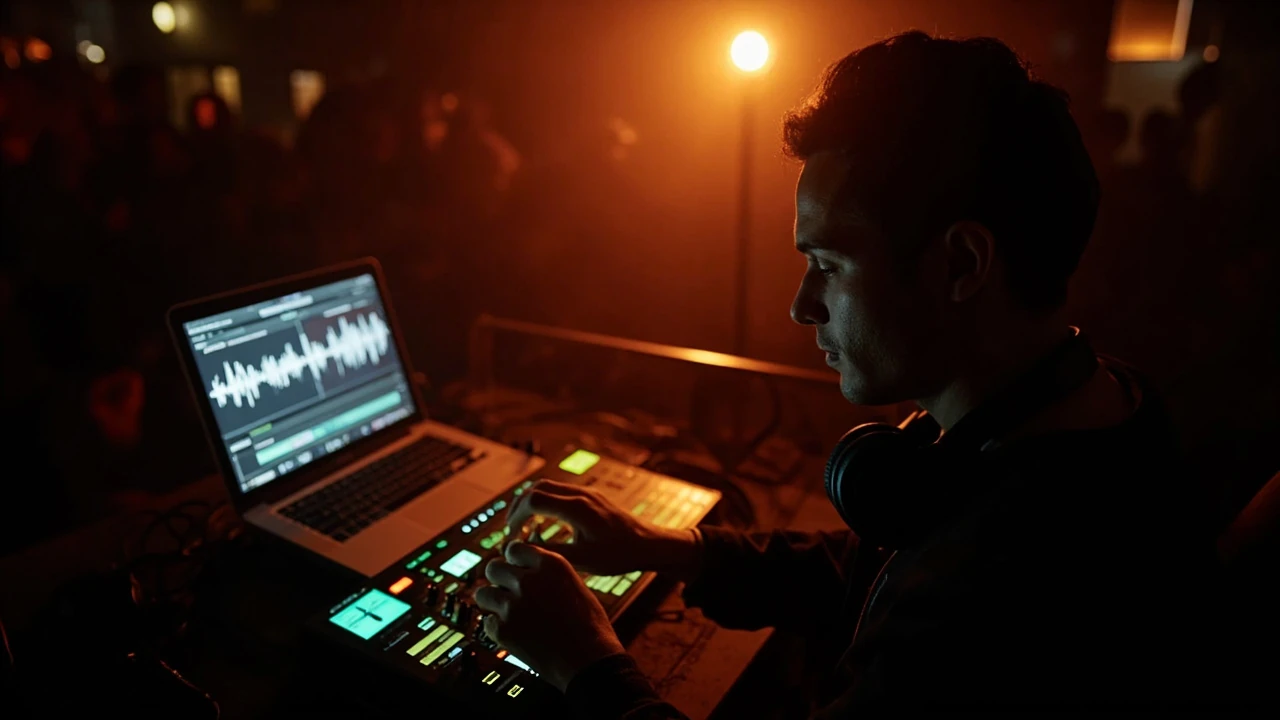
EDM music explained: how electronic dance music actually works
A producer opens a laptop, drops a kick sample into a project, and a few evenings later the same loop is pushing air through a sound system in a Berlin basement. That gap between a quiet studio and a packed room sits at the center of EDM music. A single person with a laptop, a pair of headphones, and a handful of well-chosen plugins can now make records that hold their own next to a touring DJ set. Understanding how that gap gets bridged, through sound design, arrangement, mixing, and DJ technique, makes the music easier to follow, whether the goal is to listen more carefully or to start producing.
EDM music, short for electronic dance music, is a family of styles built for clubs, festivals, headphones, and radio. It includes house, techno, trance, drum and bass, dubstep, and many adjacent styles. The shared thread is rhythm, repetition, and, in most subgenres, a steady four-on-the-floor kick. Beyond that pulse, the differences in tempo, sound design, and arrangement are wide enough that an experienced listener can usually name the subgenre within a few seconds of a drop.
What follows is a working map of EDM music: what the label covers, how a track is actually built, which subgenres matter, and what gear and software new producers tend to start with. It is written for a listener who wants better vocabulary for the music they already enjoy, and for a new producer who wants a realistic picture of the field before buying equipment or signing up for courses.
What counts as EDM music
EDM music is an umbrella term, not a single style. It covers electronic music produced primarily for dancefloor use, regardless of tempo, country of origin, or commercial reach. The abbreviation spread into general use in North America in the late 2000s, partly because promoters and radio stations needed a word that could hold house, techno, trance, and dubstep under one banner. In the United Kingdom and much of Europe, the same records are usually called dance music or electronica, with the subgenre name attached.
Most music that falls under the EDM music label shares a few traits. The beat is electronic and quantized to a grid, so it does not swing the way a live drummer plays. The arrangement follows a build-and-release shape, with energy rising through filtered sections, drum rolls, snare builds, and synth risers, then dropping into a chorus or full mix. The low end is dominated by a deep sub-bass or a punchy synth bass, and the master is usually pushed loud for club and festival sound systems.
What does not count as EDM music is a frequent source of confusion. Ambient electronic music, experimental IDM, most library music, and most downtempo and chillout are not built for dancing and usually sit outside the label. Soundtrack and game music are sometimes electronic and sometimes danceable, but they are not produced primarily for club or festival play. The boundary gets fuzzy at the edges, especially as artists like Bonobo, Caribou, and Jamie xx blend dancefloor rhythms with downtempo and indie textures, but the working definition holds for most releases.
A brief history of the EDM music umbrella
The deeper roots of EDM music sit in late-1970s disco, Kraftwerk, and the early house and techno records that came out of Chicago, Detroit, and northern England in the 1980s. Acid house, with its squelching TB-303 basslines, and the harder Detroit techno scene set the template for electronic music produced on relatively simple hardware. The Roland TR-808 and TR-909 drum machines defined the kick and snare sounds that still anchor most modern EDM music.
The 1990s saw the word electronica used widely as dance music crossed over into the charts. Acts like The Prodigy, The Chemical Brothers, Faithless, and Orbital brought big-room energy to festival main stages. At the same time, the rave scene pushed harder, faster styles such as jungle and drum and bass, which grew into their own parallel branches rather than folding into the mainstream EDM music label.
The 2010s brought the EDM music boom in North America, driven by Skrillex, Avicii, Calvin Harris, Martin Garrix, and many others. Swedish House Mafia, Tiësto, and David Guetta became festival headliners rather than club specialists, and the term EDM started to function as a marketing word for big-room house and festival progressive. By the mid-2020s, the umbrella had cooled commercially in some markets but had spread culturally, with subgenres such as future house, tech house, melodic techno, and bass house each supporting their own scenes, label rosters, and DJ circuits.
The main subgenres inside EDM music
Subgenre names inside EDM music can be intimidating, but they are mostly shorthand for tempo, drum pattern, and the character of the synth sounds. Once a listener can place a track on the spectrum from deep and minimal to loud and maximal, the names start to make sense.
| Subgenre | Typical tempo | Core drum character | Signature sound | Where you tend to hear it |
|---|---|---|---|---|
| Deep house | 118 to 124 bpm | Four-on-the-floor, swung hats | Warm chords, jazzy pads, soft sub bass | Small rooms, late-night sets, lounge-leaning clubs |
| Tech house | 122 to 128 bpm | Four-on-the-floor with crisp percussion | Rolling basslines, dubby stabs, minimal vocals | Ibiza and Mediterranean clubs, festival day stages |
| Progressive house | 124 to 130 bpm | Four-on-the-floor, long builds | Layered synths, emotional breakdowns, big drops | Mainstream festival main stages, radio-friendly releases |
| Big room house | 126 to 132 bpm | Punchy four-on-the-floor, heavy kick | Loud supersaw leads, simple drops, festival energy | Festival main stages, opening slots for headliners |
| Techno | 120 to 135 bpm | Four-on-the-floor or broken patterns | Industrial textures, hypnotic loops, deep low end | Berghain-style rooms, Detroit and Berlin clubs |
| Trance | 130 to 145 bpm | Four-on-the-floor, rolling bass | Lush supersaws, long breakdowns, melodic leads | ASOT-era events, European arena shows |
| Drum and bass | 160 to 180 bpm | Fast breakbeats, rolling snares | Deep reese bass, atmospheric pads, chopped samples | UK club circuits, dedicated festivals |
| Dubstep | 138 to 142 bpm | Half-time snare on beat 3 | Sub-heavy bass wobbles, sparse drops, sound design | UK bass nights, crossover radio play after 2010 |
| Future bass | 140 to 160 bpm | Half-time or trap-influenced | Bright pluck leads, vocal chops, pitched samples | Online producer scenes, festival support slots |
| Hard dance and hardstyle | 145 to 160 bpm | Hard four-on-the-floor, distorted kick | Punchy kicks, detuned leads, euphoric melodies | Dedicated hard dance events, Defqon.1-style festivals |
The tempo column matters more than the names suggest. The same kick drum pattern at 124 bpm feels meditative next to the same pattern at 150 bpm, and the ear reads the speed as energy. Most EDM music sits between roughly 120 and 160 bpm, with outliers on either side. When a producer wants a track to feel serious and club-ready, they usually place it somewhere in the middle of its genre’s tempo range rather than at the extremes.
Another useful way to separate subgenres is by the relationship between kick and snare. In four-on-the-floor styles, the kick lands on every beat and the clap or snare sits on beats 2 and 4. In half-time styles such as dubstep and many future bass records, the snare lands on beat 3 and the kick is sparse, which makes the groove feel slower than the BPM number suggests. In drum and bass, the breakbeat carries the groove and the kick reinforces rather than defines it. Hearing that difference is often the fastest way to place an unfamiliar track.
Producer gear: what actually gets used to make EDM music
Outside the DAW, EDM music producers rely on a small, fairly standardized set of tools. A pair of closed-back studio headphones, a pair of nearfield monitors, an audio interface with two inputs and two outputs, and a MIDI controller with at least 25 keys and a handful of drum pads covers the practical needs of a home setup. The interface matters more than beginners expect because it determines the quality of the signal that reaches the monitors or the recording chain.
| Tool category | Common picks in EDM music | Role in the workflow | Realistic starting price |
|---|---|---|---|
| DAW | Ableton Live, FL Studio, Logic Pro, Bitwig Studio, Reaper | Hosts the arrangement, instruments, effects, and automation | Free trial to about 60 dollars for an intro edition, 200 to 600 dollars for a full license |
| Audio interface | Focusrite Scarlett 2i2, Universal Audio Volt 276, Native Instruments Komplete Audio 6, Audient iD14 | Connects monitors, headphones, and a microphone to the computer with low-latency conversion | 120 to 350 dollars |
| Monitors | Yamaha HS5, Adam Audio T5V, Kali Audio LP-6, KRK Rokit 5 G4 | Give an honest picture of the mix, especially the low end and stereo image | 200 to 500 dollars a pair |
| Headphones | Audio-Technica ATH-M50x, Beyerdynamic DT 770 Pro, Sennheiser HD 600, Sony MDR-7506 | Used for detailed editing, late-night work, and checking how a track translates outside a treated room | 80 to 400 dollars |
| MIDI controller | Native Instruments Maschine Mikro, Akai MPK Mini, Arturia MiniLab, Novation Launchkey | Plays software instruments, programs drums, and maps to the DAW for transport and mixing | 60 to 250 dollars |
| Synth and sampler plugins | Serum, Vital, Massive X, Phase Plant, Kontakt, Battery | Generate leads, basses, pads, drums, and sampled instruments inside the DAW | Free tier options, 30 to 250 dollars for paid editions |
It is worth being honest about what the gear does and does not change. A new set of monitors will reveal mix problems that cheap speakers hid, and a good interface can clean up a noisy signal, but neither will make a weak arrangement sound finished. The biggest jumps in quality for a new producer usually come from learning a DAW properly and from spending time on arrangement, not from upgrading cables or adding another pair of headphones.
Used gear is also worth considering. The previous generation of audio interfaces, monitors, and controllers sounds and behaves much like the current generation, and a second-hand pair of Adam A7X monitors or a used Maschine MK2 controller can deliver most of the quality of new equivalents at roughly half the price. The main thing to check on used monitors is whether the drivers have been pushed hard, and on used interfaces is whether the preamps are still quiet.
How a track in EDM music is actually built
Most tracks in EDM music start with a drum groove, often a simple four-on-the-floor pattern with a closed hi-hat on the offbeat. Once the groove is set, the producer layers in a bassline, either a sub-bass sine wave, a sampled bass guitar, or a more complex synth bass. On top of that come chords, pads, lead synths, vocal samples, and arrangement details such as filter sweeps, snare rolls, and white noise risers that build tension before a drop.
Sound design is the part of EDM music that gets the most attention, and with good reason. A single synth patch can carry a track, and a weak patch can flatten even a strong idea. Producers build their own sounds from raw waveforms, often using a wavetable synth, a virtual analog synth, or a sampler loaded with one-shots. They shape those sounds with filters, envelopes, LFOs, and effects such as reverb, delay, distortion, and compression until the patch sits properly in the mix.
Arrangement in EDM music tends to follow a recognizable shape. Most tracks use an intro, a buildup, a drop, a breakdown, a second buildup, a second drop, and an outro. The intro is usually eight to sixteen bars and gives the DJ room to mix in. The first drop carries the main hook. The breakdown removes the drums and leaves the melodic and harmonic content exposed. The second drop often adds a new element, a counter-melody, a vocal line, or a shifted harmony, to reward listeners who stay through the whole track.
The DAW and the basic toolkit
A digital audio workstation is the software environment in which EDM music is produced. The leading choices for new producers are Ableton Live, FL Studio, Logic Pro, Bitwig Studio, and Reaper, with Ableton and FL Studio being the most common starting points in the EDM music world. Each DAW handles audio recording, MIDI sequencing, plugin hosting, and arrangement, but the workflow feel differs. Ableton’s Session View suits live performance and loop-based writing, while FL Studio’s piano roll is widely considered one of the easiest for beat programming.
Inside the DAW, the toolkit for EDM music usually includes:
- A wavetable or virtual analog synth such as Serum, Vital, Massive, or Phase Plant for leads, basses, and pads.
- A sampler such as Simpler, Sampler, Kontakt, or Battery for drums and one-shots.
- Drum samples, either from sample packs or from recorded sessions.
- EQ and compression tools for shaping each channel and the master bus.
- Reverb and delay for spatial depth.
- A limiter on the master bus for competitive loudness.
Plugins that emulate classic hardware are popular because they add character that purely clean digital synths sometimes lack. A clean supersaw in a modern wavetable synth can sound almost too polished, and a touch of modeled analog warmth, chorus, or tape saturation often helps a track sit better next to records that used the original hardware.
For producers who want a stable, well-documented starting point, Ableton’s own Live product page lays out the core features of the DAW most EDM producers reach for first, and the free editions of Vital and many of the plugins listed above are enough to finish a first EP.
Drum programming in EDM music
Drum programming is the foundation of most EDM music, and it is also the part beginners can improve fastest. The four-on-the-floor kick lands on every beat of the bar, the closed hi-hat usually plays eighth or sixteenth notes on or near the offbeat, and a clap or snare lands on beats 2 and 4. That pattern, played with subtle velocity changes, is the basis for house, techno, and trance.
For dubstep, drum and bass, and future bass, the drum programming is more complex. The kick usually sits on beat 1, the snare lands on beat 3, and a hi-hat or shaker carries the subdivisions. Drum and bass breaks are often sampled or synthesized at roughly 170 bpm and then either used as a full bar or chopped and rearranged. A solid grasp of swing, velocity, and ghost notes is what separates a stiff beat from one that breathes.
A practical approach to programming drums in EDM music is to start with a single kick sample, lay down a four-on-the-floor or half-time pattern, then add a clap or snare on the back beat. From there, layer a closed hi-hat at eighth notes, then a shaker or open hat for groove, then percussion such as a rim, a tambourine, or a conga loop. Subtle swing, usually between 50 and 60 percent, helps the beat feel human without losing the grid.
Synth design: leads, basses, and pads
Leads in EDM music are the melodies that ride on top of the mix. The most common lead sound in festival-style EDM music is the supersaw, a thick stack of slightly detuned sawtooth waves running through a long release and a generous amount of unison. Supersaws are loud, wide, and emotional, which is why they work well over big drops. For more restrained styles, a single saw, a square, or a sampled vocal chop often carries the lead instead.
Bass design in EDM music splits roughly into two camps. In the four-on-the-floor world, a sub-bass sine wave tuned to the root of the chord is the most common choice. A sine sub leaves room for the kick and the lead and keeps the low end focused. In dubstep, drum and bass, and future bass, the bass is more of a sound design object. Producers use FM synthesis, wavetable modulation, layering, and heavy distortion to make a reese bass, a growl, or a wobble that sits across the mid and low range.
Pads and chords sit between the lead and the bass. A pad is usually a long-attack, long-release synth patch made from a few detuned voices with a lot of reverb and sometimes a touch of chorus. In deep house and progressive styles, pads often carry the harmony almost by themselves, and the lead is a small element on top. The trick with pads is to keep them low in the mix. A pad that is too loud will fight the lead and the vocal, and the track will start to feel muddy.
Arrangement and the build-and-release structure
Arrangement is the part of EDM music that turns a loop into a track. A four-bar loop with a kick, a hat, a bass, a chord, and a lead is a sketch. An arrangement is the same loop, with sections added and removed, a filter that opens and closes, a riser that builds, and a drop that releases, repeated and varied for three to five minutes. The build-and-release structure is the spine of most EDM music, and it works because human listeners respond to predictable changes in energy.
A common arrangement template in modern EDM music looks roughly like this:
- Intro: 8 to 16 bars, often drums only or drums plus a melodic element, with a filter sweep or FX.
- Buildup: 4 to 8 bars, energy rising through a snare roll, white noise riser, pitch-up effect, and added percussion.
- Drop: 8 to 16 bars, full mix with the main hook front and center.
- Breakdown: 8 to 16 bars, drums drop out, melodic and harmonic content exposed.
- Second buildup: 4 to 8 bars, similar to the first, often with an extra melodic or vocal element.
- Second drop: 8 to 16 bars, similar to the first but with a new layer or variation.
- Outro: 8 to 16 bars, energy drops, often a reverse of the intro for clean DJ mixing.
The exact bar counts vary by subgenre, track length, and label preferences, but the overall shape holds. A three-minute pop-leaning EDM track may compress the structure, while a seven-minute melodic techno track may stretch it out with longer breakdowns and more variation between drops.
Mixing EDM music for a club or a streaming platform
Mixing EDM music is partly technical and partly aesthetic. The technical side is about getting each element to sit in the right place in the frequency spectrum, with the right level, the right stereo width, and the right amount of dynamic range. The aesthetic side is about choosing what should sit forward, what should fall back, and what should disappear entirely.
A useful mixing checklist for EDM music includes:
- High-pass everything except the kick, the sub bass, and the bass guitar. Sidechain the bass to the kick so the kick punches through.
- Keep the lead wide and centered, but check it in mono for compatibility with club PA systems.
- Use reverb sends rather than reverb inserts, and keep the return level low so the track does not wash out.
- Process the master bus lightly, usually with an EQ for tonal balance, a compressor for glue, and a limiter for loudness.
- Reference the track against commercial releases in the same subgenre at matched volume.
Sidechain compression deserves special mention because it is used more aggressively in EDM music than in almost any other genre. A sidechain compressor ducks the volume of one element, usually the bass or the pad, every time the kick plays. The result is a rhythmic pumping effect that leaves the kick clear and the rest of the track sitting just behind it. Used subtly, it is a mixing tool. Used heavily, it becomes a stylistic feature, especially in future house and certain styles of techno.
Mixing pitfalls specific to EDM music
EDM music has a few recurring problems that even experienced producers hit. Mud in the low mids usually comes from too many elements sitting between 200 and 500 Hz, especially layered bass patches and busy chord stabs. A quick fix is to sweep a narrow EQ on each channel in that range and cut whatever is not adding anything. Harshness in the upper midrange often traces back to layered supersaw leads, bright vocal chops, and aggressive hats. A dynamic EQ that only acts when a frequency jumps out tends to work better than a static cut.
Stereo width can also become a problem. Producers often pan hi-hats, percussion, and width effects hard left and right without checking how the track holds up in mono. Many club PAs sum to mono in parts of the room, and a track that collapses in mono will lose its low end and its hook. Checking the mix in mono at several points during a session is a small habit that prevents a lot of late-stage fixes.
Mastering EDM music for streaming and clubs
Mastering is the final step before release, and for EDM music it serves two audiences. The track has to sound competitive on Spotify, Apple Music, and YouTube, where loudness normalization rewards peaks around -14 LUFS integrated for most platforms and around -16 LUFS for Apple Music. The track also has to survive a club PA, where the master is often pushed further and where the low end has to translate through a powerful sub stack.
A practical mastering chain for EDM music usually includes a linear phase EQ for tonal balance, a multiband compressor for taming resonances, a glue compressor for cohesion, a soft clipper for catching peaks, and a limiter to bring the loudness up to target. The aim is a master that sounds tight on small speakers, full on big speakers, and competitive on streaming platforms without sounding crushed.
It is also worth checking the master on several systems before release. Studio monitors, headphones, a car stereo, a phone speaker, and a Bluetooth speaker will each reveal different problems. A master that sounds great on monitors but dulls out on a phone speaker usually has too much energy in the 200 to 500 Hz range, while a master that loses its top end on phones usually has too much energy sitting in the lower midrange.
How DJs turn EDM music into a performance
Most EDM music is performed by DJs rather than played by live bands, which is one reason the arrangement conventions of the genre are so strict. A track with a clear intro, an obvious drop, and a clean outro gives the DJ something to mix with. A track that meanders or starts with a full mix is harder to blend and gets less play from working DJs.
There are three broad DJ styles in EDM music. Beatmatching and mixing is the traditional club approach, in which the DJ aligns the tempos and beats of two tracks and crossfades between them over 16 to 64 bars. Harmonic mixing adds key awareness, so the DJ only mixes between tracks that are in compatible keys, which produces smoother blends. Controllerism and live remixing go further, with the DJ triggering loops, samples, and effects on top of the playing tracks to create something closer to a live remix.
For producers, the practical implication is that the first 16 bars of a track matter as much as the chorus. A DJ can usually tell within the first bar whether a track is mixable. If the intro is too busy, if the kick and bass are not clearly separated, or if the track starts with a melodic element that will clash with the track currently playing, the DJ will skip it. Tracks that follow the conventions of the genre get played, and tracks that ignore them often sit on hard drives.
Live instruments inside EDM music
Although EDM music is built around electronic production, live instruments appear in more places than a casual listener might expect. The most common is the vocal, which is usually recorded in a studio and then chopped, tuned, and processed inside the DAW. Many top EDM music records also feature live guitar, bass, keys, or strings, either performed by the producer or by session musicians hired for a specific project.
Some acts blend full bands with electronic production. LCD Soundsystem, Disclosure, and Jungle bring live drumming and live bass into house and garage-influenced tracks. Rufus Du Sol, Odesza, and Bonobo build atmospheric sets around live keys, guitar, and vocals. The result sits in a hybrid space that still falls under the EDM music umbrella, but with a more human feel than a purely grid-locked production.
Inside the wider world of electronic and dance-adjacent music, the boundary between the dancefloor and the concert hall is porous. The same producer might release a club EP, score a film, and tour with a five-piece band. The production skills transfer easily between contexts, which is one reason EDM music producers often end up working in adjacent fields such as sound design, advertising, and game audio.
How to listen to EDM music with more attention
Active listening is a skill that pays off across all genres, and EDM music rewards it particularly well because so much of the work is in sound design and arrangement. A simple method is to pick a track you like, sit with it on good headphones or monitors, and listen three times. The first pass is for the overall feeling and the hook. The second pass is for the rhythm and the low end, paying attention to the kick, the sub, and the way the bassline moves. The third pass is for the details: the hi-hat pattern, the synth modulation, the small percussive elements, the reverb tails.
A few questions worth asking while listening to EDM music include:
- Where does the energy build, and where does it release? Is the structure predictable or surprising?
- Which element sits forward, and which elements support it?
- How wide is the stereo image, and where is the center focus?
- What is happening in the low end, and is the kick clearly separated from the bass?
- Is the production clean and modern, or is it deliberately rough and lo-fi?
Over time, the answers to those questions start to come automatically, and a listener begins to hear the producer’s choices rather than just the track. That shift from hearing music to hearing the craft behind it transfers to every other genre as well.
Getting started as a producer of EDM music
A realistic first setup for a new EDM music producer can be modest. A laptop, a pair of headphones, a small MIDI keyboard, a DAW, and a couple of good synth plugins are enough to make professional-sounding demos. The cost of entry has dropped so much that the main constraint on most new producers is time and attention rather than equipment.
For listeners who want to compare the way different producers approach the same kind of material, it helps to keep a small reference folder of finished tracks in each subgenre and to study how they differ. A track by Disclosure, a track by Fred again.., and a track by Charlotte de Witte will share some surface traits but will reveal very different priorities in sound design, arrangement, and mix. For those curious about how related ideas play out in acoustic instruments, exploring topics such as organ registration or pipe voicing shows how the same attention to voicing and registration shapes an entirely different kind of music.
EDM music is a working tradition rather than a static style. The tools change, the platforms change, the festival headliners change, but the underlying craft of building a track that moves a room has stayed remarkably consistent for forty years. Learning the conventions is the fastest way to start making music that lands, and breaking them deliberately is the fastest way to start making music that sounds like you.
Frequently asked questions
What is EDM music in simple terms?
EDM music is a family of electronic music styles produced mainly for dancing, including house, techno, trance, drum and bass, dubstep, and many adjacent subgenres. It is built on electronic drums, synth-based sound design, and arrangements designed for clubs, festivals, and streaming.
Is EDM music the same as electronic music?
No. EDM music is a subset of electronic music. Electronic music is the broader category, which also includes ambient, IDM, experimental, soundtrack, and other non-dance styles. EDM music specifically refers to electronic music made for dancing and club or festival play.
What BPM is most EDM music?
Most EDM music sits between 120 and 160 BPM. House, techno, and tech house usually sit between 120 and 130 BPM. Trance sits between 130 and 145 BPM. Hard dance, hardstyle, and hardcore sit between 145 and 200 BPM. Drum and bass and jungle sit between 160 and 180 BPM.
What software do producers of EDM music use?
The most common DAWs for EDM music are Ableton Live, FL Studio, Logic Pro, and Bitwig Studio. Popular synth plugins include Serum, Vital, Massive, and Phase Plant. Most producers also use EQ, compression, reverb, delay, and a mastering limiter as standard tools.
Do I need expensive gear to start producing EDM music?
No. A laptop, headphones, a DAW, and a couple of free or low-cost plugins are enough to make professional-sounding demos. As skills grow, producers usually invest in better monitors, a controller keyboard, an audio interface, and a small collection of trusted plugins, but the entry cost is much lower than for most acoustic instruments.
How long does it take to make a track in EDM music?
For an experienced producer, a single track of EDM music can take anywhere from a few days to several weeks, depending on complexity. Beginners often spend several months on their first finished tracks because they are still learning the workflow. Most producers report that speed improves quickly once arrangement and mixing become second nature.
What is the four-on-the-floor kick in EDM music?
The four-on-the-floor kick is a drum pattern in which a kick drum plays on every beat of the bar, 1, 2, 3, 4. It is the rhythmic foundation of house, techno, trance, and most other club-oriented EDM music. It is usually paired with a closed hi-hat on the offbeat and a clap or snare on beats 2 and 4.
What is the difference between house and techno in EDM music?
House usually features warm chords, soulful vocal samples, and grooves in the 118 to 128 BPM range, with a strong influence from disco and garage. Techno tends to be more minimal, hypnotic, and industrial, with longer loops, fewer obvious hooks, and a tempo range of around 120 to 135 BPM. Both share the four-on-the-floor kick.
Can you make EDM music without knowing music theory?
Yes, many producers of EDM music work by ear, by reference, and by trial and error rather than from written theory. A working knowledge of scales, chord progressions, and key relationships makes the process faster and opens up harmonic mixing, but it is not strictly required. Many top producers started without formal training.
Where should I publish EDM music as a new artist?
New producers of EDM music usually start by uploading to SoundCloud, Bandcamp, and YouTube, then move to Spotify, Apple Music, and other streaming platforms through a distributor such as DistroKid, CD Baby, or TuneCore. Building a small but loyal audience through DJ support and online promotion matters more for early growth than any single platform choice.