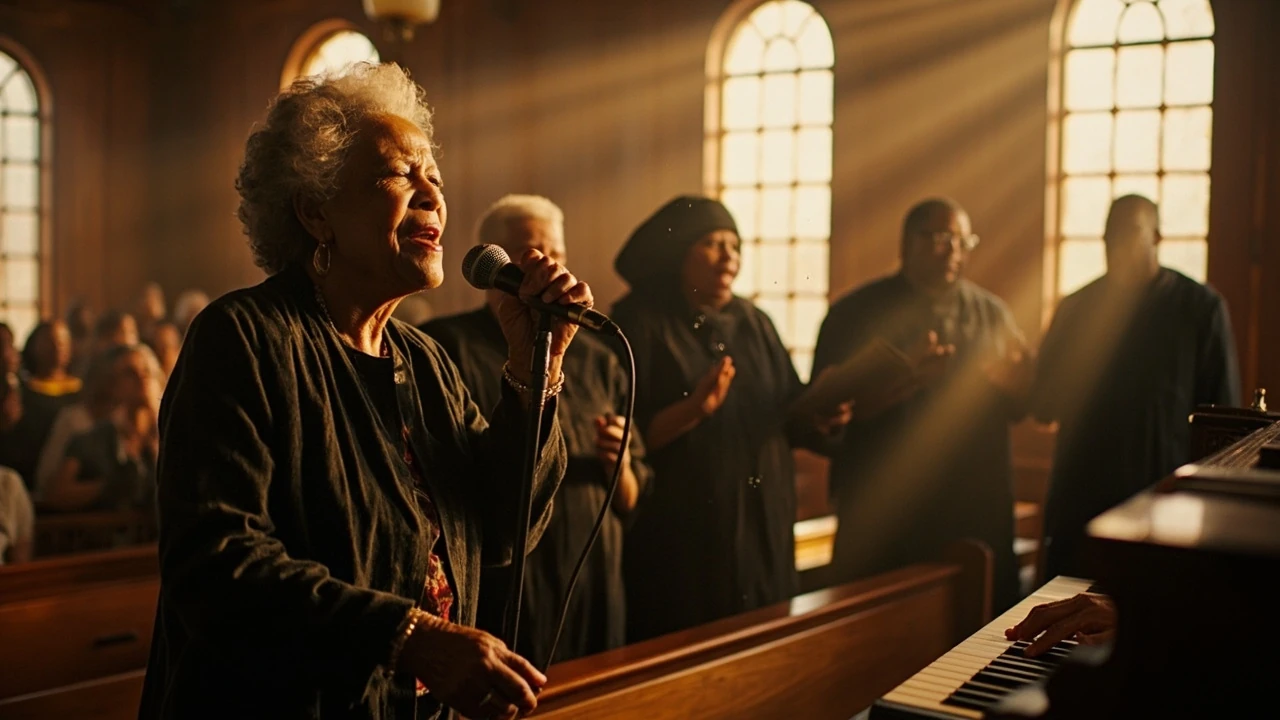
A grandmother stands at the front of a small wooden church in the Mississippi Delta, clapping an off-beat rhythm while the choir answers her line with a tight three-part harmony. The pianist hammers a boogie pattern in the bass, and a single-rank pipe organ hums behind the singers, filling the room with air when the harmony thins. The result is older than any radio playlist and more layered than a single hymnbook page. That layered sound is what most listeners are searching for when they type gospel music into a search bar.
Gospel music is one of the few American art forms that grew directly out of a specific community’s daily life. It started among enslaved and free Black Americans in the 19th century, fused with blues and later jazz, then spread into recordings, films, and the wider Protestant world. Today the term covers a family of styles, from the slow four-part harmony of a traditional church choir to the brass-heavy sound of an early Aretha Franklin track to a contemporary praise band on a Sunday stage.
This article unpacks what gospel music actually is, where it came from, how it is built, and where it sits next to the pipe organ. The pipe organ reference is not accidental: most of the early gospel tradition was written for, and shaped by, the organ, and that relationship still matters for listeners, organists, and church musicians today.
What gospel music is, and what it is not
At its core, gospel music is sacred Christian music rooted in the African American experience. It is music written to express personal faith, to accompany worship, and to carry theological ideas through melody, rhythm, and call-and-response rather than through lecture or printed commentary. A useful working definition is this: gospel music is vocal sacred music that combines Christian text, African American musical language, and a strong sense of rhythmic pulse.
That definition rules out a few common confusions.
- It is not the same as spirituals, although the two overlap. Spirituals are the older 19th-century songs, often anonymous, that came out of slavery and emancipation. Gospel is the 20th-century commercial and church tradition that built on them.
- It is not the same as contemporary Christian music (CCM), which usually refers to post-1970s radio-friendly praise songs written mainly by and for white evangelical artists.
- It is not a synonym for “any upbeat church music.” A hymn sung in four parts without syncopation is a hymn, not a gospel song, even if the text is devotional.
The point of drawing these lines is not to gatekeep. It is to help a listener, singer, or programmer know what to expect when a song, an album, or a concert is labeled gospel.
A short history of gospel music
Three threads feed into the modern gospel sound: the spirituals of the 19th century, the blues of the early 20th century, and the revival-tent and storefront-church culture of the same period. Each of these threads left a clear mark on how a gospel song is built.
The spiritual foundation
African American spirituals such as Steal Away, Swing Low, Sweet Chariot, and Wade in the Water are the bedrock. These songs used call-and-response, pentatonic melody, and flexible rhythm in a way that white Protestant hymnody of the same era did not. When gospel composers of the 1930s and 1940s wanted a sound that felt rooted, they borrowed directly from this older layer.
Spirituals were not always published with named composers, and many circulated orally inside congregations before being written down. Collectors like John Wesley Work II and his son John Wesley Work III were among the first to publish systematic collections for a wider reading public, and their work preserved songs that would otherwise have stayed local and unrecorded.
The blues and jazz influence
Around 1900, blues was beginning to take shape in the Mississippi Delta and along the Texas–Louisiana border. By the 1920s, the first blues recordings were circulating, and the rhythmic feel of blues, with its bent notes, flattened thirds and sevenths, and walking bass, started to leak into church music through musicians who played both. Jazz added syncopated harmony and the idea that a soloist could improvise inside a known chord progression.
This is why so many early gospel songs have a shuffle feel. A song like Thomas A. Dorsey’s Take My Hand, Precious Lord (1932) is a hymn in form but uses blues harmony in the chorus. Dorsey is widely called the “father of gospel music” because he made that blend explicit and built a publishing and concert infrastructure around it.
The publishing, radio, and revival years
From the 1930s through the 1960s, gospel music grew as a recorded and broadcast art. Singers like Mahalia Jackson, the Clara Ward Singers, the Staple Singers, and the Five Blind Boys of Alabama toured a circuit that included churches, revival tents, and eventually concert halls. Radio programs and labels like Savoy, Specialty, and Vee-Jay carried the music out of the South and into northern cities during the Great Migration.
This is also the period when the visual language of gospel performance was set: choir robes, a lead singer at the front, a piano or organ as the harmonic engine, and a congregation that was expected to respond.
The crossover moment and after
By the late 1950s, gospel harmony, vocal technique, and rhythmic feel were influencing secular R&B, soul, and early rock and roll. Aretha Franklin’s father, C.L. Franklin, was a famous Baptist preacher, and her 1960s work at Atlantic Records shows gospel’s harmonic density applied to secular material. Sam Cooke left the Soul Stirrers in 1957 and crossed over a year later with You Send Me. The pattern has continued: many soul and R&B singers started in the church choir, and the boundary between gospel and its secular neighbors has stayed porous.
The building blocks of a gospel song
A gospel song is built from a small set of repeatable elements. Once you can hear them, the differences between substyles start to make sense.
| Element | What it does | Typical example |
|---|---|---|
| Call and response | A lead voice sings a line, the choir answers it. | “Precious Lord” call, “Take my hand” response |
| Three- or four-part harmony | Choir voices stack in close intervals, often with a strong soprano line. | Staple Singers on Uncloudy Day |
| Walking or boogie bass | Piano or organ plays a moving bass line that gives the song forward motion. | Dorsey’s piano behind Take My Hand, Precious Lord |
| Shouted or whooped lead | Lead singer adds melismas, moans, and speech-like ornaments. | Mahalia Jackson in Dust Bowl Blues |
| Pentatonic or modal melody | Melody sticks close to five-note or modal scales, giving an open, hymn-like feel. | Many verses of Amazing Grace in older gospel arrangements |
These elements appear in different proportions depending on the substyle. A traditional a cappella group will lean on harmony and call-and-response. A 1950s gospel quartet will add a shouted lead. A contemporary praise song will keep the harmony but lean on a band.
Main styles inside the gospel family
“Gospel music” is a family name. The styles under it have different rhythmic feels, different instrumentation, and different historical contexts. The most important ones for a general reader are listed below.
Traditional or classic gospel
This is the Dorsey–Jackson sound of the 1930s to the 1960s. Slow or moderate tempo, piano-led, choir supported, lyrics that treat a personal crisis in devotional language. Albums like Mahalia Jackson’s Amazing Grace (1972) are the touchstone. The organ is used as a soft pad, not as the main voice.
Gospel quartet
A small male vocal group, usually four or five singers, often performing a cappella or with light guitar. The style grew out of the hard gospel of the 1940s and 1950s. Groups like the Fairfield Four, the Blind Boys of Alabama, and the Soul Stirrers defined the sound. The lead singer shouts, and the group answers with tight, low harmony underneath.
Urban contemporary and praise and worship
From the late 1970s onward, a new generation of writers, including Andraé Crouch, produced gospel with electric bands, drum kits, and a softer, pop-friendly melodic surface. This style overlaps heavily with what is now called contemporary praise and worship. The organ becomes optional; a synth pad or electric piano often replaces it.
Southern gospel
Mostly a white American tradition with its own roots, but it shares a name and some habits with Black gospel. Tight family-like harmony groups, often with a piano and sometimes a small organ, and lyrics that lean on personal testimony. The Gaither Vocal Band and the Oak Ridge Boys are well-known examples.
Black gospel and CCM crossover
Modern gospel often blurs the line with contemporary Christian music, R&B, and even hip-hop. Artists like Kirk Franklin, Fred Hammond, and Tye Tribbett use drum machines, full bands, and choreographed choirs. Lyrically the songs sit between personal testimony and doctrinal teaching.
The table below is a quick reference for the most common style distinctions.
| Style | Period | Core sound | Typical instruments |
|---|---|---|---|
| Traditional / classic | 1930s–1960s | Slow to moderate, choir-led, blues harmony | Piano, light organ, sometimes guitar |
| Gospel quartet | 1940s–1960s | A cappella or lightly accompanied, shouted lead | Voice only, or small guitar |
| Urban contemporary | 1970s–present | Pop-influenced, melodic, choir or group vocals | Keyboards, drum kit, bass, guitar |
| Southern gospel | 1940s–present | Tight harmony, testimony-based lyrics | Piano, sometimes organ |
| Black gospel / CCM crossover | 1990s–present | High production, modern rhythm, choir hooks | Full band, drum machines, choir |
The pipe organ and the gospel sound
The relationship between gospel music and the pipe organ is older than most listeners realize. In the late 19th and early 20th centuries, the pipe organ was the largest and most powerful instrument in most American churches, Black and white. Many For additional context, early gospel songs were first heard in churches where a small one- or two-manual organ accompanied the choir.
For a fuller sense of how an organ is voiced for this kind of supportive role, the practical walk-through in pipe voicing: how organ builders shape tone one pipe at a time shows how individual ranks are tuned and regulated to sit underneath a vocal ensemble without covering it.
The organ’s job in a gospel setting is usually to do three things at once: hold the choir’s harmony, add weight to the bass, and provide a soft cushion of sound when the singers drop out. This is a different use than, say, a Bach prelude, where the organ is the soloist. In gospel, the organ is a member of the rhythm section, even though it has no drums.
A few practical points follow from that role:
- Registration matters more than volume. A full principal chorus with all the mixtures will drown a choir; a single 8′ principal with a soft 4′ flute on top will sit in the texture.
- Manual changes are used as color, not as drama. Switching from a Great principal to a Swell flute in the last verse is a common gospel organ move.
- The pedal is mostly used for slow harmonic support, not for solo lines. A 16′ Bourdon on the pedals, used lightly, gives the choir a low floor without taking over.
For a general introduction to the building blocks of registration, organ registration: a practical guide to shaping pipe organ sound covers the same vocabulary from a different angle, and a broader view of how stops are named and grouped is in organ stops explained: families, ranks, and how to read a stop list.
How gospel music is performed live
Anyone who has only heard gospel on a recording has missed a large part of it. A live gospel service is a directed conversation between a lead singer (or singers), a choir, an instrumentalist, and a congregation. The structure is flexible and depends on what the room will carry.
The role of the lead singer
The lead singer is the storyteller. They choose the tempo, set the emotional tone, and decide when to extend a phrase. A skilled lead will hold a single word for several bars, bend the pitch down, then come back up to the tonic on the next line. This is sometimes called “whooping” or “shouting,” and it is the most distinctive vocal gesture in the tradition.
The role of the choir
The choir is the answer. They repeat the lead’s last line, hold a sustained chord underneath an improvisation, or break into a full-throated refrain at a signal. Choirs are often divided into at least three parts, with sopranos carrying the tune and altos, tenors, and baritones providing the harmony.
The role of the pianist and organist
The piano is the engine. In most traditional and contemporary Black gospel settings, the pianist plays a left-hand walking bass and a right-hand voicing that mirrors the choir’s harmony. The organist watches the room and adds weight or color when the song needs it.
A common organ technique in gospel is to play a soft, sustained chord on a Swell flute in the first verse, then add a 4′ principal in the second verse, then bring in the pedal at 16′ in the last chorus. This kind of slow registration build is one of the easiest ways for a small organ to support a large choir without being heard as a separate instrument.
Gospel music in worship and in concert
Gospel exists in two main contexts: worship and concert. The two overlap, but the priorities are different.
- In worship, the song is part of a service. Its job is to carry a theological point, mark a moment in the liturgy, or invite a personal response. The congregation is the audience, and the lead singer is often a pastor or worship leader.
- In concert, the song is the event. The audience is listening, not responding in the same way, and the singers are expected to deliver a polished set. Albums and broadcasts grew out of this concert tradition.
The same song can work in both, but the arrangement often changes. A worship arrangement of a gospel song is usually simpler, slower, and easier for a congregation to join. A concert arrangement adds instrumental breaks, key changes, and extended vocal improvisation.
Notable figures who shaped the sound
Most of the names below are well known inside the tradition, and a few are widely known outside it. Their importance is that each one shifted the balance of harmony, rhythm, or staging in a way that the next generation copied.
- Thomas A. Dorsey (1899–1993): composer, pianist, and the main figure who fused blues harmony with sacred text.
- Mahalia Jackson (1911–1972): the most famous traditional gospel soloist, known for a powerful contralto and a slow, deliberate delivery.
- Clara Ward (1924–1973): led the Clara Ward Singers and brought a more theatrical, high-energy stage style to gospel.
- Sam Cooke (1931–1964): lead singer of the Soul Stirrers before crossing into secular soul and pop.
- Aretha Franklin (1942–2018): began as a gospel singer, then took that vocal language into R&B and soul.
- Andraé Crouch (1942–2015): wrote a generation of contemporary gospel songs that crossed into mainstream Christian music.
- Kirk Franklin (b. 1970): producer, songwriter, and choir director who defined 1990s and 2000s urban gospel.
How to listen to gospel music with more detail
Listening to gospel is easier when you know what to listen for. A few practical habits help.
- Pick one voice to follow first. In a choir arrangement, the soprano usually has the tune. In a quartet, the lead has it.
- Listen for the bass. The piano or organ bass line is what gives a gospel song its forward motion. If the song feels flat, the bass is probably missing or too quiet in the mix.
- Notice the call-and-response. Most gospel songs have a clear back-and-forth between a lead phrase and a choir answer. When you can hear that pattern, the form of the song opens up.
- Watch for ornamentation. A lead singer’s whoops, scoops, and held notes are not mistakes. They are the moment where the singer takes ownership of the song.
- Try a few eras. A 1945 Soul Stirrers track, a 1972 Mahalia Jackson live album, and a 2000s Kirk Franklin record sound like three different genres. All three are gospel.
Frequently asked questions
Is gospel music only for Black churches?
No. Gospel music grew out of the African American church, and it still has its deepest roots there, but the style has been adopted by choirs and worship teams of many backgrounds. The term “gospel” itself comes from the Old English gōdspel, meaning “good news,” and the music is, at its center, Christian devotional singing.
What is the difference between a gospel song and a hymn?
A hymn is usually strophic, metrical, and harmonized in a way that is comfortable to sing in a congregation. A gospel song is usually built around a repeating chorus, leans on call-and-response, and uses blues or jazz harmony underneath. The texts overlap; the musical language is different.
Did the pipe organ play a role in early gospel?
Yes. Many of the churches where gospel was first heard had pipe organs, and the organ was used to support the choir and add weight to the harmony. The organ has never been the main instrument in gospel, but it has been a steady, quiet presence.
How is gospel music different from contemporary Christian music?
Contemporary Christian music (CCM) is a mostly post-1970s, mostly white evangelical form built around radio-friendly arrangements. Gospel has older roots, stronger ties to African American musical traditions, and a different harmonic and rhythmic language. The two styles have borrowed from each other often.
Can a pipe organ lead a gospel service on its own?
It can, but it is not common. A solo organ prelude before a service is normal in many Protestant and Catholic churches, and an organ can carry a full hymn tune with the right registration. For a typical gospel song, however, the piano and choir are the lead voices, and the organ is the support.
What should an organist do if asked to play for a gospel choir for the first time?
Listen first. Sit in a rehearsal if possible and watch what the pianist does. Then keep the registration light: a soft 8′ flute on one manual and a 16′ Bourdon on the pedals is usually enough. Add stops slowly across verses, follow the choir’s dynamics rather than leading them, and avoid solo passages unless asked.
Are there gospel songs that are also well-known as secular songs?
Yes. Several songs crossed over, including Sam Cooke’s You Send Me and A Change Is Gonna Come, and many of Ray Charles’s Atlantic recordings. In the other direction, secular melodies have been adapted into gospel contexts, though this is less common than the gospel-to-secular flow.
Where should a new listener start?
Three albums give a useful cross-section of the tradition: Mahalia Jackson’s Amazing Grace (1972, recorded in 1961) for traditional gospel, the Staple Singers’ Uncloudy Day (1959) for the quartet and family-group sound, and Kirk Franklin’s Whatcha Lookin’ At (1996) or God’s Property (1997) for late-20th-century urban gospel. Each is widely available and shows a clear style.
Practical takeaways
Gospel music is a sacred vocal tradition with deep roots, a clear set of building blocks, and a long relationship with the pipe organ. For a listener, the most useful habit is to notice the three elements that almost every gospel song shares: a lead voice, a choir answer, and a moving bass line. For an organist, the most useful habit is to listen before playing, keep the registration light, and treat the organ as a member of the rhythm section rather than a soloist. Either way, the music rewards close attention, and the tradition is large enough that a single article can only sketch the outline.