How does a pipe organ work? A supply of pressurized air enters selected pipes through valves. The organist uses the keyboards to choose notes and the stops to choose which groups of pipes will speak. The sound comes from the pipes themselves, while the console brings their controls within reach of one player.
That simple route explains a surprising amount of what happens during a performance. One held key can produce several pitches at once. Moving to another keyboard can change the sound without changing the notes. A foot may play a bass line while the other foot adjusts an expression pedal. Each movement has a different job, and following those jobs makes the instrument much easier to understand.
Follow the wind from the blower to the pipe
A modern pipe organ commonly receives its wind from an electrically powered blower. Windlines carry that air toward the instrument, and reservoirs or regulating devices help provide the pressure required by the pipework. From there, wind reaches the windchests beneath the pipes. The exact arrangement depends on the organ, but a continuous supply of wind is fundamental to an acoustic pipe sounding.
The Oklahoma Historical Society’s explanation of its organ follows this route through the blower, windlines, reservoirs and windchests. It is a useful real installation to compare with a simplified drawing. The equipment may be distributed through rooms or chambers, so the visible console is only one part of the complete instrument.
Wind does not simply escape through every pipe whenever the blower runs. Valves and the instrument’s note and stop mechanisms govern where it goes. A pipe needs the appropriate wind path to be open before it can sound. Releasing a key closes the relevant note control; the sustained supply to the selected pipe then ends.
This is why an organ tone can continue while a key is held. A piano string starts with a hammer strike and its vibration decays. The organ has an ongoing energy supply through the wind. The player shapes the beginnings, lengths and endings of notes against that sustained sound, which is one reason articulation matters so much in organ playing.
Two ways a pipe can turn wind into sound
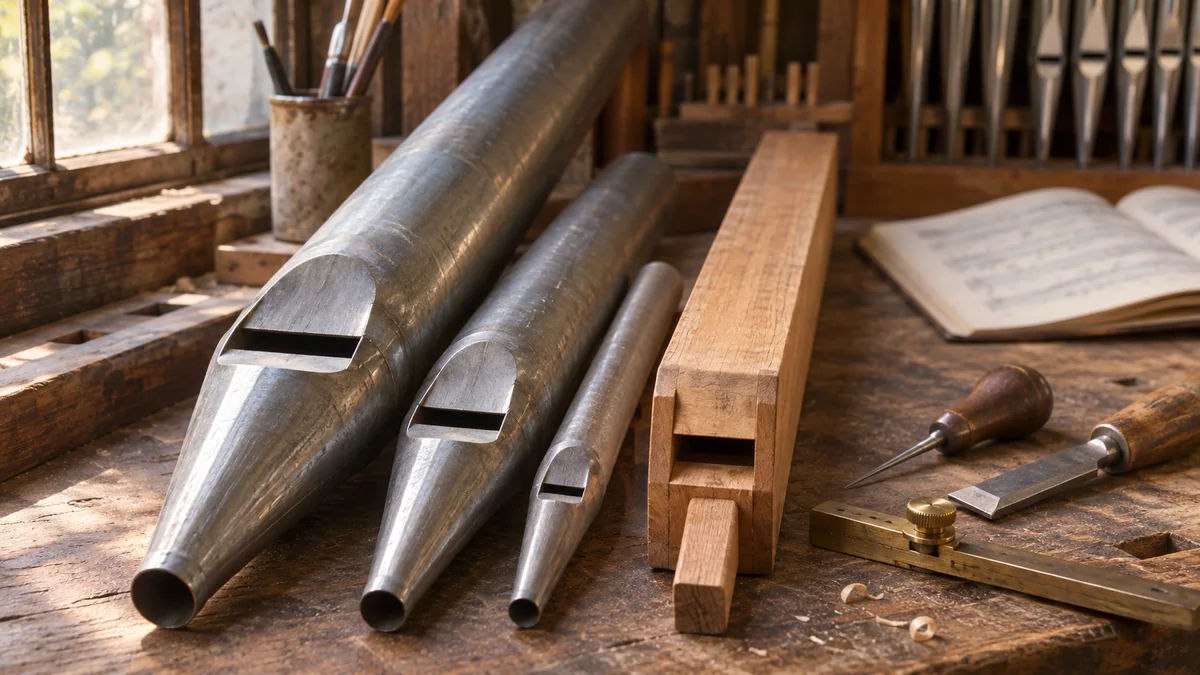
Flue pipes and reed pipes are the two broad sound-producing families to recognize first. In a flue pipe, wind is directed through a narrow passage toward the edge of the pipe’s mouth. The resulting oscillation interacts with the air inside the resonating pipe. A recorder offers a familiar comparison, although an organ has many separate pipes rather than a player changing finger holes on one instrument.
A reed pipe contains a vibrating reed tongue associated with a shallot and resonator. Wind sets the reed into motion, and the resonator helps shape the resulting sound. This produces a different mechanism from the edge-tone process of a flue pipe. A stop called Trumpet or Oboe generally belongs to the reed family; names and construction details vary across organ-building traditions.
Yamaha’s demonstration of combining timbres shows how several sounding pitches can blend into a single tonal color. For an initial listening comparison, try principal, flute and string-toned voices when they are available. These labels describe musical character; a string-toned organ stop still produces its sound with organ pipes, rather than bowed strings hidden inside the case.
Length, width, shape and the treatment of the mouth or resonator all matter to a pipe’s behavior. Open and stopped pipes also behave differently. This is why measuring the outside length alone does not tell the whole story of a pipe’s pitch or tonal character. The builder designs and voices the pipe as part of a larger set, intended to work with the other pipes and the room.
Wood and metal are both used in organ pipework. The impressive metal pipes in a façade may be only a small part of the instrument. Other ranks can stand behind the casework or in chambers. Looking at the display pipes is therefore a good introduction to the visual design, but an incomplete inventory of the sounds available to the player.
How a key reaches a valve
The connection between a key and the valve it controls is called the key action. A mechanical, or tracker, action transmits movement through a physical linkage. Pressing the key moves that linkage and operates the valve. On an electric-action pipe organ, the key sends an electrical signal that ultimately operates the appropriate valve mechanism.
Electrical control does not make the pipe sound electronic. Wind still enters an acoustic pipe. Yamaha’s explanation of pipe organs using electrical signals describes how this allows the console to be positioned at a distance from the pipes. Sound production and the means of controlling it are separate questions.
Windchest designs differ too. On a slider chest, the note mechanism admits wind to a channel, while a movable slider determines which rank has an open passage above it. Yamaha’s description of sliders and the windchest illustrates how these controls intersect. It is one common way to explain the logic, rather than a claim that every organ contains the same chest design.
From the audience, most of this mechanism is out of sight. A small movement at the console can operate equipment elsewhere in the building. During an authorized demonstration, a builder’s model or an exposed teaching action can make the connection visible. There is no need to open an instrument or move its internal components to understand the basic sequence.
Stops select sounds; ranks describe pipework
A rank is a set of pipes with a related tonal character, arranged across a range of notes. A stop is the player’s control for bringing a sound into use. On a straightforward instrument, a stop may control one rank. That convenient example is not a universal counting rule: a mixture can involve several ranks, while extension or borrowing can allow pipework to serve more than one control.
Yamaha’s guide to the role of stops shows how a name and a pitch designation work together on a stop label. Choosing a combination of stops is called registration. It gives the player a way to build a solo color, a supporting accompaniment or a fuller ensemble from the resources of that particular organ.
Consider a simplified instrument with one independent rank covering 61 notes. That rank would have a pipe for each note in the assumed range. Three independent single-rank stops of the same range would require three such sets. This is an illustration of the counting principle, not a specification for every organ: real instruments can have different keyboard ranges and more complicated ways of sharing or combining pipework.
Registration also explains why an organist may press the same key twice and produce a markedly different sound. The key selects the note control, while the active stops determine what responds to it. A change of registration can alter color and pitch content together. Counting drawknobs without knowing what they control gives only a partial picture of the instrument.
When reading a stoplist, start with the division, stop name and pitch marking. Then look for details such as mixtures, borrowed stops or extensions. Those details are more informative than treating a total number of stops as a complete measure of the organ. They describe how the player’s available controls relate to the actual pipework.
What 16′, 8′, 4′ and 2′ mean
The foot number on a stop describes its sounding pitch level. An 8′ stop sounds at the normal written pitch; a 4′ stop sounds an octave above that, while a 16′ stop sounds an octave below. Brigham Young University’s OrganTutor explanation of eight-foot pitch provides the reference point for reading these labels.
| Pitch marking | Relation to 8′ pitch | What a listener can notice |
|---|---|---|
| 16′ | One octave lower | A lower layer beneath the normal written pitch |
| 8′ | Normal written pitch | The reference level for the note being played |
| 4′ | One octave higher | An added upper-octave layer |
| 2′ | Two octaves higher | A higher layer that changes the combined sound |
The number is not a volume rating. A 16′ stop is lower in pitch than a corresponding 8′ stop, but that does not automatically make it louder. Nor is every pipe in an 8′ rank eight feet long. The pipes become shorter as their notes rise, and stopped pipes can achieve a given pitch with a different physical length from open pipes.
For a listening demonstration, ask the organist to hold one note with an 8′ stop, then add a 4′ stop without changing the key. The additional octave becomes audible even though the hand has stayed in place. Adding a 2′ stop extends the same idea upward. This is a simple way to hear how registration changes the pitch content of one played note.
Manuals, pedals and couplers divide the work
The keyboards played by the hands are called manuals. A pedalboard gives the feet another keyboard, often used for a bass line, though the music can assign it other roles. Multiple manuals allow the player to move between groups of sounds or play contrasting parts simultaneously. The number of manuals alone does not reveal the number of pipes or the complete tonal resources.
A division is a section of the instrument with its associated pipework and controls. Names such as Great and Swell help identify divisions, but naming conventions differ. A coupler links controls so that playing on one keyboard can also call on resources associated with another. The exact function is shown by the coupler’s label and the instrument’s specification.
| Control | Main job | What to watch during a demonstration |
|---|---|---|
| Manual key | Select a note through the key action | When the note begins and ends |
| Stop control | Select a sound or resource | How the color changes on the same note |
| Pedalboard key | Play notes with the feet | An independent bass or other musical line |
| Coupler | Connect specified keyboard resources | How another division responds |
| Expression shoe | Move shutters for an enclosed division | A change in the sound reaching the room |
| Combination piston | Recall a prepared registration | Several stop changes made together |
These controls explain some of the choreography at the console. A foot pressing a pedalboard note is playing music. A foot moving an expression shoe is adjusting a control. A thumb pressing a piston may change the registration for the next passage. Similar-looking movements can therefore have quite different consequences for what the audience hears.
How an organ becomes louder, softer and clearer
Adding or removing stops changes the sound available to the player. An enclosed division offers another control: shutters between the pipes and the room can open or close under an expression shoe. Closing those shutters changes how sound escapes from the enclosure. It does not mean the organist has physically shortened the pipes or stopped the blower.
Touch also matters, particularly to the start, duration and release of notes. Playing an organ as if it were a piano can be misleading: simply striking a key harder is not the ordinary way to create the piano-like dynamic change a beginner might expect. The instrument’s action, registration and musical articulation need to be understood together.
The room contributes to the result. Reflections and reverberation affect the way successive notes overlap and the balance a listener perceives. Yamaha’s discussion of sound at different listening positions notes that the experience near the console differs from the sound in the audience seating. A recording microphone adds another listening position of its own.
This is worth remembering when comparing organ videos. A close microphone can emphasize attack and detail, while another position captures more of the room. A bright or distant recording does not, by itself, establish how the instrument sounds from every seat. Listening in the building gives useful information that a single clip cannot provide.
A listening sequence that reveals the mechanism
A short demonstration can make the instrument understandable without technical jargon. Ask the player to begin with one simple 8′ sound. Listen to a held note, its release and a short melody. Then hear a different 8′ sound on the same notes. Keeping the pitch level constant makes the change of tonal character easier to follow.
Next, compare an open and a stopped flute if the organ has suitable examples, then hear a reed against a flue sound. For more detail on that distinction, see our explanation of reed stops and their sound. Finish by adding an upper-octave stop and, if available, demonstrating the shutters of an enclosed division. Each step should change one thing at a time.
If a note does not behave as expected, describe what happened rather than reaching into the instrument. Note the keyboard, active stops and whether the problem occurs on one note or several. That information helps a qualified technician investigate. Removing a pipe, changing an adjustment or applying a household cleaning product can create additional problems.
Yamaha’s maintenance guidance points out how easily soft metal pipework can be damaged. Tuning and voicing are specialist tasks with different purposes. Our guide to organ tuning explains the maintenance context; a beginner’s first demonstration is best kept to supervised playing and listening.
Frequently asked questions about pipe organs
Is a pipe organ a keyboard instrument or a wind instrument?
It is controlled from keyboards, but the pipes are sounded by wind. Those descriptions refer to different aspects of the same instrument: how the performer operates it and how it produces sound.
Does each key have only one pipe?
Not necessarily. A key can activate pipes from several selected ranks, and mixtures can supply several pitches together. The combination of note controls and registration determines what responds when that key is pressed.
Why can the organ hold a note for so long?
Wind continues to supply the selected pipe while its control remains open. Unlike a struck piano string, the tone does not rely solely on energy delivered at the start of the note.
Does an electric-action organ use loudspeakers?
Electric action describes how the console controls pipe valves. An electric-action pipe organ still produces sound in acoustic pipes. That term alone does not describe an electronic sound-generation system.
What happens when the organist pulls out a stop?
The relevant sound or resource becomes available to the note controls. Pulling a stop does not ordinarily make every pipe in that rank sound immediately; the player still needs to select notes.
Is an 8′ stop always made of eight-foot pipes?
No. The marking identifies a pitch level, and pipe lengths vary across the rank. Open and stopped construction also affect the physical length needed for a given sounding pitch.
Why does the organ have so many keyboards?
Several manuals let the player use and contrast different divisions conveniently. They can support a solo and accompaniment or allow a quick move between registrations. The number of manuals is only one part of the specification.
Can a visitor try the controls?
Only with permission and supervision from the responsible organist or owner. A demonstration can show notes, stops and expression clearly while keeping the instrument’s setup and delicate internal components undisturbed.