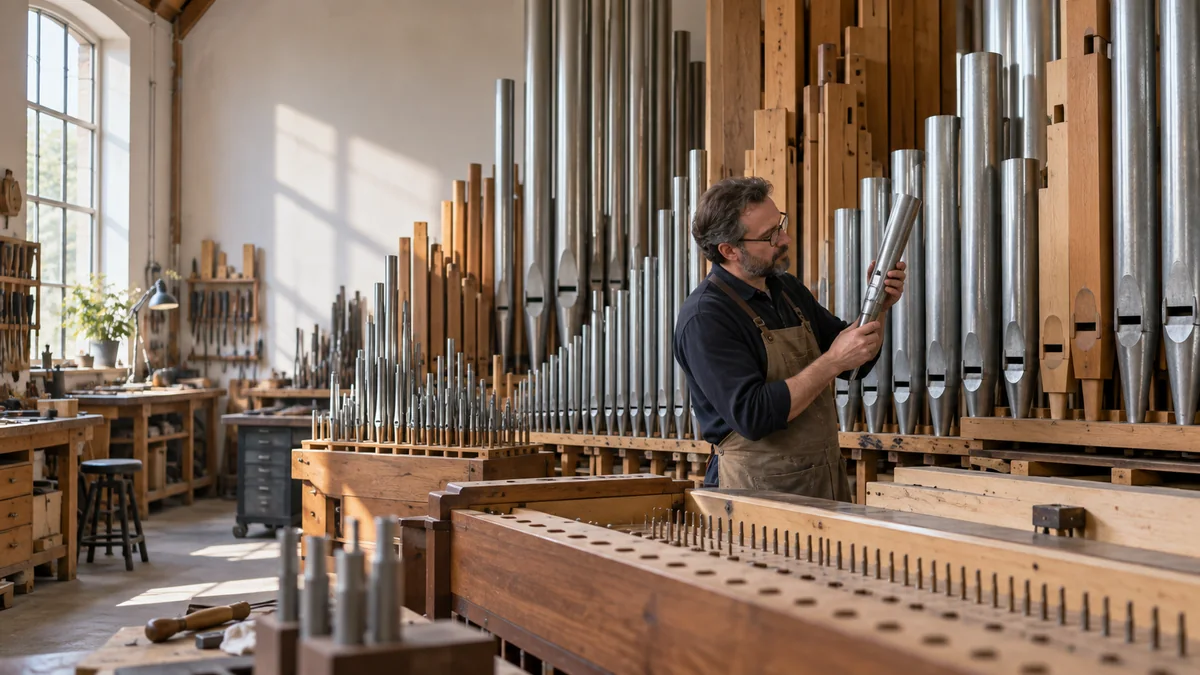
How many pipes are in a pipe organ?
Answering the question “how many pipes are in a pipe organ” depends almost entirely on what kind of instrument you are standing in front of. A small chamber organ built for a recital room may hold only a few dozen pipes, while a large cathedral organ can contain more than thirty thousand. The reason for that enormous range is structural: each rank of pipes covers one note per key across the manual or pedal compass, and most pipe organs contain many ranks. The total count is therefore a function of how many ranks the builder chose, how many notes each rank covers, and whether the design borrows ranks between manuals through couplers.
For a rough working figure, small organs sit between 200 and 800 pipes, mid-sized church and concert organs land between 1,500 and 5,000 pipes, and the largest instruments built for cathedrals and town halls pass 10,000. The extremes, such as the famously large instruments in Atlantic City, Sydney Town Hall, and the Wanamaker department store in Philadelphia, run well past 28,000 pipes. Those numbers are useful starting points, but the question “how many pipes are in a pipe organ” only really makes sense when you know what the pipes are doing for the player.
That is the gap between a marketing brochure and a working instrument. A small organ with 400 well-chosen pipes can outperform a large organ with 6,000 poorly scaled pipes, because every rank has to speak at the right volume, at the right pitch, and with the right harmonic development. If you are trying to picture a specific instrument, the safest way is to read the organ builder’s stop list, count the pipes per rank, and add them up. The guide below shows you how.
What a single pipe actually does
Before adding anything up, it helps to remember that a pipe organ is not a single instrument in the way a piano is. Each pipe is an independent oscillator, shaped to speak one note at one fixed pitch. When you press a key, the valve underneath that specific pipe opens and lets wind reach the pipe’s mouth, where the air stream strikes a lip and produces a sustained tone. Press the same key with a different stop drawn, and a completely different pipe sounds, in a different rank, with a different timbre. The number of pipes in a pipe organ is therefore a count of how many of these individual sound sources the builder has provided.
Because each pipe plays one pitch, the pipes in a rank are arranged from longest to shortest, with the longest speaking the lowest note and the shortest the highest. Metal pipes are usually made from a tin and lead alloy, although cheaper alloys and aluminium are used in practice organs. Wooden pipes, common for stopped flues and many bass registers, are turned or built up from staves. The tallest pipe in the whole organ, often a thirty-two-foot wooden open or stopped bass, can be over ten metres long, while the highest pipes may be only a few centimetres.
Ranks, stops, and the real counting method
Every playable pipe belongs to a rank, and every rank belongs to a stop that the organist can pull at the console. The most reliable way to find out how many pipes are in a pipe organ is to read the stop list and add up the pipes in each rank.
For most flue ranks, the rule is simple:
- Each manual rank normally spans 61 notes, one per key on a five-octave manual.
- Each pedal rank normally spans 32 notes, one per key on a standard pedalboard.
- A rank that crosses from manual to pedal (a “borrowed” or “extended” rank) still contains the same number of pipes as its full compass.
For reed ranks, the rule changes, because reed pipes require a separate resonating pipe (the “resonator”) on top of the beating reed. The number of pipes is therefore equal to the number of reeds plus the number of resonators, but the player still sees one stop per rank.
A small two-manual organ with eight stops might have the following typical pipe count:
| Stop | Type | Compass | Pipes |
|---|---|---|---|
| Open Diapason 8′ | Flue, manual | 61 notes (C–g”’) | 61 |
| Stopped Diapason 8′ | Flue, manual | 61 notes | 61 |
| Principal 4′ | Flue, manual | 61 notes | 61 |
| Flute 4′ | Flue, manual | 61 notes | 61 |
| Nazard 2 2/3′ | Flue, manual | 61 notes | 61 |
| Mixture III | Compound, manual | 61 notes, three pipes per key | 183 |
| Trumpet 8′ | Reed, manual | 61 notes | 61 |
| Bourdon 16′ | Flue, pedal | 32 notes | 32 |
| Pedal Principal 8′ | Flue, pedal | 32 notes | 32 |
| Total | 613 |
A modest organ of this kind sits in the middle of the practical range, and it explains why the question “how many pipes are in a pipe organ” cannot be answered with a single number. The total depends on the mix of stops, the number of manuals, and the choice of pedal stops.
Typical pipe counts by organ size
Although every instrument is designed for its own room, organ builders work within broad tiers. The following table shows how pipe counts scale with the size of the instrument, based on common practice in twentieth and twenty-first century building.
| Size category | Typical use | Stops | Approximate pipes |
|---|---|---|---|
| Continuo or chamber organ | Recital room, teaching | 4–8 | 200–500 |
| One-manual practice organ | Home, conservatory | 3–6 | 150–400 |
| Two-manual chapel organ | Small chapel, side room | 8–14 | 500–1,200 |
| Two-manual church organ | Parish church | 14–22 | 1,200–2,000 |
| Three-manual church organ | Parish or recital church | 24–40 | 2,000–3,500 |
| Three-manual concert organ | Town hall, recital venue | 40–60 | 3,500–6,000 |
| Four-manual cathedral organ | Cathedral, basilica | 60–100 | 6,000–12,000 |
| Five- to seven-manual symphonic organ | Major civic or cathedral organ | 100–200+ | 12,000–33,000+ |
These bands describe what is reasonable, not what is mandatory. A skilled builder can produce a remarkably expressive two-manual organ of around 1,500 pipes, while a poorly scaled large organ may contain far more pipes than its sound justifies. Size and quality are different conversations.
Where the extremes really sit
Most readers asking “how many pipes are in a pipe organ” have seen headline figures about the largest instruments. The largest pipe organs in active service, such as the Midmer-Losh organ in the Boardwalk Hall in Atlantic City and the organ in the Wanamaker building in Philadelphia, sit in a category of their own. The Wanamaker organ is generally described in published accounts as containing just over 28,000 pipes spread across six departments. The Atlantic City organ, when the entire console is engaged, runs close to 33,000 pipes.
At the other end of the scale, a positive organ of the kind used for continuo work in a Baroque chamber ensemble can have as few as twenty to thirty pipes. Small portative organs used in teaching may have one rank of about forty-five pipes and a single manual. The smallest practical pipe organ is therefore well under 100 pipes, and the largest practical pipe organ is well over 30,000. Both are real, working instruments, and both are correctly described as pipe organs.
How the manual and pedal compass changes the total
Two organs with the same number of stops can have very different pipe counts if the compass of the keyboards and pedalboard is different. The wider the compass, the more pipes each rank must contain.
- A short compass manual of 56 notes, sometimes used in older English organs, needs 56 pipes per manual rank.
- A standard continental manual of 61 notes (C to g”’) needs 61 pipes per rank.
- An extended manual of 67 notes or more, occasionally fitted to modern recital instruments, needs 67 or more pipes per rank.
- A standard pedalboard of 32 notes (C to g’) needs 32 pipes per pedal rank, while a short 30-note pedalboard needs 30.
When a builder chooses a wider manual or pedal compass, the pipe count grows without changing the number of stops. A 70-stop organ with 67-note manuals and a 32-note pedal will easily contain several hundred more pipes than the same 70-stop organ built to a 56-note manual and 30-note pedal. The published pipe count is therefore not a direct measure of stops, and the two numbers should be read together.
Why mixture stops push the count up fast
Mixture stops are compound stops that sound more than one pipe per key, with each additional rank tuned to a higher harmonic. A Mixture III sounds three pipes per key, a Mixture V sounds five, and a sharp Mixture VII or IX may sound nine on the upper notes only. The pipes per key in a mixture also changes with pitch: a typical Mixture III may run as two ranks on the lowest octave, three in the middle, and four or five on the top. The result is that mixture stops often account for a quarter to a third of all pipes in a moderate organ.
If you are trying to estimate pipe count from a stop list, work out the number of speaking pipes in each rank and account separately for mixtures, extensions, borrowed ranks, and non-speaking facade pipes. The American Guild of Organists offers a useful technical primer in its guide to ranks, stops, manuals, and pipe families.
How couplers, extensions, and unification change the count
Modern organ builders often reduce the pipe count without losing the player’s flexibility by using unification, extension, and borrowing. In a unified organ, one rank of pipes may be used at more than one pitch through the action. A single 16-foot Principal rank might be pulled at 16′, 8′, 4′, and 2′ stops from different manuals. The result is fewer pipes, but more stops at the console.
The same principle is used in extensions, where a rank is split into several pitch sections to provide more stops. In both cases, the player’s experience is rich, but the actual pipe count is lower than the stop count would suggest. A unit organ with 100 stops may contain 4,000 pipes, while a traditional organ of 50 stops might contain 5,000. The number of stops, in other words, does not equal the number of pipes.
Couplers, on the other hand, do not add pipes. A coupler simply lets the keys of one manual also play the pipes of another. The pipes themselves are unchanged, and the pipe count stays the same. The article on how organ couplers affect registration explains how that mechanism works at the console.
Counting pipes in a specific organ
For a given instrument, the safest method is to work from the stop list rather than from a guess. The following steps give a reliable total:
- List every stop, grouped by manual and pedal.
- For each flue rank, multiply the compass of the keyboard or pedal by the number of ranks in the stop (one for a principal or flute, two or more for a mixture).
- For each reed rank, count one pipe per note across the compass, including the resonators.
- Subtract any pipes that are shared between stops, which is the case when a stop is drawn from an existing rank at a different pitch.
- Add up the totals. This is the working pipe count of the organ.
Most professional organ builders publish a complete pipe schedule with the contract documents. The schedule lists every pipe by note, material, mouth width, cut-up, and length. It is the most accurate source, and the difference between the schedule and a stop list estimate is usually under five percent for a traditional instrument. For a unified organ, the difference can be much larger, and the stop list alone is misleading.
How pipe material affects size, not count
Material changes the sound, the cost, and the dimensions of each pipe, but it does not change how many pipes are in a pipe organ. A wooden stopped pipe that sounds an 8-foot C is much shorter and wider than a metal open pipe of the same pitch, but both count as one pipe. For a 32-foot wooden Contra Trombone, the pipe may be over ten metres long, while the highest pipes in a mixture are barely the size of a pencil. The variety of sizes inside a single instrument is part of what makes pipe organs visually striking.
Wooden pipes are typically used for the lowest flues, for stopped flues, and sometimes for the largest reed resonators. Metal pipes, made from a tin and lead alloy, are used for most principal ranks, for most mixtures, and for the upper work of the instrument. The proportions of wood to metal in a given organ depend on the builder’s style and the room, but the total count of pipes is unaffected.
Common questions about pipe counts in real organs
Several specific instruments come up repeatedly when readers ask how many pipes are in a pipe organ. The following notes describe the figures most often quoted in published sources.
- The organ at Sydney Town Hall, a large four-manual instrument completed in 1890 and rebuilt since, contains roughly 8,000 pipes and is one of the largest in the southern hemisphere.
- The organ in Liverpool Cathedral is regularly described as having just over 10,000 pipes across four manuals, with one of the largest pedal compasses in the world.
- The organ in the Cathedral of Our Lady in Antwerp contains around 9,000 pipes and is a good benchmark for a large continental cathedral organ.
- The organ in Passau Cathedral, St. Stephen’s, has been described in builder’s literature as containing around 17,774 pipes across five divisions.
- The Wanamaker organ in Philadelphia is regularly cited at roughly 28,000 pipes, while the Midmer-Losh organ in Atlantic City runs close to 33,000 when all divisions are in use.
These are working instruments, and exact counts depend on which divisions are counted and how pipes shared between stops are attributed. For a strict total, only the builder’s stop list and pipe schedule are reliable.
Why the question is harder than it looks
Anyone asking how many pipes are in a pipe organ is usually comparing instruments, budgeting for a new build, or trying to understand what they are looking at inside an organ case. Each of those purposes needs a different answer.
For a comparison between organs, the better question is how many ranks the organ has, because ranks determine the tonal palette. For a new build, the better question is how many speaking stops the specification requires, because the stop count is what the player experiences. For a tour of the organ case, the better question is how many ranks are visible behind the pipe shades, because that tells you what the builder chose to show. None of these answers is the same as a raw pipe count, and the pipe count alone is a weak way to compare instruments. The article on organ pipe scaling and tone explains why two ranks of the same stop can sound different simply by being scaled to a different room.
A practical way to compare two organs
Once you have the pipe count for each instrument, divide by the number of speaking stops to get the average pipes per stop. A traditional organ often has an average between 50 and 70 pipes per stop, because most stops are 61-note manual ranks and most manuals carry a mixture or two. A heavily unified organ may drop below 30 pipes per stop, because the same rank is borrowed at several pitches. The two organs are not equivalent in player experience even if the totals are similar.
For a more useful comparison, multiply the number of stops by the number of manuals, then add the number of independent pedal stops. That figure, sometimes called a “tonal mass index” in trade literature, gives a much better sense of what the player can do than a single pipe count. The pipe count is best read as a number that tells you the cost and the size of the organ case, not the player’s expressive range.
Quick reference: counting pipes in a flue rank
For most readers, the easiest way to count is to remember three rules.
- A standard manual flue rank contains 61 pipes, one per key on a 61-note manual.
- A standard pedal flue rank contains 32 pipes, one per key on a 32-note pedalboard.
- A mixture stop contains a multiple of the compass, with the multiple rising with pitch.
Use these rules to check any stop list in seconds, and you will get within a few percent of the actual pipe count.
What “pipes” really means
One last clarification often surprises readers. The “pipes” in a pipe organ are the speaking pipes that the organist can hear. They do not include the windchests, the bellows, the trackers or cables, the action, the stop knobs, or the console. When a builder says the organ has 6,000 pipes, the figure refers to the speaking pipes only, not the whole instrument. Even the largest organ with 30,000 pipes contains tens of thousands of additional mechanical parts that never make a sound.
That distinction is one reason the question “how many pipes are in a pipe organ” is asked so often. People expect the number to tell them how big the organ is, but it really only tells them how many independent sound sources the builder chose to provide. For a full picture, the number has to be read alongside the stop list, the number of manuals, the pedal compass, and the room.
Frequently asked questions
What is the average number of pipes in a church pipe organ?
Most two- and three-manual church organs contain between 1,200 and 3,500 pipes. The exact figure depends on the number of stops, the manual compass, and the pedal compass, but this range covers the majority of instruments in active parish use.
How many pipes does a small practice organ have?
A one-manual practice organ typically has between 150 and 400 pipes, often arranged as a single rank per stop. Smaller continuo organs with a single rank of stopped pipes may have as few as 30 to 50 pipes.
How many pipes are in a cathedral organ?
Large cathedral organs usually have between 6,000 and 12,000 pipes. The very largest instruments, such as the Atlantic City organ and the Wanamaker organ, contain between 28,000 and 33,000 pipes and are exceptional cases rather than typical cathedral practice.
Does every stop on an organ have 61 pipes?
No. Most manual flue stops have 61 pipes, but pedal stops usually have 32, reed stops have one per note across the compass, and mixture stops have several pipes per key. A 32-note pedal stop therefore has 32 pipes, not 61.
Why do some organs have more stops than pipes?
When an organ uses unification or extension, one rank of pipes can be used at more than one pitch. The result is more stops at the console without more pipes. The reverse is also possible, where a single stop can contain more pipes than a single rank because of mixture ranks.
Do couplers increase the pipe count?
No. A coupler simply lets one keyboard play the pipes of another. The pipes themselves are unchanged, and the total pipe count stays the same whether the coupler is engaged or not.
Are wooden and metal pipes counted the same way?
Yes. Each pipe is one pipe regardless of material. The figure for the total number of pipes in a pipe organ does not distinguish between wood and metal; it counts all speaking pipes in all ranks.
How can I find out how many pipes are in a specific organ?
The most reliable way is to read the builder’s pipe schedule or the official stop list. Most organ builders publish this with the contract documents, and many cathedrals and concert halls list it on their websites. Headline figures in tour guides are often rounded or include different divisions, so the schedule is the better source.
Do larger organs always sound louder?
No. The maximum loudness of an organ is set by the largest pipes and the wind pressure, not by the total pipe count. A small organ with high-pressure reeds can sound louder than a large organ with quiet flues, and the room acoustics shape the final result more than the pipe count does.
Does every pipe speak when the organ is played?
No. Each rank sounds only when its stop is drawn, and even then, only the pipes for the keys that are pressed. The pipes in undrawn ranks sit silent, and most of them sit silent most of the time. That is one of the reasons pipe organs need regular tuning: the silent pipes drift, and the speaking pipes need to be rechecked before each service.