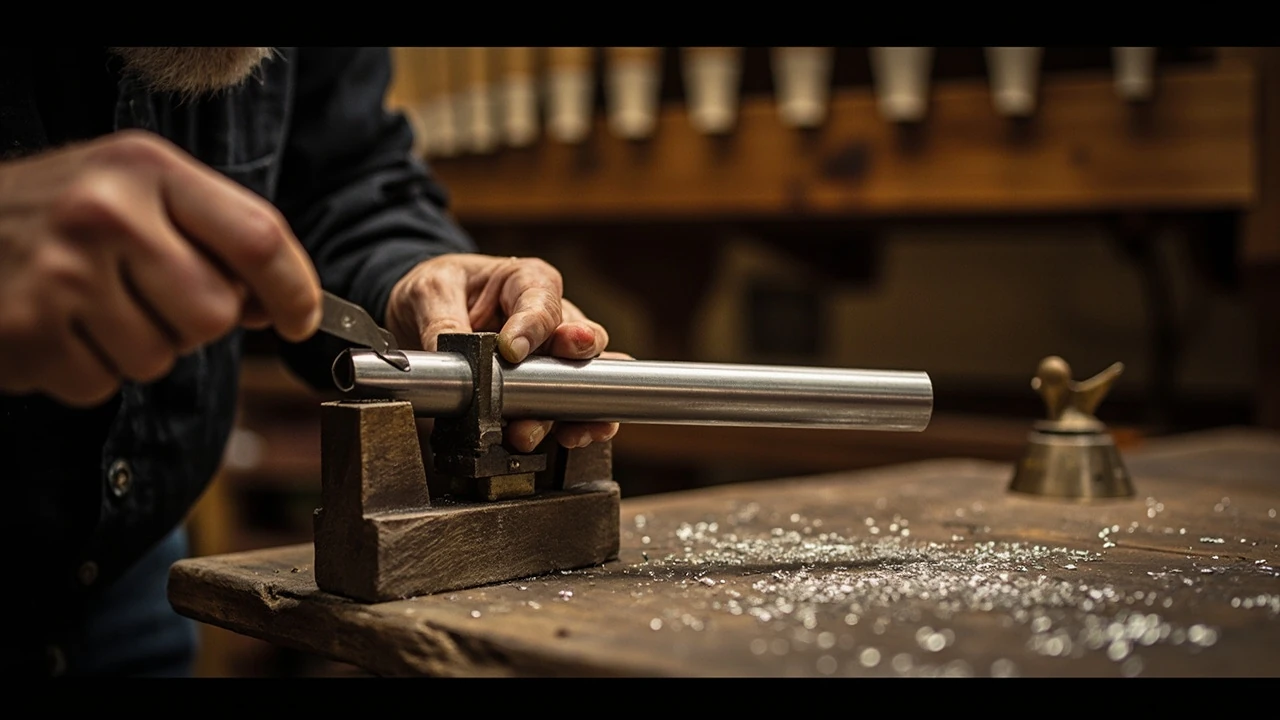
How organ pipe nicking changes speech
A small nick filed into the edge of an organ pipe’s languid can shift the way that pipe speaks in ways that are easy to hear and surprisingly hard to predict. Voice the same flue pipe twice, once without nicks and once with a careful row of them, and the difference shows up first in the attack, then in the tone color, and finally in how steadily the pipe holds its pitch when the wind changes. Understanding how organ pipe nicking changes speech is part acoustics, part ear training, and part craft tradition, because every nicking pattern is a compromise between clarity, warmth, and stability.
Nicking is a voicing step, not a tuning step, and it sits inside a wider chain of choices that begins with pipe metal, scale, and cut-up, and ends with how the finished rank sits in a building. This article walks through the mechanism, the practical effects on tone and speech, the main nick patterns a voicer is likely to use, and the limits of what nicking can and cannot fix. It is written for organists, organ students, and curious listeners who want to understand why two otherwise similar ranks can sound so different.
What nicking actually is
In flue organ pipes, the tone is produced when a thin ribbon of wind leaves the foot hole, passes through a narrow channel called the flue, and strikes a sharp edge called the upper lip. The languid is the curved plate just below the upper lip that shapes the airstream before it hits the edge. Nicking means cutting a row of small, regularly spaced notches into the trailing edge of the languid, close to where the wind meets the lip.
Those notches are tiny. In practice they are often only a fraction of a millimetre deep and a few millimetres apart, and they are placed right at the point where the wind breaks against the upper lip. The voicer chooses the depth, width, spacing, and number of nicks based on the pipe’s scale, its intended role, and the result the ear demands.
Nicking is almost always done on open metal flue pipes. It is less common on stopped wooden pipes and is not normally applied to reed pipes, which produce tone through a vibrating tongue rather than an air jet. When people talk about how organ pipe nicking changes speech, they are almost always talking about the open metal flue pipe, because that is where the technique has the strongest and most controllable effect.
How the air jet meets the lip
To hear why nicking matters, it helps to picture what the air jet is doing at the upper lip. A flue pipe works because the ribbon of air leaving the flue is unstable. It wants to swing to one side of the lip or the other. When it swings, a pulse of air enters the pipe body, a rarefaction follows, and the pipe body resonates at its natural frequency, reinforcing the next pulse in the same direction. The result is a regular oscillation that we hear as a pitched note.
The behavior of the jet right at the moment of contact is sensitive to small disturbances. A clean, uninterrupted trailing edge tends to produce a smooth jet that may not commit quickly to one side, which can make the onset of the note slow, breathy, or unstable. Introducing a regular pattern of nicks along the languid edge creates tiny disturbances at predictable points along the jet. Those disturbances give the jet something to lock onto, which is why nicking is often described as a way of helping the pipe speak promptly.
The main acoustic effects of nicking
The effect of nicking on a flue pipe can be broken into four overlapping categories: attack, tone color, pitch stability, and harmonic content. Each is the result of how the nicks change the boundary between the air jet and the surrounding air right at the upper lip.
| Aspect of speech | Effect of light or careful nicking | Effect of heavy or excessive nicking |
|---|---|---|
| Attack | Faster, more decisive onset; clearer separation between notes in a passage | Hard, percussive onset; harsh “chiff” that can dominate the tone |
| Tone color | Brighter, more focused, slightly more projection | Noisy, edgier, with audible wind noise around the note |
| Pitch stability under wind variation | Improved stability, especially in large-scaled pipes | May shift pitch more, or introduce a brittle, unstable edge |
| Harmonic content | Slight reinforcement of upper partials without loss of body | Strong upper partials, breath noise, and a thinner fundamental |
The art of voicing is to land somewhere inside the second column without sliding into the third. A pipe that has been voiced for clarity but then nicked just enough to commit quickly to its pitch is the usual goal.
Why tone color shifts when nicks are added
Adding nicks changes the way the jet breaks against the lip, which changes the shape of the pressure pulse that drives the pipe body. Even a clean-sounding note is actually made up of a fundamental tone and a long series of higher partials, and the relative strength of those partials is what we describe as tone color. A smooth, unbroken jet tends to emphasize the lower partials and produce a round, flute-like tone. A nicked jet introduces small, regular disturbances that excite a wider band of frequencies in the air column, especially in the upper partials.
That is why a freshly nicked principal often sounds more present than its un-nicked neighbor. The extra upper partial energy is what carries the line in a polyphonic texture, and it is also what gives the pipe a slightly more “edgy” character. The amount of upper partial energy added is not just a function of the nicks themselves but of how the pipe’s resonator responds to the changed excitation. A wide, slow-speaking pipe body will respond differently from a narrow, bright one even with the same nicking pattern.
How attack and steadiness respond to nicking
One of the clearest ways to hear how organ pipe nicking changes speech is to listen to the first tenth of a second of a note. In an un-nicked pipe, the jet may need a few cycles to settle, which produces a soft, slightly delayed attack. The note blooms in rather than speaking immediately. This can be charming in a slow solo melody, but in a chorus of many pipes it can sound woolly and under-defined.
Nicking shortens that settling time. The disturbances at the languid edge give the jet a head start, so the pipe speaks on the first pulse of stable wind. In a well-voiced rank, this makes the difference between a line of notes that articulates cleanly under the fingers and one that smears. The trade-off is that very heavy nicking can introduce a hard, almost percussive quality at the very start of the note. That characteristic edge is what organ builders call “chiff” when it is a small, controlled amount of noise in the attack, and what listeners usually call “harsh” when it is too much.
Pitch steadiness also improves with appropriate nicking, particularly in larger-scaled open metal pipes that are sensitive to small changes in wind pressure. The extra coupling between jet and resonator helps the pipe resist the slow pitch drift that comes when the wind supply is not perfectly regulated.
Where nicking fits inside a voicing session
Nicking is one of the later steps in voicing a flue pipe, not the first. The voicer will normally have already adjusted the pipe’s scale, the cut-up (the height of the mouth above the languid), the position of the upper lip, the ear of the pipe, and the size of the foot hole. By the time nicks are filed into the languid, the pipe is already speaking in a recognizable way. Nicking is then used to refine what is already there.
- Adjusting cut-up changes how much of the air jet crosses into the pipe, which strongly affects both loudness and tone.
- Bending the upper lip or moving the languid shifts the position where the jet strikes, which affects stability and tone color.
- Opening or closing the ears changes the pipe’s response to wind and its tendency to overblow to upper partials.
- Nicking then fine-tunes attack, projection, and stability without changing the pipe’s basic scale or geometry.
Because it is a small, controlled change, nicking is also one of the steps a voicer is most willing to revisit. A pipe that has been voiced cleanly but refuses to speak promptly in the finished room can often be brought to life with a careful set of nicks, without disturbing the other voicing work.
Common nick patterns and what they do
Although every voicer has a slightly different approach, nicking patterns can be grouped into a few families. The choice of pattern depends on the scale of the pipe, its musical role, and the room it will sit in.
| Pattern | Description | Typical use | Risk if overdone |
|---|---|---|---|
| Single row of small nicks | Evenly spaced shallow notches across the languid | Most principal and flute ranks, especially in the middle of the compass | Hard, percussive attack |
| Wider, deeper nicks | Larger, less frequent notches | Large-scaled bass pipes that need extra promptness | Noisy, breathy tone; unstable pitch |
| Partial-row nicks | Nicks only at the ends or center of the languid | Balancing speech across the pipe width; correcting local instabilities | Asymmetric tone; uneven response across the mouth |
| No nicks | Clean languid edge | Small-scaled, soft stops and many wooden flutes | Slow attack; woolly ensemble blend |
One of the more interesting results in this table is that nicking is sometimes removed, not added. A pipe that has been nicked for a dry acoustic and is later moved to a long reverberant room may need its nicks reduced or even filed out, because the extra upper partials become overpowering in the new acoustic. This is one of the more visible signs that voicing is not a one-time job.
Nicking in different families of pipes
Not every open metal flue pipe benefits equally from nicking. The size of the pipe, the cut-up, the wind pressure, and the musical role all change how much nicking the pipe can absorb before it starts to sound forced.
- Principals and related chorus work: typically receive a measured set of small nicks, because the rank needs to cut through the ensemble without sounding hard.
- Open metal flutes: usually nicked more lightly, because the role of the flute is to provide a smooth foundation rather than a sharp attack.
- String-toned stops: often nicked, sometimes quite decisively, because the goal is a focused, slightly silvery line.
- Large-scaled open bass pipes: frequently need stronger nicking, because their long air columns are more sensitive to jet disturbances and to wind variation.
- Small-scaled high-pitched ranks: often left un-nicked, because their tone is naturally quick and bright, and extra nicking pushes them toward a noisy, unfocused result.
For a broader look at how families of pipes differ in tone and function, the site’s guide on organ stops gives a useful map of the territory. For the physical and acoustic principles behind how those pipes produce sound, the article on organ acoustics goes into the building and the room side of the story.
Limits of what nicking can fix
Because nicking is a small change to a small surface, it can only do so much. Several problems show up repeatedly in voicing sessions where nicking alone is not the right answer.
- Unstable pitch that traces back to wind supply: nicking will not save a pipe that is fighting an unsteady wind chest.
- Poor tone that comes from the wrong scale for the room: no amount of nicking will turn a thick-scaled principal into a silvery string tone.
- Slow speech caused by a pipe that is badly out of tune with itself: nicking cannot substitute for proper pipe regulation and ear setting.
- Acoustic problems from the room: a long, dry reverb tail will expose heavy nicking in unflattering ways, but nicking cannot fix a room.
Good voicing is often the art of recognizing when a problem is actually in the pipe, the wind, the room, or the organist’s ear. For organists who want a clearer picture of how voicing sits inside the wider work of looking after an organ, the site’s organ tuning guide is a useful reference point, because tuning and voicing are the two ongoing maintenance activities that most affect what an organ sounds like from week to week.
How to listen for the effect of nicking
If you want to develop a more reliable ear for how organ pipe nicking changes speech, three simple listening tests are surprisingly informative. None of them requires special equipment, only a willing pipe or rank and a quiet room.
- Compare the attack: play a short, detached note at a comfortable dynamic and listen to the first 100 milliseconds. A well-nicked pipe will commit to its pitch almost immediately. An un-nicked pipe will bloom in.
- Compare the response at low wind: if your organ has a swell pedal or a tremulant that varies wind, listen to whether the pitch stays steady. Nicking usually improves this.
- Compare blend in a chord: play the rank together with another similar rank, and listen for whether the line has presence without sounding edgy. The right amount of nicking is the level that gives presence without grit.
It is worth doing these tests on the same note in two different stops if your organ allows, because the difference between a nicked principal and an un-nicked flute is one of the clearest illustrations of the effect in the average church or concert organ.
Nicking in historical perspective
Nicking is an old technique, but its use has changed. Nineteenth-century organ builders in particular refined the practice, often in connection with higher wind pressures and larger instruments that demanded more projection. Some earlier pipes were voiced with very light or no nicking, partly because the wind supplies of the day were steadier and the rooms were often more reverberant, and partly because the desired tone was different.
Twentieth-century revival styles went in several directions. Some builders returned to nearly nicking-free languids for a softer, more historical sound. Others kept or even increased nicking, especially in large instruments intended for concert use. The result is that a modern organ builder choosing a nicking pattern is also making a small statement about which historical model they are working from, and what kind of room and repertoire they have in mind.
How organ pipe nicking changes speech in practice
Putting the pieces together, the answer to how organ pipe nicking changes speech can be summarized in a few short observations that any organist can check at the console.
- It shortens the time the air jet needs to commit to the upper lip, which makes the pipe speak on the first pulse of wind.
- It adds a controlled amount of upper partial energy, which brightens the tone and helps the line project.
- It improves the pipe’s resistance to small changes in wind pressure, which steadies the pitch.
- It is a small, reversible change, and it is one of the most useful tools a voicer has for refining attack without touching the pipe’s scale.
At the same time, nicking is not free. Too much nicking makes the pipe noisy and hard. Too little leaves it slow and under-defined. The narrow band in between, where the pipe speaks promptly but still sings, is the territory a voicer is always working in.
Practical takeaways for organists and listeners
Most organists will not file nicks themselves, but understanding the effect makes a difference at the console. When a stop sounds sluggish or under-defined in a particular building, the cause is often a combination of the pipe’s voicing and the room’s acoustic, and the cure may be a small voicing adjustment rather than a change in registration. When a stop sounds harsh in a dry room but smooth in a live one, nicking is one of the things to ask the voicer about.
Listeners who are not organists can still hear the effect. In a well-maintained instrument, the chorus speaks with a characteristic clarity that comes from balanced nicking across the ranks. In an instrument that has been heavily voiced for a different room, the same chorus can sound brittle or edgy. Recognizing that difference is a good first step toward understanding the kind of organ you are listening to.
For organists who want to go further, the organ registration guide on the same site is a useful companion, because registration is the organist’s side of the same conversation that voicing is the builder’s side of. Both are about shaping the tone of a pipe to fit a particular musical line, a particular texture, and a particular room.
Frequently asked questions
What does nicking do to an organ pipe?
Nicking cuts a row of small notches into the trailing edge of the languid, right where the air jet meets the upper lip. The nicks give the jet regular disturbances to lock onto, which makes the pipe speak more promptly, slightly brightens the tone, and improves the pipe’s resistance to small changes in wind pressure.
Does nicking make an organ pipe louder?
Indirectly, yes. Nicking does not change the wind that enters the pipe, but it makes the pipe speak more of that wind as sound rather than as wasted breath. The result is a more focused, projecting tone rather than a simply louder one. The amount of increase depends on the pipe’s scale and the rest of its voicing.
Which organ pipes are usually nicked?
Most open metal flue pipes are nicked to some degree, especially principals, string-toned stops, and large-scaled bass pipes. Small-scaled high ranks, many wooden flutes, and most stopped pipes are usually left un-nicked. Reed pipes are not nicked at all, because they produce tone through a vibrating tongue rather than an air jet.
Can nicking fix a pipe that will not speak properly?
Sometimes, but not always. Nicking is a useful fix for slow or uncertain speech, and for some kinds of pitch instability. It cannot compensate for a badly cut-up mouth, an unsteady wind supply, a pipe that is out of tune with itself, or a room that is acoustically hostile to the rank.
How can I tell if a pipe has been nicked?
Look closely at the trailing edge of the languid, just below the upper lip. A nicked pipe has a regular row of small, evenly spaced notches. The notches are easy to miss without a light and a magnifier, but in a well-lit voicing shop they are clearly visible as a small “saw-tooth” pattern along the edge.
Is nicking the same as voicing?
No. Voicing is the whole process of shaping a pipe’s speech and tone, including cut-up, lip position, ear setting, and other adjustments. Nicking is one specific step inside voicing, usually done near the end of the process to refine attack and stability.
Does nicking affect tuning?
It can, slightly. A nicked pipe may sit a small fraction of a semitone higher or lower than an un-nicked one, because the changed jet behavior alters the pressure pulse that drives the resonator. A voicer will normally retune the pipe after nicking as part of the same session.
Can nicking wear off over time?
The shape of the nicks themselves is essentially permanent, but the conditions around them can change. Dust, corrosion, and small dents in the languid can change how the air jet behaves, which is one of the reasons an organ benefits from regular cleaning and inspection in addition to tuning.
What is the difference between nicking and halving?
Halving is a different voicing technique, in which a small rectangular hole is cut into the languid, usually near the center. It is used to reduce wind consumption and to soften tone in specific registers. Nicking is a row of small edge notches and is primarily about attack and stability.
Why does a heavily nicked pipe sometimes sound thin?
Because the nicks push so much of the air jet’s energy into the upper partials that the fundamental has less reinforcement, and because the air jet itself becomes less efficient at driving the resonator. The result is a tone that is bright and immediate but lacks body. A voicer will usually reduce the nicking or thicken the languid in response.