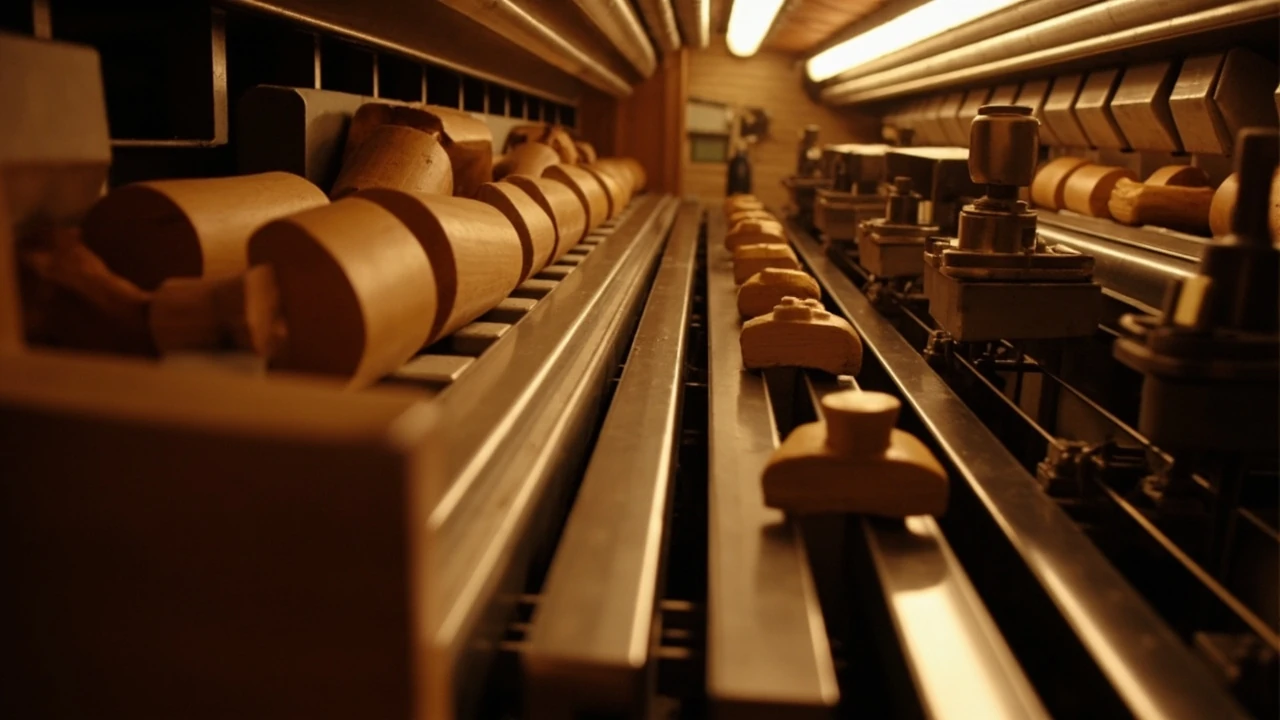
Press a key on a well-regulated pipe organ and the first thing you hear is a pitch, the second is a tone. Most listeners focus on the note itself, but the character of that note, whether the principal chorus sounds transparent, whether a flute stop blooms slowly, whether a reed speaks immediately, is shaped long before the pipe produces sound. It is shaped in the reservoir, the bellows, the tremulant, and the windchest. Wind pressure is the invisible hand that opens or closes that character. Understanding how pipe organ wind pressure changes tone is the difference between hearing an organ as a fixed piece of furniture and hearing it as a living instrument that responds to regulation, voicing, and room.
This article looks at the mechanism from bellows to lip, at the relationship between pressure and pitch, at the practical effects on different families of pipes, and at what an organist, voicer, or careful listener can actually observe. The aim is not to replace a voicer, but to give a reader the vocabulary and the expectations needed to evaluate what they are hearing.
How pipe organ wind pressure changes tone
Wind pressure changes tone because every pipe on the organ is a small aerodynamic oscillator. The pressure feeding the pipe sets the velocity of the air jet that crosses the mouth, sets how quickly the pipe’s air column oscillates, and sets how stable that oscillation remains from one second to the next. Change the pressure, and you change the boundary conditions of the oscillator. The pitch moves, the harmonic spectrum tilts, the speech becomes easier or more reluctant, and the loudness curve across the compass shifts.
The classic instrument is voiced at a target pressure chosen by the builder. For most European-style organs that target sits somewhere between 60 and 100 mm of water column for chorus work, with lower pressures for baroque-style work and higher pressures for romantic and symphonic organs. A change of only a few millimetres of water column can be enough to make a flue pipe sound sluggish or to make a reed pipe lose its edge.
What the pressure reading actually means
Organ builders do not usually measure wind in kilopascals. They measure it in millimetres of water column (mm H₂O) or, in older British practice, inches of water column. The unit comes from a simple u-tube manometer: the higher the column of water the pressure can support, the higher the pressure inside the windchest. Modern digital manometers read the same quantity and display it directly.
A typical small practice organ might run at 45 to 55 mm. A medium-sized two-manual organ might run at 65 to 80 mm. A large romantic organ in a reverberant cathedral might run at 90 to 110 mm. Cavaillé-Coll’s organs in Paris, often used as the reference for symphonic sound, ran at pressures higher than many baroque instruments, often between 90 and 160 mm depending on the division and the stop.
| Instrument style | Approximate pressure | Typical character |
|---|---|---|
| North German baroque | 45–65 mm H₂O | Quick speech, light tone, transparent chorus |
| French classical | 55–75 mm H₂O | Defined principals, balanced reeds |
| English romantic (Willis, Hill) | 75–100 mm H₂O | Full chorus, rich reeds, strong 32′ |
| French romantic (Cavaillé-Coll) | 90–160 mm H₂O | Symphonic tone, broad flues, voiced reeds |
| Theatre and cinema organs | 150–300+ mm H₂O | Bright, projected, immediate speech |
| High-pressure solo stops | 200–500+ mm H₂O | Orchestral imitative stops, very short pipes |
The numbers above are typical ranges drawn from builder practice, not fixed rules. Some builders deliberately use lower pressure to slow speech and warm the tone. Others use higher pressure to push more harmonic content into a long reverberant room.
The mechanical chain from bellows to pipe
Before pressure reaches a pipe, it travels through a chain of components, each of which can subtly alter what the pipe finally sees. Understanding this chain is the first step in understanding why two organs at the same nominal pressure can sound different.
- The blower or fan pressurises a primary reservoir or an external wind supply.
- A regulator, usually spring-loaded bellows with weights, converts the primary supply into a stable working pressure.
- Conduits (wind trunks or wind lines) carry the regulated air to each windchest.
- Within the windchest, a pallet opens to admit wind to a groove that feeds one or more pipes.
- A valve or slider admits that wind to a specific pipe’s foot.
- The air leaves the foot, crosses the pipe’s mouth, and the pipe speaks.
Anywhere in this chain the pressure can change. A leaky pallet bleeds pressure away. A dirty conduit adds resistance. A regulator whose springs have weakened allows the pressure to sag when many notes are drawn. A new blower running at a different speed can shift the entire instrument. Even temperature matters, because the density of air changes with temperature, and the resistance of conduits changes with humidity.
The role of the regulator
The regulator is the organ’s pressure stabiliser. It is essentially a weighted bellows that opens to feed wind to the instrument when pressure drops and closes when pressure rises. In a healthy organ the regulator keeps the working pressure within about one or two millimetres of the target while the entire keyboard is playing.
When a regulator is underweight, the pressure sags noticeably under load and the bass and full chords go flat. When a regulator is overweight, the pressure rises above the voicing target, the chorus gets brighter, and any soft stops become raspy. The choice of regulator weight is a voicing decision as much as a technical one.
How pressure changes pitch
Pressure affects pitch because the air jet in a flue pipe moves faster at higher pressure, and faster jet velocity shifts the frequency at which the pipe’s air column resonates. The relationship is not linear, and the direction of pitch change depends on whether the pipe is behaving as a true edge tone or as a quasi-resonator locked to the pipe’s geometry.
For most flue pipes the practical rule is straightforward. A modest increase in pressure raises the pitch slightly. A modest decrease in pressure lowers it. The size of the effect depends on scale and on voicing, but a difference of 5 mm H₂O across a chorus can produce a pitch change of a few cents, which is enough to make a mixture sound restless against a principal.
Reed pipes show the same direction of change but with different sensitivity. A reed’s pitch is anchored by its resonator, but the speech and the upper harmonics shift with pressure. Many voicers tune a reed by adjusting the length of its resonator, then refine the speech and tone by trimming the shallot and the wire.
Pitch, temperature, and the actual sound
Readers sometimes confuse wind pressure drift with thermal drift in the room. Cold pipes speak flat because the air column is denser, and warm pipes speak sharp because the air column is less dense. Pressure also affects pitch, but the two effects can oppose each other on a cold day when the heater is pushing pressure up to compensate for sluggish speech. This is one reason a careful voicer checks pitch only after the instrument has been at working pressure for at least several hours.
How pressure changes harmonic content
Tone is more than pitch. Tone is the shape of the harmonic spectrum and the way those harmonics evolve through the note’s life. Wind pressure is one of the strongest tools the voicer has for shaping that shape.
Higher pressure pushes more energy into the upper harmonics of a flue pipe. The pipe sounds brighter, more present, and often more aggressive. Lower pressure reduces the upper partials relative to the fundamental. The pipe sounds rounder, warmer, and often softer. This is why a 16′ principal voiced at 50 mm in a small chapel sounds very different from a 16′ principal voiced at 90 mm in a cathedral, even if the scaling, material, and room are similar.
| Pressure | Speech | Upper harmonics | Loudness curve | Listener impression |
|---|---|---|---|---|
| Slightly low | Slower, more breath | Reduced | Smaller pipe louder relative to large | Warm, soft, slightly veiled |
| On target | Clean, immediate | Balanced | Even across the chorus | Defined, characteristic |
| Slightly high | Quicker, harder | Boosted | Large pipe louder relative to small | Bright, assertive, sometimes edgy |
The interesting column is the loudness curve. Organ pipes are not all equally sensitive to pressure. Larger-scale pipes move more air and their volume responds more strongly to higher pressure than smaller-scale pipes of the same voicing. A 32′ bourdon responds to a 5 mm pressure rise with a noticeably bigger increase in level than a 2′ principal. That is why an over-pressured organ sounds as if the bass is too strong and why an under-pressured organ sounds as if the treble is too strong.
How pressure changes speech and transient behaviour
Speech is the small interval between the key reaching the bottom of its travel and the pipe producing a stable, musical note. On a flue pipe, speech is governed by how quickly the air jet stabilises at the mouth, and that speed is driven by the pressure feeding the pipe.
- Higher pressure speeds up the jet. Speech becomes almost instantaneous. The note “speaks before the key is down”, which organists usually describe as a more immediate, organ-like response.
- Lower pressure slows the jet. Speech becomes lazy, breathy, and romantic. Useful in slow music, problematic in fast passagework.
- For reed pipes, pressure affects the time it takes the reed tongue to start vibrating against the shallot. Low pressure can make a reed pipe “chiff” audibly, because the tongue is slow to lock against the shallot. High pressure can make a reed pipe lose its chiff entirely and sound glassy.
The transient is the first 50 to 200 milliseconds of the note, where the harmonic spectrum is still settling. Pressure changes the shape of that transient. A voicer who wants a flute stop with a soft attack will run the flute at lower pressure or use a larger mouth. A voicer who wants a principal that cuts a large acoustic will use slightly higher pressure and a higher cut-up.
Pressure and the families of pipes
Not all stops respond to pressure in the same way. The same organ at the same nominal pressure can have a principal at 75 mm, a flute at 65 mm, and a reed at 110 mm if the builder has chosen to run separate windchests for those families. This is one of the deepest voicing decisions in organ building.
Principals and the chorus
Principal pipes are flue pipes of moderate scale, voiced to define the chorus. They are the pipes most often used as the reference for the working pressure. If the principal is well voiced at 75 mm, the rest of the chorus usually settles around that figure. Running a principal too low makes it lose its defining edge. Running it too high makes it shriek at 2′ and 1½′.
Flue flutes and string-toned stops
Flute stops are usually voiced at the same pressure as the principals, but with larger mouths, lower cut-ups, and softer attack. Some builders run the flute division on a slightly lower pressure to give it a more singing quality. String-toned stops, which are narrow-scaled flue pipes designed to imitate string tone, often run at higher pressure with thin walls to encourage upper harmonics.
Reeds
Reed pipes are the most pressure-sensitive stops on the organ. A reed’s tone depends on a small brass tongue vibrating against a shallot, with the resulting sound filtered by a tuned resonator. The pressure affects how the tongue vibrates, the shape of the tone, and the loudness of the upper harmonics. Many romantic organs run the reed division on its own higher-pressure windchest, often 30 to 60 mm above the flue pressure.
| Pipe family | Typical pressure relative to flue target | Effect of over-pressure | Effect of under-pressure |
|---|---|---|---|
| Principal chorus | Reference (0 mm) | Hard attack, edgy treble | Loss of definition, slow speech |
| Flute | Reference or -5 mm | Loses softness, becomes woody | Too breathy, chorus becomes cloudy |
| String-toned | +5 to +10 mm | Glass-like, loses body | Becomes flute-like, loses edge |
| Reed (general) | +10 to +40 mm | Hard, glassy, may break into double speech | Slow, lost power, breathy tone |
| Solo reeds (trumpet,posaune) | +20 to +60 mm | Bright, projecting | Lost presence, weak bass |
| High-pressure solo stops | +150 to +400 mm | Overdriven, harsh | Same behaviour as a flute at low pressure |
What the listener can actually observe
Most readers of an article on how pipe organ wind pressure changes tone are not voicer-builders. They are organists, students, or careful listeners. The practical question is what to listen for. Here is a short observational checklist that does not require a manometer.
- Play a full chord in the left hand on a principal chorus, then the same chord on a solo reed. Listen for any pitch sag. A regulator that cannot keep up with the load will produce a small but audible flatness on the loudest combinations.
- Hold a soft 8′ flute and listen to its attack. If the attack feels late or the first 100 ms of the note is breathy rather than musical, the pressure is probably running low for that stop.
- Draw a 32′ bourdon and play a low note. Listen for any unsteadiness in the tone. A 32′ is the biggest air user on the instrument, and it reveals regulator weakness more quickly than any other stop.
- Pull a mixture and play softly. If the high partials are too loud relative to the rest of the chorus, the pressure is probably running slightly high.
- Compare the same stop in different manual divisions. A well-built organ will sound coherent across the whole instrument. A choir division running on its own under-pressured windchest will sound veiled.
Pressure, voicing, and the limits of a single article
Wind pressure is one of three or four master variables the voicer manipulates. The others are mouth size, cut-up height, and scaling. A change in any one of them is a change in boundary conditions for the pipe, and the four variables interact. A higher cut-up can compensate for lower pressure. A larger mouth can soften the effect of higher pressure. Scaling can be chosen to push the operating range of a stop up or down.
This is why the question “how pipe organ wind pressure changes tone” has no single answer. Pressure changes tone on its own, but in a real instrument the tone the listener hears is the result of pressure acting on a pipe whose mouth, cut-up, and scale were chosen to work with that pressure. The first thing a voicer learns is to change one variable at a time and to re-evaluate everything else.
Common problems traced back to pressure
Some recurring organ complaints are really pressure problems in disguise. A short list helps the reader recognise the symptoms.
- “The chorus has lost its bite.” Usually means pressure has dropped slightly, often because the regulator spring has weakened or the blower fan is sluggish.
- “The bass goes flat in loud passages.” Almost always a regulator problem. The regulator cannot supply enough air at the working pressure to support a heavy chord.
- “The reeds are too hard.” Pressure is too high, or the reed has been voiced on a higher-pressure chest than it is now playing on after a renovation.
- “The 16′ trumpet has no presence in the room.” Either the room is over-reverberant, the chest pressure is too low, or the resonator is too short. Pressure is the first thing to check.
- “The mixture is too loud.” Pressure is too high, or the mixture was voiced at a different pressure than the rest of the chorus.
Pressure in the context of room and repertoire
An organ’s working pressure should be chosen for the room as much as for the pipes. A 70 mm chorus in a dry studio acoustic sounds thin and exposed. A 70 mm chorus in a reverberant stone church sounds full and present. A 110 mm chorus in a dry room is overbearing; in a long reverberant room it can sound warm.
Repertoire matters too. A North German baroque programme benefits from the clarity that comes from moderate pressure and quick speech. A French romantic programme benefits from the harmonic density that comes from higher pressure and rich scaling. A modern symphonic programme, with its mixtures-on-swell and reed choruses, often needs higher pressure to project.
Pressure is therefore not a number but a decision. It is the decision about how much harmonic content the instrument will deliver to a particular room for a particular kind of music. Once that decision is made, the rest of the voicing flows from it.
A short historical note
Early organs ran at very low pressure, often below 40 mm H₂O, because bellows technology was limited and because small church rooms did not need more. The rise of the romantic organ in the nineteenth century brought higher pressures, larger windchests, and the use of separate higher-pressure chests for reeds. Theatre organs of the early twentieth century pushed pressure even higher, partly for projection and partly because high pressure allowed very short pipes to imitate orchestral instruments convincingly. The twentieth-century revival of baroque practice brought a return to lower pressures, but usually with more reliable blowers and better regulators, so the instruments spoke with the immediacy of their historical models without the unreliability of the originals.
Frequently asked questions
Does raising wind pressure make a pipe organ louder?
Raising pressure usually increases loudness, but the effect is uneven. Large-scale pipes respond more strongly than small-scale pipes, so a pressure rise can make the bass seem too heavy and the treble too thin. Pressure is a voicing tool, not a volume knob.
Why does my organ sound flat when I play a big chord?
Pressure is sagging under load, which means the regulator is not supplying enough air at the working pressure. A voicer or technician needs to check the regulator, the bellows, and the wind supply. This is one of the most common service issues on older instruments.
How does wind pressure affect pitch?
Higher pressure raises the pitch of a flue pipe slightly, because the air jet moves faster and shifts the operating point of the resonator. Lower pressure lowers the pitch. The effect is a few cents per 5 mm of water column on a well-voiced pipe, which is enough to matter in a mixture.
Why are reeds on my organ louder than the flues?
Reed divisions are often run on a separate higher-pressure windchest. This is normal and gives the reeds the presence needed to lead a chorus. If the imbalance has appeared recently, the most likely cause is the flue pressure dropping or the reed pressure rising. Both are quick checks for a technician.
What unit is used to measure organ wind pressure?
Most builders use millimetres of water column (mm H₂O). Some older British references use inches of water column. One inch of water column is about 25.4 mm. Modern digital manometers can read in either unit, but a 19th-century reference expressed in inches will translate to a number about 25 times smaller in millimetres.
Can wind pressure be too low for a pipe organ?
Yes. Below the voicing target the chorus loses definition, flutes become breathy, and reeds lose their power. The instrument will sound undernourished. Below a certain pressure, which depends on the design of the pipe, the pipe will simply stop speaking reliably.
Does temperature change how pressure affects tone?
Yes. Cold air is denser, so the same pressure produces a different jet velocity, and the pipe’s response shifts. Most professional voicers wait for the organ to stabilise at room temperature before doing final regulation, and a careful organist will allow a few minutes for the pipes to warm up after switching on in a cold church.
Is high pressure always better for projection?
No. Projection depends on the room as much as on the pressure. A dry room with a 110 mm chorus will sound harsh. A long reverberant room with a 110 mm chorus will carry beautifully. The pressure should match the room.
What is the relationship between wind pressure and the tremulant?
A tremulant varies the pressure at the windchest slightly above and slightly below the working pressure. The variation is small, often a few millimetres, but it modulates the speech of every pipe on the chest and produces the characteristic “wobble” of the tremulant. A tremulant on a higher-pressure chest usually has to move a wider range to be audible.
How do I know if my organ’s pressure is set correctly?
The cleanest test is to play a recorded piece you know well on the organ and listen for definition in the chorus, evenness across the compass, and stability under loud chords. If the chorus has lost its clarity or the bass sags, the pressure is probably off. A technician can confirm the figure with a manometer at the windchest.