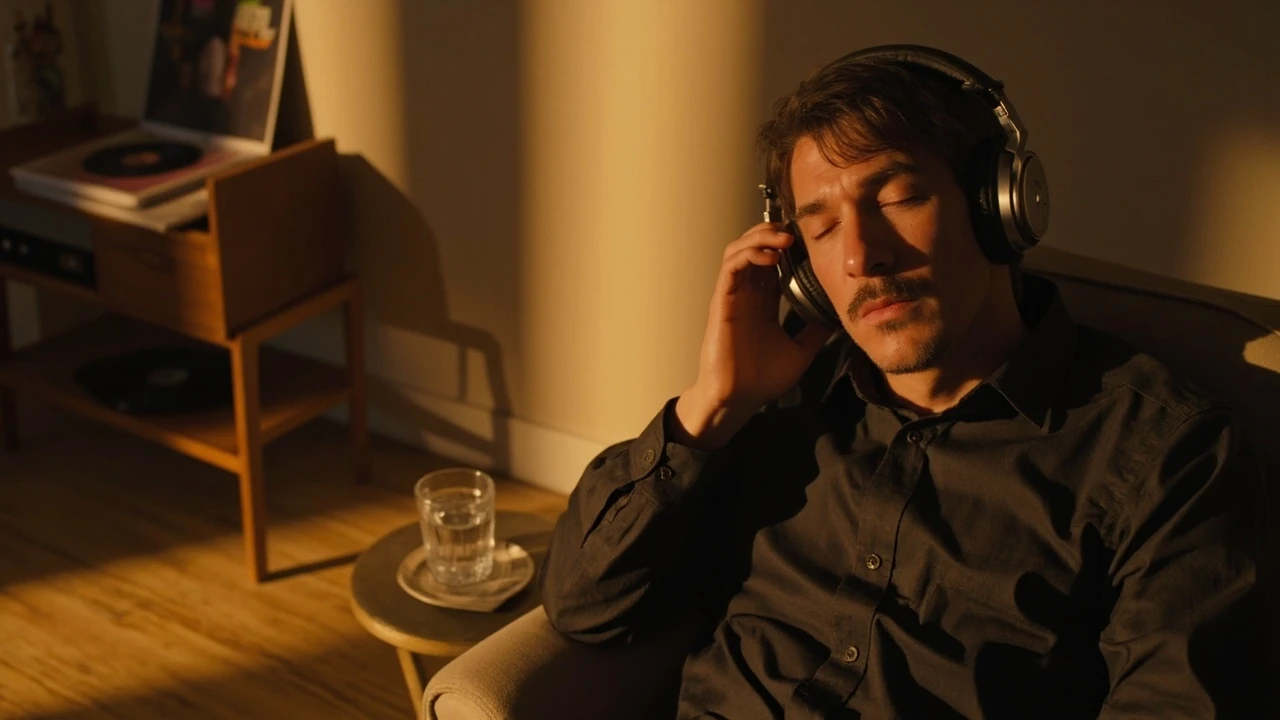
Listening to music
A teenager hears a pop song on a car radio and feels the chorus land. A builder of pipe organs hears the same recording and counts the attack of each transient, notices which stops seem too loud in the mix, and wonders whether the producer rolled off the bass below the room’s natural resonance. Both people are listening to music, but the experience of the same audio signal is not the same at all. The difference is not talent and not taste. It is attention.
Listening to music is the act of directing attention to sound. The phrase sounds simple, yet it hides several distinct activities that researchers, performers, and instrument builders have been describing for decades. There is the background listening most people do while cooking, the analytical listening an audio engineer uses when checking a mix, the structural listening a musicologist applies to a Bach fugue, and the social listening that happens when a room full of people sing together. Each of these changes what the listener notices, remembers, and enjoys.
This guide treats listening to music as a skill that can be understood, trained, and applied. It explains how the ear and brain turn air pressure into meaning, why the same recording can sound different in different rooms, and what a careful listener actually does during a session. It also looks at the choices that affect every listener, from headphone quality to room acoustics to the way attention drifts during long pieces. If you want more from the time you spend with recordings or live performance, the material below gives you a practical map.
What listening to music actually involves
When sound reaches the ear, three things happen at once. The cochlea breaks the air pressure wave into frequency bands. The auditory nerve carries that information toward the brainstem and the cortex. Higher regions then compare what is heard to stored patterns, predict what is likely to come next, and adjust attention based on surprise, emotion, and expectation. Listening to music is the conscious part of that chain, the part where the listener decides what to follow, what to ignore, and what to remember.
A useful breakdown comes from the work of the composer and researcher Pierre Schaeffer, who distinguished four listening modes that are still taught in sound studies programs today. Each mode answers a different question, and most listeners shift between them without noticing.
- Listening to focus on the sound itself. The question is “what am I hearing?” without referring to a source or meaning. This is the mode used in acoustic ecology and in much of electroacoustic composition.
- Listening to identify the source. The question is “what is making that sound?” A trumpet, a pipe organ, a kettle, a voice. This is the mode most listeners use most of the time.
- Listening to grasp meaning. The question is “what does this sound communicate?” A melody resolves, a chord changes, a rhythm syncopates. This is the mode used in music analysis and in everyday emotional response.
- Listening to choose. The question is “is this what I want to hear, or should I change it?” A mixing engineer riding faders, a listener deciding which track to play next, an organist choosing the next stop.
Most people spend the largest share of their listening time in the second mode, identifying the source, because everyday attention is built to localize and label. A trained listener simply learns to spend more time in the other three, especially the first and third, where the texture of the sound and the structure of the music reveal themselves.
The difference between hearing and listening
Hearing is passive. The cochlea responds to any sound above threshold, and the brain processes the signal whether the listener is paying attention or not. Listening is the act of selecting some of that signal and using it for a purpose. The distinction matters because it changes the listener’s experience even when the physical stimulus is identical.
| Aspect | Hearing | Listening |
|---|---|---|
| Driver | Acoustic energy reaching the ear | Directed attention |
| Awareness required | None | Active, sustained |
| Output | Reflex, detection | Understanding, evaluation, memory |
| Typical use | Background noise, alarms, conversation | Music study, mixing, live performance |
| Limit | Damage at high levels | Fatigue, distraction, habituation |
That difference explains a familiar frustration. Many people say they “love music” yet feel flat about a new album after the third play. They have been hearing the album, not listening to it. Attention is a finite resource, and the brain conserves it by treating repeated exposure as routine. A small change in how a listener approaches a recording can change the experience without changing the recording at all.
Why the same recording sounds different in different rooms
Before a sound reaches the listener, it interacts with the room. A small bedroom with soft furnishings absorbs high frequencies and lets bass build up. A concrete hall reflects almost everything and adds a long reverberant tail. Headphones remove the room entirely and present each ear with a carefully controlled signal. These three listening environments are not equally good for every purpose, and the differences are large enough to mislead a casual listener.
| Environment | Strengths for listening to music | Weaknesses |
|---|---|---|
| Good headphones in a quiet room | Detail, stereo image, low background noise | No room acoustics, fatigue over long sessions |
| Treated stereo room | Realistic spatial cues, natural bass | Cost of treatment, need for careful speaker placement |
| Untreated living room | Comfortable, social | Standing waves mask bass, reflections blur the image |
| Live concert hall | Reverberation, energy, shared experience | Seat-dependent sound, no replay control |
For a deeper look at how a room’s acoustics shape what an instrument sounds like before it even reaches the listener, a working knowledge of organ stops explained: families, ranks, and how to read a stop list shows how builders describe tone in similar terms. Pipe organ tone is built from families of pipes, and the room adds a second, sometimes much larger, layer of color on top of that.
The three layers most listeners miss
A piece of recorded music usually contains more than the melody. Most popular and classical tracks carry three layers at once, and a trained listener learns to follow each one. The middle layer, the harmonic and rhythmic foundation, is often what people actually tap their foot to, even when they think they are following the tune.
- The foreground. Lead vocal, solo instrument, main melody. This is what most listeners describe when asked what they heard.
- The middle ground. Bass line, chord progression, drum pattern, supporting harmony. This is the structure that gives the foreground its weight.
- The background. Reverb tails, room noise, hiss, audience sound, subtle percussion. This carries the sense of space and the sense of reality.
Following only the foreground is a habit reinforced by streaming services that emphasize vocals in their default mixes. A useful exercise is to spend a single play of a familiar recording following only the bass line, then only the drums, then only the room. The same song will sound different each time, and the difference is real, not imagined.
How attention works while listening to music
Attention is not a single switch. Research in cognitive neuroscience treats it as a set of partly independent systems. Sustained attention keeps the listener on the music over minutes. Selective attention filters out distractions. Divided attention lets the listener follow two streams at once, such as a melody and a bass line. Each system tires at a different rate and is affected by different factors.
- Fatigue. Sustained attention drops sharply after about twenty minutes in untrained listeners. Trained listeners extend this window with practice.
- Distraction. Visual input competes with audio input. Watching a phone while listening reduces recall of melodic detail by a measurable amount.
- Expectation. The brain predicts what comes next based on pattern. When the prediction is violated, attention spikes. When the prediction is confirmed, attention relaxes. This is why a familiar song can feel relaxing and a new piece can feel exciting even at the same tempo.
- Emotion. Emotional response is fast and partly automatic. It is shaped by tempo, mode, lyrical content, and personal memory, and it influences what the listener remembers most clearly.
Practical sessions for listening to music benefit from these limits. A focused session of twenty to thirty minutes, followed by a short break, is more productive than a single two-hour stretch. The break does not have to be silent. It just needs to remove the visual competition that pulls attention away from the audio stream.
Practical ways to listen to music more deeply
Improving at listening to music is similar to improving at any perceptual skill. The listener picks a target, makes the task concrete, and gives the brain a reason to allocate attention. The following methods are used by audio engineers, music students, and serious hobbyists. None of them require special talent. They require repetition and honest feedback.
Set a single question before pressing play
The simplest change that improves a session is to decide in advance what you are trying to hear. “What instruments play in the bridge?” is a better question than “I wonder what this sounds like.” A specific question directs attention, and directed attention changes perception. The same recording, listened to twice with two different questions, produces two different experiences.
Use a reference recording
A reference recording is a track you know very well, used to anchor your ear. Listen to the reference first, then to the new recording on the same system at the same volume. Differences in bass extension, room sound, vocal placement, and stereo width become obvious. Without a reference, every track sounds like itself, and comparisons are vague.
Listen at a fixed level
Loudness changes perception. Louder playback exaggerates bass and treble, masks midrange detail, and raises the emotional intensity of almost any material. Pick a comfortable level and hold it for the whole session. Replay gain or a calibrated SPL meter helps.
Take notes on what you hear
A short written note forces the listener to name what they noticed. Naming a sound makes it more memorable. Notes also reveal patterns over time, such as a recurring preference for drier recordings or for material with strong low-end energy.
Vary the listening environment
Listening to the same track on headphones, on a good stereo, and in a live venue gives three different views of the same material. No single view is complete. A well-trained listener keeps notes on how a track behaves in each environment.
How musicians listen differently from non-musicians
Trained musicians and audio professionals often appear to hear things that casual listeners miss. In most cases, the difference is not sensitivity of the ear. It is the listener’s mental model. A trained listener has more categories available, and categories shape perception. A drummer hears subdivisions that a non-drummer cannot name. A pipe organ builder hears the behavior of individual ranks and how a room reinforces or fights the lower pipes. For a practical look at how a builder actually shapes the sound, the article on pipe voicing: how organ builders shape tone one pipe at a time describes the same kind of detailed attention, applied to the source rather than the listener.
Non-musicians can borrow the same approach without becoming musicians. The technique is to learn one or two specific things to listen for, repeat a session with that focus, and let the categories build up over time. Within a few weeks of practice, listeners report hearing parts of familiar recordings they had not noticed before.
Listening to music for relaxation, focus, and sleep
Most listening to music is functional. People put on a track to relax, to concentrate, to fall asleep, or to change a mood. The acoustic features of the music interact with the listener’s state in predictable ways. Slow tempo, low dynamic range, and stable harmony support relaxation. Moderate tempo, repeating patterns, and minimal lyrics support concentration. The effect is not subtle, and it is also not magic. It depends on the listener’s response to predictable sound.
| Use case | Useful features | Features to avoid |
|---|---|---|
| Relaxation | Slow tempo, stable harmony, soft attack | Sudden dynamic changes, dense lyrics, low rumble |
| Concentration | Moderate tempo, repeating patterns, no lyrics | Strong vocal hooks, wide dynamic range |
| Sleep onset | Very low volume, long fade, steady pulse | Sudden percussive hits, lyrical narrative |
| Mood lift | Major mode, rising melodic contour, strong rhythm | Sustained dissonance without resolution |
For listeners who use music as a tool rather than as the main event, the practical advice is to keep a small library of tracks for each use case. Familiarity helps the brain reach the desired state more quickly, because the response is partly learned. A new track at sleep time may keep the listener awake simply because the brain is processing unfamiliar sound.
The role of equipment, and its limits
Better equipment improves listening to music up to a point, and the point is often earlier than the marketing suggests. Once a system reproduces frequency, dynamics, and stereo image accurately, further upgrades add less than careful listening does. A trained listener on a modest system usually extracts more from a recording than an untrained listener on an expensive one.
- Headphones. Closed-back models give isolation and consistent bass. Open-back models give a more natural soundstage at the cost of bleed.
- Speakers. Placement in the room matters more than the brand of speaker. A well-placed pair of modest monitors outperforms poorly placed premium speakers for analytical listening.
- Room treatment. A few broadband absorbers at the first reflection points and bass trapping in the corners changes a room from a source of confusion to a tool.
- Source and amplification. Differences at this level are small in most domestic setups and large only when the rest of the chain is already accurate.
The right way to spend a budget is to fix the weakest part of the chain first. A listener with a poor room and excellent speakers will hear the room. A listener with a good room and modest speakers will hear the recording.
Listening to live music
Live music adds three things a recording cannot carry. There is the energy of a room full of people, the spatial detail of sound arriving from many angles, and the unpredictability of a performance. Each of these changes how the listener should approach the event. The seat matters. The distance from the stage matters. The listener’s state of rest matters.
For listeners who want more from a concert, a few habits help. Arrive early enough for the ears to adjust to the room. Choose a seat that balances direct sound and room sound, often about two thirds of the way back in a moderate hall. Avoid talking during the music, even in applause, because the brain reallocates attention to the conversation. After the performance, a short walk without headphones lets the memory consolidate.
How recording formats affect what you hear
Streaming, lossy files, vinyl, and high-resolution digital each present different trade-offs. The honest summary is that well-mastered material at standard quality sounds excellent on good systems, and poorly mastered material sounds poor even on the best system. Format matters less than mastering, and mastering matters less than the original recording. A listener who learns to recognize a good master hears more from any format.
High-resolution audio can preserve detail that lossy compression removes, but the difference is most audible on careful listening rather than on casual playback. For most listeners, investing in better speakers or headphones and a better room yields more return than investing in higher-resolution files.
A short self-test for any new system or room
Before trusting a system or a room, run a brief test with familiar material. A small set of well-chosen recordings reveals most of the problems a listener needs to know about. The list below is a starting point, not a definitive reference.
- A solo voice with a single acoustic guitar. Tests the midrange and the sense of intimacy.
- An acoustic jazz trio with brushed drums. Tests the stereo image and the sense of space.
- A pipe organ work, especially a Bach prelude. Tests bass extension, room response, and dynamic headroom.
- A modern pop or electronic track with strong sub-bass. Tests the system’s handling of low frequencies and its tendency to add distortion.
- A sparse classical piece with long silences. Tests the noise floor of the system and the listener’s ability to notice small details.
For listeners who want a deeper understanding of how registration and voicing shape tone, the guide on organ registration: a practical guide to shaping pipe organ sound shows the same kind of systematic testing applied to a builder’s choices, with the same goal: to make the sound match the room, the music, and the listener.
Listening habits that help over time
Skill at listening to music builds with consistent practice. A few habits support that growth without taking over a listener’s life. The aim is to add small, regular sessions to a routine that already includes plenty of casual listening.
- One focused session per week. Twenty to thirty minutes with a specific question, a reference recording, and a short written note.
- One new piece per week. A track or movement chosen for its unfamiliarity, listened to three times in a row without interruption.
- One live event per season. A concert, recital, or rehearsal where the listener can experience sound in a real space.
- One revisit per month. A favorite recording from years ago, listened to with fresh attention and a new question.
These four habits cover analytical listening, exploratory listening, social listening, and reflective listening. Together they build a rounded practice that supports any further interest, from audio engineering to performance to simple enjoyment.
Common listening mistakes and how to avoid them
Most listeners make a small set of recurring mistakes. None of them are serious, and all of them respond to a small change in habit.
- Listening at a volume that hides the room. High volume masks reflections and bass problems. Moderate volume reveals them.
- Listening while scrolling. Visual input competes with audio input and reduces the listener’s recall of musical detail.
- Listening only to familiar material. Familiarity is comfortable, but it trains the brain to skim. New material forces the brain to work.
- Listening only for melody. The melody is one layer. Missing the bass and the rhythm removes most of what makes a piece feel like itself.
- Listening without a question. Undirected attention wanders within a few minutes and leaves the listener with a vague sense of having heard something.
Each of these is a habit, not a failure. Habits can be changed. The hardest one for most listeners is the phone, because the phone trains the brain to expect constant input. Removing the phone from the room during a focused session is a small change that pays off quickly.
Listening to music in social settings
Listening to music with other people changes the experience in ways that are easy to underestimate. A shared room synchronizes attention in a way that headphones cannot, and synchronized attention amplifies emotional response. This is one reason concerts and group singing feel more powerful than the same recordings at home. It is also why background music in a restaurant feels different to a group than to a single diner.
For social listening, the practical advice is to keep the volume low enough that conversation remains comfortable. High volume in a social setting pushes the brain toward individual attention, which works against the social function of the music. Moderate volume, combined with a small speaker and a thoughtful choice of material, supports both conversation and listening at once.
What listening to music cannot do
It is worth being honest about the limits of music as a tool. Listening to music cannot replace medical care for hearing loss, tinnitus, or sound sensitivity. It cannot restore lost sleep on its own. It cannot teach an instrument without practice. It cannot resolve a disagreement. The honest claims for listening are modest: it can support a state, sustain attention, and shape a mood. Those are real and useful, and they do not need to be exaggerated.
For listeners with hearing concerns, the safest habit is to keep playback at moderate levels and to use hearing protection at live events where the sound pressure is high. Listening to music is a long-term practice, and protecting the ear is part of the practice.
Frequently asked questions
What is the best way to start listening to music more deeply?
Pick one familiar recording and listen to it three times in a row. The first time, follow the melody. The second time, follow the bass line. The third time, follow the room sound or the reverb. A single twenty-minute session like this trains the ear more than hours of background listening.
How long does it take to get better at listening to music?
Most listeners notice a clear difference after four to six weeks of focused practice, with two or three short sessions per week. The early gains are the largest. After a few months, improvements become more subtle and depend on the listener’s goals.
Is listening to music on headphones better than on speakers?
Neither is universally better. Headphones give isolation, consistent bass, and detailed stereo image. Speakers give a more natural sense of space and are usually less fatiguing over long sessions. For analytical listening, headphones are convenient. For relaxation, speakers are often easier on the ear.
Does expensive equipment really improve listening to music?
Up to a moderate level, yes. Beyond that level, the gains are small and depend on the room, the recording, and the listener’s training. A modest system in a good room, used by a careful listener, often outperforms an expensive system in a poor room.
Why does the same song sound different in different rooms?
Because the room adds its own response to the sound. Hard surfaces reflect high frequencies. Soft surfaces absorb them. Bass builds up in corners. Headphones remove the room entirely. The recording is the same, but the sound at the ear is not.
Can listening to music help me focus while working?
Yes, for many people. The best material is moderate in tempo, low in lyrical content, and predictable in structure. Instrumental tracks and ambient pieces work well for many listeners. The effect is partly learned, so a familiar library helps more than a constant stream of new tracks.
Is it normal to hear new details in a song after many listens?
It is normal and expected. The brain treats familiar material as a place to relax, and relaxation allows attention to drift to layers that were previously below the threshold of notice. Many listeners hear new things in recordings they have owned for years.
What is the difference between active and passive listening to music?
Passive listening is hearing the music in the background, often while doing something else. Active listening is directing attention to specific features of the music, such as a single instrument, a harmonic change, or a recording technique. Both are valid, and most listeners do both during a normal day.
Does listening to music before sleep actually help?
For many people, yes. Slow tempo, low volume, and predictable structure support the transition to sleep. The effect is partly physiological, through reduced heart rate, and partly psychological, through reduced mental chatter. Listeners who find music stimulating rather than relaxing should choose material accordingly.
How do I protect my hearing while still enjoying music?
Keep playback at moderate levels, take breaks during long sessions, and use hearing protection at live events where sound pressure is high. If a recording sounds harsh at moderate volume, the recording may be at fault rather than the system. Loud playback never fixes a poor recording and can cause lasting damage.