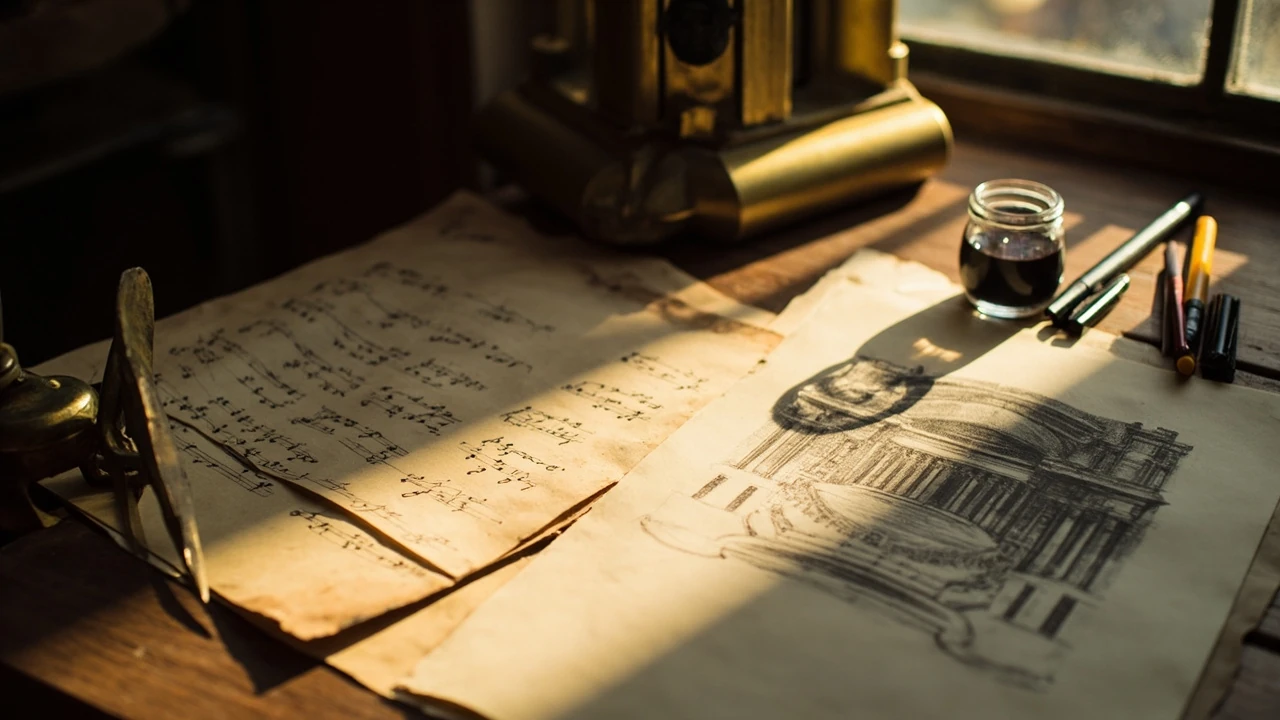
Music and arts: where two traditions share a single studio
A pipe organ builder, a choral conductor, and a stained-glass restorer walk into the same workshop on a Tuesday morning. One of them tunes a rank of principal pipes, the other rehearses a new anthem with a quartet, and the third grinds glass against a lead came. To an outside observer the room looks like three separate jobs stacked into one space. In practice, the three of them are doing the same thing with different materials. They are organising time, tone, and proportion, and they are listening for the moment a design begins to breathe.
The relationship between music and arts is not a metaphor. The two fields share tools, buildings, patronage systems, training routes, and a vocabulary of contrast, line, and resonance. When a young musician asks whether they should also study drawing, theatre, or architecture, the honest answer is usually that the boundary they are worried about was never as firm as their school timetable suggested. This article works through what the overlap actually is, where it is useful, where it is overclaimed, and how a working musician or artist can navigate both worlds without losing craft in either one.
What the shared core of music and arts actually is
Music is sometimes treated as a separate subject because it is heard rather than seen, and because notation looks technical. That framing hides a simpler fact. Music is one of several arts that organise raw material into shaped time. Painting, sculpture, theatre, and architecture do the same with shape, light, and space. The shared core is the act of structuring a sensory experience so that it carries meaning from a maker to a listener or viewer.
This is why cross-training is older than any conservatory. Bach copied keyboard music by hand while studying compositions by Buxtehude, and his day job for the Thomaskirche included supervising instrument repair and listening to architecture. Wagner, before writing a single opera, had worked as a chorus master and had studied theatre staging. The modern conservatory, with its separated departments, is the historical exception rather than the rule.
Materials, time, and proportion: three ideas that travel between the arts
If the shared core is shaped experience, then the building blocks of that shaping tend to be the same regardless of the medium. Three ideas in particular travel from one art to another without translation: materials, time, and proportion.
Materials that have their own voice
A clay pipe, a sheet of vellum, a bronze bell, and a length of gut string are not neutral carriers. Each one resists what the maker wants, and the resistance is part of the result. Organ builders talk about this directly when they discuss pipe materials and their acoustic behaviour. A principal pipe voiced in high tin behaves differently from the same pipe in spotted metal, and the difference is not a defect to engineer away. It is a tonal colour the builder chooses when they plan a stop.
Painters run into the same constraint with pigments. Ultramarine and ochre behave differently in oil, and the choice affects how a passage ages. Theatre directors run into it with bodies, voices, and the acoustics of the room. The trained artist in any medium learns to read the material before fighting it.
Time as a sculpted element
Music shapes time directly. Every note has a duration, every silence has a length, and every phrase has a curve. The other arts shape time less directly, but they still shape it. A film editor, a choreographer, and a stage designer all decide how long a viewer dwells on a given image or gesture, even when no one is counting beats.
The clearest crossover for musicians is in architecture. Walking into a Gothic cathedral and walking into a Baroque chapel feels different in part because the room has been built to a different tempo. Vault rhythm, column spacing, and window cadence set a pace that the music later reinforces. When a composer writes a piece for a specific space, they are writing into that pre-existing tempo, not against it.
Proportion as a hidden scaffold
Proportion is the least visible bridge between music and arts. It is also the most stubborn. A pipe organ’s case, the casework of a violin, the facade of a stage, and the layout of a hymn board all work or fail on the same kind of numerical relationship: ratios that the eye and ear accept without being told why. When the ratios are off by enough, both the building and the music sound wrong before anyone can name the problem.
How a working musician uses the visual arts in practice
For a professional musician, the visual arts are not an optional enrichment. They show up in three daily ways: in the spaces where music is performed, in the printed and digital materials that surround a programme, and in the design of the instruments themselves. Each one rewards attention and punishes neglect.
Performing spaces and their acoustic signatures
Concert halls, churches, and recital rooms are designed, and the design is audible. A singer who walks into a dry room with a short reverb will adjust their breath, their vowel choice, and their dynamic range. The same singer in a long, warm space will lean into legato and use less physical effort, because the room carries so much of the work. This is not theory. It is what conductors and vocal coaches do every time they rehearse in a new venue.
Instrument builders face the same problem from the other side. A voicing that works perfectly in a dry practice room can sound thin in a stone church, and a voicing that flatters the church can be hard to control in the practice room. Decisions about pipe scaling, wind chest layout, and case acoustics are made with the eventual room in mind, not with the workshop alone.
Programme design, scores, and the page
Even in the digital era, the printed programme, the cover of a score, and the layout of a recital poster shape what an audience expects before a single note is played. A programme cover that signals seriousness pulls attention inward. A cover that signals playfulness primes the audience to receive a more theatrical performance. Editors and designers know this; musicians who ignore it are losing a tool they could otherwise use.
Instrument design as applied sculpture
An instrument is a piece of functional sculpture. The shape of a cello scroll, the case of a tracker organ, the layout of a marimba, and the housing of a digital sampler are all designed objects. The best instrument makers treat the visual design as part of the performance, not as packaging. A case that looks unstable on the platform reads as unstable to the audience even before the first chord is heard.
How a working visual artist uses music in practice
The flow runs the other way as well. Painters, sculptors, photographers, and stage designers use music in three different roles: as a working environment, as a structural model, and as a subject in its own right. Each role is worth understanding on its own terms.
Music as a working environment
Many studios run with a permanent soundtrack, and the choice of soundtrack is rarely accidental. Loud, fast music tends to support physical work such as carving or welding. Slow, regular pulse tends to support tasks that need sustained attention, such as glazing, retouching, or editing. Artists who work alone often develop a private sense of which rhythm matches which phase of the work. What looks like a preference is usually a workflow choice with measurable effects on pace and error rate.
Music as a structural model
Composers think in arcs. They set up a phrase, develop it, and resolve it, often in timeframes of seconds. Visual artists working on a series face the same problem at the scale of a wall or a room. The question of how a sequence of images resolves into a final frame is structurally identical to the question of how a sequence of phrases resolves into a coda. Artists who have thought about musical form tend to plan their sequences more deliberately, even when they would not describe what they are doing as composition.
Music as a subject and as a collaborator
Music also appears in visual art as subject matter, and that subject is unusually demanding. Painting or sculpting a musician is not the same as painting or sculpting a sitter, because the musician is mid-action, mid-breath, and the viewer often knows what the music should sound like. A still image has to imply sound. That is a high bar, and the artists who clear it are usually the ones who have listened closely enough to know what they are after.
Where the connection is genuine, and where it is overclaimed
Music and arts are genuinely related, but the relationship is sometimes stretched into shapes that do not hold. A short, honest list helps separate the working connections from the decorative ones.
| Claim | How it holds up |
|---|---|
| Studying painting improves a musician’s sense of phrasing. | Frequently true, especially for sight-reading and ensemble listening. |
| Listening to classical music makes a painter more creative. | Weak. Effects are usually about mood and pace, not creativity in the abstract. |
| Architecture and acoustics are the same field. | False. They overlap, but room acoustics and structural design are different disciplines with different training. |
| A graphic score is a valid alternative to a written score. | Depends on the room and the players. Useful in contemporary practice, limited in repertoire music. |
| Art schools should require a music module. | Plausible, but evidence is patchy. Cross-training helps, mandated modules do not always land. |
The pattern is that the more specific the claim, the more it tends to hold. The more a piece of writing claims that music and painting are “really the same thing”, the less useful it tends to be for a working artist.
A short history of how the two fields got bundled together
Modern subject divisions are recent. For most of European history, the arts were grouped by patronage, not by medium. A court painter, a court musician, and a court poet were employed by the same household, paid out of the same purse, and worked to the same calendar of feasts, weddings, and funerals. Their training was different, but their deadlines and their audiences overlapped.
The 19th century changed that. Conservatories, art academies, and drama schools hardened into separate institutions. Universities split the humanities from the performing arts. By the mid-20th century, a young musician and a young painter were likely to be trained in different buildings, funded by different schemes, and assessed by different criteria. The bundling is a recovery, not an invention.
Two modern movements pushed back against the split. The Bauhaus, in the 1920s, treated design, music, and theatre as parts of a single curriculum, and the cross-training it produced showed up decades later in fields as different as graphic design and electronic music. Fluxus, in the 1960s, treated the boundary between music and visual art as a working surface rather than a wall. Both movements are useful counter-examples for anyone who thinks the modern departmental split is the only honest way to organise the arts.
What a working musician or artist gains from the other field
It is easy to list benefits in the abstract. It is harder to be specific. The table below is an attempt to put concrete gains in one place so the reader can decide which ones matter for their own work.
| Skill in field A | Practical use in field B | How to acquire it without retraining |
|---|---|---|
| Drawing basic proportion | Stage presence, posture at the console, sensible score marking | One evening-class term of life drawing is usually enough. |
| Reading stage lighting | Knowing how the audience sees you, planning when to step out of shadow | Watch three productions from the lighting booth, not the stalls. |
| Understanding a stop list | Reading a programme, set list, or exhibition plan with the same structure | Read two introductions to organ stops written for non-specialists. |
| Sound design vocabulary | Talking to a sound engineer without losing the room | Sit in on one rehearsal and ask what the engineer is doing. |
| Colour theory | Designing recital programmes, websites, and album covers that support the music | One short course in graphic design fundamentals. |
| Architectural drawing | Understanding how a room’s shape changes a performance | Tour a major venue with an architect, not the marketing manager. |
None of these require a second degree. They require a deliberate habit of stepping across the boundary, looking carefully, and bringing back something specific.
Three working habits that hold the two fields together
Some habits are useful in both fields, and adopting them tends to make cross-training easier. The list below is short on purpose.
- Keep a notebook of unfinished problems, not just finished work. Both musicians and visual artists hit walls that take weeks to move through, and a written record of what has been tried saves a great deal of time.
- Schedule one slow, regular session a week. A two-hour block at the same time and place is more useful than three hours squeezed into a busy day. The brain treats it as a commitment and prepares for it.
- Show unfinished work to one trusted person. Both fields punish isolation, and the colleague who sees the rough cut is often the one who spots the structural problem before it hardens into a habit.
Reading the connection in real performances and exhibitions
The test of any claim about music and arts is whether it shows up in the work. A reader who wants to see the connection in action can look for it in a few predictable places.
- Theatrical opera productions. A well-staged opera is a working demonstration of how music, set, costume, and light solve a single dramatic problem together. A badly staged one shows what happens when one element is ignored.
- Concert hall architecture. Walking through a major concert venue with a plan of the room in hand, listening for where the sound blooms and where it dies, is a faster education than most textbooks.
- Art exhibitions with sound components. The few that work do so because the sound has been composed for the room in the way the paintings have been hung for the wall. The ones that fail usually treat the sound as decoration.
- Historic organ cases. A 17th- or 18th-century organ case is a piece of furniture design that was built to be looked at while the music was being played. Seeing one in a working church, ideally with someone playing, is a good way to feel the connection rather than read about it.
- Festival programmes that mix music with visual or performance art. These are uneven, but the well-curated ones show how a single artistic direction can carry across very different media.
Three things beginners often get wrong about music and arts
Beginners tend to approach the overlap in one of three ways, and two of the three are mostly wrong. Naming the mistakes is faster than working through them one by one.
- Treating music and arts as the same thing. They share a core, but the training, the day-to-day craft, and the assessment are different. Collapsing the two flatters the beginner and annoys the specialist on both sides.
- Assuming cross-training is a luxury. For most working musicians and artists, a few weeks of attention to the other field produces noticeable gains within a season. The cost is low, and the return is reliable.
- Picking up only the most visible habits. Learning one visual artist’s signature move and copying it is not the same as learning how visual artists actually work. The transferable skill is the method, not the style.
A practical way to start cross-training this month
The point of cross-training is to change something small in the working week, not to retrain. The list below is a starter set, not a syllabus.
- Visit one working studio in the other field. A working studio, not a museum. Watch for an hour, ask two questions, leave.
- Read one short book on the other field. Aim for a working manual, not a history. Histories are valuable later, manuals change practice now.
- Try one small project in the other field. A short drawing, a recorded soundscape, a few minutes of writing about a painting. Finish it, do not polish it.
- Talk to one person who works across both fields. Ask how they schedule, what they drop when time gets tight, and what they refuse to give up.
- Keep a record. After a month, write three sentences on what actually changed. If nothing changed, the cross-training has not started yet.
When the connection matters most
The relationship between music and arts is most useful in three situations. Recognising them helps a working artist decide when to invest the time.
- When a new commission crosses media. A piece for organ and installation, a song cycle with projected images, a stage work with a sound score. These are the projects that fail most often, and the failure is usually traced to one side not understanding the other.
- When a long career begins to narrow. Many musicians and artists find that after fifteen or twenty years, their work has settled into a groove. A deliberate dip into the other field tends to reopen questions that the main practice has stopped asking.
- When teaching. Students learn more from a teacher who can show how an idea works across two media than from one who can only describe it inside a single field. The most useful teachers are the ones who have done this kind of cross-training themselves.
Frequently asked questions
Is music considered an art?
Yes. Music is one of the traditional fine arts and shares the same aims as the visual and performing arts: organising raw material into shaped experience. It is set apart by being heard rather than seen, but the difference is one of medium, not of category.
How are music and the other arts connected in schools?
In most modern schools they are taught as separate subjects, often in different buildings and with different assessment systems. Cross-disciplinary teaching exists, but it is more common in specialist programmes than in mainstream curricula. A few integrated programmes treat the two together, particularly in early years.
Can studying visual arts make a musician better at music?
It can, especially in areas such as sight reading, stage presence, ensemble listening, and programme design. The benefit is largest when the cross-training is short, focused, and applied to a specific weakness. The benefit is smaller when the cross-training is open-ended and decorative.
Do professional musicians need to know anything about painting or theatre?
Most working musicians benefit from a working, not specialist, knowledge of the other arts. They perform in spaces built by architects, in productions designed by stage designers, and in programmes illustrated by graphic artists. Knowing enough to talk to those colleagues clearly is part of the job.
What is the difference between music and visual art?
The medium, the time scale, and the primary sense. Visual art is mostly still and seen; music is mostly moving and heard. The deeper differences in training and craft are real, but the shared core of organised expression is also real, and it is what allows cross-training to work at all.
Where do music and the other arts overlap most clearly?
In performance, in shared spaces, in cross-disciplinary projects, and in the everyday work of designers, architects, and sound engineers who support both fields. Opera, film, theatre, festival work, and installation art are the obvious meeting points, but the same overlap shows up in small ways throughout both practices.
Is it worth a musician’s time to learn drawing or painting?
Usually yes, in modest amounts. A few months of regular practice tends to sharpen a musician’s sense of proportion, posture, and design. The investment does not need to be a second degree, and the return shows up in working habits rather than in the music itself.
Are there careers that combine music and visual art directly?
Yes. Art direction, exhibition design for music institutions, instrument making, music publishing, sound design, festival curation, and interdisciplinary performance all combine the two. The work is unevenly paid and unevenly structured, but it is real, and there are more of these jobs now than there were a generation ago.
How do architecture and music relate to each other?
Architecture shapes the room in which music is heard, and the relationship is most visible in sacred and civic buildings. The shape of a vault, the spacing of columns, and the materials of the walls all change the music that is performed inside. Modern concert hall design is a recognised subfield of architectural practice.
Where should a reader start if they want to learn more about the connection?
A short, practical book on room acoustics, a working manual on stage design, and a visit to a working organ builder or instrument maker are three reliable starting points. The first two explain the science, the third shows the craft, and together they cover most of what a working musician or artist needs to know.