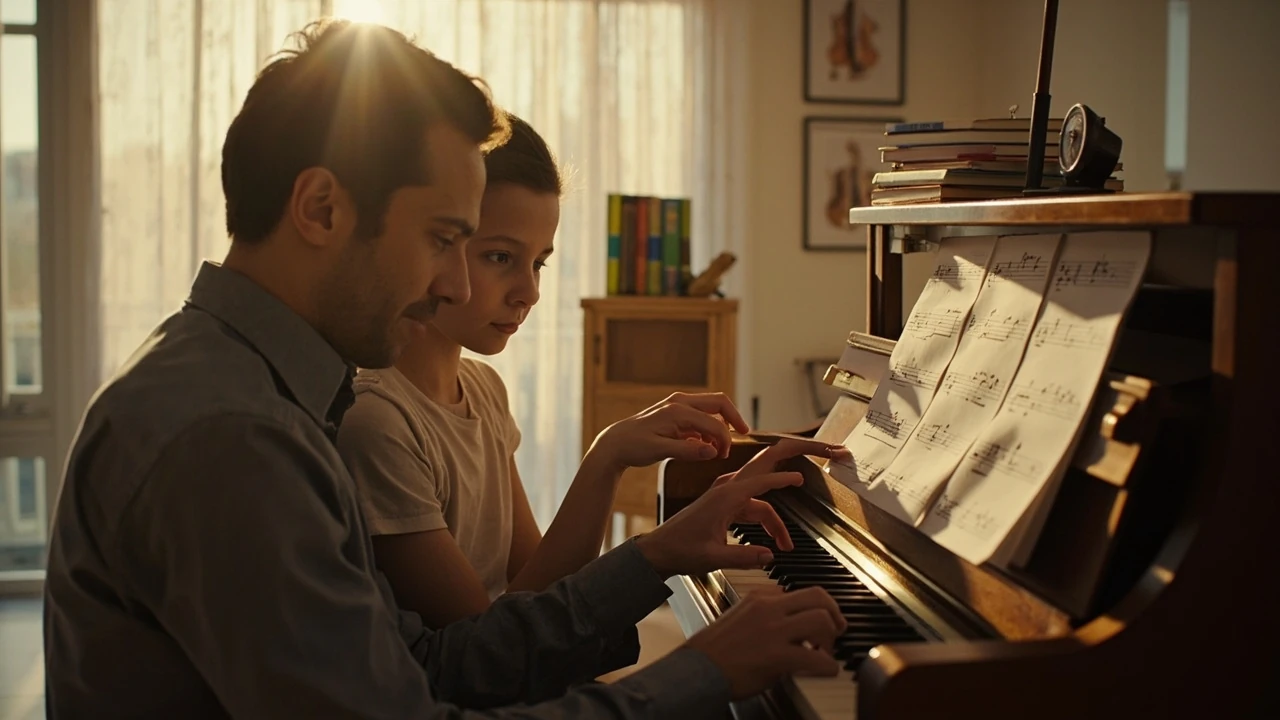
Music lessons explained: how to choose, structure, and progress
A seven-year-old pressing a single key on a school upright for the first time and an adult returning to the clarinet after twenty years sit at opposite ends of the same question: how do you set up music lessons that actually lead somewhere? The lesson itself is a small slice of the answer. The real work happens in the gap between lessons, in the choice of teacher, and in the way goals are written down. This guide walks through the practical decisions behind a useful round of music lessons for beginners, returning players, and parents booking on behalf of a child.
The aim here is decision support, not inspiration. By the end of the article you should know what to ask a prospective teacher, how a typical practice week is structured, how to read the first three months of progress, and when a change of teacher, method, or instrument makes sense. Specific examples lean toward keyboard and pipe organ where useful, because the site this article lives on works with those instruments, but the same logic applies to strings, wind, brass, voice, and percussion.
What music lessons actually cover in a typical week
A weekly music lesson has a different shape from a homework session or a self-study block. The lesson is where a teacher diagnoses, demonstrates, and sets direction; the practice at home is where the motor patterns and reading skills are built. Treating those two jobs as the same thing is the most common reason a student plateaus after a few months.
A standard 45 to 60 minute lesson usually contains four kinds of work. First, a short warm-up or technical exercise to settle the hands, breath, or voice and to surface any stiffness from the previous week’s practice. Second, a review of pieces and studies from the previous week, where the teacher corrects posture, rhythm, fingering, and reading. Third, new material: a new piece, a new scale, a new technical pattern, or a new reading concept. Fourth, the assignment of what to work on before the next lesson, usually written in a practice notebook or studio app.
Group lessons, which are common in schools and some community programs, follow a similar structure but with less one-to-one feedback. Online lessons, whether live or hybrid, add screen and audio latency as a constraint, which is why a good external microphone or a quiet room with a hard-wired connection matters more than the camera.
How to choose a teacher for music lessons
The teacher is the single biggest variable in how quickly a student progresses. A less experienced teacher who is well matched to the student usually beats a more impressive teacher who teaches a different goal, repertoire, or learning style.
Start by defining what the student actually wants. A child who wants to play pop songs on keyboard needs a different approach from a child working toward graded exams. An adult returning after a long break needs a teacher who is comfortable rebuilding fundamentals without making the student feel like a beginner again. A teenager preparing for a school performance has a deadline that should shape the lesson plan.
Once the goal is clear, look for a teacher who can show relevant experience. Questions worth asking in a first contact or trial lesson include:
- What age group and level do you teach most often?
- Do you prepare students for graded exams, or focus on repertoire and playing by ear?
- How do you structure a typical lesson, and how long is the practice you expect at home?
- What method books or resources do you use in the first six months?
- How do you handle students who want to change direction, for example from classical to jazz?
- What is your policy on missed lessons, make-ups, and cancellations?
A good teacher answers these questions directly and asks about your goal in return. A teacher who promises fast results without asking about your current level, available practice time, or access to an instrument is selling a feeling rather than a plan. For a child, the fit with the family is also part of the choice: a teacher who refuses to discuss progress with a parent is usually a poor match for a beginner under twelve, while a teenager may benefit from a teacher who speaks to them directly.
Setting realistic goals before the first lesson
Music lessons work best when the student, the parent, or the adult learner can name a concrete goal for the first three to six months. Vague goals such as “learn piano” or “get better at guitar” are not specific enough to plan around. Useful goals describe a piece, a skill, or a context.
Examples of well-shaped first goals include:
- Play a complete simple piece, hands together, at a steady tempo, by the end of term.
- Read notes on the treble staff up to two ledger lines in a method book without hesitation.
- Sit a first graded exam at initial or grade 1 level.
- Learn enough open chords to accompany three chosen songs for a family gathering.
- Re-learn one piece from a previous period of study to performance standard.
Once the first goal is set, the teacher can choose a method book, a pace, and a practice plan that fit. Without a named goal, lessons tend to drift through material without a finish line, which quickly becomes discouraging for beginners and frustrating for more advanced students.
The practice plan that makes lessons pay off
The honest truth about music lessons is that the lesson is the expensive hour and the practice is the cheap hours, and the cheap hours determine the result. A student who practises twenty focused minutes a day, five days a week, will outpace a student who practises two unfocused hours the day before each lesson.
A useful practice plan follows the same logic as a good lesson, scaled down. The following table shows a typical week for a beginner or early intermediate student with about 30 to 45 minutes a day available.
| Day | Block 1 (10 min) | Block 2 (15 min) | Block 3 (10 min) |
|---|---|---|---|
| Monday | Warm-up and technical exercise | Current piece, slow practice | Review of last week’s piece |
| Tuesday | Warm-up and technical exercise | New piece, hands separately | Sight reading from method book |
| Wednesday | Warm-up and technical exercise | Current piece, hands together | Ear training or aural exercises |
| Thursday | Warm-up and technical exercise | New piece, hands together in sections | Review of last week’s piece |
| Friday | Warm-up and technical exercise | Run-through of current piece | Free play or chosen song |
| Saturday | Longer block: full run-through of both pieces | Targeted weak spots | Listening to a recording of the piece |
| Sunday | Rest or light listening | Optional short review | Optional short review |
The exact split matters less than the consistency. Two things tend to break practice plans: practising without a notebook, so the student forgets what the teacher asked, and practising only whole pieces, so the weak sections never get isolated. A simple practice notebook or a notes app on the phone is enough to solve the first problem. The second is solved by spending at least half of the practice time on small sections, slow tempo, and difficult transitions, and reserving full run-throughs for the last few minutes.
For students with very limited time, a five-day plan with three short focused blocks tends to work better than one long weekly session. Twenty minutes a day, five days a week, totals 100 minutes; one 90-minute session on Sunday totals 90 minutes and produces far less retention.
What progress looks like in the first three to six months
Progress in music lessons is uneven, and the pattern is normal. The first two to four weeks feel slow because the student is learning how to sit, hold the instrument, read the staff, and count. The next two months often feel fast because small skills start to combine. After that, there is usually a plateau where new pieces sound harder than expected and old pieces stop feeling like progress. That plateau is the point at which many students quit, and it is also the point at which a good teacher and a clear practice plan start to pay off.
The table below maps typical signs of progress to rough timeframes for a beginner or early returner practising about 30 to 45 minutes a day, five days a week. Exact timing depends on the instrument, the age of the student, and prior experience, but the shape of the curve is similar.
| Timeframe | Typical signs of progress | What the student may feel |
|---|---|---|
| Weeks 1 to 4 | Correct posture, basic sound production, first short pieces hands separately, simple reading up to a few notes on the staff | Awkward, slow, but curious |
| Weeks 5 to 10 | Hands together at slow tempo, first full pieces, growing reading speed, beginning of simple scale patterns | Encouraged, with a sense of momentum |
| Months 3 to 4 | First pieces at performance tempo, more reliable counting, ear starts to predict errors, first attempt at simple ear training | Confident on familiar material, frustrated on new pieces |
| Months 5 to 6 | Two or three pieces at a comfortable level, easier sight reading, basic dynamics and articulation, first graded exam or first public performance if aiming for one | Plateau: old pieces feel easy, new pieces feel hard; this is normal |
If the signs above do not appear within these rough timeframes, the cause is usually one of three things: not enough focused practice, a teacher whose method does not fit the student, or an instrument that is not set up well enough to make the basics possible. A piano with several dead notes, a guitar with high action, or a rented violin that has never been set up can quietly undermine months of lessons.
Choosing an instrument when starting from zero
The instrument matters less than the student thinks, and more than a beginner teacher sometimes admits. Almost any well-taught student will make progress on almost any well-maintained instrument, but the choice shapes which repertoire is available, which teachers are nearby, and how easy practice will feel on a tired evening after school or work.
For children, the most common starting instruments are piano and violin, with guitar and recorder close behind. Piano offers a clear visual map of pitch, which makes early reading easier; violin offers a single line of music and develops the ear quickly but requires a careful setup of the instrument. Recorder is a low-cost way to start wind technique before moving to flute or clarinet, but it is loud and sharp, which matters in shared housing.
For adults, the choice usually comes down to repertoire and access. A keyboard with weighted keys, a guitar, a ukulele, a drum pad, or a digital wind instrument are all reasonable starting points. Voice lessons are also a common entry, and they require no instrument purchase at all, though they benefit from a quiet practice space and a piano or keyboard for repertoire work.
If the longer-term aim is a pipe organ, piano is the usual precursor because keyboard reading and pedal technique both develop on a weighted keyboard or a pedalboard. A useful introduction to the families of sound on an organ is in the site’s guide to organ stops explained, which is a good background read during the first year of piano lessons.
Common mistakes that slow down music lessons
Some mistakes appear so often across students that they are worth naming in advance. Catching them early saves months of plateaus.
- Practising only whole pieces, never isolated sections, so difficult passages never get the repetition they need.
- Skipping the warm-up because the student wants to play the fun piece, which entrenches tension and slows new learning.
- Changing method book or teacher too often, so the student keeps starting over without reaching a depth of repertoire.
- Stopping practice for a week or two between lessons, which resets short-term memory and lengthens the time to a finished piece.
- Using an instrument that is not in working order, because bad sounds train the ear and the hand to expect them.
- Setting a goal of “be good” rather than a specific piece, scale, or exam, which makes progress hard to see.
- Comparing the student’s timeline with another student, sibling, or online video, which sets a pace the teacher cannot match.
None of these mistakes require a special student to avoid. They are the normal pitfalls of a long, slow skill, and the practice plan in the previous section is designed around them.
When it makes sense to change teacher or method
Changing teacher is not a failure. A change is the right move when the current teacher is unable to address a specific problem, when the student’s goal has shifted, or when the working relationship has broken down. The change is more likely to be useful if the new teacher is given a clear summary of what has already been covered, ideally in the practice notebook, so the new teacher does not have to start from scratch.
Changing method book is more delicate. Method books are written in a sequence, and switching mid-sequence can leave gaps. A change is justified when the current book is moving too fast, too slow, or in a style the student will never use, or when the teacher has identified a specific concept that another book teaches more clearly. In most other cases, staying with a chosen book for at least one full level is the safer choice.
For students moving from piano to organ, the change of instrument is itself a useful checkpoint. A working understanding of how sound is shaped on an organ, including the role of stops and registration, makes the first organ lessons more productive. The article on organ registration is a practical starting point, and the broader topic of how individual pipes are voiced to produce a balanced sound is covered in pipe voicing.
Online, in-person, and hybrid music lessons compared
Online lessons became a default option for many students in the early 2020s and remain useful for students in areas without a strong local teacher base, for adults with busy schedules, and for students who want access to a specialist teacher in another city. The trade-offs are real, and the format should be chosen with the student’s age and instrument in mind.
| Format | Strengths | Limitations | Best fit |
|---|---|---|---|
| In-person lessons | Direct physical correction of posture, hand shape, and breathing; shared instrument for demonstration; easiest for young beginners | Travel time and cost; limited to local teachers; fixed weekly slot | Young children, beginners, voice and wind students, organ students |
| Live online lessons | Access to a wider pool of teachers; no travel; recordings can be reviewed; flexible scheduling | Audio and video latency; harder to correct hand position; needs a decent internet connection and a quiet room | Teenagers, adults, returners, theory and composition students |
| Hybrid lessons | In-person lesson every two to four weeks with online lessons in between; balance of correction and convenience | Requires a teacher who offers both formats; continuity of plan between formats | Intermediate students with a specific goal such as an exam or audition |
For the very youngest beginners, in-person is usually worth the travel because the teacher’s physical cues carry a lot of the teaching. For teenagers and adults, online lessons are often a better fit because the student can be more independent. A short trial period is a low-cost way to test whether the format works for a particular student before committing to a term.
How parents can support a child’s music lessons
Children between about five and eleven benefit enormously from a parent who sits in on part of the practice, not to nag, but to act as a quiet metronome and to keep the practice plan in view. The teacher can set the plan; the parent can keep it honest. A simple weekly check-in, asking what the new piece sounds like and what the practice notebook says, is enough for most students.
Three habits tend to support a child’s lessons more than any single piece of equipment:
- A consistent, distraction-free practice slot, even if it is only 15 minutes after homework.
- A working instrument at the right height, with a bench, stand, or footstool adjusted so the child sits comfortably.
- Brief, specific praise that names what changed, such as “the left hand stayed with the right hand this time”, rather than general encouragement.
As the child moves into the teenage years, the parent’s role usually shifts from supervision to logistics: keeping the instrument in working order, supporting attendance at lessons and performances, and being available for the occasional burst of frustration without taking it personally.
Adults returning to music lessons after a long break
Adults returning to an instrument after ten or twenty years are not beginners, but they are not where they left off either. The hands, breath, or voice need time to rebuild, and the ear often has clearer expectations than the body can yet meet. A useful first goal is to choose a piece from the old repertoire and rebuild it, slowly, with new technical habits if needed. A teacher who can spot the difference between rust and a habit that has gone stale is the most valuable ally in the first few months.
For adults, scheduling is usually the bottleneck. Two short, focused blocks of 20 to 30 minutes on separate days tend to work better than one longer weekly block. The first sign of progress is usually that the muscle memory for old pieces comes back faster than expected; the second is that new pieces feel learnable again.
How music lessons fit with school or university music programs
Private music lessons and school music programs are not in competition. School ensembles provide regular ensemble experience, sight reading in context, and a social reason to practise. Private lessons provide the focused, individual feedback that an ensemble setting cannot offer. A student who does both, with the private teacher aware of the school program, usually progresses faster than a student who does only one.
Where the two do clash, the usual source is repertoire. A school program may move through several pieces a term to keep the ensemble supplied, while a private teacher works on fewer pieces in more depth. The compromise is usually to choose one or two pieces a term for depth and accept that the rest of the school repertoire will be played at a more functional level.
Budgeting realistically for a year of music lessons
The lesson fee is the most visible cost, but it is rarely the largest. Over a year, the instrument, the maintenance, the method books, and the exam or performance fees add up. A rough budget for a beginner on a popular instrument such as piano, guitar, or violin in 2026 might look like the following, with all figures varying by region.
| Cost item | Beginner (first year) | Notes |
|---|---|---|
| Weekly 45 minute lesson, 40 weeks | The largest single line | Group lessons are cheaper; specialist teachers are usually more expensive |
| Instrument purchase or hire | Significant for piano; smaller for guitar, recorder, or ukulele | Secondhand or hire often makes sense for the first year |
| Method books and sheet music | Modest | Often underbudgeted; expect a steady stream of small purchases |
| Maintenance and accessories | Piano tuning once or twice a year; replacement strings, reeds, or oils as needed | Neglecting maintenance is a false economy |
| Exams or performance entries | Optional | One exam per year is a common cadence |
Two practical ways to keep a year of music lessons affordable without lowering the quality of teaching are to share a lesson between two siblings of similar age and level, where the teacher agrees, and to hire a mid-range instrument for the first six to twelve months while confirming that the student is going to continue. Hiring also avoids the trap of buying a poor instrument that makes early practice harder than it needs to be.
Measuring progress beyond “sounds better”
“It sounds better” is real feedback, but it is hard to use as a measure. A more useful record includes a few simple, written markers that can be compared across terms. A short list kept in the practice notebook or a notes app is enough.
- The longest piece played hands together, or end-to-end, with a date.
- The current technical exercise, with tempo and accuracy notes.
- One specific reading milestone, such as the range of notes read without hesitation.
- One ear training milestone, such as the ability to clap back a short rhythm or sing back a simple melody.
- One performance milestone, such as a school concert, a graded exam, or a recorded run-through shared with a relative.
Reviewed once a term, this short list gives both the student and the teacher a clear sense of where the year has gone. It also gives the student something to point to on the days when progress feels invisible.
Frequently asked questions
How long does it take to see real progress in music lessons?
For a beginner practising 30 to 45 minutes a day, five days a week, the first signs of real progress usually appear within six to ten weeks. A first short piece played hands together at a steady tempo is a useful early marker. Deeper progress, such as reading fluently or performing a graded piece, typically takes six to twelve months of consistent work.
How often should music lessons happen?
Weekly is the standard for most students because the gap between lessons is short enough that the teacher can correct problems before they harden into habits. Twice a week is common for serious students preparing for exams or auditions. Fortnightly lessons can work for adults with limited time, provided the practice plan is honest about the longer gap.
Are group music lessons as good as private lessons?
Group lessons are good value for early beginners, for ensemble skills, and for students who learn well from peers. They are usually less good for students with specific technical problems, for advanced work, or for students who are easily distracted. A common pattern is a private lesson once a week supplemented by a group class or ensemble.
Is it too late to start music lessons as an adult?
No. Adults often progress faster than children in the first year because their attention, goal-setting, and reading skills are already in place. The main limits are practice time and patience with the body, which takes longer to rebuild than the ear expects. A realistic first goal of one finished piece in three to four months is a healthy starting point.
What age is best to start music lessons for a child?
Most teachers accept beginners from about age five for piano, recorder, and violin, and from about age seven for guitar and brass. Earlier is not automatically better; the child needs to be able to focus for 15 to 20 minutes and to follow simple instructions. A short trial lesson is the most reliable way to tell.
Do I need a full-size instrument to start music lessons?
For piano, a weighted 88-key keyboard or an acoustic piano in reasonable condition is a practical starting point. Lighter, unweighted keyboards are acceptable for the first few months but will hold the student back on technique. For violin, a properly set up fractional size is more important than a specific brand. For wind and brass, a student model in good condition is usually enough for the first two years.
How do music lessons and practice time relate?
The lesson sets direction, and the practice does the work. A useful rule of thumb is that for every hour of lesson time, the student practises five to seven hours at home across the week. Less than that and progress slows; more than that and fatigue or injury can start to work against the student, especially on instruments that demand repetitive motion.
Should music lessons follow an exam syllabus?
Exam syllabuses are useful as a structure, especially for younger students, because they set a clear progression of pieces, technical work, and supporting tests. They are not the only way to learn an instrument, and many adult students prefer repertoire-based learning without exams. A teacher can blend the two, using an exam structure for technical work and a more flexible choice of pieces.
When should a student change music teacher?
A change is worth considering when the current teacher cannot address a specific recurring problem, when the student’s goal has shifted in a direction the teacher does not support, or when the working relationship has lost its trust. A two or three lesson trial with a new teacher, with an honest handover of what has already been covered, is a low-risk way to test a change.
Can music lessons help with focus and study more generally?
Many families report improvements in focus, patience, and the ability to break a task into small steps after a year of consistent music lessons, but the evidence is mixed and depends on the student. Music lessons are a structured form of deliberate practice, which is the same kind of work that supports learning in other areas, so the transfer is plausible even if it is hard to measure.