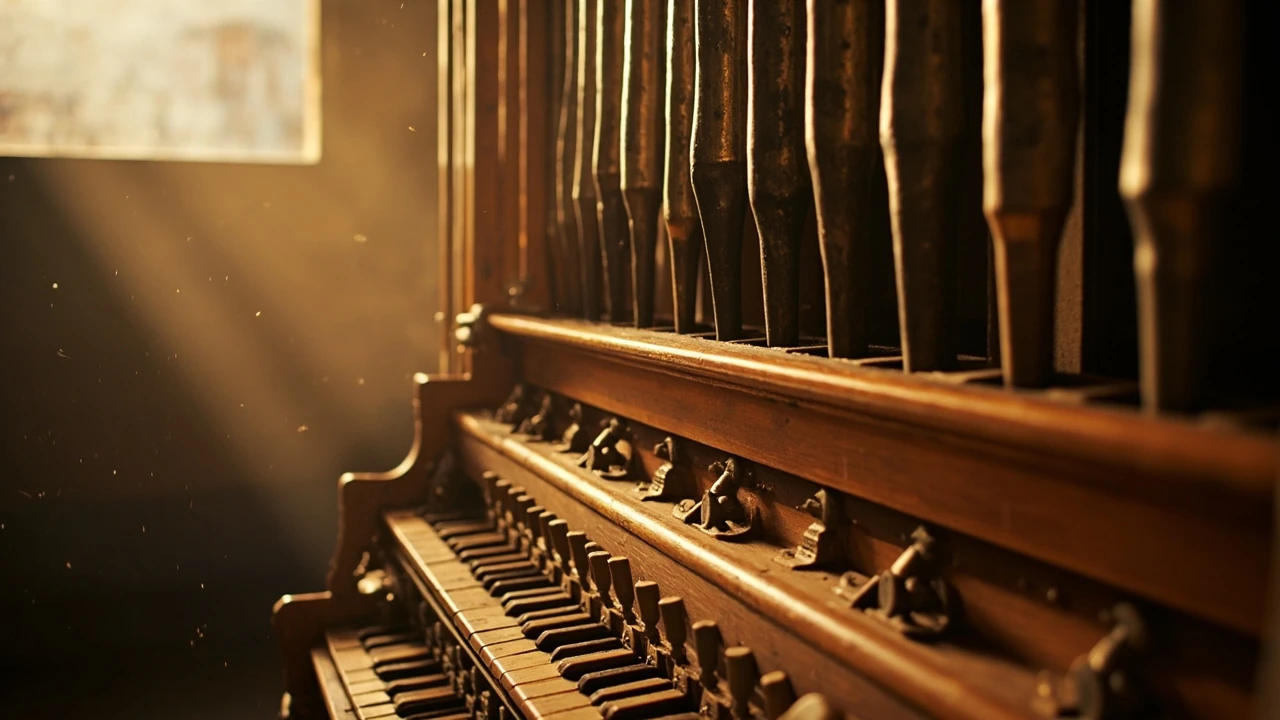
Organ acoustics: how sound actually behaves inside a pipe organ
The first note you hear from a pipe organ is not really one sound. It is a chain of small acoustic events: a valve admits compressed air, the air column inside a pipe begins to vibrate, the pipe radiates that vibration outward, and the room reflects it back toward the listener. Every stage of that chain shapes what the ear finally registers. Understanding organ acoustics means following that chain step by step, from the air that drives the pipes to the way stone, wood, plaster, and seating bend the sound before it reaches you.
This article walks through the main elements of organ acoustics in a practical order. It is written for organ students, builders, church committees, and curious listeners who want a working mental model of how a pipe organ produces, colors, and projects its sound. It does not replace a textbook on architectural acoustics or voicing technique, but it should make the basic vocabulary and the main decisions easier to follow.
What organ acoustics really covers
Organ acoustics is the study of how a pipe organ generates, transmits, and radiates sound. It sits at the intersection of three traditional fields:
- Aerodynamics, because a pipe speaks only when air is set in motion under controlled pressure.
- Musical acoustics, because the geometry of each pipe controls its pitch, timbre, and stability.
- Room acoustics, because the building around the instrument decides how the sound reaches the listener.
Compared with a piano or a violin, an organ is unusual in that the sound source itself is built into the room. A piano brings a shaped wooden box with it; a violin shapes its sound with a small resonating body held under the chin. A pipe organ, by contrast, may contain thousands of individual resonators that each behave differently and then hand the result over to walls, ceilings, and pews that were never designed with sound in mind. The result is that organ acoustics is as much about the building as it is about the instrument.
For readers who want a broader overview of how a pipe organ is built before diving deeper into the sound, the page on pipe organ fundamentals provides a useful starting point.
The four stages of organ sound
Almost everything that organ acoustics describes can be sorted into one of four stages. Each stage has its own physics, its own variables, and its own typical problems.
| Stage | What happens | Main physical controls | Common organ-building concerns |
|---|---|---|---|
| Wind supply | Bellows, reservoirs, and windchests deliver air at a stable pressure. | Air volume, pressure, leakage, regulator action. | Wind instability causes pitch wobble and slow speech. |
| Pipe excitation | The pipe sets the air column into vibration through a flue or reed mouthpiece. | Mouth geometry, languid, ear, reed length, shallot. | Tuning, tone color, speech speed. |
| Sound radiation | The vibrating air column radiates sound out of the pipe mouth and upper openings. | Pipe length, scale, material, wall thickness, cut-up. | Volume, harmonic balance, blending within a rank. |
| Room response | Walls, ceiling, floor, and furnishings reflect, absorb, and diffuse the sound. | Room volume, surface materials, audience, humidity. | Reverberation time, clarity, definition, listener comfort. |
If a listener feels that an organ is “weak,” “muddy,” “harsh,” or “stuffy,” the cause can almost always be traced to one of these four stages. The art of organ acoustics is in knowing which stage to suspect first.
Wind, pressure, and the first acoustic decision
An organ pipe does not sing because the player pushes a key. It sings because the wind system keeps a body of air under controlled pressure and then releases a thin slice of that air across a carefully shaped edge. The first variable in organ acoustics is therefore not a sound at all; it is a supply of quiet, steady air.
Wind pressure in a pipe organ is usually given in millimeters of water column (mm H2O) or in inches of water column (in H2O). Historical instruments often run between 50 and 80 mm H2O. Romantic and symphonic organs of the late nineteenth and early twentieth centuries frequently run between 90 and 150 mm H2O, and some large modern instruments use even higher pressures for chorus reeds and solo stops. The choice of pressure is a design decision, not just a number. Raising the pressure generally:
- Increases loudness, but not proportionally.
- Shortens the speech of the pipe, making it respond faster.
- Raises the pitch slightly, which is why a voicer must relearn the layout when pressure changes.
- Adds higher harmonics, which can change the timbre from round to bright or even aggressive.
The bellows, reservoir, and windchest together act as acoustic filters. A large reservoir with a heavy weight behaves like a low-pass filter, smoothing pressure fluctuations; a small, lightly loaded reservoir passes more of the player’s pumping or blower noise directly to the pipes. Stable wind is essential for clean speech. When wind sags under heavy chords, you can actually hear the pitch drop and the attack soften. This is one of the most common complaints voiced by listeners who sense something is wrong but cannot name it.
How a flue pipe turns air into sound
Most organ pipes are flue pipes, the same family of sound generators as a recorder or a whistle. In organ acoustics, a flue pipe is essentially a tuned resonator driven by a thin sheet of air.
The air enters through the foot hole, travels up through the body of the pipe, and exits through a narrow slit called the mouth. Just above the mouth is a thin lip, usually called the upper lip, and just below it is a fixed edge called the languid. The jet of air passing between the lips oscillates back and forth across the edge at a frequency set by the air column itself. That oscillation is the source of the pipe’s sound.
Several acoustic variables are already at work in this small space:
- The cut-up, which is the vertical height of the mouth relative to the pipe’s diameter. A higher cut-up makes the pipe speak faster and louder, often with more upper harmonics.
- The mouth width, which controls how much of the circumference participates. Narrow mouths tend to be more fundamental-rich, while wide mouths can sound more open and reedy.
- The ear, a small leather or metal tab beside the mouth that deflects the jet and helps stabilize the oscillation.
- The foot hole size, which sets the air input. A small foot raises pressure in the pipe and changes the tone.
The rest of the pipe acts as a resonator. For an open pipe, the air column vibrates with a pressure node (a point of free movement) at the mouth and another at the open top, which makes the fundamental wavelength twice the pipe length. For a stopped pipe, the closed bottom forces a pressure antinode there and the open top keeps a pressure node, which gives a fundamental wavelength four times the pipe length. Stopped pipes therefore sound an octave lower than an open pipe of the same length, and they also lack even-numbered harmonics, which is why they tend to sound darker and more hollow.
How a reed pipe works
Reed pipes follow a different path. Instead of a thin jet of air striking an edge, a beating reed vibrates against a shallot. The shallot is a half-cylindrical block with a curved opening; the reed is a thin metal tongue that rests against that opening. Air pushed past the reed makes it snap open and closed many times per second, and the resonator above the reed shapes the tone.
Organ acoustics treats a reed pipe as two coupled systems:
- The reed, which is the sound generator. Its stiffness, length, and curvature control the basic frequency of vibration.
- The resonator, which is usually a conical or cylindrical pipe above the boot. The resonator modifies the spectrum and projects the sound.
Because the reed itself sets the frequency, reed pipes are tuned primarily at the reed, not by moving the pipe length in the way flue pipes are tuned. The resonator can be tuned to match the reed and to shape the harmonics. If a reed resonator is too short for the reed’s frequency, the pipe sounds “lazy” or “choked.” If it is too long, the pipe sounds “wild” or unstable. This balance is one of the central problems of reed voicing.
Pitch, scaling, and why a rank of pipes is not a row of equal pipes
Within a single rank, every pipe produces a different pitch but they are not the same pipe scaled mathematically. Organ acoustics is full of compromises because pipes are physical objects with real-world limits. A 16-foot open wooden pipe that produces low C in a pedal division might be more than five meters long and yet need to behave like a 5-centimeter model scaled to the same proportions. It cannot, because real air, real wood, and real mouths do not scale linearly.
Voicers solve this by adjusting the scale (diameter), cut-up, mouth width, and material from note to note so that the rank holds together musically. The trend in a well-voiced rank is usually:
- Larger scale at the bottom for power and fundamental weight.
- Progressively narrower scale toward the top to keep the tone from spreading and losing clarity.
- Subtle changes in mouth height and ear position to keep speech speed even across the compass.
- Material changes, such as switching from wood to metal or from lead alloy to high-tin alloy, in places where the harmonic structure needs reinforcement.
This is why a skilled voicer is sometimes described as an acoustic surgeon. Each pipe has to behave as if it were a perfect scaled version of the rank’s design, even though that perfection is unattainable in practice.
Timbre and the harmonic series in organ pipes
Every organ pipe produces not just a single frequency but a blend of harmonics. A flue pipe’s harmonic structure depends on mouth geometry, cut-up, and wind pressure. A reed pipe’s harmonic structure depends on reed curvature, resonator shape, and boot volume. The way these harmonics are mixed is what organ builders call the speech of a pipe, and it is one of the most important topics in organ acoustics.
| Pipe type | Typical harmonic profile | Perceived tone | Typical use |
|---|---|---|---|
| Narrow-scaled principal | Strong fundamental and upper partials, bright 2nd-4th harmonics. | Bright, clear, articulate. | Plenum, chorus, solo melody. |
| Wide-scaled flute | Strong fundamental, weaker upper harmonics. | Rounded, soft, foundational. | Accompaniment, flues harmoniques, solo color. |
| Stopped wooden pipe | Odd harmonics only, weak upper partials. | Dark, woody, covered. | Bourdon, gedackt, sub-octave color. |
| Cylindrical open metal pipe | Even harmonic support, moderate upper partials. | Penetrating, singing, slightly stringy. | Diapason, principal chorus. |
| Trumpet reed | Strong fundamental, powerful 2nd and 3rd harmonics. | Bold, brassy, projecting. | Chorus reeds, solo declamation. |
| Krummhorn or regal reed | Complex, slightly beating spectrum. | Quint, nasal, distinctive. | Solo color, chorale accompaniment. |
You can hear these differences in a single phrase by listening for the way the sound decays. A principal loses its upper harmonics quickly and leaves a clean fundamental. A flute keeps a long, even tail. A stopped pipe’s tail is hollow because the missing even harmonics leave a characteristic gap. A trumpet keeps its upper harmonics almost to the end, which is why it can feel almost as loud in the room’s reverberation as in the direct sound.
Why the room matters so much
Room acoustics is the largest single variable in organ acoustics, and the one that is hardest to change after an organ is built. The instrument’s sound leaves the pipes and then meets the walls, ceiling, floor, and furnishings of the building. Each surface does one of three things: reflects, absorbs, or scatters the sound.
For most of the eighteenth and nineteenth centuries, organ builders worked in spaces with hard plaster walls, stone or wood floors, and wooden pews. These surfaces are highly reflective at low and middle frequencies and only slightly absorbent at high frequencies. The result is a long reverberation time, which organ music was written to exploit. The composer and the building are part of the same acoustic system.
Modern rooms, especially those with carpet, upholstered seating, acoustic tiles, and HVAC systems, absorb a much greater share of the high-frequency content. The same organ in a heavily treated room sounds duller and closer, and the chorus loses its edge. Builders who inherit such rooms often compensate by adjusting the scaling, raising wind pressure, or using brighter alloys. None of these fixes is as good as working with the original room, but they are part of the practical toolkit of organ acoustics.
Reverberation, clarity, and the listener’s seat
Reverberation time is the easiest room-acoustic measurement to talk about and the easiest to misunderstand. It is the time it takes for a sound to decay by 60 decibels after the source stops. A small dry room might have a reverberation time below one second. A large cathedral might have five seconds or more. Organ music does not require one specific value; it requires that the value match the instrument’s design and the music’s character.
Within a single room, listeners also sit in different acoustic positions. Three typical zones are worth knowing:
- The near field, close to the organ. Here you hear mostly direct sound, with strong individual voices and very little room effect. Solo lines can be very dramatic here, but the chorus may not yet have blended.
- The reverberant field, far from the organ. Here the direct sound is weak and almost everything you hear is reflections. The chorus sounds rich, but solo detail can blur.
- The critical distance, the region where direct and reflected sound are equal. Most listeners in well-designed halls are seated near this distance. It is where the chorus blends and solo lines still speak.
These zones explain why two listeners can describe the same organ very differently. The organ builder’s task is to produce a sound that behaves well across all three zones, not just in one ideal seat.
Acoustic problems organ builders actually solve
Most of the practical work in organ acoustics comes down to a small set of recurring problems. A good understanding of these problems makes it easier to interpret a builder’s recommendations and to make decisions about an existing instrument.
- Wind instability, which causes pitch droop, slow speech, and chorus beats. Solutions include larger reservoirs, better leathering, and lighter or more sensitive valve actions.
- Cut-up miscalculation, which makes pipes either too sluggish or too aggressive. Solutions are local mouth adjustments and changes to ear position, sometimes combined with new languids.
- Room mismatch, where the building absorbs or reflects too much. Solutions include position changes for the organ, screen pipes that direct sound into the room, and selective voicing of the largest chorus stops.
- Temperament drift, where a rank that was once well-tuned has changed because of humidity, pipe corrosion, or windchest movement. Solutions are careful retuning and, when necessary, partial restoration of the affected pipework.
- Case acoustics, where the case either traps sound or fails to project it. Solutions include opening the lid, repositioning the largest ranks, or in some cases lowering the front of the case to free the high chorus.
Each of these problems has both an acoustic and a practical side. The acoustic diagnosis may point to wind instability, for example, but the practical fix might be as modest as rebalancing a regulator or as large as replacing a windchest.
How a listener can train the ear for organ acoustics
You do not need a background in physics to develop a working ear for organ acoustics. A few simple habits can make a real difference in what you notice during a service or recital.
- Listen for speech, which is how quickly a pipe begins to sing. Fast speech sounds articulate, slow speech sounds hymn-like. Both are valid; the mismatch is what reveals a problem.
- Listen for chorus, which is how well the upper work sits on the foundation stops. A good chorus sounds like one sound with a clear hierarchy of ranks, not like several competing sounds.
- Listen for blend, which is how well the stops cohere when more are added. If the sound becomes muddy as more stops are drawn, the upper work is probably too loud or the foundation is too covered.
- Listen for the room, which is what the building does to the sound. Walk from the front of the nave to the back, and notice how the same phrase changes.
- Listen for decay, which is the shape of the sound after a key is released. Does it fade quickly with most stops? Does a particular stop linger? That tail tells you about both pipe voicing and room reflection.
These five habits are essentially a checklist that the professional voicer uses during tonal finishing. Applying them as a listener turns a recital into a study session.
Common myths about organ sound
A few persistent ideas about organ acoustics do not match the physics, and it is worth naming them openly.
- Bigger pipes are always louder. Larger pipes can move more air, but loudness also depends on wind pressure, mouth geometry, and how many pipes speak at once. A well-voiced small rank can outclass an unvoiced large rank.
- Metal pipes sound bright and wooden pipes sound dark. Material matters, but scale, cut-up, and pressure matter more. There are bright wooden ranks and dark metal ranks in almost every builder’s catalog.
- Higher wind always makes an organ sound better. Higher wind increases power but also increases harmonic content. A Romantic organ may need 100 mm H2O to speak; a Baroque organ may collapse into noise at the same pressure.
- Reverberation is always good. Long reverberation supports slow, broad music, but it smears rapid passages and obscures counterpoint. A balance has to be found.
Recognizing these myths is part of what separates a casual listener from someone who can describe organ sound in useful, specific terms.
What the physics community has established
Organ acoustics has a long, careful scientific literature. The basic physics of edge tones, jet drives, and pipe resonances was already well understood by Lord Rayleigh at the end of the nineteenth century, and a useful modern summary of the field is the entry on organ pipes on Wikipedia. For readers who want to go further into room acoustics, the Acoustical Society of America maintains educational resources that explain reverberation, diffusion, and absorption in accessible form. These are the same frameworks that organ builders and consultants use when they evaluate a new room or a major restoration.
For those who want to explore the instrument’s structure as well as its sound, the pipe organ overview at Martin Ott Pipe Organ offers a useful companion to the acoustics discussion here.
How organ acoustics shapes decisions about new instruments
When a new pipe organ is designed, acoustic decisions are made long before the first pipe is cast. These decisions include room placement, case design, wind pressure, scaling, and the choice of temperament. Each of them is a question of organ acoustics even when the people discussing it use other words.
A few of the most important decisions in practice are:
- Placing the instrument where the room can return sound to the listener. A central position with a long sightline and a hard rear wall is often ideal.
- Choosing a wind pressure that matches the building. Small dry rooms favor lower pressures and broader scaling; large resonant rooms can take higher pressures and narrower scales.
- Matching scaling to the case. A tall case with deep swell shutters can carry wider scales than a small shallow case.
- Deciding whether the chorus should lean toward the principal tradition, the romantic tradition, or a symphonic blend. This is partly aesthetic and partly acoustic, since each tradition implies different scaling and pressure assumptions.
For a closer look at how those design decisions appear in actual specifications, the page on organ stops and stop lists shows what the choices look like once they have been turned into a playable instrument.
A short checklist for evaluating an organ’s acoustics
Whether you are sitting in the congregation, visiting a builder’s workshop, or playing a new instrument for the first time, a short checklist can help you organize what you hear.
- Does the chorus speak cleanly, with no audible pitch wobble under full organ?
- Do the solo reeds project above the chorus without sounding forced?
- Does the foundation carry the harmony without losing the melody?
- Does the room support a long, even decay, or does it swallow certain frequencies?
- Do the flutes blend into the chorus, or do they stand apart?
- Does the pedal feel balanced with the manuals, or does one dominate?
- Does the tuning hold when the temperature changes between movements?
Even a partial answer to these questions is useful. They describe what a good organ should do, and they make it easier to talk to a builder or a consultant in specific, technical terms.
What organ acoustics cannot do
It is also worth noting the limits of organ acoustics. The discipline describes how an organ behaves, but it does not make one organ sound like another. A careful voicing in the wrong room will still be a careful voicing in the wrong room. A well-built organ in a heavily damped space will still feel small. The instrument and the building have to meet in the middle, and that meeting depends as much on art as on measurement.
For listeners, the practical conclusion is that organ acoustics is not a fixed set of rules but a shared language between builders, players, and the people who sit in the room. Learning the language makes the music richer, even if you never design a pipe or measure a reverberation time.
Frequently asked questions
What is organ acoustics in simple terms?
Organ acoustics is the study of how a pipe organ produces and projects sound. It covers the wind supply, the way pipes turn air into tones, the way those tones are colored by pipe shape and material, and the way the building returns the sound to the listener.
Why do pipe organs sound different in different buildings?
The building is part of the instrument. Wall materials, ceiling height, audience size, and furnishings change how much sound is reflected, absorbed, or scattered. The same organ in a stone cathedral and in a carpeted hall will produce two very different listening experiences, even though the pipes are identical.
What is the difference between a flue pipe and a reed pipe?
A flue pipe produces sound by sending a thin jet of air against a fixed edge, much like a recorder. A reed pipe produces sound through a vibrating metal tongue that beats against a shaped block, with a resonator above it to shape the tone. Flues are the majority of an organ’s stops; reeds provide the louder, more colorful voices.
Does wind pressure change the pitch of an organ?
Yes. Raising the wind pressure raises the pitch slightly, and lowering it lowers the pitch. This is one reason that organ tuning must be done with the wind running at the operating pressure the instrument is designed for, not with the bellows empty or under reduced pressure.
What is cut-up in organ acoustics?
Cut-up is the vertical height of the mouth of a flue pipe relative to the pipe’s width. A higher cut-up makes the pipe speak faster and louder, usually with more upper harmonics. A lower cut-up produces a slower, rounder, and quieter tone.
How does reverberation time affect organ music?
Reverberation is the time it takes for a sound to decay in a room. Long reverberation supports slow, sustained music but can blur fast counterpoint. Short reverberation favors clarity and articulation but may leave the chorus without richness. The ideal value depends on the music and the room’s other acoustic properties.
Are metal pipes always brighter than wooden pipes?
No. Material is only one factor. Scale, wall thickness, cut-up, mouth width, alloy composition, and wind pressure all shape the tone. There are bright wooden ranks and dark metal ranks in most builders’ work, so the material alone does not decide the character of a stop.
Can a small organ be made to sound like a large one?
Not really. A small organ can be voiced to be full and clear within its size, but it cannot reproduce the room-shaking weight of a large instrument. The acoustics of a small organ and a large organ are different by definition, and the music written for them reflects that.
Why does an organ sometimes sound out of tune with itself?
Modern organs are usually tuned to equal temperament, which sounds even across all keys. Older organs were often tuned to meantone, Werckmeister, or other historical temperaments, which sound pure in some keys and more restless in others. Both approaches are valid; they just treat tuning differently.
How do I learn more about organ acoustics?
Useful starting points include the article on organ pipes from Wikipedia, the educational resources offered by the Acoustical Society of America, and any introductory text on organ design. Visiting a workshop and listening to unfinished ranks being voiced is also a powerful way to connect theory with sound.