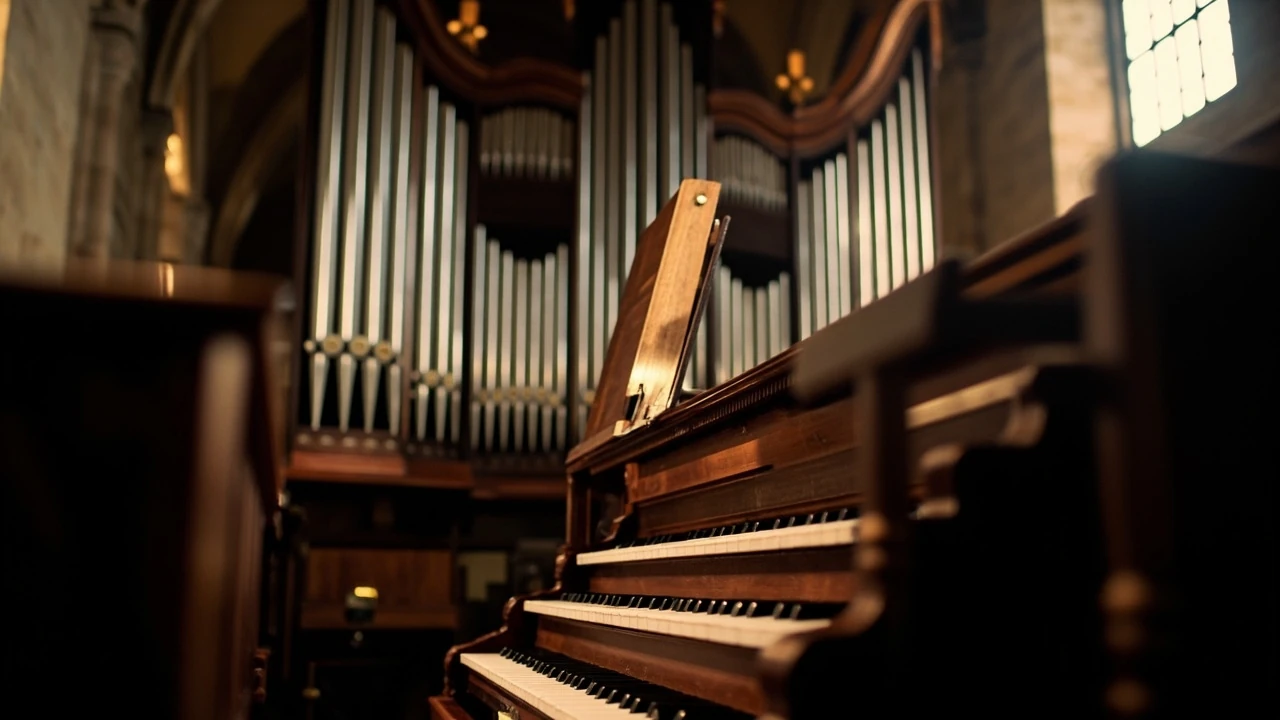
A pipe organ is often described as a whole orchestra compressed into one piece of furniture, yet the basic idea behind it is older and simpler than that image suggests. Press a key, air flows into a pipe, and the pipe speaks. Repeat that process with hundreds, or even thousands, of pipes, controlled from several keyboards and a pedalboard, and the result is an instrument capable of both a single sustained line and a sound that fills a large stone building.
Understanding how an organ instrument actually works helps players, listeners, choir directors, and anyone choosing a builder ask better questions. The rest of this article walks through the parts of a pipe organ, how the sound is shaped, the difference between mechanical, tracker, and electric action, the main families of stops, and what to look for when listening to or commissioning one.
What is an organ instrument
An organ instrument is a keyboard instrument that produces sound by directing pressurized air through tuned pipes. Each key controls a valve that admits air to one or more pipes, and each pipe sounds a specific pitch when wind passes through it. Because the pipes are the actual sound source, the instrument behaves more like a controlled wind ensemble than a piano or a harpsichord.
The earliest pipe organs date back to the water organs of ancient Greece and the hydraulis described by engineers such as Ctesibius in the third century BCE. By the Middle Ages, the instrument had been adapted to use bellows rather than water pressure, and by the Baroque era it had grown into the central liturgical and concert instrument of Western Europe. The basic structure has remained consistent for centuries: a wind supply, a control mechanism, and ranks of pipes organized into stops.
Three features distinguish a pipe organ from any other keyboard instrument. First, each note usually has multiple pipes, often one per stop, so a single key can trigger many sounds at once. Second, the instrument is polyphonic in a literal acoustic sense, because the wind supply is continuous and a pipe continues to sound as long as its valve is open. Third, the sound is shaped less by the keyboard touch and more by the builder’s choice of pipe scales, materials, and wind pressures, which is why a Schnitger, a Cavaillé-Coll, and a modern American builder all sound recognizably different.
The main parts of a pipe organ
A pipe organ is built from a small number of well-defined subsystems. Looking at a large instrument from the loft, the most visible elements are the pipes themselves and the case that surrounds them. Behind the case, the action, windchests, and blower are doing the invisible work that turns key presses into sound.
The four functional groups that every organ shares are:
- Wind supply: bellows, reservoirs, and a motor or blower that keep air at a stable pressure.
- Control action: the mechanical, pneumatic, or electrical linkage between keys and the valves under the pipes.
- Windchest and pipework: the boxes that distribute wind to the pipes and hold the stops in place.
- Console: the keyboards, pedalboard, stops, and couplers that the player operates.
Inside the case, the largest single component is usually the pipework, which can account for the majority of the instrument’s mass and cost. The smallest component by size, the console, is the part the player touches directly and is the one most people picture when they think of a pipe organ.
How a pipe organ produces sound
The acoustic principle is straightforward. When a small stream of air is split by a sharp edge inside a pipe, the airstream begins to oscillate, and the pipe resonates at a frequency set by its length, diameter, and the shape of its mouth. The result is a sustained tone, similar in physics to a recorder or a whistle, but with the air supplied from a central reservoir rather than from the player’s lungs.
Three small components inside the pipe do the actual sounding. The foot admits wind from the windchest. The mouth is a cut opening in the side of the pipe where the air breaks against an edge called the upper lip. The ears are small projections beside the mouth that help stabilize the tone. Adjusting any of these elements changes the pipe’s behavior, which is why organ builders spend so much time on voicing.
Once a pipe speaks, its pitch depends on the air column inside it. Open metal pipes sound roughly an octave higher than a closed pipe of the same length, which is why the longest basses in a 32-foot rank can reach more than five meters and still produce only the lowest C of the pedal compass. For more detail on how each pipe is tuned and finished, the process is called voicing, and it is treated as a separate craft within organbuilding.
The wind supply: bellows, reservoirs, and blowers
Before any pipe can speak, the organ needs a steady supply of air at a controlled pressure. Modern instruments use an electric blower to push air into a wind reservoir, a large airtight box fitted with weights or springs that hold the internal pressure constant. The reservoir feeds the windchests, and small relief valves open briefly whenever a chest takes in air when a note is played.
Pressure is a critical and often misunderstood parameter. A higher wind pressure makes pipes louder and brighter, but it also stresses the pipework and the action, and it changes the harmonic balance of older stops. A small practice organ might run at 50 millimeters of water column, a Romantic symphonic organ at 80 to 120 millimeters, and a high-pressure solo stop on a theatre organ can exceed 250 millimeters. The choice of pressure influences the entire character of the instrument.
Historical organs used hand-pumped bellows before electric blowers became common in the early twentieth century. The change from human pumping to electric supply freed builders from the need to place the organ near a bellows room, but it also removed one of the small expressive nuances that players used to feel: the way the wind sagged slightly when the bellows pumpers tired. Today, some builders deliberately add small regulators that introduce similar subtle fluctuations to recover that breathing quality.
Action types: tracker, electric, and hybrid
The action is the mechanism that connects a key to the valve under a pipe. There are three broad families, and the choice has a noticeable effect on the player, the builder, and the maintenance schedule.
A mechanical or tracker action uses wooden or plastic rods, called trackers, to pull open the pallet directly under the pipe. The keyboard, tracker, pallet, and pipe are physically connected. The feel is light and precise, and the timing between key and pipe is essentially instant. Tracker actions are favored in Baroque-style instruments and by many organists who want a direct relationship between finger and pipe, but they become physically complex in large instruments because the tracker runs must cross the entire organ.
An electrical action uses a small switch under each key to send a low-voltage signal to an electromagnet that opens the pallet. The keyboard can be placed almost anywhere, and long distances are no problem. The trade-off is that the connection is no longer purely mechanical, and the player feels the keyboard rather than the pipe. The flexibility, however, allows movable consoles and very large instruments that would be impractical with trackers alone.
A pneumatic action, common in late nineteenth- and early twentieth-century organs, uses small bellows and air pressure to transmit motion. It is lighter than a tracker and cheaper than a full electric system, and it has been refined into reliable forms, though many builders and players consider the response less precise than a well-built tracker. Hybrid systems combine the two, often using electric or pneumatic elements for the heavy swell boxes and a tracker for the main key actions.
| Action type | How it works | Typical feel | Best suited to |
|---|---|---|---|
| Mechanical (tracker) | Rods connect key to pallet directly | Light, precise, direct | Baroque and classical style instruments, smaller organs |
| Electrical | Switch triggers electromagnet | Adjustable, often heavier | Large symphonic organs, movable consoles |
| Pneumatic | Air pressure transmits motion | Light, slightly delayed | Mid-sized Romantic and early modern instruments |
| Hybrid | Tracker combined with electric or pneumatic assists | Variable | Large instruments that aim for a traditional feel with modern flexibility |
The console: keyboards, stops, and couplers
The console is the part of the organ instrument that the player operates, and it is the most variable part of the design. A small continuo organ might have a single manual of 56 keys and a few stops. A large concert organ can have four or five manuals, each with 61 notes, a 32-note pedalboard, and several hundred stops arranged on terraces beside and above the keys.
The manuals are usually named after the divisions they control rather than after their physical position. The Great carries the main chorus of the organ. The Swell is enclosed in a box with shutters that can be opened and closed with a pedal, producing the swell effect. The Positiv or Choir division sits in front of the player and contains solo and accompanying stops. The Pedal division is played from the pedalboard with the feet and provides the bass line.
Stops are the on-and-off switches that connect a rank of pipes to a keyboard. Pulling a stop puts its pipes in circuit; pushing it back in silences them. The list of stops available is called the disposition, and it is one of the most useful summaries of what an organ can do. Stops are described in detail in organ stops explained: families, ranks, and how to read a stop list, but the short version is that stops fall into a few clear families based on how their pipes are built.
Couplers are the second tier of control. A coupler ties one keyboard to another so that, for example, every note played on the Positiv also sounds on the Great. Most organs also include sub and super octaves that sound one octave below or above the written note, and unison off switches that silence the main chorus. The combination action, often electric or electronic, lets a player preset combinations of stops in advance and switch between them with a single piston.
Pipe families and how they color the sound
Most of the sound-shaping power of a pipe organ comes from the pipes themselves, not the keyboard. The pitch is set by length, but the tone color is set by the pipe’s material, scale, and voicing. The two broad families are flue pipes and reed pipes.
Flue pipes produce sound the way a recorder does, with air striking a sharp edge. They include the principal chorus, which carries the weight of the instrument; the flutes, which are open or stopped pipes with a rounder tone; and the strings, which are narrow-scale pipes with a more string-like sound. Theodoli, salicionals, and gemshorns all sit within these families and are chosen to give each division a recognizable character.
Reed pipes work the way a clarinet or a harmonica does. A metal tongue vibrates against a shallot, and a resonator above amplifies the tone. Reeds are loud, colorful, and capable of imitating brass instruments. Trumpet, posaune, krummhorn, and cromorne are all reed stops, and a chorus of principal plus mixture plus trumpet is the classic full sound of a Baroque organ.
The next table summarizes how these families are typically used inside a single manual division.
| Pipe family | How it speaks | Typical character | Common stops |
|---|---|---|---|
| Principal chorus | Flue, medium-to-wide scale | Bright, defining, foundation | Principal 8, Octave 4, Super-octave 2, Mixture |
| Flute | Flue, wide scale, sometimes stopped | Rounded, gentle, solo | Stopped Diapason, Holzflöte, Flute harmonique |
| String | Flue, narrow scale | Thin, violin-like, blending | Salicional, Violone, Gemshorn |
| Reed | Vibrating tongue against a shallot | Strong, brassy, projecting | Trumpet, Posaune, Krummhorn, Oboe |
| Hybrid and color stops | Flue or reed with extra resonators | Specialized, imitative | Vox humana, Cornet, Dulzian |
Registration: choosing which pipes speak
Registration is the art of deciding which stops to draw before playing. Because each key can trigger many pipes at once, the choice of registration shapes the music before a single note sounds. A thin registration of a single 8-foot flute can accompany a choir; a full plenum of principals, mixtures, and reeds can carry a congregation through a long hymn.
A few practical rules apply across most styles. Start with the pitch level. The 8-foot stop sounds at written pitch, the 4-foot an octave higher, the 16-foot an octave lower, and the 2-foot two octaves above. Combining 8, 4, and 2 foot stops with a mixture in a 2-to-3 ratio gives the classic chorus sound. Adding a reed provides projection in a resonant room, and adding a flute in the tenor or alto gives warmth.
Registration is also about subtraction. Large Romantic organs can easily reach full organ, but in a small room or in chamber music, the most effective registration is often a single 8-foot stop with a light mixture. The French Baroque tradition of tierce en taille layers a 1 3/5 foot stop inside a 4-foot line to create a distinct solo color, and the German Romantic tradition of Schwellwerk crescendos through a single enclosed division. A practical overview of these techniques is given in organ registration: a practical guide to shaping pipe organ sound.
Windchests, trackers, and how notes get to the pipes
Below the pipes sits a windchest, which is essentially a large airtight box that holds the air supply and the pallets. When a key is pressed, the corresponding pallet opens, and air flows into the foot of every pipe above the open pallet that is connected to a pulled stop. Closing the key closes the pallet and silences the pipes.
There are two main chest types. A slider chest, common in older and historically styled instruments, uses wooden sliders that slide in and out to connect pipes to pallets. Slider chests are simple and reliable, but they make it awkward to add or change stops once the organ is built. A cone chest or a unit chest uses individual valves for each pipe and offers more flexibility, which is why most modern builders prefer it for new instruments.
The tracker action is the oldest form of key-to-pallet connection, and it is still the most admired by many players. Each key is connected by a series of wooden arms, sometimes with thin stickers and rollers, to a vertical tracker that runs up to the pallet. A well-built tracker action is light, fast, and quiet, and it is the standard against which other actions are measured. A more technical description of how each pipe is then adjusted sits in pipe voicing: how organ builders shape tone one pipe at a time.
Pressure, scaling, and voicing decisions
Three design choices dominate the sound of any pipe organ: the wind pressure at which the pipes speak, the scale of each rank, and the voicing applied to each pipe. Pressure sets the volume and brightness. Scale sets the balance between fundamental and overtones. Voicing refines the attack, the harmonic content, and the steadiness of the tone.
Wind pressure is measured in millimeters or inches of water column. Low pressure, often between 40 and 60 millimeters, gives the gentle, slightly breathy tone of a Baroque or classical organ. Medium pressure, around 70 to 100 millimeters, gives the full sound of a Romantic or symphonic instrument. High pressure, above 150 millimeters, is reserved for solo reeds, Tuba stops, and some theatre organ ranks, where the goal is to cut through a large orchestra.
Scale refers to the diameter of the pipe relative to its length. A narrow-scale pipe sounds bright and stringy, a wide-scale pipe sounds round and flute-like. Builders choose scales carefully so that each stop blends with the chorus. A chorus of principals works because each rank has been scaled to match the others at the unison level, and the mixtures on top reinforce the harmonics that the chorus as a whole wants to project.
Voicing is the final adjustment of each pipe. The builder cuts the mouth up or down, adjusts the languid, raises or lowers the ears, and often scrapes or solders the metal until the pipe speaks cleanly and blends with its neighbors. A small change to the height of a mouth can change a pipe from speechy to flute-like, and a millimeter of languid can change a rank from brilliant to covered. Voicing is often the difference between an organ that is technically complete and one that is musically satisfying.
Acoustics: how the room shapes the sound
An organ instrument is only half the story. The room in which it stands, and the way the pipes couple to that room, are as important as the pipework. A dry acoustic, like a small rehearsal room, makes an organ sound smaller and more immediate. A long reverberation time, like a stone cathedral with a five-second tail, makes even a modest instrument sound large and adds a halo of overtones to every note.
Three room properties matter most. The reverberation time tells you how long each note lingers. The clarity, often measured as C80, tells you how much of the early sound reaches the listener before the reverberant field begins. The bass ratio tells you how strongly low frequencies are supported. A well-designed room for organ music has a reverberation time of around 1.5 to 3 seconds for a smaller instrument and up to 5 to 6 seconds for a large cathedral organ, with a clarity figure that keeps the speech of each note clear.
This is one of the reasons organs are so often difficult to evaluate from recordings. A stop that sounds covered on a recording made in a dry room can sound glorious in a resonant one, and vice versa. Listening to an organ in person, in the room for which it was designed, is the only reliable way to judge it.
Types of organ by style and period
Although the basic mechanism is the same, the stops and the voicing differ so much from one tradition to another that organs are usually grouped by period and national school. The next list sketches the most common styles you will encounter in Western Europe and North America.
- Italian Baroque: a single manual, short-compass pedalboard, few stops, very clean principal choruses, a strong use of ripieno.
- French Baroque: distinct reed and cornets, a wide range of flute colors, plein-jeu and grand-jeu registrations, and a strong ornament tradition.
- German Baroque: a complete pedal division, multiple choruses, mixtures that build from small to large, and a strong chorale-prelude tradition.
- English Romantic: tubular pneumatic action, enclosed Swell, very heavy sound pressure, and a continuous crescendo from piano to fortissimo.
- French Romantic: harmonic flutes, high-pressure reeds, enclosed divisions with expression, and a strong symphonic repertoire.
- American Classic and Symphonic: eclectic mixtures of stops, high wind pressures, versatile actions, and a wide range of orchestral colors.
- Theatre organ: a unit chest, very high pressures, traps and percussions, a single unified manual layout, and a strong emphasis on entertainment.
Each style is a working philosophy, not a rigid set of rules, and modern builders often blend several traditions. A new instrument in a North American university chapel may use a French-style Swell, a German-style Pedal, and an English-style enclosed Choir, because the goal is to support a wide range of repertoire rather than to follow a single historical model.
Care, tuning, and maintenance
Like any precision instrument, a pipe organ needs regular care. The most frequent task is tuning. Because pipes are sensitive to temperature and humidity, a stable room makes tuning easier. A well-tuned organ should hold its pitch for a year or more, but a new instrument or one in a new room usually needs a tuning every few months for the first year, and an annual tuning thereafter.
Other routine work includes oiling tracker action parts, checking leather pallets for shrinkage, cleaning dust from pipe mouths, and occasionally regulating the wind supply. Reed pipes need their tongues adjusted more often than flue pipes, and wooden pipes can shift as the building settles. A regular service contract with a qualified organ technician is the best way to keep an instrument stable.
Two practical points are worth highlighting for anyone responsible for an organ. First, keep the room climate as stable as possible: large swings in humidity are the most common cause of tuning instability and cracked wooden pipes. Second, log every change. A simple book that records tunings, repairs, and any change in the blower or wind supply gives the next technician a baseline and saves hours of diagnosis later.
How to choose a builder or evaluate a new organ
Choosing a builder is the most consequential decision a church or concert hall will make about its organ, and it is worth treating as a long process rather than a single transaction. The right builder is the one whose work matches the room, the repertoire, and the maintenance capacity of the institution.
The next checklist gives the main points to cover before signing a contract. Use it as a structured starting point rather than as a scoring sheet.
- Listen to recent instruments: visit two or three organs the builder has completed in similar rooms, ideally during services or concerts, and ask to play them yourself.
- Ask for a written disposition: the list of stops with their scales, pressures, and pipe materials tells you far more than a glossy brochure.
- Check the case design: how the pipes are arranged affects both the look and the way the sound reaches the listener.
- Confirm the action type: tracker, electric, or hybrid, and the reason the builder recommends that choice for your room.
- Plan for maintenance: a reliable local technician is more important than any single design choice.
- Budget for voicing over time: voicing is a process that continues for years after the dedication, and most contracts include at least two or three follow-up visits.
It also helps to consult outside advice. A trusted organ consultant can review the contract, the disposition, and the room acoustics, and can save an institution from expensive mistakes that are easy to make in a field where the technical language is unfamiliar.
What an organ instrument cannot do
A pipe organ is a powerful instrument, but it has real limits. It cannot play louder than the room and the wind supply allow, which is why a stop in a dry acoustic sounds smaller than the same stop in a resonant one. It cannot crescendo on a single held note, because each pipe either speaks or does not speak. The only way to grow a sustained tone is to add more ranks, which is why organists prepare combinations in advance and step through them as the music unfolds.
It is also less portable than a piano or a harpsichord. Even small organs weigh several hundred kilograms, and a large instrument can fill an entire truck. The pipes need a stable climate and a quiet space, and they will not survive being moved every few months the way a digital keyboard can. These limits are not flaws, but they shape the kind of music the instrument serves best.
Finally, the organ instrument is sensitive to changes in its environment. A new heating system, a humidifier, or a remodeled ceiling will all affect the sound. An organ that was perfectly voiced at installation may need a new round of regulation five years later if the room has changed. Building a relationship with the original builder or with a local technician is the most reliable way to keep the instrument responsive over decades.
Frequently asked questions
What makes an organ instrument different from a piano?
The piano produces sound by a hammer striking a string, and the loudness of each note depends on how hard the key is pressed. An organ produces sound by air flowing through a pipe, and the loudness of each note depends on which stop is drawn and on the pipe’s design, not on the player’s touch. A held organ note will continue to sound as long as the key is down, while a piano note fades almost immediately.
How many pipes does a typical pipe organ have?
A small continuo or chamber organ may have 200 to 500 pipes. A mid-sized church organ often has 1,500 to 2,500 pipes. A large concert or cathedral organ can have 5,000 to 10,000 pipes, and a few exceptional instruments exceed 30,000. Because many pipes are repeated across different stops, the number of pipes is much larger than the number of notes the instrument can play.
What is a rank of pipes?
A rank is one set of pipes, one for each key of the keyboard, tuned to a specific pitch level. An 8-foot principal rank, for example, has one pipe for every key at concert pitch. A 4-foot rank sounds an octave higher. A chorus is built by combining several ranks at different pitch levels to create a richer sound.
What is the difference between flue pipes and reed pipes?
Flue pipes produce sound when air strikes a sharp edge, the way a recorder does. Reed pipes produce sound when a metal tongue vibrates against a shallot inside a boot, the way a clarinet does. Flues are the foundation of the instrument, and reeds provide the bright, projecting colors on top of that foundation.
How is a pipe organ tuned?
Most flue pipes are tuned by adjusting a metal tuning slide or a wooden tuning cap on the top of the pipe, which changes the effective length of the air column. Reed pipes are tuned by moving the wire that controls the length of the vibrating tongue. The procedure is carried out with a tuning knife, an electronic tuner, and a reference pitch, and it usually takes a few hours for a mid-sized instrument.
Why do some organs sound so different in recordings than in person?
Recordings capture a single microphone position in a single room, but the sound you hear in person depends on the room’s acoustics, your position, and the way low frequencies interact with the building. A long reverberation time adds a halo to every note, and that halo is hard to capture on a recording. Listening in the room for which the organ was built is the only reliable way to judge it.
What is a combination action?
A combination action is a system of memory levels and pistons that lets the organist preset which stops are drawn for a particular piece or section of a piece. Pressing a single piston changes all the stops at once, which is the only practical way to move between registrations on a large instrument. Combination actions are usually electric, even on instruments with mechanical key actions.
How long does a pipe organ last?
A well-built and well-maintained pipe organ can last 100 to 200 years or more. Many Baroque and Romantic instruments are still in use today. The most vulnerable parts are leather-faced pallets and bellows, which usually need renewal every 50 to 80 years, and the metal pipes themselves, which can last indefinitely if kept dry and free of dust.
What is the difference between a tracker organ and an electric organ?
A tracker organ uses a mechanical linkage, often wooden rods, to connect each key to the valve that admits air to the pipe. An electric organ uses a switch under each key to send a low-voltage signal to an electromagnet. Tracker organs give a more direct feel and a faster response, while electric organs allow the console to be placed at a distance and are essential for very large instruments.
Can a pipe organ play any kind of music?
A pipe organ is most at home in music written for it, which ranges from Renaissance polyphony through Baroque chorale preludes, Classical and Romantic symphonies for organ, and a large modern repertoire. It can also be used in chamber music, improvised continuo, and popular styles, although a single flute stop and a quiet acoustic are usually more effective than full organ in those settings.