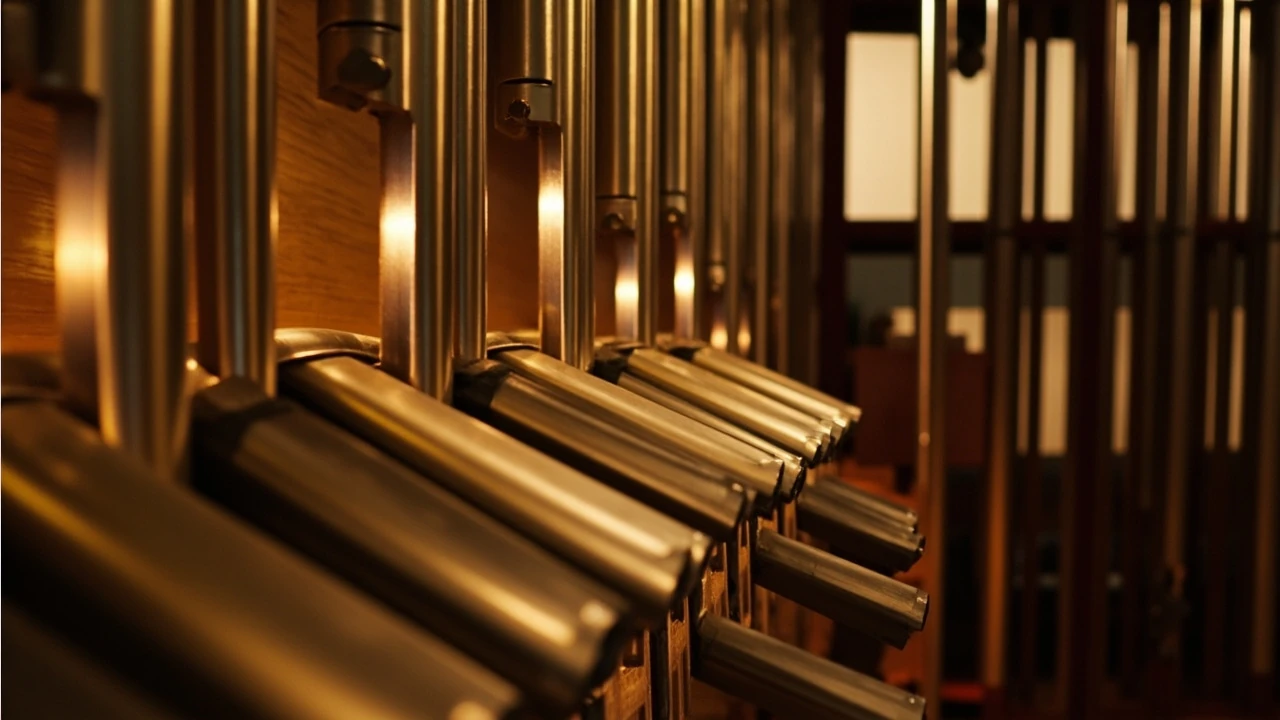
A long bass pipe standing nearly as tall as a person, a row of small metal pipes the length of a forearm, and a cluster of wooden stopped pipes shaped like wooden flutes all sound at radically different pitches and characters. The reason is organ pipe scaling: the deliberate relationship between a pipe’s length, diameter, mouth size, and material that builders use to set its pitch and tone. Organ pipe scaling and tone explained starts with the simple idea that a pipe is a tuned acoustic resonator, and every physical dimension influences how it speaks, sustains, and projects.
This article walks through the physical principles, the scaling rules that builders use in practice, the design choices that distinguish a string-toned Salicional from a round Hohlföte, and the trade-offs a voicer makes when shaping a rank. The aim is practical understanding: the kind of knowledge that helps a player listen more carefully, helps a student read a stop list with more confidence, and helps a curious listener understand why two pipes of the same pitch can sound nothing alike.
Organ pipe scaling and tone explained
At its core, organ pipe scaling is the set of proportions between a pipe’s acoustic length, its internal diameter, its mouth width, its mouth height, its cut-up height, and the size of its upper opening. Each of these dimensions changes how the air column inside the pipe vibrates, how much of the pipe’s energy is radiated as sound, and which harmonics dominate the resulting tone.
Tone is the character of the resulting sound: how round or stringy, how reedy or flute-like, how gentle or commanding the pipe sounds once it speaks. Scaling and tone are inseparable because the dimensions that set pitch also set the harmonic spectrum, the speaking behaviour, and the way the pipe interacts with the room around it.
What organ pipe scaling really means
In organ building, “scaling” refers to the diameter-to-length ratio of a pipe at a given pitch, usually expressed as a width measurement at a reference pitch (often middle C or the top of the compass) and a corresponding scaling factor that grows or shrinks with pipe length. Wider scaling means a relatively larger bore for a given pitch. Narrower scaling means a tighter, more string-like bore.
Most builders publish a scaling chart for each stop. That chart shows how the pipe’s diameter changes from the largest bass pipe to the smallest treble pipe. The same pitch, voiced on two different scalings, will sound like two different instruments: a Principal at one scaling sounds robust and fundamental-rich, while a Salicional at the same pitch uses a much narrower scaling and sounds more like a string.
Three categories of flue pipe scaling cover most of what a player will encounter:
- Wide scaling: large bore relative to length. Produces a full, round, fundamental-rich tone with strong lower partials. Typical of flutes such as the Bourdon, the Hohlföte, and the major Principal ranks.
- Medium scaling: balanced bore. Produces an even tone useful in chorus and solo work, the workhorse of most principal choruses.
- Narrow scaling: small bore relative to length. Produces a stringy, edgy tone with strong upper partials. Typical of string stops such as Salicional, Violina, and some céleste ranks.
How pipe length and diameter set pitch
For an open flue pipe, the sounding pitch is set primarily by the acoustic length of the air column. The air column vibrates as a standing wave with a pressure node near the mouth and a pressure antinode at the open top. The wavelength of the fundamental is roughly twice the acoustic length of the pipe, so an open pipe of about 8 feet in acoustic length sounds at approximately 16 Hz, which is below the threshold of human hearing. In practice, the lowest useful open metal pipe at 8-foot pitch is around 8 feet long and sounds close to the C two octaves below middle C.
For a stopped pipe, only a quarter-wavelength fits in the same physical length, so a stopped pipe of half the length of an open pipe sounds the same pitch. That is why 16-foot stopped bass pipes can be half the height of their open equivalents and still produce the same written pitch on the keyboard.
Diameter shapes tone. Doubling the length while leaving diameter alone lowers the pitch by an octave but does not change the pipe’s tonal family. Doubling the diameter at the same length shifts the harmonic series and changes the way the air column vibrates, producing a fuller, more fundamental-rich tone. The two adjustments are independent in theory, but in practice they interact: a longer pipe needs a slightly larger bore to behave the same way tonally as a shorter pipe, which is the whole reason scaling charts exist.
Why scaling and tone change together
The harmonic content of a flue pipe depends on how easily the air column vibrates at higher modes. A narrow pipe suppresses modes other than the fundamental and sounds pure, flute-like, or stringy. A wide pipe encourages higher modes to develop and sounds rich, round, and substantial. Because scaling changes diameter, it changes the harmonic balance, and that is what we hear as tone colour.
This is also why a Principal at 8-foot pitch and a Salicional at 8-foot pitch are different stops even though they sound the same written note. The Principal uses wider scaling that emphasises the fundamental and lower harmonics, so the note sounds grounded and chorus-like. The Salicional uses much narrower scaling that suppresses the fundamental relative to upper harmonics, so the same note sounds silvery and string-like, with less body but more edge.
The acoustic physics behind organ pipe scaling
To understand why scaling works the way it does, it helps to look at the basic acoustics of a flue pipe. The pipe is a tube in which air is driven past a sharp lip at the mouth. The air jet oscillates between striking the inside of the pipe (the “labium”) and the outside of the lip, and the pipe’s air column reinforces one frequency more than any other. That reinforced frequency is the pipe’s pitch.
Pitch depends mostly on the effective length of the air column. Tone depends on the geometry of the pipe around that air column.
Standing waves, end correction, and pitch
The basic acoustic rule is that the open pipe is roughly half a wavelength long at the fundamental. The actual vibrating column extends a small distance beyond the open end of the pipe, an effect called end correction. The open end behaves as if it extends about 0.6 times the pipe radius beyond the physical top of the pipe. Because the radius of a wide pipe is larger than the radius of a narrow pipe of the same pitch, a wide pipe needs a slightly shorter physical length to sound the same pitch as a narrow pipe. Builders compensate for this by adjusting physical length to keep the sounding pitch stable across a rank.
This is one reason why scaling is more than a simple diameter number. A scaling chart already includes these corrections, so when a builder specifies a stop, the chart covers both diameter and the small length adjustments that keep the rank in tune.
Harmonic series and tone colour
Every flue pipe produces a harmonic series in addition to its fundamental. The relative strength of these harmonics is what we hear as tone. The fundamental gives the note its basic pitch, the second harmonic gives it body, the third harmonic gives it edge, and higher harmonics give it brightness and “speech”.
The geometry of the pipe controls how strongly each harmonic develops. A narrow bore damps the higher modes and emphasises the fundamental. A wide bore supports higher modes more freely, so the fundamental and lower harmonics dominate the sound but the tone is fuller. A tapered or conical bore changes the picture further by shifting which harmonics couple most strongly to the pipe’s geometry.
Material, wall thickness, and the pipe wall
Metal pipes are made from spotted metal (a tin and lead alloy), high tin content alloys, or pure tin, depending on the builder’s tradition. Heavier alloys produce darker, more fundamental-rich tones because the pipe walls vibrate less and the air column’s energy stays inside the pipe rather than being lost to wall motion. Lighter alloys, especially pure tin, can produce brighter tones with more upper harmonic development because the pipe walls vibrate a little and the air column’s energy spreads more easily into the room.
Wooden pipes behave differently. The thicker walls of a stopped wooden pipe make it harder for high modes to develop, which is partly why wooden stopped flutes sound round and gentle. Open wooden pipes, especially in bass registers, can produce rich, warm tones with strong lower harmonics, and they are a hallmark of many Baroque and Romantic instruments.
Wall thickness also matters. Thinner metal walls produce a slightly more responsive tone, especially in the upper work. Thicker walls, sometimes used for bass pipes, produce a darker, less responsive tone that suits the weight of the lower octaves.
How scaling numbers work in practice
Builders describe scaling in different ways, but the most common convention is to give a width measurement at a reference pitch, usually at middle C, and then a multiplication factor that adjusts the width at other pitches. A scaling of “100” at middle C with a factor of 1.06 means that each pipe below middle C is about 6 percent wider than the pipe an octave above, and each pipe above middle C is about 6 percent narrower.
This is a useful mental model because most ranks behave well with proportional scaling, and the changes in width track the natural changes in pipe length. Builders tweak the actual numbers to taste, but the principle of “wider in the bass, narrower in the treble” is nearly universal.
Reference pitches and why they matter
When you see a stop described as “scaled 105” or “scaled 85”, that number is usually a reference width at middle C in millimetres. A stop scaled 110 at middle C is wider, fuller, and more fundamental-rich than the same stop scaled 90. Strings often use scalings in the 70 to 85 range. Flutes often use scalings in the 95 to 110 range. Principal chorus work usually sits between 95 and 105, depending on the school of building.
Reference pitch also affects how a stop is described. A scaling of 100 at middle C will produce a noticeably fuller 8-foot flute than the same physical pipe scaled 100 at tenor C, because the pipes below middle C are much larger and the bass dominates the sound of the rank. For most stops, the practical reference is middle C, and that is the convention used in most builder documentation.
Scaling charts as a builder’s map
A scaling chart is a table that lists every pipe in a rank, its pitch, its length, its diameter, and often its mouth dimensions. The chart is the builder’s working map for that stop, and it is the document a voicer uses when shaping each pipe. A chart for a Salicional will show very narrow pipes with small mouths, a chart for a Principal will show moderately wide pipes with proportionally larger mouths, and a chart for a wide flute will show large pipes with generous mouths and cut-ups.
Players rarely see a builder’s scaling chart, but the principles behind the chart are visible in the sound. If you can imagine a stop in terms of how wide its scaling is, how the mouths are cut, and how the upper harmonic development is shaped, you can predict a lot about how that stop will behave in a registration.
Flue pipe families and how their scaling sets their tone
Each flue pipe family has a characteristic scaling range, and that range is what gives the family its typical tone. Players who understand the families can listen to a stop list and anticipate how a stop will sound, even before they pull the stop and hear it.
Principal chorus
The Principal chorus is the backbone of most pipe organs. It usually uses medium scaling, with mouths cut to give a clear, harmonically rich tone. Octave and Super Octave ranks follow the same scaling philosophy at higher pitches. A well-built Principal is full but not heavy, bright but not edgy, and it carries the room with strong fundamental and second harmonic content.
Wide flutes and stopped flutes
Wide flutes such as the Bourdon, the Subbass, and the major stopped flutes use wide scaling to produce round, fundamental-rich tones. The Hohlföte, a stop sometimes called the “hollow flute” because of its hollow tone, is a good example of a wide-scaling flute that has a soft, gentle character rather than the projection of a Principal. Stopped flutes use a plug at the top of the pipe to set the pitch with half the length, and they tend to sound darker than open flutes of the same pitch because the closed end suppresses odd harmonics.
String stops
String stops use narrow scaling to produce stringy, silvery tones with strong upper harmonics. The Salicional is a classic example: narrow scaling, often a small mouth, and a tapered top section that emphasises the upper modes. The Violina is similar, often with a small amount of chorus and a slightly keener edge. Some strings use a céleste rank tuned slightly sharp to produce a gentle beating effect when combined with the unison rank.
Hybrid flutes and orchestral colours
Many stops fall between these families. A Flûte Harmonique uses harmonic bridging, in which a small hole drilled near the top of the pipe encourages the second harmonic to speak strongly, producing a flute-like tone at half the expected length. A Gemshorn uses a tapered conical bore that produces a slightly keener, more pointed tone than a true Principal. A Spire Flute combines a narrow scaling with a relatively small mouth, producing a thin, gentle tone that can sit in a chorus without dominating it.
Hybrid stops are where organ building becomes most expressive. The builder chooses a scaling and voicing that produces a specific colour, and that colour is what the player hears when the stop is drawn.
Reed pipes: how scaling and tone work differently
Reed pipes work on a different principle. A vibrating metal tongue (the reed) sets the air column in motion, and the resonator above the reed (the boot and the resonator block, or in the case of a rank of reeds, the individual resonators) determines the pitch and tone. The reed itself is the sound generator, and the resonator shapes how that sound develops.
Resonator scaling in reed pipes
Reed resonators follow scaling principles similar to flue pipes, with lengths and diameters chosen to set the pitch and shape the tone. Trumpet resonators are usually short and wide, producing a bright, brassy tone with strong upper harmonics. Krummhorn resonators are narrow and cylindrical, producing a capped, slightly nasal tone. Oboe resonators are short and tapered, producing an edgy, penetrating tone. The exact proportions depend on the builder’s school, but the principle is consistent: length sets pitch, diameter and shape set tone.
Reed voicing and tone
Reeds are voiced primarily by adjusting the reed itself: the length of the tongue, the curl of the tongue, the shape of the shallot, and the pressure at which the tongue sits against the shallot. A tight, well-curled reed produces a clean, articulate tone. A looser reed produces a fuller, more diffuse tone. The resonator sets the pitch and adds the characteristic colour, but the reed is what gives the stop its personality.
For players, this means reed stops sound more variable across instruments than flue stops do. A Trumpet on one organ can be bright and round, while a Trumpet on another organ can be brassy and edgy. Both are Trumpets, but the scaling, the voicing, and the room all contribute to the final result.
The role of voicing in shaping tone
Scaling sets the proportions of the pipe, but voicing is the process of adjusting each pipe so that the rank speaks evenly and produces the intended tone. Voicing is part science, part craft, and it is where the builder’s individual style becomes audible.
Mouth size, cut-up, and expression
The mouth is the rectangular opening cut into the pipe near the top, with a sharp upper edge called the languid. The cut-up is the height of the mouth measured from the languid to the top of the pipe. A higher cut-up means more of the pipe is open at the mouth, which encourages stronger higher harmonics and a brighter tone. A lower cut-up means less of the pipe is open, which produces a more fundamental-rich tone.
Voicers adjust the cut-up pipe by pipe to even out the speech. Pipes in the lower treble often need a slightly lower cut-up to keep the tone from becoming too edgy, while pipes in the upper treble often need a slightly higher cut-up to keep the tone from becoming dull. These small adjustments are what make a rank sound even and musical.
Ears, nicks, and upper lips
Small adjustments in the upper lip of the mouth, the shape of the languid, and the position of the ears (the small projections on either side of the mouth) all influence the way the air jet behaves. A sharp upper lip produces a clean, articulate speech. A slightly rounded lip produces a softer, more flute-like speech. The voicer uses these tools to fine-tune each pipe.
For a player, the practical result is that two ranks with identical scaling can sound quite different in the hands of different voicers. Scaling is the foundation, but voicing is what brings it to life.
Tuning stability and scaling
Scaling also affects how a rank holds its tuning. Narrow pipes change pitch more easily with temperature than wide pipes because the air column is shorter and small changes in temperature have a larger relative effect. Wide pipes change pitch more slowly, but their larger thermal mass also means they take longer to warm up. A well-designed organ accounts for this by placing narrower ranks closer to the wind supply and wider ranks further away, so that the whole instrument warms up at roughly the same rate.
For a voicer, the practical implication is that a rank must be tuned in a stable temperature. Voicing a rank in a cold organ and then expecting it to hold its pitch in a warm room is a common cause of unstable ranks. The builder plans for the room in which the organ will live.
How scaling and voicing interact with the room
A pipe organ is not just a collection of pipes. The pipes sit in a room, the room reflects and absorbs their sound, and the listener hears the result of that interaction. Scaling, voicing, and room acoustics are three parts of a single system, and the result is what we call the organ’s tone.
Reverb and projection
A pipe with a strong fundamental projects differently from a pipe with strong upper harmonics. A wide-scaling Principal with a strong second harmonic will fill a dry, intimate room. A narrow-scaling string stop with strong upper harmonics will sit clearly in a reverberant cathedral. The builder chooses scaling and voicing to suit the room, and the player adjusts registration to suit the music.
Wind supply and pressure
Wind pressure also matters. Higher wind pressure increases the energy of the air jet, which produces a louder, more harmonically rich tone. Lower wind pressure produces a softer, more fundamental-rich tone. Historic organs often used low pressures in the 50 to 75 millimetre range, while larger Romantic and modern organs can use pressures from 75 to 200 millimetres or more. The pressure at which a pipe is voiced is part of its character, and that pressure must be matched to the rank’s scaling and voicing.
Climate and seasonal change
Most pipe organs are tuned to a reference temperature, often around 18 to 21 degrees Celsius. A rank that is voiced and tuned in a warm room will sound flat in a cold room, and a rank voiced in a cold room will sound sharp in a warm room. Organ builders design the pipe layout, the wind system, and the scaling to minimise these effects, but a small amount of seasonal variation is normal. Players who understand this can plan for it, especially when recording or performing in variable conditions.
Comparing common scaling families
The following table summarises the typical scaling range, the dominant harmonic behaviour, and the typical tone colour for several common flue pipe families. The numbers are approximate and depend on the school of building, but they give a useful picture of how scaling maps to tone.
| Family | Typical scaling at middle C (mm) | Mouth proportion | Dominant harmonic content | Typical tone |
|---|---|---|---|---|
| Principal | 95 to 110 | Medium | Strong fundamental and second harmonic | Chorus, full, articulate |
| Stopped flute | 100 to 120 | Larger, often leathered | Strong fundamental, suppressed odd harmonics | Round, gentle, dark |
| Wide flute (Hohlföte) | 110 to 130 | Medium to large | Strong fundamental, weak upper harmonics | Soft, hollow, fundamental |
| Narrow flute (Spire Flute) | 70 to 90 | Small | Fundamental with controlled upper harmonics | Thin, clear, gentle |
| String (Salicional, Violina) | 65 to 85 | Small, sometimes beaded | Weak fundamental, strong upper harmonics | Silvery, stringy, edgy |
| Gemshorn | 80 to 100 | Small, conical bore | Even harmonic development, slightly pointed | Keen, slightly nasal |
These ranges are not absolute. Different builders, different periods, and different room acoustics can shift the numbers significantly. The table is a starting point, not a rule, and the best way to understand a stop is to listen to it.
Voicing choices and how they map to scaling
Voicing decisions are tied to the chosen scaling. A builder who picks a wide scaling for a flute will generally cut a generous mouth and a low cut-up to keep the tone round. A builder who picks a narrow scaling for a string will cut a small mouth and a higher cut-up to encourage upper harmonics. The two decisions are made together, and they shape the character of the stop.
| Voicing element | Wide scaling effect | Narrow scaling effect | Practical result |
|---|---|---|---|
| Cut-up height | Lower | Higher | Lower cut-up darkens the tone; higher cut-up brightens it |
| Mouth width | Generous | Narrow | Generous mouth increases volume and upper harmonics; narrow mouth tightens the speech |
| Languid angle | Shallower | Steeper | Shallower languid gives smoother attack; steeper languid gives crisper attack |
| Ears and nicks | Smaller, often removed | Larger, more defined | Smaller ears let the jet move freely; larger ears stabilise the jet for clarity |
| Upper lip profile | Rounded | Sharp | Rounded lip softens the speech; sharp lip focuses the attack |
A Salicional voiced on narrow scaling will sound thin if the mouth is too wide, and a Bourdon voiced on wide scaling will sound dull if the cut-up is too high. The voicing adjusts the scaling to bring out the intended character.
Common scaling choices and what they mean for registration
For a player, the practical value of understanding scaling is that it helps with registration. Knowing how a stop is scaled tells you how it will behave with other stops, how it will balance in a chorus, and how it will project in a particular room.
Solo stops versus chorus stops
Solo stops usually use scaling that emphasises a particular character. A wide-scaling flute will sit well as a solo voice. A narrow-scaling string will sit well as a solo voice. Chorus stops usually use scaling that integrates well with other ranks. A well-built Principal at 8-foot pitch will combine with a 4-foot Octave, a 2-foot Super Octave, and a mixture to produce a balanced chorus, because all those ranks use similar scaling principles.
Foundations and combinations
Foundations, the wide-scaling flutes and stopped basses that anchor the pedal and lower manuals, use scaling that produces a strong fundamental. They provide the weight of the sound. Strings and narrow flutes add colour. Mixtures add brilliance. A good registration uses stops whose scaling and voicing complement each other rather than competing.
Reeds in combination
Reeds work in combination with foundations and principals. A Trumpet on a wide-scaling Principal chorus will project strongly. The same Trumpet on a narrow-scaling string chorus will sound edgy and exposed. The scaling of the supporting ranks shapes the way the reed sits in the texture, and that is part of the art of registration.
How builders decide on scaling for a new stop
When a builder designs a new stop, the starting point is the desired tone. A Principal needs to sound like a Principal, a Salicional needs to sound like a Salicional, a wide flute needs to sound like a wide flute. The builder then chooses a scaling that produces that tone, a mouth proportion that complements the scaling, a material that suits the room, and a wind pressure that brings the stop to life.
Reference stops and the role of tradition
Most builders work with reference stops, well-tested designs that have proven their character in other instruments. A new organ often includes ranks that are based on these reference designs, with adjustments for room, climate, and the rest of the stop list. This is part of why a builder’s style is recognisable across instruments: the scaling and voicing reflect a consistent approach to tone.
Custom scaling for unusual requirements
Some stops need custom scaling. A particularly large room may need wider scaling to fill the space. A particularly dry room may need narrower scaling to keep the tone from becoming muddy. A particularly bright room may need warmer scaling to balance the reverberation. The builder adjusts the design to suit the situation, and the result is a stop that fits its environment.
Listening tests that reveal scaling
You can hear scaling, even if you cannot see the pipes. A few simple listening tests will reveal the underlying proportions of a rank.
- Test the fundamental: play the lowest note on the stop alone, then play it with a Principal. A stop with strong fundamental will reinforce the Principal. A stop with weak fundamental will sound separate from the Principal, and you will hear the difference clearly.
- Test the upper harmonics: play a high note on the stop alone, then play it with a Principal of the same pitch. A stringy stop with strong upper harmonics will sound brighter than the Principal. A flute-like stop with weak upper harmonics will sound softer than the Principal.
- Test the speech: play a chord on the stop and listen to how quickly the pipes speak. A wide-scaling stop with a low cut-up will speak slowly. A narrow-scaling stop with a high cut-up will speak quickly.
- Test the blend: play the stop with a 4-foot rank and a 2-foot rank. A well-scaled stop will blend smoothly. A stop that does not match the chorus will sound disconnected, especially in the tenor and treble.
These tests work on any well-maintained organ, and they are a useful way to develop your ear. After a few minutes of listening, you can often predict a stop’s scaling from the way it sounds.
Scaling and tone in different organ-building traditions
Different schools of organ building have different scaling traditions, and these traditions reflect different ideas about what an organ should sound like.
North German Baroque
North German Baroque organs, built in the 17th and 18th centuries, often use scaling that emphasises brilliance and clarity. Principals are scaled for clear, articulate speech, mixtures are bright and well developed, and reeds are voiced to project. The scaling supports a sound that is rich in upper harmonics and well suited to large, reverberant rooms.
French Classical
French Classical organs use scaling that produces a more refined, balanced tone. Principals are scaled for even harmonic development, flutes are scaled for roundness, and reeds are scaled for colour. The result is a sound that is clear, articulated, and suited to the music of the French Classical repertoire.
English Romantic
English Romantic organs use scaling that emphasises warmth and weight. Principals are scaled for fullness, strings are scaled for body, and reeds are scaled for projection. The result is a sound that is rich, powerful, and well suited to the orchestral transcriptions of the Victorian and Edwardian periods.
American Classic and modern eclectic
American Classic and modern eclectic organs draw on a range of traditions, and the scaling reflects the builder’s choice. Some builders lean towards North German scaling, others towards French scaling, others towards a synthesis of several traditions. The scaling is part of the builder’s signature, and it shapes the way the organ fits the music it plays.
How scaling affects organ maintenance
Scaling has practical consequences for organ maintenance. A well-scaled rank holds its tuning, responds well to temperature change, and speaks evenly. A poorly scaled rank can be difficult to tune, slow to speak, and prone to instability.
Tuning stability
Narrow ranks change pitch more easily with temperature than wide ranks. A Salicional that holds its tuning in a stable room may go flat in a cold church. A Bourdon at 16-foot pitch may hold its tuning well, but it will respond slowly to temperature change because of its thermal mass. Organ tuners plan for this, and a good organ tuner understands the scaling of the instrument they work on.
Voicing repair and restoration
When a rank is restored, the restorer tries to return the scaling and voicing to the builder’s original intent. Sometimes that means undoing changes made by previous voicers, sometimes it means adjusting the voicing to suit a changed room. In either case, the restorer works from the scaling chart and the original design, and the result is a rank that sounds the way the builder intended.
Frequently asked questions
What is organ pipe scaling?
Organ pipe scaling is the set of proportions between a pipe’s length, its internal diameter, its mouth size, and its cut-up height. It determines the pitch, harmonic content, and tonal character of the pipe.
How does scaling affect the tone of an organ pipe?
Wider scaling produces a fuller, more fundamental-rich tone with strong lower harmonics. Narrower scaling produces a thinner, more stringy tone with stronger upper harmonics. The diameter-to-length ratio is the main variable that builders adjust to shape tone.
Why do two organ pipes of the same pitch sound different?
Two pipes of the same pitch can have very different scalings, materials, mouth proportions, and voicing. Those differences change the harmonic content of the sound, which is what we hear as tone colour. A Principal and a Salicional at the same pitch sound different because of their different proportions.
What is the difference between a Principal and a Salicional?
A Principal uses medium scaling with a moderate mouth, producing a chorus-ready tone with strong fundamental and second harmonic. A Salicional uses much narrower scaling with a smaller mouth, producing a stringy tone with weak fundamental and strong upper harmonics.
How does material affect the tone of an organ pipe?
Heavier alloys such as spotted metal produce darker, more fundamental-rich tones because the pipe walls vibrate less. Lighter alloys such as high-tin alloys produce brighter tones with more upper harmonic development. Wooden pipes produce warm, full tones, especially in stopped flutes and open bass pipes.
What is voicing in an organ pipe?
Voicing is the process of adjusting each pipe so the rank speaks evenly and produces the intended tone. The voicer adjusts the cut-up, the mouth shape, the languid, the ears, and the upper lip, and sometimes the reed, to bring the pipe to its final character.
Does the room affect how scaling and tone work?
Yes. A wide-scaling Principal will fill a large, reverberant room differently from a small, dry room. Builders choose scaling and voicing to suit the room, and players adjust registration to suit the music and the acoustic. The room is part of the instrument.
Why do stopped pipes sound different from open pipes?
Stopped pipes use a closed end at the top, so only a quarter-wavelength fits in the same length, and odd harmonics are suppressed. The result is a round, fundamental-rich tone that is darker than an open pipe of the same pitch.
How does wind pressure change organ tone?
Higher wind pressure produces a louder, more harmonically rich tone with more upper harmonic development. Lower wind pressure produces a softer, more fundamental-rich tone. The pressure at which a pipe is voiced is part of its character.
Can organ pipe scaling be changed after the organ is built?
Major changes to scaling are difficult and expensive, because they usually require new pipes. Small changes can be made by adjusting the voicing, the cut-up, or the upper opening. Most organ builders prefer to plan the scaling carefully before construction rather than change it later.
Understanding how a pipe is scaled is one of the most useful things a player, student, or listener can learn about the pipe organ. The proportions set the pitch and the tone, the voicing brings those proportions to life, and the room shapes what we hear. When you listen to a rank, you are listening to a small acoustic system that has been carefully designed and adjusted to produce a particular sound. Once you can hear the scaling in the sound, the stop list becomes a richer document, and the instrument becomes a more transparent partner in the music.