An organ pipe is a small wind instrument with a particular job: sound one note with a chosen tone color. A flue pipe uses a thin air jet at its mouth; a reed pipe uses a vibrating metal tongue. The difference is easy to miss from the audience, where most of the working parts are hidden behind a case or a row of display pipes.
Look closely at one pipe and several questions become easier to answer. Why is its foot separate from its body? Why can a short, capped pipe sound as low as a much longer open one? And why do two pipes of similar length sound different? Here is how to read those details without confusing a pipe’s appearance with its musical function.
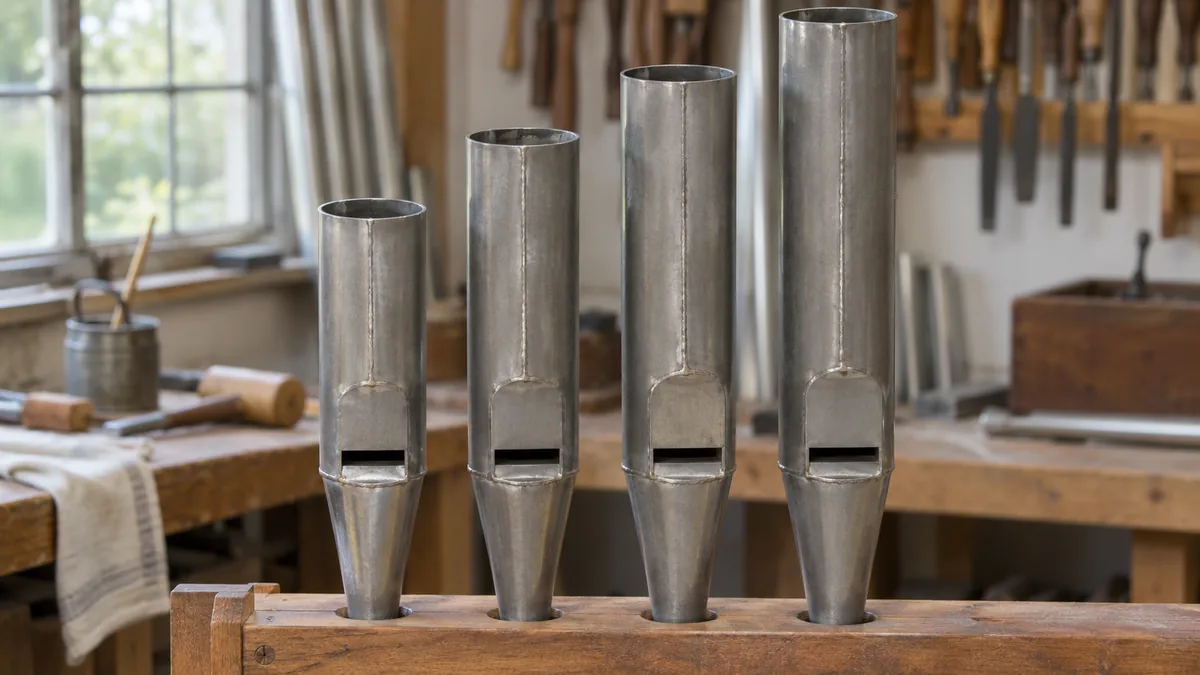
Follow the wind through a flue pipe
Start at the bottom. The foot receives wind from the windchest and carries it toward the mouth. Inside, a partition called the languid separates the foot from the resonating body. A narrow passage at the front forms the flue, or windway. Wind emerging through it becomes a thin jet directed toward the upper lip.
The jet interacts with the lip and the resonating air in the body. Its motion alternates across the edge, sustaining the oscillation that we hear as a note. The metal wall is not struck like a bell, and a flue pipe contains no reed. Yamaha’s illustrated explanation of flue and reed pipes shows the two arrangements side by side.
The mouth is the opening between the upper and lower lips. Its height is often called the cut-up. The width of that opening, the windway, the placement of the languid, and the treatment of the edges belong to the pipe’s voicing. A pipe maker cannot choose those features independently of the intended wind pressure and tone.
On a wooden flue pipe, the same basic process happens in a different-looking construction. Four boards commonly form a rectangular body, and a block and cap help form the windway below the mouth. From a distance, that box may look unrelated to a round metal pipe. The sounding principle is the same.
For a first inspection of a photograph, identify the mouth before comparing lengths. The tapered foot below it delivers wind and supports the pipe. The body above it contains the principal resonating air column. Measuring the complete object from toe to top would therefore mix the speaking body with the supporting foot.
A reed pipe starts with a metal tongue
A conventional beating-reed organ pipe has a flexible tongue, usually brass, held against a component called the shallot. Wind entering the boot sets the tongue into repeated motion against the shallot opening. Above that assembly, a resonator influences the resulting sound. This mechanism produces the distinctive voices associated with stops such as Trumpet, Oboe, and Clarinet.
The names describe intended tonal characters, rather than exact copies of orchestral instruments. Nor does every Trumpet stop have the same resonator or the same strength. A builder chooses the tongue, shallot, resonator, and wind conditions as a working combination. The resulting voice must also fit the rest of the organ.
In a reed pipe, the tongue’s vibrating length matters to pitch. The resonator also interacts acoustically with the reed. That is why a simple rule based only on the visible tube’s length cannot explain every reed stop. Short-resonator and full-length reed designs should not be treated as interchangeable objects with different-sized decorative tops.
The Associated Pipe Organ Builders of America’s resources distinguish conical and cylindrical resonator families. That is a useful starting point for looking at the pipes. It is still necessary to identify the actual stop: a photograph of a flared resonator does not establish its exact pitch, wind pressure, or voicing.
Why an open pipe and a stopped pipe need different lengths
An open flue pipe has an open upper end. A stopped pipe closes that end with a stopper or cap. Closing the top changes the resonances of the air column, so a stopped pipe can produce approximately the same fundamental pitch as an open pipe with roughly twice its speaking length.
For the simplest cylindrical models, the fundamental wavelength is approximately twice the effective length of an open pipe and four times the effective length of a pipe closed at one end. Those are relationships between wavelength and resonating length. They do not mean that an open pipe somehow contains an air column twice as long as its body.
The UNSW explanation of pipe resonances also shows why bore shape and the conditions at the ends matter. Real pipes require end corrections, and their mouths do not behave like ideal textbook boundaries. Treat the simple relationships as explanations of the octave difference, not as a cutting plan for making a correctly voiced pipe.
The change also affects the harmonic pattern. In the ideal closed cylindrical model, the resonances follow the odd-numbered series. A real stopped flute has its own spectrum and attack, shaped by construction and voicing. Calling every stopped stop a pure sine wave would lose those audible details.
A chimney flute adds another possibility: its stopper includes a small tube. It belongs to a family of constructions between the simple visual categories of an entirely open top and a completely closed one. When identifying a pipe, look for that detail instead of assuming every capped shape behaves identically.
Read pitch marks before estimating a pipe’s size
The number on a stop describes its sounding pitch relationship. At 8-foot pitch, the stop sounds at the normal keyboard octave. A 4-foot stop sounds an octave higher for the same key; a 16-foot stop sounds an octave lower. The mark refers to a convention based on an open pipe’s bass length, rather than the measured length of every pipe in the rank.
Consequently, an 8-foot stopped rank does not need an eight-foot open body for its lowest note. Each successive note also has a different pipe length. The Yamaha guide to stop names and pitches is helpful when moving from a console label to the pipework it controls.
| Mark | Sounding relationship | What it does not tell you |
|---|---|---|
| 16′ | One octave lower | The exact physical length of a stopped or reed pipe |
| 8′ | Normal keyboard pitch | Whether the pipes are flues or reeds |
| 4′ | One octave higher | The material or loudness of the rank |
| 2′ | Two octaves higher | Its suitability as a solo sound |
| 2⅔′ | An octave and a fifth higher | That the pipe belongs to a mixture |
| 1⅗′ | Two octaves and a major third higher | The stop’s complete tonal character |
A mutation stop supplies a pitch outside the simple octave series. A mixture combines several ranks, usually at different octave and fifth pitches, under one stop control. A Roman numeral often indicates its number of ranks. Mixtures may have breaks where the composition changes across the keyboard, so their pipes cannot be described as several identical rows at the same pitch.
Wood and metal describe construction, not a guaranteed sound
Metal organ pipes are often made from tin-lead alloys. Their bodies are formed from sheet metal and joined along a seam. Wooden pipes are assembled from boards and commonly have square or rectangular cross-sections. Both materials can serve musical purposes that a listener might associate with warmth, clarity, or brilliance.
The Greifenberger Institute’s account of pipe materials describes how choices vary with size, durability, tradition, and the intended register. It also cautions against giving material too much credit for tone. Mouth dimensions, scaling, wind, and individual treatment work together.
A shiny surface is therefore a poor guide to what a pipe sounds like. The front pipes may have been polished, painted, or otherwise finished as part of the case design. Those visual decisions are not a specification of the entire instrument. The pipes heard in a quiet flute stop may be inside the case and invisible to the audience.
When comparing photographs, note construction separately from interpretation. “Rectangular wooden pipe with a stopped top” records visible features. “Warm-sounding pipe” is a listening judgment that the photograph cannot establish. A useful description should make clear which kind of evidence it uses.
Scale and voicing explain differences within one pitch
Pipe scale concerns dimensions and proportions, especially the body’s width in relation to its speaking length. Two pipes can sound the same note while differing substantially in diameter. A relatively wide pipe commonly favors a flute-like character; narrower scaling is associated with string-like voices. Principal scaling serves another tonal role between those familiar families.
These are tendencies within an interconnected design. The Greifenberger Institute’s explanation of scaling discusses the relationship between body proportions, mouth dimensions, and the harmonic character sought by the builder. A width measurement alone does not supply the finished sound.
Voicing establishes how a pipe speaks and how it belongs in its rank. Tuning brings its pitch into the intended relationship with other pipes. The tasks interact, but their purposes differ. Raising a tuning slide does not perform the same job as changing the mouth or the reed’s curvature.
Imagine a scale played on one stop: a note suddenly jumps out, then the following notes return to the previous balance. The listener has found a specific observation worth reporting. It could involve the pipe’s regulation, its condition, or the instrument around it. The observation alone is not enough to decide which part should be altered.
Document the stop, note, and behavior rather than attempting an adjustment. That gives the organ builder a reproducible starting point. Altering a mouth edge to cure an assumed defect can change both attack and tone, and some alterations cannot simply be reversed.
The windchest decides when a pipe may speak
A pipe stands within a larger wind and control system. In a typical slider chest, a key opens a pallet admitting wind to a note channel. A slider associated with a stop aligns holes beneath the selected pipework. The note and stop selections together determine which pipes receive wind.
Yamaha’s windchest diagrams make the distinction visible: note channels correspond to keys, while sliders select tonal resources. A slider is not a moving shelf for one note. Other chest designs use different valve arrangements, so this description should not be imposed on every organ.
A rank groups pipes with a related tone across a compass. A stop often controls one rank, although mixtures, borrowing, and extension complicate a one-stop-equals-one-rank count. With several stops drawn, one key may sound several pipes. With no suitable stop selected, pressing that key need not produce a note.
Mechanical, pneumatic, and electric action describe ways of transmitting the player’s commands. Electric action does not turn the pipes into loudspeakers. Our broader introduction to the pipe organ’s wind, stops, and keyboards explains how those controls relate to the whole instrument.
Observe a pipe without turning the visit into a repair
During a supervised demonstration, ask the organist to play one stop across part of its compass. Listen for the beginning of each note, the sustained tone, and the release. Then hear a short phrase. A pipe’s role is easier to understand when the sound is connected to an actual registration and musical passage.
Keep the playing setup consistent while comparing. Changing stops, opening a swell box, or moving to a different seat introduces another variable. A recording also contains microphone placement and room sound. Neither a quiet recording nor a distant listening position establishes that an individual pipe is weak.
| Observation | Record | Avoid assuming |
|---|---|---|
| A note is silent | Key, keyboard, stop, and couplers selected | That the pipe itself is missing |
| A note continues after release | Which note and which registration were used | That bending a pipe will stop it |
| One note stands out | Its neighbors and the room conditions | That more wind is the appropriate cure |
| A pipe looks damaged | A photograph taken from safe access | That a visitor should straighten or remove it |
Metal pipes can be soft enough to dent under careless handling. Yamaha’s maintenance guidance explains their vulnerability and the problems with casual polishing of old pipework. Leave cleaning, lifting, and adjustment to the person responsible for the instrument. A darkened surface can be part of its history, not a request for metal polish.
Questions about organ pipes
Does one pipe normally make one note?
Yes. In ordinary use, each pipe is voiced and tuned for a particular note. The organ needs a set of pipes to cover a keyboard compass. Selecting several stops can make several pipes speak from one key, which is different from one pipe supplying an entire melody by itself.
Is the foot part of the pipe’s sounding length?
The foot carries wind toward the sounding mechanism and supports the pipe. For a flue pipe, the principal resonating body is above the mouth. Its overall physical height includes the foot, so a photograph or tape measurement must distinguish those parts before applying a length-and-pitch comparison.
Why can a stopped pipe be shorter?
The closed upper end changes the air column’s resonances. In the simplest cylindrical comparison, a stopped pipe needs about half the speaking length of an open pipe for the same fundamental pitch. Mouth geometry, end corrections, and the actual construction prevent this from being an exact manufacturing rule.
Are the largest visible pipes always sounding?
They may be speaking pipes, but a façade can also include non-speaking display pipes. Even a speaking front pipe sounds only when the relevant controls admit wind to it. The builder’s specification and a supervised demonstration provide better evidence than appearance alone.
Does a reed organ have the same pipes?
A harmonium or pump organ typically uses free reeds without the ranks of resonating pipes described here. A reed stop in a pipe organ is a different construction. A sale description using only the word “organ” should therefore be checked before assuming it refers to a pipe instrument.
Can I identify an alloy from a photograph?
A photograph may show seams, finish, and general construction, but it cannot reliably establish a tin-lead percentage. Use the builder’s records or a specialist assessment when material composition matters. Brightness, tarnish, paint, and lighting can all make visual guesses misleading.
What does Mixture IV mean?
It normally identifies a mixture with four ranks sounding from the stop. Those ranks add different pitches, commonly octave and fifth relationships, and the composition may change across the compass. IV does not mean four manuals or four pipes in the entire instrument.
Should a silent pipe be removed for inspection?
Leave it in place and report the note, stop, and circumstances to the organ’s caretaker. Silence can originate in the windchest, action, selection of stops, or the pipe itself. Removing a delicate pipe before that diagnosis can introduce damage and make the original fault harder to trace.