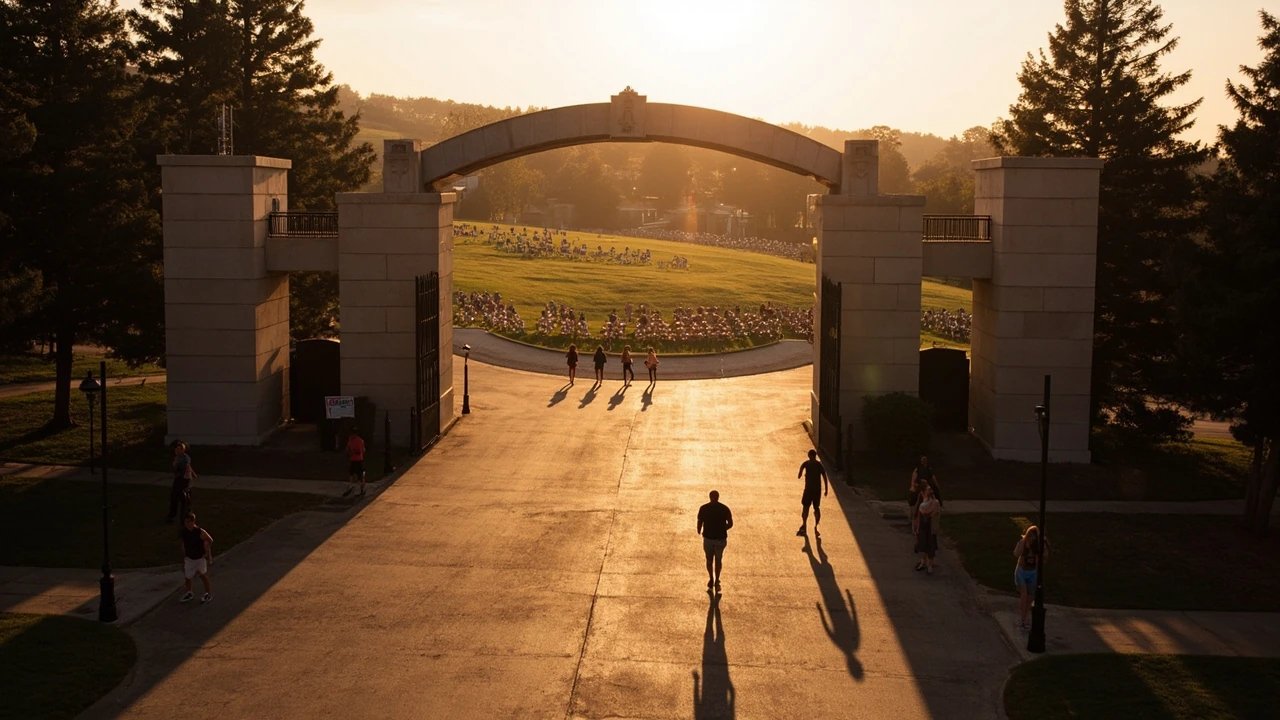
A first-time visit to Ruoff Music Center usually starts with the same set of questions: where to park, whether the seats under the canopy actually keep you dry, how early to arrive for a general admission lawn spot, and whether the sound in the back of the lawn is worth the ticket price. The venue looks simple from the road, but the practical details of a concert night there reward a little preparation, especially for families, older listeners, and anyone driving in from outside Hamilton County.
Ruoff Music Center at a glance
Ruoff Music Center is a roughly 24,000-capacity outdoor amphitheater in Noblesville, Indiana, about 25 miles north of downtown Indianapolis. It opened in 1989 as Deer Creek Music Center, was renamed to Klipsch Music Center in 2002, and took its current name in 2017 after a naming rights deal with Ruoff Home Mortgage. Live Nation operates the venue, which hosts a spring-through-fall concert season of rock, country, pop, hip-hop, Christian, and family shows.
The basic layout has not changed across the renamings. A covered, reserved-seating pavilion sits in front of the stage, an open general admission lawn rises behind it, and the surrounding grounds hold entry gates, concession stands, restrooms, a small merchandise row, and several parking fields. Most visitors never need to go past the main gate and the lawn entrance, but the venue is large enough that a wrong turn on the way out can cost fifteen minutes after the encore.
Seating, layout, and sightlines
The seating chart at Ruoff Music Center is split into three broad zones: the covered pavilion, the uncovered reserved terrace, and the open general admission lawn. Each zone behaves differently, and the right one depends on the kind of show, the weather, and the listener’s tolerance for standing.
| Section | Location | Capacity type | Cover | Best for |
|---|---|---|---|---|
| Pavilion (100s, 200s) | Orchestra level, covered roof | Reserved seats | Yes, full roof | All-weather shows, listeners who want a fixed seat |
| Terrace (300s) | Upper bowl, sloped seating | Reserved seats | Partial overhang | Mid-budget views of the whole stage |
| Lawn | Open grass behind pavilion | General admission | None | Groups, casual picnics, late-arrival tickets |
The pavilion seats roughly 6,000 people under a fixed roof, with the first ten or so rows close enough to read the artist’s setlist tape. The terrace adds another 3,000 or so reserved seats, most of them under a partial overhang that protects against light rain but not a sideways storm. The lawn, by far the largest zone, holds the rest of the audience and is where most first-time visitors end up.
Sightline quality depends less on price than people expect. A seat in the first three rows of the pavilion feels intimate but can put the side-stage video screens at an awkward angle. The middle of the pavilion, around sections 4 through 7, usually offers the cleanest straight-on view of the stage and the central screens. On the lawn, the first third of the grass, just behind the pavilion, hears the mix almost as well as a paid seat; the back third hears mostly the delay towers, which is fine for casual listening but loses the quieter moments of an acoustic set.
Choosing the right zone for the show
The band on stage changes the math. A loud rock or country act with a dense light show is enjoyable from almost any zone, because the visual carries even when the sound thins out. A singer-songwriter, a jazz group, or a classical crossover act depends much more on hearing the vocals clearly, and a lawn spot at the back will feel empty during the soft songs. Families with small children usually do best in the back-center of the lawn, where a quick exit is possible and a blanket gives the kids room to move without blocking other ticket holders.
Getting there and parking
Ruoff Music Center sits just off Exit 210 on I-69, with the address on the usual GPS and map apps. For most shows, the venue opens its parking lots about two hours before the scheduled start time, and the main access road funnels traffic past a series of staffed lots. Parking is generally included in the ticket price, though premium closer lots sometimes cost extra and are sold in advance.
| Approach | Best route | Typical time saved | Caveat |
|---|---|---|---|
| From Indianapolis south | I-69 north to Exit 210 | Baseline option | Heavy after 6 p.m. on weeknight shows |
| From Carmel / Westfield | US-31 north to 146th Street, then east | 10-15 minutes | Surface streets fill quickly after the encore |
| From Anderson / Muncie | I-69 south to Exit 210 | Baseline option | Southbound ramp backs up before showtime |
| Rideshare drop-off | Designated zone near main entrance | Avoids parking entirely | Pickup after the show has a long walk and a queue |
Three practical parking notes from regular attendees. First, the lots closest to the main gate are also the first to fill; arriving when the gates open is the simplest way to grab one. Second, the surface is gravel and grass, so low-profile cars can scrape on the entry curb if the driver is not careful. Third, the post-show exit moves faster from the lots on the east side of the venue, because most traffic leaves west toward I-69, and the east-bound feeders empty quickly.
What to bring, and what to leave in the car
The venue’s entry policy is posted on the official site and is updated for each tour, but a few rules stay consistent across seasons. Bags larger than a small clutch are usually not allowed, outside food and drink are not permitted, and professional cameras with detachable lenses are typically turned away at the gate. Small point-and-shoot cameras, phones, and sealed water bottles are generally fine.
For lawn shows, a low-back blanket or low-profile lawn chair is the standard setup, and the venue sells approved chairs on site for anyone who forgot one. Tall beach chairs, umbrellas, and pop-up tents are restricted because they block sightlines for the people behind you, and security will ask you to take them down. A light poncho in a jacket pocket is worth carrying in any month, because the covered pavilion seats are the only fully protected zone, and the rest of the audience is exposed.
Acoustics and sound across the venue
For an outdoor shed, Ruoff Music Center holds up well against its peers, largely because the venue is small enough relative to the lawn that the delay towers can cover the back rows without long time gaps. The pavilion, with its hard roof and side walls, is a much more reflective space than the lawn, and the mix engineer usually compensates by pulling some of the high frequencies down in the front rows to keep the sound from getting harsh. Listeners used to small club shows sometimes find the pavilion slightly brighter than expected; listeners used to arena shows usually find the whole venue a step warmer and more direct.
| Zone | Acoustic character | Loudness perception | Notes |
|---|---|---|---|
| Pavilion, front third | Direct, slightly bright | Highest sustained level | Earplugs recommended for rock and country |
| Pavilion, rear | Even, more reflective | Moderate | Best place to hear vocal nuance |
| Terrace | Balanced, with delay-tower support | Moderate | Comfortable for two-hour sets |
| Lawn, front | Clear, mix-driven | Moderate to high | Surprisingly good for a free-standing area |
| Lawn, rear | Delay-tower driven, slightly scooped | Lower, less detailed | Acoustic sets lose definition here |
For organ and pipe-driven shows, the picture is different. Touring theater-organ and symphonic-organ productions sometimes stop at Ruoff Music Center on summer organ tours, and the outdoor setting presents a particular problem for an instrument built around room resonance. The venue handles this by reinforcing the pipes with a touring PA system, but the experience is closer to a large park concert than to listening to a pipe organ in a stone church, and listeners who care about the room acoustic should look for a smaller indoor venue in the Indianapolis area. Related coverage of how organ builders shape pipe tone explains the kind of acoustic detail that the open-air setting cannot reproduce.
Food, drink, and on-site amenities
The concession stands at Ruoff Music Center are standard amphitheater fare: burgers, hot dogs, nachos, pretzels, popcorn, and a few regional items such as locally branded sausages. Lines get long at the set break, and the closest stands to the lawn entrance are usually the busiest. Beer, wine, and a small spirits selection are available, with ID checked at the point of sale, and most stands accept both card and mobile pay. Outside alcohol is not allowed past the gate.
Restrooms are spread around the perimeter of the lawn and behind the pavilion. The cleanest facilities, with the shortest lines, are usually the ones furthest from the main entrance, and that pattern holds across most amphitheaters, not just this one. A family restroom and an accessible restroom are available near the main concourse, and a first-aid station is staffed for every show. A small nursing room for parents of infants is also available on request at the guest services booth.
What the venue does well
- Quick entry from the parking lots, with multiple staffed gates
- Clear sightlines from the front third of the lawn
- Reasonably priced concession beer compared with larger arenas
- Reserved pavilion seats that genuinely stay dry in light rain
- A small dedicated accessible-seating section with companion seats
What to plan around
- Lawn seats exposed to weather, including sudden summer storms
- Long concession lines at the set break, especially near the lawn entrance
- Slow post-show exit if parked in the closest west-side lots
- Limited shade during late-afternoon shows on the uncovered terrace
Accessibility and family considerations
Accessible seating is offered in the pavilion, on the terrace, and in a dedicated area on the lawn with a paved surface for wheelchairs and mobility devices. Companion seats are sold as part of the same purchase, and the venue notes that all accessible areas are on the same grade as the corresponding entry gates, so no ramps are required once inside. Service animals are welcome, and the guest services booth can coordinate a quiet space for guests who need a break from the crowd during the show.
For families, the back-center of the lawn is usually the most practical spot. Children can sit on a blanket, move around without blocking a row of reserved seats, and a parent can carry them to a restroom without climbing over a row of seats. Ear protection matters more than parents often expect; a sustained 95 dB rock show is louder than a busy restaurant and is well above the level pediatric audiologists flag for young children, and inexpensive foam ear muffs from a hardware store do a better job than cotton balls.
Weather and the outdoor schedule
The concert season at Ruoff Music Center runs from late spring through early fall, with most shows scheduled in June, July, and August. The venue is open-air, so every show is effectively a weather call, and the house policy is to proceed in light to moderate rain and to delay or cancel only when lightning is in the area or when a stage roof is at risk. In practice, that means a typical summer show has a small chance of being delayed by a passing storm but rarely fully cancelled.
| Month | Average daytime high | Storm likelihood on a show night | Practical note |
|---|---|---|---|
| May | 72 F / 22 C | Moderate | Bring a light jacket for the encore |
| June | 81 F / 27 C | High, often brief | Use sunscreen; storms pass in 20 minutes |
| July | 85 F / 29 C | High | Hottest shows; hydration is non-negotiable |
| August | 84 F / 28 C | High, sometimes severe | Watch the radar before driving in |
| September | 78 F / 26 C | Moderate | Most comfortable month for lawn shows |
These averages are based on the standard climate record for the Indianapolis area and are useful as a planning baseline, but a single storm can break the pattern on any given night. Checking the local radar in the parking lot, before the walk to the gate, is a habit that regular attendees develop quickly.
How Ruoff Music Center compares to other Midwest sheds
Indianapolis has a small but distinct set of outdoor venues, and the choice between them usually comes down to a few specific points. Ruoff Music Center is the largest by capacity and the most touring-act focused, while smaller spaces such as the lawn at the Indianapolis Zoo or the venues in nearby cities offer a more intimate setting. A short comparison is often the most useful way to decide where to spend a summer evening.
| Venue | Capacity | Setting | Best for |
|---|---|---|---|
| Ruoff Music Center | About 24,000 | Suburban amphitheater, covered pavilion plus open lawn | Major touring acts, family shows, large groups |
| Gainbridge Fieldhouse | About 17,000 | Indoor arena, downtown Indianapolis | Winter tours, basketball, hockey |
| Old National Centre | About 2,000 | Indoor theater, downtown Indianapolis | Mid-tier acts, comedy, seated listening |
| Conner Prairie amphitheater | About 1,500 | Outdoor grounds, Fishers | Smaller touring shows, summer festivals |
For most people reading a guide like this, the practical question is whether a show at Ruoff Music Center is worth driving in for when the same act might also play an indoor venue later. The answer depends on the tour routing more than anything else, and it is worth checking the full tour schedule before committing to a particular date.
Tipping, etiquette, and small courtesies
Outdoor amphitheater etiquette is mostly common sense, but a few patterns help. On the lawn, setting up blankets in a tidy rectangle rather than a wide circle keeps the aisles clear and lets the people behind you see over your shoulder. Using a low chair rather than a tall one is the single biggest improvement a lawn guest can make for the experience of strangers sitting behind them. During quieter songs, talking over the music is the most common complaint from regulars, and it is the easiest to avoid.
Tipping the attendants who check tickets and direct parking is not expected at a venue this size, but a small tip for the staff at a premium parking lot or at a reserved-seat usher is appreciated. Concession workers in most amphitheaters are paid hourly and do not depend on tips, so leaving a couple of dollars on the bar or counter is a kind gesture, not an obligation.
Working out the cost of a typical show
Ticket prices for a Ruoff Music Center show vary widely with the act, the day of the week, and the seat zone. Lawn seats for a mid-tier rock or country show often start in the $40 to $60 range, pavilion seats in the $80 to $150 range, and premium or front-pit seats can run several hundred dollars for a stadium-level act. Parking is included in most ticket types, but premium close-in lots are sometimes sold separately. Concession prices are similar to other large amphitheaters and add up quickly for a family.
For a family of four on the lawn, a realistic budget for a show with food and drink on site is roughly $300 to $500, with the higher end for a popular act and a few drinks each. That figure is an order-of-magnitude estimate based on typical amphitheater pricing and the published ticket ranges, and it is meant only as a planning check, not a quote.
Frequently asked questions
Where is Ruoff Music Center located?
The venue is in Noblesville, Indiana, just off Exit 210 on I-69, about 25 miles north of downtown Indianapolis. The address is widely supported by GPS and map apps, and the exit is signed for the venue itself.
How many people does Ruoff Music Center hold?
Total capacity is roughly 24,000, split between the covered pavilion, the uncovered terrace, and the open general admission lawn. The exact mix depends on the stage configuration for a given tour, but the overall figure has been consistent for many seasons.
Can you bring lawn chairs into Ruoff Music Center?
Low-profile lawn chairs and blankets are allowed on the lawn, and approved chairs are sold on site. Tall beach chairs, pop-up tents, and umbrellas are restricted because they block the view of the people behind you.
Is there covered seating at Ruoff Music Center?
Yes, the pavilion sections under the fixed roof are fully covered, and the upper terrace has a partial overhang. The lawn is uncovered, so rain gear and a poncho are useful in any month of the season.
Does Ruoff Music Center have accessible seating?
Accessible seating is offered in the pavilion, on the terrace, and on a paved section of the lawn, with companion seats sold as part of the same purchase. Service animals are welcome, and a quiet space is available through the guest services booth.
How early should I arrive for a lawn show?
For a popular act, arriving when the parking lots open, usually about two hours before the scheduled start, is the simplest way to get a close lawn spot and to avoid a long walk from the outer lots. For a smaller show, an hour before the start is usually enough.
What is the bag policy at Ruoff Music Center?
The standard policy allows small clutches and similar bags, with larger bags usually not permitted. The current policy is posted on the venue’s official site and can change between tours, so it is worth checking before leaving home.
What happens if it rains during a show?
Most shows proceed in light to moderate rain, and only lightning, high winds, or a stage-roof risk will delay or cancel the performance. Delays usually clear within 20 to 40 minutes, and the venue announces any change on its social channels first.
Are there good places to eat near the venue?
Noblesville has a downtown restaurant district about ten minutes from the venue, and the cluster of national chains along the I-69 corridor offers the usual pre-show options. Many regulars eat before they arrive, because the on-site concession lines are longest at the set break.
How does Ruoff Music Center compare to an indoor arena in Indianapolis?
The main trade-off is weather exposure against price and atmosphere. Outdoor amphitheater shows are usually cheaper for the same artist and feel more like a summer event, while indoor arena shows are climate-controlled and better for winter tours or acts with very detailed, quiet music. The right choice depends on the tour, the season, and the listener’s tolerance for rain.
For listeners who want a quieter, more acoustic-focused show, a related guide on shaping pipe organ sound covers the kind of listening experience that an indoor venue supports far better than an open-air shed. And for readers comparing the stop lists and instrument families that a real organ tour might explain between sets, the practical guide to organ stops and ranks offers a useful reference.
For broader context on the venue’s role in the regional touring circuit, the Ruoff Music Center entry on Wikipedia covers the venue’s history from its 1989 opening through the name changes, and the Concert Hall guide maintains an updated calendar of major amphitheater shows across the Midwest. Before driving in, check the radar and the venue’s social channels for the most current gate, weather, and entry notes, because those are the three details most likely to change between the time tickets are bought and the time the headliner takes the stage.