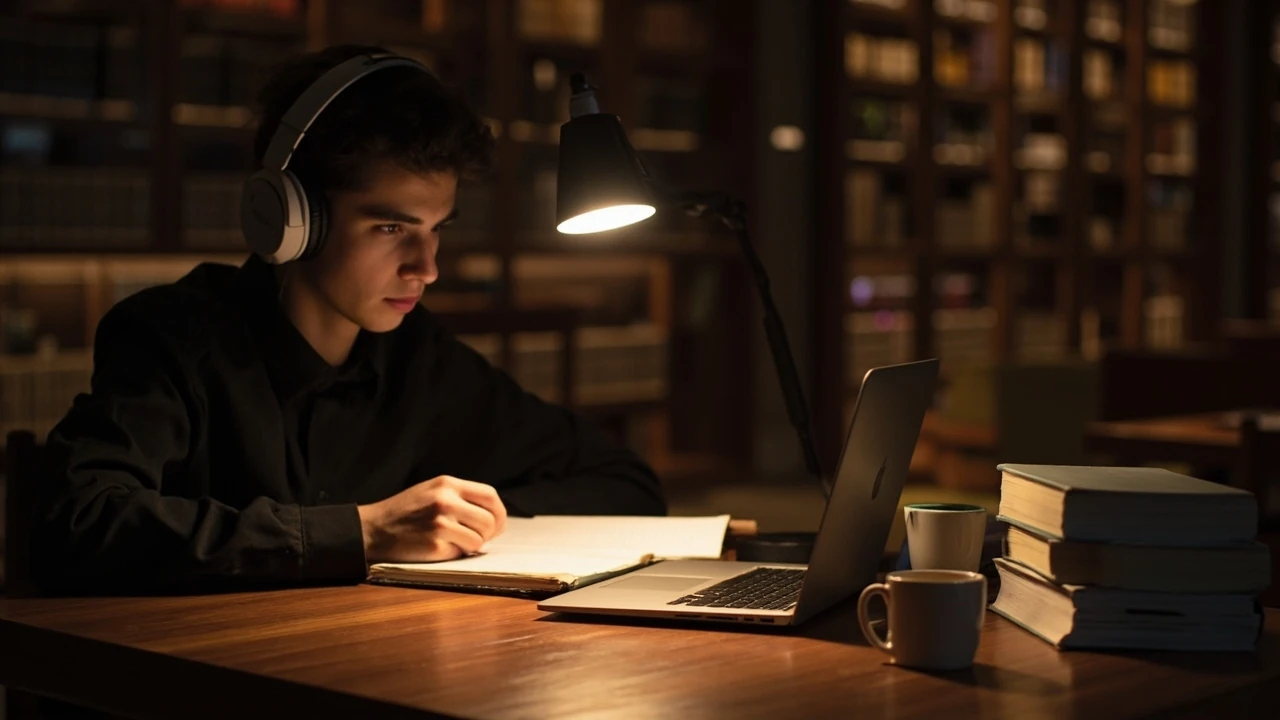
Study music: how to choose sound that actually helps you concentrate
You sit down with a textbook, open a long reading, or start a problem set, and within ten minutes your attention drifts. The room is quiet, but your mind is loud. For many students, the practical fix is not more discipline but a deliberate choice of study music tuned to the task in front of them. Used with intention, background sound can steady attention, mask distracting noise, and lower the perceived effort of starting a difficult assignment.
Used carelessly, background audio works against you. The wrong tempo, lyrics about heartbreak, or a song tied to a strong memory can hijack working memory and pull your eyes off the page. The goal here is to help you choose study music the way a careful listener would: by understanding what the research actually measures, how tempo and lyrics affect cognition, and which formats fit which kinds of work.
What we mean by study music
Study music is any audio deliberately played in the background to support a learning task. The category spans several different soundscapes, and the differences matter:
- Lo-fi and chillhop — slow hip-hop beats, soft piano, vinyl-style crackle, often around 60 to 90 BPM.
- Classical and orchestral music — solo piano, string concertos, Baroque counterpoint, full symphonies.
- Ambient and drone music — long pads, nature field recordings, slow synth washes with little rhythmic change.
- Video game and film scores — atmospheric, often instrumental, designed to sit behind attention rather than dominate it.
- White, pink, and brown noise — non-musical sound used to mask speech and sudden environmental noise.
- Nature soundscapes — rain, forest, ocean, café ambience, often layered with very subtle instrumentation.
What these formats share is a low demand on language processing and a stable texture. The point is not what the music says but how it behaves in the background of a working session.
Why background sound can help concentration
Listening while studying sits at the intersection of two well-documented effects: a moderate level of perceptual stimulation can keep the brain’s attention networks from going idle, and steady external sound can mask the unpredictable noises that break concentration. Neither benefit is automatic, and both depend on the type of sound you choose.
The moderate arousal hypothesis
Cognitive performance tends to follow an inverted-U curve relative to arousal. Too little stimulation and the mind drifts; too much and working memory is overloaded. Background music often sits in the productive middle of that curve, especially for routine or under-stimulating tasks. The arousal is gentle, predictable, and rhythmic, which is why a familiar playlist can make a long reading session feel shorter than it is.
Masking unpredictable environmental noise
The most disruptive sound in a study environment is usually not steady music but sudden human speech. A door closing, a phone notification, a conversation in the hallway, or a roommate calling a name activates the brain’s language and attention systems, forcing a context switch. A continuous background layer raises the baseline of auditory input so that small intrusions become less noticeable. In a noisy dorm, library, or shared flat, this masking function is often the single largest reason study music works.
Emotional scaffolding
Music also sets an emotional frame. Familiar, low-arousal music tends to lower perceived stress and reduce the unpleasantness of difficult material. That effect is real, but it is double-edged: the same familiarity that calms you can also pull you into listening rather than working. The safest choice is music you like well enough to relax into but not so well that you start following the arrangement in your head.
When study music hurts more than it helps
Before optimizing your playlist, it helps to know the situations where background music is more likely to subtract than add. The four most common problem cases are listed in the table below.
| Situation | Why music can backfire | Better alternative |
|---|---|---|
| Reading dense or unfamiliar text | Language-based music competes for the same verbal working memory you need to parse sentences. | Instrumental-only tracks, ambient drones, or silence with earplugs. |
| Solving novel math or logic problems | Complex reasoning benefits from a quiet mind; rhythmic distractions interrupt the slow build of a solution. | Pink or brown noise at low volume, or no audio at all. |
| Writing your own sentences | Lyrics, melodic hooks, and rich arrangements leak into the writing voice and phrasing. | Ambient pads, minimal piano, or short timed silence blocks. |
| Studying a topic you already feel emotional about | Strongly liked music triggers autobiographical memories and emotional reactions, pulling focus away. | Neutral new material, such as a long ambient album you have not heard before. |
The pattern is consistent: the more a task depends on language generation or deep reasoning, the more likely background music is to interfere. The more a task is repetitive, under-stimulating, or performed in a noisy environment, the more likely music is to help.
Tempo, lyrics, and genre: the three variables that matter most
Once you understand when background sound is appropriate, the practical question becomes which kind. Three acoustic variables do most of the work: tempo, lyrics, and genre texture.
Tempo and the body
Measured in beats per minute, tempo influences heart rate, gait, and subjective energy. Music around 60 to 80 BPM sits close to a relaxed resting heart rate and tends to feel calming. Tracks in the 90 to 110 BPM range feel more awake and are better for active review or flashcard work. Anything above roughly 130 BPM often pulls the body into movement, which is useful for exercise but usually counterproductive for sitting still and reading.
Lo-fi and chillhop producers deliberately target the 60 to 90 BPM range for this reason. Classical and ambient music are more variable, but the pieces most often recommended for study tend to be slow movements, adagios, and the slower movements of Baroque works, not fast allegros.
Lyrics as a working-memory load
Even when you are not paying attention to words, the brain still processes them. When a song is in a language you understand, lyrics activate the same verbal working-memory channels you use to read, write, or solve word problems. Studies comparing instrumental and vocal versions of the same tracks have repeatedly shown a small but consistent advantage for the instrumental version on language-heavy tasks.
This is why a beautiful aria or a favorite pop song is rarely a good study companion, even if it is emotionally comforting. The comfort comes at the cost of attention.
Genre and predictability
Genre matters less than people think, because what the brain really responds to is predictability. Music with a stable texture, a clear rhythmic grid, and few surprises is easy for the brain to predict. Music with frequent key changes, dynamic swells, or sudden drops keeps the auditory cortex more engaged. Both kinds of music are valid, but only the first kind is well suited to sitting behind a study session.
A practical decision table for choosing study music
Rather than prescribing a single best genre, the more useful skill is matching the audio to the task. The table below pairs common study activities with the type of background sound that tends to work well, and lists a few representative examples for each case.
| Study task | Best audio profile | Representative formats |
|---|---|---|
| Reading a textbook or long article | Instrumental, slow, low dynamic range | Solo piano, ambient pads, film scores, slow classical |
| Writing notes or essays | Minimal texture, no lyrics, low BPM | Ambient drone, lo-fi beats, brown noise, single-piano recordings |
| Reviewing flashcards or doing rote drills | Slightly more energetic, still no lyrics | Chillhop, downtempo, Baroque counterpoint, video game soundtracks |
| Coding or technical problem solving | Stable, predictable, non-verbal | Lo-fi, video game scores, ambient electronica, pink noise |
| Studying in a noisy shared space | Masking layer with even spectral balance | Pink noise, brown noise, rain or café ambience, closed-back headphones |
| Final exam review under time pressure | Calm, familiar, low arousal | Personal instrumental playlist at low volume, ambient drone |
Use this table as a starting point, then adjust. Many students discover that they personally do better with low-level piano during writing, while a friend does better with full silence. The decision is empirical: try the recommended profile for a few sessions and notice whether the work feels easier or harder.
Building a study playlist that actually works
Most study playlists fail not because the music is bad but because it is assembled without a plan. Random “study music” mixes often alternate between genres and tempos, so the brain is constantly re-adapting to a new sound environment. A better approach is to build the playlist around a single sonic profile.
Step 1: choose one profile and stick to it
Pick the row in the decision table that matches your dominant task and commit to one profile for the whole session. If you are doing two hours of mixed reading and writing, choose the writing profile, since it is the more demanding constraint.
Step 2: set a target tempo band
For most study work, aim for tracks between 60 and 90 BPM. This band is wide enough to allow variety within a single sonic profile but narrow enough to keep arousal roughly constant. Long ambient pieces, classical slow movements, and most lo-fi tracks sit naturally in this range.
Step 3: avoid lyrics in your working language
Instrumental music in your native language still contains a residual language signal, but it is much weaker than sung lyrics. If you want to use music that includes vocals, choose music in a language you do not understand well, or vocals used as texture (choral pads, wordless harmonies) rather than as the focus of the track.
Step 4: pre-sort by dynamic range
Dynamic range is the difference between the quietest and loudest moments in a track. A playlist that alternates whisper-quiet ambient pieces with big cinematic swells will constantly reset your attention. Use relatively even dynamic range, with the loudest moments only modestly louder than the quietest.
Step 5: control the volume carefully
Background audio should sit well below conversational level. A useful rule is that you should be able to hear your own thoughts clearly over the music. If you find yourself raising the volume to stay engaged, the music is competing with the work rather than supporting it.
The science behind the effect
Several lines of research speak to the question of whether study music improves or impairs learning. The honest answer is that effects are modest, mixed, and highly dependent on the task. A few robust patterns do emerge.
Background music and reading comprehension
Studies of reading with and without background music generally find small negative effects when the music includes lyrics and small neutral or positive effects when the music is instrumental and slow. The effect size is small, but for long reading sessions the cumulative drag of a poor audio choice can be noticeable.
Background music and working memory
Working memory is sensitive to auditory interference, especially verbal interference. Performance on digit-span tasks, mental arithmetic, and sentence-completion tests is typically slightly worse with vocal music than with instrumental music or silence. The difference is largest when the working-memory load is already high.
The Mozart effect, taken carefully
Early studies on the so-called Mozart effect showed a short-term boost in spatial reasoning after listening to Mozart. Subsequent work has shown that the effect is small, brief, and not specific to Mozart; similar arousal boosts appear after listening to other kinds of stimulating audio. The takeaway is that any pleasant, moderately engaging audio can produce a short lift in mood and energy, but the effect should not be over-promised.
Sound masking in noisy environments
The strongest, most consistent evidence is for sound masking. In open offices, shared study spaces, and noisy homes, a steady background layer reduces the disruptive effect of unpredictable speech and environmental noise. Pink noise and brown noise are particularly effective because their spectral balance is similar to human speech, which makes them efficient at covering conversational intrusions.
The relationship between arousal and performance is summarized in the Yerkes–Dodson law entry on Wikipedia, which describes the inverted-U pattern and its practical limits. For a closer look at how office-level sound shapes task performance, the review on the influence of ambient noise on cognitive task performance from PMC collects several of the relevant experimental findings in one place.
How different formats compare in real study sessions
Below is a more granular comparison of the most common study-music formats, focusing on the practical strengths and weaknesses of each rather than genre aesthetics.
| Format | Typical tempo | Lyrics | Best for | Main weakness |
|---|---|---|---|---|
| Lo-fi / chillhop | 60–90 BPM | Rare | Long reading, note review | Texture can feel repetitive over hours |
| Solo classical piano | Variable, often 50–90 | None | Writing, careful reading | Familiar pieces can pull attention inward |
| Ambient / drone | Often tempo-less | None or wordless | Deep focus, problem solving | Too flat for energizing review |
| Video game scores | 60–110 BPM | None | Coding, technical work | Memorable themes can become distracting |
| Film scores | Variable | None | Reading, atmospheric work | Dynamic swells break attention |
| Pink or brown noise | N/A | N/A | Masking noise in shared spaces | Can feel sterile over long sessions |
| Nature soundscapes | N/A | N/A | Calming pre-study routine | Limited arousal for active tasks |
The table makes a broader point visible: the formats differ less in quality than in their arousal profile. Choosing between them is mostly a question of how awake you need to be and how much verbal interference the task can absorb.
Headphones, speakers, and the listening environment
The format of the music is only half the question. The other half is how the sound reaches your ears.
Closed-back over-ear headphones
Closed-back headphones isolate you from external noise and deliver a stable left-right stereo image. They are the best choice for noisy environments and for music with delicate dynamic detail, because nothing leaks in or out. The trade-off is heat, pressure, and ear fatigue over very long sessions.
In-ear monitors
In-ear monitors offer strong isolation in a small package and are useful when you need portability. Foam or silicone tips that fully seal the ear canal provide better passive noise reduction than loosely fitting earbuds, which often let in enough environmental sound to defeat the purpose of study music.
Open-back headphones
Open-back headphones sound more natural and spacious, but they leak sound in both directions. They are pleasant for solo listening at home but unsuitable for libraries, shared study rooms, or open offices where the leaked audio would bother others.
Speakers
Speakers free your ears and avoid the pressure of headphones, but they also send sound into the room. In a shared space, speaker audio competes with other people’s music or speech. Speakers work best in a private study room, used at a low, steady volume that fills the room without dominating it.
Noise-isolating but not noise-cancelling solutions
Not everyone wants to wear headphones. In that case, earplugs that lower overall volume by 15 to 25 decibels, combined with low-level ambient audio from a single speaker, can achieve a similar effect: a quieter baseline with a steady background layer underneath.
A routine for the first 30 minutes of a study session
How you start a study session shapes the next two hours. The following routine is a concrete way to integrate study music into the opening of a session without making the music itself the focus.
- Minutes 0–5: put on closed-back headphones or insert earplugs. Play brown or pink noise at low volume. Stand up, stretch, and review what you plan to accomplish.
- Minutes 5–10: switch to the instrumental playlist that matches the first task. Set the volume so you can hear your own thoughts clearly. Open the reading or problem set.
- Minutes 10–20: work without touching the audio. If a track feels wrong, change it once; do not fiddle with the playlist continuously.
- Minutes 20–30: if the task is going well, leave the music on. If attention is fragmenting, drop the volume or switch to brown noise for ten minutes before returning to music.
The point of the routine is not the specific numbers. The point is to make the audio choice a deliberate, early decision and then protect working memory from being pulled back into audio adjustments during the session.
Common mistakes that undermine study music
Most problems with study music come from a small number of recurring patterns. The list below covers the mistakes that show up most often in real practice.
- Playing music you love too much. Favourite tracks activate autobiographical memory and pull attention away from the page. Reserve them for the walk to class, not the work itself.
- Mixing genres inside one session. A playlist that jumps from ambient to hip-hop to metal resets the auditory scene every few tracks. Choose one profile per session.
- Letting the volume creep up. If you catch yourself turning the music louder, the audio is competing with the task. Drop the volume or switch to a flatter, less engaging track.
- Using music as a procrastination tool. Spending twenty minutes building the “perfect” study playlist is itself a form of avoidance. Pre-build a small set of playlists and rotate them.
- Forgetting to take headphone breaks. Long sessions with closed-back headphones can leave ears warm and fatigued. Plan a five-minute break every 60 to 90 minutes.
- Studying with music that contains inside jokes or strong memories. Even without lyrics, a familiar theme from a film you watched with a friend can pull you into a mental replay.
Adapting study music to different times of day
Arousal is not constant across a day, and neither is the kind of audio that works best. A simple way to think about this is to match the audio to your natural energy curve rather than fighting it.
| Time of day | Cognitive profile | Audio recommendation |
|---|---|---|
| Early morning, before full alertness | Low arousal, slow ramp | Slightly more energetic lo-fi, light chillhop, video game scores |
| Mid-morning peak | High alertness, good for hard work | Quiet ambient or silence; less masking is needed |
| Early afternoon dip | Lower energy, more distractible | Upbeat instrumental music, pink noise in a noisy room |
| Late afternoon | Recovery of focus | Returning to lo-fi or ambient for a second productive block |
| Evening review | Calmer, more reflective | Solo piano, slow classical, quiet ambient |
This schedule is illustrative, not prescriptive. The point is that the same audio profile does not serve every part of the day. Two playlists, one slightly more energetic and one calmer, often cover most needs.
How this fits with broader listening habits
For listeners who already care about how sound is shaped, the question of study music overlaps with a more general interest in acoustic craft. The way a recording is mixed, the choice of instrument, and the resonance of a room all change how a track behaves in the background. On a site dedicated to the engineering of complex instruments, this is a familiar concern: a sound that is rich in the foreground may be intrusive in the background. Understanding the difference is useful whether the instrument in question is a pipe organ, a piano, or a synthesizer.
Two areas of the broader site speak to that overlap. The explanation of organ stops shows how small acoustic choices change the character of an instrument, and the guide to pipe voicing shows how those choices combine in a live performance. The same kind of attention to sonic profile, applied to your study playlist, is what separates background music that helps from background music that distracts.
A simple checklist before you press play
Before you start a study session with music, run through this short list. If you can answer yes to most of the questions, the audio is likely to support your work.
- Is the music instrumental, or in a language I do not understand well?
- Is the tempo in a calm or moderate band rather than fast?
- Is the volume low enough that I can hear my own thoughts?
- Is the playlist built around one sonic profile, not a random mix?
- Does the music match the difficulty of the task in front of me?
- If the room is noisy, am I using a masking layer in addition to music?
- Have I set a time to take a headphone break before fatigue sets in?
If you answered no to several of these, the audio is more likely to compete with the work than to support it, and it is worth adjusting before you begin.
Frequently asked questions
Does study music really improve focus, or is it just a placebo?
For many people, the effect is real but modest. The strongest benefit is sound masking in noisy environments, where a steady background layer reduces the disruptive effect of unpredictable speech and sudden noises. The second benefit is a moderate arousal lift that makes routine or under-stimulating tasks feel less tedious. For highly verbal or deeply analytical tasks, the effect can be slightly negative, especially when the music includes lyrics.
Is lo-fi music the best genre for studying?
Lo-fi is popular because it is usually instrumental, slow, and stable in texture, which are all properties that suit background listening. It is not intrinsically better than other instrumental formats, but it is convenient. If lo-fi works for you, there is no reason to switch. If it does not, ambient, solo piano, or video game scores will serve the same purpose.
Should I listen to music with lyrics while studying a foreign language?
Yes, with a caveat. Music in the language you are learning is a useful exposure tool, but it is a learning tool, not a focus tool. Use it in short, intentional listening blocks rather than as the background of a separate study task. If you need to read or write in that language, switch to instrumental music so the verbal channel is not overloaded.
Is it better to study in silence or with music?
It depends on the environment and the task. In a quiet room, silence is often the best choice for hard reading or writing. In a noisy room, a steady masking layer is usually better than silence, because unpredictable environmental noise breaks attention more than steady background audio does. The strongest personal signal is whether you consistently do better with or without sound; trust that signal.
What is the best tempo for study music?
For most study work, tracks in the 60 to 90 BPM range are the safest default. This band is close to a relaxed resting heart rate and rarely pulls the body into movement. Faster tempos can be useful for active review, but they can also feel restless over long sessions.
Do noise-cancelling headphones remove the need for study music?
Active noise cancellation reduces steady low-frequency noise well, but it handles sudden speech and irregular sounds less effectively. In a quiet environment, good noise-cancelling headphones plus silence can be excellent. In a shared space with conversations, a masking layer is still useful on top of the cancellation.
How long should a study playlist be?
Long enough that you do not have to interrupt the session to change it, but short enough that you can listen to it on repeat without strong memory associations forming. A two-to-three-hour playlist of instrumental tracks in one sonic profile is a reasonable default. Anything much longer tends to drift across genres, which defeats the purpose.
Can I use the same playlist for every subject?
You can, but a single profile may not suit every subject. A simple compromise is to maintain two or three playlists for different cognitive demands: one calm and minimal for writing and dense reading, one slightly more energetic for review and drills, and one masking-only (pink or brown noise) for noisy environments.
Does study music help with exam anxiety?
Calm, familiar instrumental music can lower perceived stress in the minutes before an exam, which is useful. During the exam itself, of course, audio is not allowed, so the practical effect is limited to the pre-exam window. If anxiety is severe, music is a small part of a larger set of strategies that includes sleep, breathing, and preparation.
Is it okay to fall asleep to study music?
Yes, though it is no longer functioning as study music at that point. Slow ambient music or pink noise can be useful for sleep, and the line between a study playlist and a sleep playlist is often a matter of volume. If the music is part of a wind-down routine that helps you sleep, that is a separate benefit worth keeping.