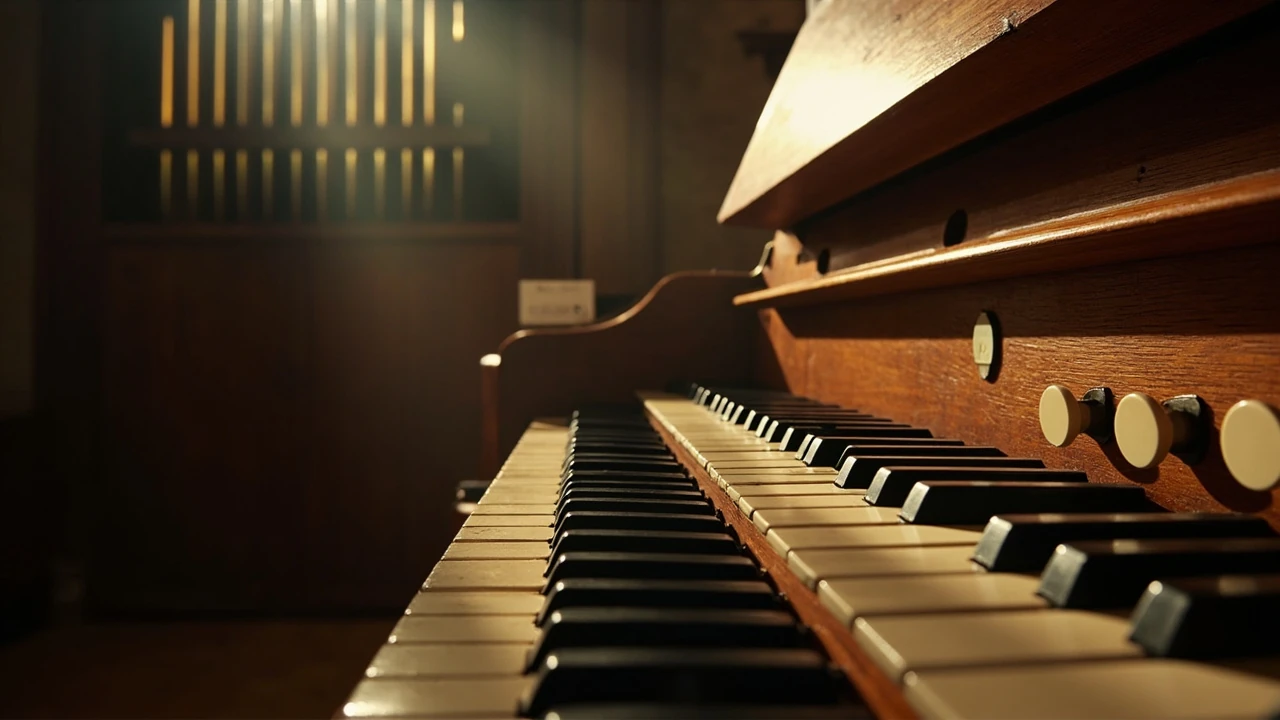
Tracker action vs electric action feel: what actually changes under your fingers
Sit down at two otherwise similar pipe organs, play the same passage, and most experienced players can tell within a few bars which one uses a mechanical tracker action and which one uses an electric action. The notes are the same, the stops are the same, the room may even be similar, but the response under the hands is different. That difference is what organ builders, teachers, and players mean when they talk about the tracker action vs electric action feel, and it is the single most important tactile decision a player makes when choosing or evaluating an instrument.
This guide focuses on what a player actually feels and hears, not on the engineering diagram of either mechanism. The aim is to give organists, students, choir directors, and informed listeners a clear framework for comparing the two actions in practice, and to point out where the usual generalizations break down.
What “feel” actually means at an organ console
Before comparing action types, it helps to separate the word “feel” into the components a player can really notice. Most disagreements about tracker action vs electric action feel are disagreements about which of these components a player values most.
- Key resistance: the downward force required to depress a key, usually measured in grams or ounces.
- Key return force: the upward push the key gives the finger as it returns, often the most distinctive part of tracker feel.
- Travel and depth: the distance the key must move before the valve opens.
- Latency: the time between starting to press a key and the pipe speaking.
- Repeat speed: how quickly a key can be released and re-struck without the action “missing” a note.
- Coupler behavior: whether added couplers add resistance, change response, or feel the same as the un-coupled manual.
- Dynamic information: how much the pipe tells the player about how the note started, and how much the player can shape that start.
A useful comparison of tracker action vs electric action feel needs to look at all seven of these, because an instrument that wins on one can easily lose on another.
How a tracker action actually works
A tracker action is a purely mechanical linkage. When a key is depressed, a wooden or plastic tracker rod pulls on a lever, which in turn pulls on a pallet arm, which opens a pallet valve under the windchest. The pipe speaks when that pallet opens and admits wind to its foot. Nothing between the key and the pallet is electrical, electro-pneumatic, or electronic.
Because every component is a physical connection, several consequences follow directly from the design. There is no power amplification: whatever force the finger applies has to be enough to overcome key return springs, tracker friction, and the weight of the pallet spring. There is no signal processing: there is no time delay added by a relay. And there is no isolation: changes in one manual’s resistance are felt, to a small but real degree, on every other manual coupled to it.
Modern tracker actions also include various refinements such as adjustable sticker lengths, roller boards to reduce friction, and in some cases thin tubular trackers for long runs. These reduce the worst of the mechanical penalty but do not eliminate it, and many builders argue the residual friction is exactly what gives the action its character.
How an electric action actually works
In an electric action, the key does not pull a tracker. It moves a small switch contact. Closing that contact sends a low-voltage electrical signal to a relay, which can be either electromechanical (a solenoid moving a pallet) or, in more recent instruments, a solid-state switching system that controls a separate pneumatic or direct-electric valve action further down the chain.
The key consequence is that the finger only has to close a switch. Once that happens, the action provides whatever force is needed to open the pallet. The key can be very light, the pallet can be very large, and the two need not be related at all. Anything beyond the switch is invisible to the player.
There is no single “electric action.” Some older organs use direct-electric actions where the key switch directly operates a small pneumatic or magnetic valve. Many mid-20th-century instruments use electro-pneumatic actions where a key switch admits air to a primary pneumatic that opens a much larger pallet. Modern digital and hybrid instruments use sampled pipe sounds triggered by an electronic sensor on the key, with no actual windchest at all. All of these get grouped under “electric action” in everyday speech, which is part of why the tracker action vs electric action feel comparison can get muddled.
Tracker action feel in practice
A well-regulated tracker action has a very recognizable feel. The key is heavier than an electric-action key, often noticeably so. The downward travel feels distinct: there is usually a small region at the top where nothing seems to happen, then a clear point where the pallet opens and the pipe speaks. When the key is released, the spring pushes the finger back up with a definite, slightly resilient push rather than letting the key float.
Players who have spent years on tracker instruments often describe several subjective qualities of that resistance. They report that the finger feels connected to the mechanism rather than merely signaling it. They report that small adjustments in pressure change how the note starts, especially in slow legato playing. And they report that the slight unevenness between manuals forces a kind of physical listening that smooths out phrasing.
Against these qualities, tracker actions have real practical limits. Repeat speed is the obvious one: the finger has to wait for the pallet to close and the key to return, which is slower than an electrically driven return. Large choruses and heavy couplers add resistance that the player must work against, sometimes substantially. And the mechanism itself is sensitive to humidity, temperature, and the gradual wear of felt, leather, and bushings, which is why a tracker organ’s feel can drift in ways an electric-action organ’s does not.
Electric action feel in practice
A well-regulated electric action feels light, level, and almost silent under the fingers. The key goes down with a small, smooth force. The pallet opens with no perceivable delay, and the key returns without any push. Most players describe it as “easy.” A few describe it as “empty.”
That emptiness, when it shows up, usually comes from one of three sources. The first is the absence of mechanical return force: without the spring of a tracker pushing the finger back, the player has to lift actively. The second is the absence of perceived latency: the pipe sounds “instantly,” which sounds like a virtue until the player realizes that the slight delay of a tracker is part of what gives a phrase its shape. The third is the uniformity across manuals: with no tracker friction to vary between divisions, the player loses a small but real source of information about which manual is sounding and how hard the windchest is working.
These are not flaws of the action. They are properties of it. And many players, especially those playing large Romantic repertoire on instruments with many stops and couplers drawn, actively prefer the light, level feel. The tracker action vs electric action feel question is therefore rarely a question of which one is better. It is a question of which trade-off a particular player wants for a particular repertoire in a particular room.
Side-by-side comparison of feel characteristics
The differences are easier to grasp as a single table. The numbers below are typical of well-regulated mid-sized instruments; specific organs can fall outside these ranges in either direction.
| Characteristic | Typical tracker action | Typical electric action | What the player notices |
|---|---|---|---|
| Key resistance (downward force) | 60–120 g on the un-coupled manual; more with couplers drawn | 25–55 g, very stable | How much the finger has to work to depress the key |
| Return force | Noticeable upward push from pallet springs | Light or passive; player lifts the finger actively | Whether the key “gives back” or floats |
| Key travel before sound | A small but distinct dead region, then a clear opening point | Smooth, continuous; little feel of a threshold | How binary the start of the note feels |
| Perceived latency | Slight but audible; can be shaped by finger pressure | Effectively zero; pipe and key feel synchronous | How much control the player feels over note onset |
| Repeat speed | Slower; physically limited by mechanism return | Faster; limited only by key return spring and switch debounce | How fast repeated notes can be played cleanly |
| Coupler resistance | Adds real weight; each coupled manual is felt on the others | Effectively no change in key feel when couplers are added | How much the player feels the “size” of the instrument |
| Maintenance sensitivity | High; felt, leather, and bushings affect feel directly | Lower for the key mechanism itself; higher for relays and contacts | How the feel changes between services |
| Information given to the player | Continuous: pressure, travel, return all carry signal | Binary in the extreme: key is either moving or not | Whether the player feels “in dialogue” with the mechanism |
That table is the spine of the tracker action vs electric action feel question. The first three columns are facts about the mechanisms. The last column is what the player actually experiences, and the player is the only one who can decide which row matters most for them.
Where the usual generalizations break down
Almost every “tracker is more expressive” or “electric is more reliable” claim is true for some instruments and false for others. A few of the more common generalizations are worth testing directly.
“Tracker actions are always heavier”
They are usually heavier, but not always. Some modern tracker actions, especially those using thin tubular trackers and well-balanced roller boards, can be almost as light as a mid-weight electric action. Conversely, a poorly regulated tracker organ with worn bushings can be so heavy that an unaccompanied hymn becomes a workout. Weight is a function of regulation and design, not of action type alone.
“Electric actions feel the same everywhere”
This is closer to true, but a careful player can still tell a high-quality direct-electric action from a heavy electro-pneumatic one. The latter, especially in older organs with leather pneumatics that have hardened, can feel sluggish and uneven in a way that no tracker action would. The “electric” label hides real differences.
“Tracker actions are more expressive”
Some are. Some are not. A tracker action that is out of regulation gives the player very little useful information. A perfectly regulated electric action with a well-voiced chorus and a responsive windchest can be every bit as expressive as a tracker, just in a different way. Expressiveness is shared between the action, the windchest, the voicing, and the pipes themselves. For a deeper look at how the windchest affects what reaches the player’s ear, the site’s overview of organ acoustics and windchest behavior is a useful companion read.
“Electric actions are unreliable”
Old direct-electric and early electro-pneumatic actions could be unreliable, and many still are because of decades-old wiring and hardened pneumatics. Modern solid-state electric actions are extremely reliable. So are modern tracker actions. The reliability question is mostly about the age and condition of the specific instrument, not about action type.
What the action does not control
It is easy, when focused on feel, to overstate what an action can do. A few things the action does not control are worth keeping in mind.
- Touch-controlled dynamics. Unlike a harpsichord or piano, a pipe organ does not respond to finger pressure with louder or softer pipes. The action transmits a binary decision, open or closed. Players who describe shaping dynamics through tracker resistance are usually describing articulation and onset, not volume.
- Tuning stability. Both action types can be installed in organs that stay in tune, and both can be installed in organs that do not. The action is largely irrelevant to pitch drift; the wind, the temperature, and the pipe material matter far more.
- Tone color. The stops, the scaling, and the voicing determine the tone. The action determines only how reliably the pipe speaks and how much information the player has about that speaking.
- Acoustic behavior in the room. The room is at least as important as the action. Two identical organs in two different rooms will sound and feel different in ways that have nothing to do with the mechanism.
Keeping that boundary in view keeps the tracker action vs electric action feel comparison honest.
How repertoire interacts with action type
Different repertoires reward different actions, and the choice of instrument often follows from the choice of music rather than the other way around.
| Repertoire family | What it asks of the action | Action type that usually fits well |
|---|---|---|
| Early polyphony and Bach | Clear articulation, light finger independence, audible distinctions between manuals | Tracker action, with adjustable touch through finger choice |
| French Romantic (Widor, Vierne, Dupré) | Many stops and couplers, large dynamic range, fast full-keyboard passages | Electric action often preferred for sheer practicality |
| German Romantic (Brahms, Reger, Rheinberger) | Heavy registrations, thick textures, careful part-playing | Either, with regulation quality more important than action type |
| 20th- and 21st-century music with rapid changes | Fast manual changes, instant response, sometimes extensive sequencer use | Electric action, particularly with memory and stepper systems |
| Continuo and chamber repertoire on small organs | Direct connection between finger and pipe, no latency | Tracker action, often with few couplers |
| Accompaniment of choir or congregation | Sustained legato, modest dynamic shaping, reliability over weeks of service | Either, with regulation and wind supply as the deciding factors |
None of these is absolute. A small electric-action organ can play Bach beautifully. A large tracker organ can play Widor convincingly. The table is a starting point, not a rule, and players are right to ignore it when a specific instrument is in unusually good condition or unusually poor regulation.
How to evaluate feel when you sit down at an unfamiliar organ
If the goal of a tracker action vs electric action feel comparison is to make a real decision, it helps to have a short, repeatable way of testing an unfamiliar instrument. The list below takes a few minutes and gives useful information about any pipe organ, regardless of action type.
- Play a slow legato scale on each manual alone, with no stops drawn, listening for the moment each pipe speaks.
- Play the same scale with the full principal chorus on that manual, noting any change in resistance or response.
- Add a 16-foot stop in the pedal, then play a slow hymn on the manuals, feeling for the extra pull of the coupler.
- Play a fast repeated-note figure on a single finger to test the repeat speed at the front and back of the keyboard.
- Add every coupler available, including any sub- and super-octave couplers, and play a chord on each manual to feel the maximum load.
- Listen to a long, soft note from a flue stop and a reed stop, and notice whether the action gives you any information about how the pipe started.
- Finally, play a passage from real repertoire you know well. A few bars are usually enough to expose how the action serves the music or gets in its way.
Doing the same routine on two different organs side by side is the most reliable way to answer the tracker action vs electric action feel question for your own hands.
Practical implications for organists choosing an instrument
Beyond feel, an action choice has consequences that show up over years of playing a particular instrument. A few are worth thinking about before committing.
- Physical wear. Tracker actions, especially heavier ones, are tougher on the hands and forearms than light electric actions. Players with joint issues often find tracker actions difficult, while others find the very resistance therapeutic and informative.
- Listening habits. Players who learn on trackers often develop a finely calibrated sense of articulation; players who learn on electric actions often develop a more legato-based technique. Neither is wrong, and both transfer, but the transfer takes time.
- Maintenance expectations. A tracker action typically needs more frequent, more skilled maintenance than an electric action. A well-cared-for tracker can outlive a poorly-cared-for electric action, but the tracker requires a builder who understands the mechanism. For a fuller look at what maintenance actually involves, the site’s page on tracker action maintenance and regulation walks through the main points.
- Coupler culture. On a tracker, players learn to manage couplers actively, drawing them only when needed. On an electric action, players tend to draw all the desired stops at once and forget about the keyboard. Both are valid, but the resulting interpretations can sound quite different.
Common questions students ask about feel
Students and adult learners often arrive at the tracker action vs electric action feel question with a related worry: am I being misled by preference, or is there an objective answer? A few honest answers help.
First, there is no objective ranking of the two. The most that can be said is that each action rewards a different set of habits. Second, almost any well-regulated organ can be made to sound musical in the hands of a player who has thought about what the action is giving back. Third, the first five minutes at an unfamiliar organ are almost always misleading; it takes at least a full service or rehearsal to hear what the action is really doing. Fourth, players who have only played one type of action often over-rate the unfamiliarity of the other. A tracker player on an electric instrument usually settles in within a service; an electric player on a tracker usually needs a little longer.
How the rest of the organ modifies the action’s feel
Action feel does not exist in isolation. The windchest, the winding system, the pipe voicing, and the climate of the room all change what reaches the player’s fingers.
- A tracker organ with a tired winding system will feel heavier than the same action on a well-wound instrument, because the pallet springs are working against insufficient wind.
- An electric action with hardened pneumatic primaries will feel sluggish even though the key mechanism is light.
- Reed stops add wind demand that the action may have to communicate to the player. On trackers, drawing a heavy reed can be felt as a small additional drag.
- Voicing decisions about how quickly the pipe speaks can either exaggerate or mask the small latency of a tracker.
Two organs with the same action but different windchests, wind supplies, or voicings can feel like entirely different instruments. The action is one ingredient, not the whole cake.
A short checklist for builders, teachers, and buyers
The list below is useful for anyone making a practical decision rather than arguing about feel in the abstract. None of the items are definitive on their own, but a string of “no” answers is a strong signal that the instrument is in poor shape.
- Is the resistance even across the full width of the keyboard?
- Do all notes in a chord speak at exactly the same moment under light finger pressure?
- Does the action return fully between repeated notes, even at speed?
- Are couplers adding predictable, smooth resistance rather than sudden changes?
- Is the action silent in operation, or do you hear clicking, scraping, or popping?
- Is the regulation stable across a full day of playing, or does it drift as the room warms?
- Does the action reward small finger adjustments, or does it feel binary?
Where the debate is going
The tracker action vs electric action feel conversation has not changed much in the last 50 years, but the instruments on offer have. New hybrid actions combine a tracker linkage with electric or pneumatic assistance, offering some of the mechanical connection of a tracker with reduced resistance on heavy couplers. Modern digital and sample-based organs, which are technically electric actions driving samples rather than pipes, are increasingly present in practice rooms and small churches, and they offer a feel that is neither tracker nor traditional electric.
At the same time, the tracker revival in organ building, which began in the mid-20th century, has produced a generation of trackers that are lighter, more reliable, and more uniform than the historical instruments they imitate. The old arguments that trackers are simply too heavy for large Romantic repertoire are less true now than they were in 1960. None of this changes the underlying mechanical realities, but it does change the practical landscape in which a player makes a choice.
Putting it together
Tracker action vs electric action feel is a comparison between two genuinely different physical systems, and the difference under the hands is real. But the choice between them is not a moral one. It is a question of which trade-off fits the player’s hands, the repertoire, the room, and the music. A careful player who has sat at both kinds of instruments, run a few of the same passages through each, and listened honestly to what the action gave back is in a much better position to choose than a player who has only read about the difference.
The clearest test is also the simplest one. If the action helps the player hear and shape what the pipes are doing, it is doing its job. If the action gets in the way of that hearing and shaping, even a beautiful mechanism is the wrong mechanism for the music at hand. Everything else, including the long tradition of debate on both sides, is commentary on that basic fact.
For readers who want to extend the comparison to other organ components, the site’s guide to organ stops and families explains how the stops shape the sound, and the page on organ registration shows how players put stops together. Both of these shape what the player feels through the action as much as the action itself does.
Frequently asked questions
Is tracker action harder to play than electric action?
For most players, a tracker action requires more force per key than a light electric action, and the added resistance can make long services tiring. The resistance is not wasted, though; it carries information about how the mechanism is responding, which many players find useful. Whether tracker is “harder” therefore depends on whether the resistance is interpreted as effort or as feedback.
Can an electric action feel as responsive as a tracker?
It can feel different without being inferior. Electric actions typically have less perceived latency and lighter keys, which many players read as more responsive. Tracker actions have a small delay and a clear threshold at the point the pallet opens, which other players read as more communicative. Both are forms of responsiveness, and the best electric actions can be every bit as musical as the best trackers.
Do all tracker organs feel the same?
No. Tracker actions vary widely in weight, in friction, in the evenness of regulation across the keyboard, and in the feel of the return. A light, well-regulated tracker on roller boards feels nothing like a heavy tracker with worn bushings, even on identical repertoire. Action type is a category, not a specification.
Do all electric organs feel the same?
No. Direct-electric, electro-pneumatic, and modern solid-state actions feel different from one another. Older electro-pneumatic actions can feel sluggish; modern direct-electric actions can feel almost weightless. The “electric” label hides more variation than most players realize.
Does the action type affect how loud the organ plays?
Not directly. Loudness is controlled by stops, scaling, voicing, and wind pressure. The action type influences how reliably a note speaks when the player wants it to, which affects how loud the music sounds in performance, but it does not change the maximum volume of any individual pipe.
Is one action type better for learning?
Beginners often learn more easily on a light, predictable electric action because it lets them focus on notes and fingering without having to manage resistance. Students who intend to play historical repertoire often benefit from early experience on a tracker so that their technique develops in dialogue with a mechanical action. The best answer depends on the repertoire the student is learning.
Does the action affect how long an organ lasts?
Both action types can last for many decades when properly maintained. Tracker actions have more parts that wear and require periodic replacement, but the parts are simple and well understood. Electric actions have fewer mechanical parts but depend on wiring, contacts, and relays that can age in less obvious ways. The age of an organ is more a function of maintenance than of action type.
Can a digital organ give a useful impression of either feel?
Modern digital and sample-based instruments can mimic the touch of a tracker or an electric action to a useful degree, especially for practice and small-scale accompaniment. They cannot reproduce the small mechanical variations that a real pipe organ gives back, and most experienced players can tell the difference within a few minutes. They are excellent practice tools and inadequate substitutes for real pipe-organ experience.
How does humidity affect feel?
Humidity affects tracker actions more than electric ones. Felt and leather bushings swell in damp conditions and shrink in dry ones, which can change key resistance and return force across a single day. Electric actions are mostly unaffected by humidity, though their switching contacts can occasionally oxidize. A tracker organ in a stable climate is far more predictable than a tracker organ in a variable one.
What is the single most important thing to listen for when comparing the two?
Whether the action helps the player shape the beginning of each note. In a well-regulated instrument of either type, the finger can feel exactly when the pipe starts to speak, and that moment is the foundation of articulation. If the player can feel that moment clearly, the action is doing its job. If not, no amount of mechanism is going to make the music more responsive.