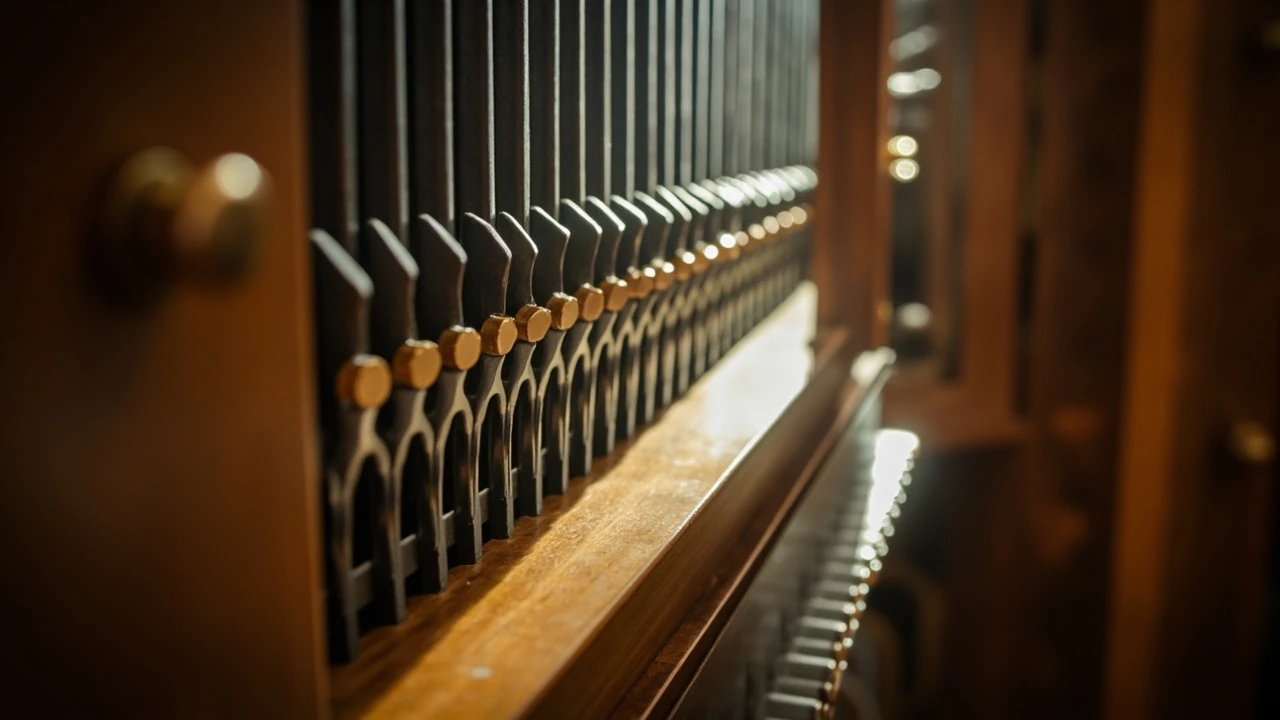
What is a celeste stop and how it works
A celeste stop is a rank of organ pipes tuned a small amount sharp or flat against another rank of the same nominal pitch. When both ranks sound together, their waveforms alternately reinforce and cancel each other, and the listener hears a slow, pulsing shimmer that seems to move even while the keys are held still. That is the short answer to what is a celeste stop and how it works: a deliberately mistuned rank, paired with a foundation rank of similar color, producing an acoustic beating pattern the ear reads as gentle motion.
Builders use the word “celeste” in different ways. Some instruments have a single celeste rank drawn on its own manual; others offer a matched pair where the celeste is voiced and tuned to interact with a specific partner stop, such as a salicional or a narrow-scaled gamba. Knowing which kind a given organ has matters when you choose a registration, audition an unfamiliar instrument, or try to recover what a French Romantic composer had in mind when he asked for a céleste without naming the partner.
The acoustic principle behind the shimmer
The shimmer of a celeste is not a special harmonic or a hidden overtone. It is the same physical phenomenon that makes two slightly out-of-tune guitar strings produce a slow wah-wah when struck together. When two sound sources play the same nominal pitch but with a tiny difference in frequency, their waveforms slide in and out of phase, and the listener hears a steady tone whose loudness rises and falls at a rate equal to the difference between the two frequencies.
In a pipe organ, the builder takes a rank of pipes, scales it like a normal rank, voices it in a soft, often stringy tone, and tunes each pipe a small amount away from concert pitch. The amount of mistuning is chosen deliberately. Too little and the beating disappears beneath the room’s own reflections; too much and the rank simply sounds out of tune against the rest of the organ. Most builders settle between a few cents and roughly a quarter of a semitone of detuning, with the actual figure depending on the scale of the pipes, the wind pressure, and the reverberation of the room.
Why the beating reads as motion
The ear does more than register a pulsing loudness. As the two ranks pull against each other in the listener’s auditory system, the brain also reads a slight wandering of pitch, because the combined waveform shifts subtly with each cycle. The result is a slow sense of rotation or undulation around the sound source, which is why organists often call a well-voiced celeste a voix céleste, a heavenly voice, rather than a kind of tremulant. The movement lives in the interference of two sources, not in any motion of the wind or the pipe itself.
Celeste vs. tremulant: what is actually different
A celeste and a tremulant both add movement to a sustained tone, but they do it in different ways. A player who understands the difference can choose more deliberately between them and avoid registrations where one effect fights the other.
| Feature | Celeste stop | Tremulant |
|---|---|---|
| Source of movement | Acoustic beating between two mistuned ranks | Mechanical variation of wind pressure to a single rank |
| Components required | Two ranks of pipes, or one rank coupled to a partner stop | A single rank and a tremulant mechanism in the wind supply |
| Speed of motion | Slow, set by the tuning offset, not adjustable in real time | Usually adjustable at the console, typically faster than a celeste |
| Typical tone color | Soft, often stringy or narrow-scaled, intimate | Can be applied to any foundation stop, including principals and flutes |
| Common role in repertoire | Sustained harmonic background, a halo color under a melody | Vocal expression, solo phrasing, soft chorus emphasis |
| Risk when misused | Sounds watery or out of tune with the wrong partner | Sounds nervous or mechanical if the speed is set too fast |
A tremulant changes a single rank by pushing its wind supply up and down, which modulates loudness and pitch in a regular, often adjustable cycle. A celeste depends on the interaction of two ranks, so the speed of its shimmer is fixed by the tuning offset rather than by a control the player can reach for. Both effects have their place, and many Romantic organs are voiced with the assumption that a player will use them together for very soft, atmospheric solos, where the tremulant colors a line and the celeste colors the held harmony underneath it.
How a celeste rank is actually built
Celeste stops differ from builder to builder, but several physical decisions repeat across instruments. These are the variables a voicer tunes and shapes to make a celeste work in a particular room.
- Pipe material and scale: Most celestes are made of metal, often a narrow-scaled, thin-walled pipe that speaks quickly and quietly. Some builders use wooden gedeckts or covered wooden pipes for the lower octave, where metal pipes of the required size become impractical in a chamber that small.
- Mouth openings and cutups: Celeste mouths are usually cut low and the voicing is kept light, so each pipe speaks promptly with little harmonic edge. The goal is a pure, almost flute-like tone that can blend with another rank rather than overpower it.
- Wind pressure: Celeste ranks generally receive a slightly lower, or at least more carefully regulated, wind supply than the foundation rank they are meant to pair with. Erratic wind will mask the delicate beating with a wobble of its own.
- Tuning offset: The celeste is tuned sharp or flat against the partner rank, not against the equal-tempered scale. The exact offset is chosen by ear, often starting near 6 to 10 cents for narrow scales and widening for larger scales that already produce richer beating between otherwise identical pipes.
- Range: Celeste ranks are usually shorter than the manual compasses, because they are meant as a soft color rather than a full chorus line. A typical range runs from the lowest manual note to the top of the keyboard, sometimes missing the bottom octave or two where the beating is harder to control.
Common pairings: which foundation stops a celeste is designed to match
A celeste is rarely used on its own. The shimmer only emerges when the celeste is heard together with another rank whose tone color and pitch it can interfere with. Builders name celeste stops in ways that signal the intended partner, and a careful reading of the stop list will often tell the organist what the builder had in mind.
| Celeste name (examples) | Typical partner stop | Resulting color |
|---|---|---|
| Voix céleste | Salicional or narrow-scaled string | Soft, singing string tone with a slow shimmer |
| Unda maris (wave of the sea) | Dulciana or principal-like string | Brighter, more transparent halo, common on Romantic and eclectic instruments |
| Gamba céleste | Viola da gamba or viole | Slightly nasal string with movement, useful for solo lines |
| Flûte céleste | Flûte harmonique or orchestral flute | Airy flute background, more breath than beat |
| Aeoline or Aeolodicon | Soft string or salicional | Very quiet, distant, often extended down to tenor C only |
When two stops on the same manual have clearly related names, that is usually a builder’s invitation to draw them together. If the stop list separates them, the celeste can still be combined through coupling, but the result is less controlled and the organist has to rely on the wind and tuning being stable enough to keep the beating slow.
How organists use a celeste in real registrations
In practical playing, a celeste is almost always combined with at least one other stop from the same manual. The patterns below are easy to internalize once the underlying goal is clear: produce a sustained, harmonically rich background that seems to hover, rather than to declare a melody.
- Solo melody with a halo: Draw the foundation stop alone on one manual, the celeste and its partner on a second manual, and couple the manuals so the melody speaks without shimmer but the held notes acquire the beating. This is the classic French Romantic singing voice above a quiet chorus registration.
- Full swell box with a touch of celeste: On enclosed divisions, add a single celeste rank at a lower volume than the surrounding stops. The result is a slow wash of movement that suggests distance, used often in hymn introductions and quiet postludes.
- Celeste without a partner: Some organs are voiced so that the celeste shimmers even when drawn alone, because the pipes within the same rank are tuned with slight irregularities. This is more common in older or unusual instruments, and it can sound watery if the tuning has drifted.
- Celeste as a soft 8-foot foundation: A few builders label a celeste as a Salicional céleste or Viola céleste intended to be drawn with a soft 8-foot flute on the same manual, so the listener hears flute, viola, and shimmer in a single composite sound.
Repertoire that depends on the celeste effect
The celeste became a standard part of the organ only in the second half of the nineteenth century, when Romantic and symphonic organ building created a demand for soft, atmospheric colors. Several composers wrote passages that essentially ask for a celeste sound, and lose much of their character without one.
- Louis Vierne and Charles-Marie Widor: Their slow movements and quieter versets frequently call for a céleste with a soft string or flute, often within the enclosed Récit division of a Cavaillé-Coll style organ.
- César Franck: Franck’s harmonic writing often relies on sustained pedal tone beneath a melody; a céleste combined with a soft foundation stop is a near-ideal realization of the texture he implies at the keyboard.
- Olivier Messiaen: Although Messiaen often uses the swell box and tremulants as well, several of his registrations specify a céleste with a flûte or a viole for long, slow-moving chords.
- Sigfrid Karg-Elert and Max Reger: Late-Romantic German repertoire often pairs a Lieblich Gedeckt or an Aeoline with a céleste for very soft passages, especially in chorale preludes where a held harmonic field is more important than a declamatory line.
None of these composers literally wrote céleste in every passage where the sound is implied, which is part of why a player needs to understand the effect rather than only the stop list. A registration that produces a slow shimmer where the music is hushed is usually closer to the composer’s intent than a registration that simply follows the printed marking.
Listening tests: how to tell a well-voiced celeste from a poor one
Because the celeste depends on subtle tuning, it is also the stop that suffers most when an organ is out of tune or out of regulation. A few practical listening tests will reveal most of what an organist or careful listener needs to know.
- Single-note test: Draw the celeste alone, hold a middle manual key, and listen. The tone should be even, gentle, and free of chiff. If the pipes themselves seem to wobble, the wind is unstable and the celeste will not blend with anything.
- Coupled test: Add the intended partner stop, hold the same note, and listen for slow, regular beating. The beat rate should remain constant across the held note, and the loudness should rise and fall smoothly rather than jerk.
- Range test: Play a slow scale from the bottom to the top of the keyboard while both ranks are drawn. A good celeste keeps an even beat rate across most of the compass. A poor one speeds up at one end and slows at the other, which signals that the voicer has not adjusted the offset for pipe scale.
- Dynamics test: Open and close the swell box while holding a chord with the celeste drawn. The shimmer should be present at every dynamic, not only when the box is nearly closed. If the beating disappears when the box is open, the celeste is too quiet for its partner.
- Coupling test: Couple manuals and play a melody on one manual with both ranks drawn on the other. The melody should remain clear, and the held notes underneath should shimmer without blurring the line.
If the celeste fails any of these tests, the cause is almost always one of three things: the wind supply is fluctuating, the tuning offset is wrong for the room, or the partner stop is voiced in a way that does not match the celeste’s scale. All three are correctable, but they require a voicer, not a player.
Common problems and what causes them
Most practical problems with celeste stops come down to mistuning, mistiming, or a mismatch in the room. The table below summarizes what an organist or technician is most likely to encounter.
| Symptom | Most likely cause | Where the fix belongs |
|---|---|---|
| Beating too fast, almost like a tremulant | Tuning offset too large for the scale of the pipes | Voicer retunes the celeste closer to the partner rank |
| No audible beating at all | Celeste tuned in equal temperament to the partner, or partner drift | Voicer or tuner resets the offset, often by ear against the partner |
| Celeste sounds out of tune when played alone | Partner stop has drifted or has been retuned since the original voicing | Tuner re-establishes the offset against the actual partner in the room |
| Shimmer changes between soft and loud | Wind pressure on celeste and partner is not stable | Organ builder or service technician checks the wind supply |
| Beating present in bass but not in treble | Offset too small for the higher partials, or short compass | Voicer adjusts the offset or shortens the rank further |
Organists who understand these patterns can describe a problem to a tuner in a useful way, which makes a repair cheaper and quicker. Saying the céleste speeds up in the tenor is far more useful to a voicer than saying the swell celeste sounds wrong.
Celeste stops in different national traditions
Although the acoustic principle is universal, the way celeste stops appear in stop lists varies by country and period. Knowing the convention helps when reading an unfamiliar organ.
- French Romantic (Cavaillé-Coll and successors): The Récit division typically contains a Voix céleste at 8-foot pitch, intended to combine with the Salicional or the Flûte harmonique. A separate Unda maris may also be present at a slightly different pitch.
- British Victorian and Edwardian: Celeste stops are often named after a partner, such as Salicional and Celeste or Gamba and Celeste, and the builder expects both to be drawn at once from a single drawknob or knob pair.
- German Romantic and early twentieth century: Aeoline and Aeolodicon stops are common at 8-foot pitch, voiced as quiet, narrow-scaled strings. They are sometimes paired with a Lieblich Gedeckt for a soft chorus effect in enclosed divisions.
- American eclectic and symphonic: Celeste ranks are often offered at multiple pitches, including 16, 8, and 4 feet, sometimes within a string division that already includes Salicionals and Violas. The orchestral concept is to provide a slow shimmer for string-section writing.
- Italian and Iberian traditions: Celeste stops appear later and less often, usually the result of French or German influence on late-Romantic organs in those regions.
How a celeste differs from a chorus rank
A choir organ or a Hauptwerk chorus is built from many ranks that are deliberately tuned to the same pitch, producing a stable, harmonically rich sound. A celeste is the opposite: a single rank built to disagree, gently, with one other rank. The contrast is one reason a celeste placed inside an otherwise chorused division stands out so clearly to the ear, and also one reason a celeste can be misused by being added to ranks it was not designed to match.
- Equal temperament vs. intentional offset: Chorus ranks are tuned to equal temperament. Celeste ranks are tuned to a small but real offset from their partner.
- Many ranks vs. two ranks: A chorus combines many ranks at the same pitch, each adding a partial. A celeste combines two ranks at the same pitch, each contributing the same partials but with a moving amplitude.
- Stability vs. motion: A chorus aims for a steady tone. A celeste aims for audible, controlled motion.
- Ensemble vs. solo color: A chorus rank is part of a registration built from many stops. A celeste is almost always a color stop used alone or in a small group, with a clear sense of being a special effect rather than a building block.
Practical checklist for choosing a celeste registration
Before drawing a celeste in a piece, a short mental check will keep the effect from sounding like a defect.
- Identify the partner stop the celeste is intended to match, by reading the stop list or by ear against the rank it shimmers with.
- Confirm the swell box or enclosure is closed enough that the shimmer can be heard against the room rather than masked by direct sound.
- Make sure the melody, if any, is on a different manual so it is not blurred by the beating on its own notes.
- Hold a sustained chord for a few seconds before playing, so you can hear whether the beat rate is comfortable and whether the room is reinforcing the effect.
- Avoid adding the celeste to large chorus stops, reeds, or mixtures. The beating will be lost in the chorus and the celeste will simply sound out of tune.
- If the piece has any full organ passage later, plan how to step back into the celeste registration without leaving a gap. A small swell pedal crescendo can cover the transition.
Used with that kind of care, a celeste is one of the most evocative stops the organ offers, and a reminder that a carefully tuned acoustic effect can do what no single rank can do alone.
Frequently asked questions
What is a celeste stop in simple terms?
A celeste stop is a rank of organ pipes tuned a small amount off pitch from another rank of similar tone. When the two ranks sound together, their sound waves beat against each other and the listener hears a slow, pulsing shimmer that seems to move even when the keys are held still.
How is a celeste different from a tremulant?
A tremulant changes the wind supply to a single rank and makes that rank pulsate in loudness and pitch. A celeste uses two ranks of pipes with a small tuning difference, so the movement comes from acoustic interference rather than from a moving wind supply. A celeste cannot be sped up or slowed down from the console, while a tremulant usually can.
Can a celeste stop be played by itself?
Yes, but the effect is less obvious without a partner stop to interfere with. On some organs the celeste is voiced to shimmer even when played alone, but the classic celeste sound emerges when it is combined with the stop it was designed to match.
Why is it often called a voix céleste?
Voix céleste is French for heavenly voice. French Romantic organ builders, especially in the Cavaillé-Coll tradition, used the name to describe the slow, floating quality the two ranks create together. The English celeste and the German Celeste come from the same root.
What is the difference between a celeste and an unda maris?
The terms are often used interchangeably, but historically unda maris (wave of the sea) was a softer, more transparent version of the céleste, often paired with a narrower and brighter string. In practice, the choice of name on a particular organ tells you more about the builder’s taste than about an absolute acoustic standard.
Does every organ have a celeste stop?
No. Celeste stops are most common on Romantic, symphonic, and eclectic organs built from about 1860 onward. Baroque organs, early Classical instruments, and many modern tracker organs in the German Baroque style do not include celeste ranks, although they may use other means, such as a tremulant or an unsteady wind supply, to add motion to a sustained tone.
How much is a celeste rank detuned?
The exact amount varies by builder, by pipe scale, and by the room. A typical celeste might be detuned by a few cents up to about a quarter of a semitone against its partner. The voicer chooses the offset by ear so that the beating is slow and even rather than nervous.
Can a celeste stop be repaired or improved?
Yes. Most celeste problems are caused by drift in the partner stop, by unstable wind, or by a tuning offset that no longer suits the room. A voicer can re-establish the offset, a tuner can stabilize the partner rank, and an organ technician can correct wind problems. A celeste that was once beautiful can almost always be made beautiful again.
Is a celeste the same as a chorus?
No. A chorus is a group of ranks of different tone colors that are all tuned to the same pitch to produce a stable, harmonically rich sound. A celeste is the opposite in spirit: two ranks deliberately tuned slightly differently to produce motion. Drawing a celeste with a chorus almost always masks the effect and can make the celeste sound out of tune.
What kind of music benefits most from a celeste stop?
Slow movements, quiet hymn introductions, intimate chorale preludes, and any passage that asks for a sustained harmonic background rather than a clear melody. French Romantic and early twentieth-century literature uses the celeste constantly for these textures, and much of the late-Romantic German chorale repertoire also depends on it.