Why do organs have multiple keyboards
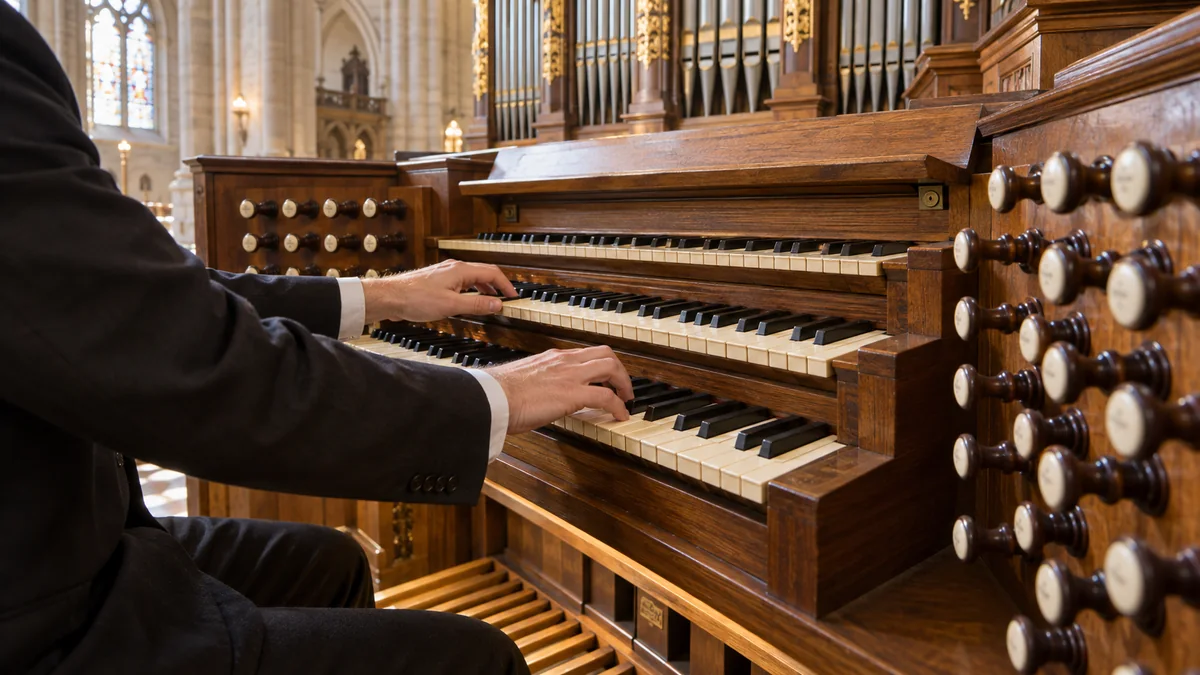
At a pipe organ console, the stacked keyboards can look redundant. They are not. Each hand-played keyboard, called a manual, gives the organist immediate access to a different division or grouping of stops. The pedalboard adds a keyboard for the feet. Together they let one player separate a melody, accompaniment, and bass; change color without interrupting a phrase; and build or reduce the sound while the music continues.
The short answer is that each keyboard on a pipe organ controls its own self-contained group of stops, which is the technical term for the ranks of pipes that can be drawn or silenced. The longer answer involves centuries of building tradition, the limits of how many stops one human can comfortably operate, and the need to play different musical lines on different sound families at the same moment. This guide walks through that answer in detail, so anyone listening to an organ recital, choosing an instrument for a church, or simply curious about the console in front of the choir loft can understand what all those keyboards are doing.
What a keyboard on a pipe organ actually controls
On a pipe organ, pressing a key admits wind to pipes selected by the stops that are drawn. A rank is normally a set of pipes with one pipe for each note, while a stop is the player’s control for bringing one rank or a related set of ranks into use. Stops are organized into divisions, and a manual normally controls one of those divisions. A second manual therefore gives the player another registered sound that is ready under the hands.
According to the standard description of the instrument, a pipe organ has one or more keyboards played by the hands, and most have a pedalboard played by the feet, with each keyboard controlling its own division, a single grouped collection of stops. This separation is the foundation of almost every other design decision in the instrument. Once the builder has decided that the hands need one division, it is a small step to give the hands a second division, and then a third, so that different ranks of pipes can be used independently by the same performer.
The smallest portable pipe organs may have only one or two dozen pipes and one manual. The largest pipe organs in the world can have over 33,000 pipes and seven manuals. The growth from one manual to seven is not a matter of fashion. Each new manual represents an additional division, an additional self-contained set of stops, and therefore an additional set of sound colors that can be brought into play without disturbing the others.
The practical reason for more than one manual
Think about what happens in a Bach trio sonata. The right hand has a fast running line, the left hand has a slower line, and the feet have a third independent line that imitates one of the hands at the octave below. If all three lines were played on a single keyboard, the player could only choose one set of stops at a time, and the three voices would blur into a single texture. With two manuals and a pedalboard, the right hand can take a bright principal chorus, the left hand a quieter flute, and the feet a deep independent line on a 16-foot stop. The three voices are now clearly separated, even though the organist is still one person.
That separation is the practical core of the answer to why do organs have multiple keyboards. Manuals are not there for show, and they are not there because the player has more fingers on one hand than on a piano. They exist so that a single performer can hold different sound worlds under each hand, and change between them, while a piece of music is still in motion.
How organ builders divide the instrument
Once a builder accepts the idea that each manual is its own division, the next question is what stops belong to which division. There is no single right answer, and the conventions that exist are mostly the result of a long European building tradition centered on Germany, France, the Netherlands, and England, with regional accents in Spain, Italy, and the United States.
| Common division | Typical compass | Character | Used for |
|---|---|---|---|
| Great (or Hauptwerk) | 61 notes, CC to g””, often 56 notes on older instruments | The chorus of the organ, with principals, mixtures, and often a secondary chorus of flues | Main hymn playing, the core of the counterpoint, the loudest passagework |
| Swell | Often 61 notes on a modern console | Commonly enclosed behind shutters | Accompaniment, crescendos, solo colors, dynamic shading |
| Positif (or Choir, or Positive) | 61 notes, usually unenclosed | A solo or accompanying division, often with a small chorus of its own | Soli in trio sonatas, soft hymn verses, echo effects |
| Solo | 61 notes | A specialized division with orchestral or string stops | French Romantic solo writing, imitating orchestral instruments |
| Bombarde | 61 notes, often with a shorter bass | A loud chorus, usually 16-foot and 8-foot reeds at higher pressures | Tutti climaxes, large Romantic hymn playing |
| Choir (or Chair) | 61 notes, sometimes enclosed | A gentle accompanying or solo division | Choir accompaniment, soft solos, antiphonal effects |
| Echo | Varies by instrument | A soft or spatially separated division on some larger organs | Distant effects and quiet color |
| Pedal | 32 notes, CC to g’, sometimes 30 notes | The bass division, with its own chorus of stops and its own independent couplers | Bass lines, pedal points, independent pedal solos |
The exact list on any given organ depends on the builder, the room, and the repertoire the organist is expected to play. A small one-manual tracker organ in a chapel may have only eight stops, all on the same manual. A large civic organ in a German city may have four manuals, a pedal division, sixty to seventy stops, and dozens of couplers that route stops from one manual to another.
How an organist actually uses multiple keyboards
Once an organist has more than one manual available, several specific techniques open up. None of them are possible on a single keyboard, and together they are the reason a two-manual organ often sounds more flexible than a one-manual organ with twice as many stops.
- Independent voices. The right hand can play a solo on one manual while the left hand accompanies on another, with the pedalboard carrying the bass.
- Manual change for color. A phrase that has been growing in volume can be moved to a louder manual at the climax, without changing stops, in a fraction of a second. This is the organist’s equivalent of a string section moving from con sordino to senza.
- Plenum vs. solo. The two hands can play a full chorus on one manual while the other hand plays a solo melody on a second manual, with the solo automatically louder or softer depending on how the registration is set.
- Echo and antiphonal effects. A phrase played on a manual that sounds from a remote chamber, perhaps the west end of a cathedral, gives a sense of distance. The technique is common in French Baroque writing and in pieces by later French Romantic composers.
- Accompaniment and dialogue. One manual plays a soft accompaniment while a second manual plays a contrasting solo. This is the basis of most French Classical dialogue pieces and most of Bach’s trio sonatas.
None of these techniques require more than two hands. What they require is that the hands have somewhere to go. Each manual is a separate physical location on the console, and the player can move the upper hand from one to the other by lifting the wrist slightly and reaching forward or back.
Why one big keyboard is not enough
A reasonable question follows: why not simply put every stop on one keyboard and change registrations with pistons? Pistons are useful, but they do not replace the physical separation of divisions. With stacked manuals, two contrasting registrations remain available at the same instant, and a hand can move between them without recalling a new stop combination. The layout also mirrors the organ’s tonal and architectural divisions, which helps the player understand which sound is coming from where.
Historical mechanical actions also shaped the arrangement. Tracker linkages connect keys to pallets in the windchests, and builders balance wind pressure, pallet size, couplers, and touch across the divisions. Dividing a large instrument among several manuals keeps the console usable and preserves a clear relationship between a keyboard and its pipework. The precise mechanical effect depends on the windchest and action design, so manual count alone does not determine key weight.
Different schools, different manual counts
The number of manuals has shifted over time, and the modern answer to why do organs have multiple keyboards depends on which tradition a builder is following.
| Tradition | Typical manuals | Typical pedal | Notable feature |
|---|---|---|---|
| North German Baroque | 3 (Great, Positiv, Rückpositiv or Brustwerk) | Independent pedal division | The Rückpositiv is a small manual division placed on the player’s side of the case, facing the congregation |
| French Classical | Often 3 or more, depending on the instrument | Pedal resources vary by period and builder | Contrasting Grand Orgue, Positif, Récit and reed colors; enclosure was not universal |
| French Romantic (Cavaillé-Coll) | 3 or 4 | Independent pedal division, often with a Bombarde manual | High wind pressures, enclosed divisions with large shutters, orchestral imitations |
| English Cathedral | 3 or 4, sometimes 5 | Independent pedal division | Mixture work in the chorus, tuba stops, large enclosed Swell |
| American Classic (Skinner, Aeolian-Skinner) | 3 or 4, with secondary keyboards and an Echo | Independent pedal division | Extensive use of unit chests, secondary expression, orchestral solo stops |
| Symphonic (Mander, Walker, others) | 3 or 4 | Independent pedal division | Mixture of English and French styles, often with a Bombarde manual |
| Neo-Baroque (20th century) | 2 or 3 | Independent pedal division | Return to tracker action, smaller mixtures, leaner choruses |
The variation is real, but the underlying rule is constant. Each manual is a division, and the organist wants at least one division for the main chorus, one for solo or accompaniment, and one for the loudest moments. When composers wrote for organ in the eighteenth and nineteenth centuries, they assumed those divisions existed. To perform much of that repertoire convincingly, the modern builder has to provide them.
The pedalboard as a third keyboard
As the general pipe organ overview explains, most pipe organs also have a pedalboard played by the feet. The pedalboard is another keyboard, and it answers a related need: while the hands move between manuals and stop groups, the feet can play an independent bass line. The American Guild of Organists’ guide to the pipe organ gives a useful working explanation of manuals, pedals, ranks, divisions, and couplers.
Pedal technique is a discipline in its own right. The feet share a single bass line using toes, and sometimes heels, according to the repertoire and school of playing. In a Bach trio sonata, for example, the pedal part can be as rhythmically active as either hand and needs a registration clear enough to remain independent.
Couplers and how manuals are linked
Once a builder has given the organist two or three manuals and a pedal, the next layer of flexibility is the coupler. A coupler lets one keyboard play the stops of another division. With Swell to Great engaged, for example, stops drawn on the Swell can also sound when the Great manual is played. Great to Pedal lets the pedalboard play the drawn Great stops.
- Inter-manual couplers. Swell to Great, Great to Positif, and so on. They let the player combine stops from different divisions onto one manual.
- Manual-to-pedal couplers. Great to Pedal, Swell to Pedal. They let the pedals play stops normally drawn on a manual.
- Sub and super couplers. Couplers that shift a manual up or down an octave. They are common in French Romantic organs and in some 20th century instruments.
- Unison off couplers. Couplers that disconnect one manual from its own stops, so it can be used purely as a coupler keyboard.
Without couplers, a manual plays the stops assigned to its own division. Couplers add specified connections between divisions; they do not necessarily make every stop available from every manual. The stop jamb or combination display shows which couplers the particular instrument provides.
How manuals shape registration in practice
Organ registration is the art of choosing which stops to draw, and manuals are the framework inside which that choice happens. A good registration plan starts with the manual layout, not with the individual stops.
One practical sequence for a planner or organ committee looks like this:
- Decide which manual will play the main hymn or principal chorus.
- Decide which manual will play the melody in a softer verse.
- Decide which manual will carry the loudest verse, if the instrument has a Bombarde or a loud Solo.
- Decide which stops on each manual will be drawn at the soft, medium, and loud levels.
- Decide which couplers will be used at the loudest level, and which will be turned off at the softest level.
- Decide which manual will be used for a solo, and which will provide the accompaniment.
- Test the registration on the actual instrument, with the actual room acoustic, before committing.
The deeper discussion of how to choose and combine stops is covered in a practical guide to organ registration, which takes this outline as a starting point and adds the layer of voicing, balance, and repertoire. Anyone new to the subject will find the manual concept a useful entry point, because every other decision in registration follows from it.
How console layout reflects the manual system
Open a console for a four-manual organ and the manual layout is the first thing you see. The keyboards are stacked vertically, with the lowest manual closest to the player’s lap and the highest manual farther away. The pedalboard is below, radiating outward.
Stop controls may sit on terraced jambs beside the manuals, in rows above them, or on a digital panel. Builders group and label them by division so the player can find a registration quickly. Console standards and house styles influence the placement, but the exact arrangement varies widely between historical and modern instruments.
Common misconceptions about multiple keyboards
Several wrong ideas about manual organs are persistent enough to be worth correcting directly.
- More keyboards means more sound. In a well-designed instrument, more keyboards means more control over color, not necessarily more volume. A two-manual organ can be louder than a four-manual organ in a small room, because the four-manual instrument is built to play in a larger acoustic.
- Each keyboard plays one stop. Each manual can play every stop drawn to it, in combination with all the others. The number of stops is independent of the number of manuals.
- Organs with many keyboards are always better. A one-manual organ with ten beautifully voiced stops will outperform a four-manual organ with forty poorly voiced stops. Manuals are a tool, not a measure of quality.
- Digital and electronic organs follow the same rules. Most digital organs simulate the manual system because players expect it, but the underlying tone generation is different. A digital organ can route any voice to any manual at the press of a button, and many also offer user-defined divisions.
- More manuals is always the future. Contemporary builders use anything from one manual on a small continuo organ to several manuals on a concert instrument. The right number follows the musical brief, pipework, room, action, and budget.
How the manual count has changed over time
The earliest pipe organs, descendants of the ancient Greek hydraulis described in the third century BC, typically had a single manual and a very limited number of stops. The addition of a second manual is documented in the fifteenth century, and a third manual became common in the seventeenth century as the North German and French schools developed larger instruments. The fourth manual, often a Solo or Echo, became more common in the nineteenth century as composers wrote for enclosed divisions and orchestral imitation.
Twentieth-century reform movements renewed interest in older tonal designs and mechanical actions, while symphonic and eclectic instruments continued to be built. The current range, from one-manual chamber organs to consoles with four or more manuals, reflects different repertoire, buildings, and design goals rather than a single direction of progress.
What to listen for when you hear multiple manuals
A listener who does not play the organ can still hear when manuals are doing different work. A few cues help.
- When a solo line sounds clearer than the chord behind it, the solo is probably on a louder manual with a different set of stops.
- When a phrase suddenly changes color without changing volume, the player has probably moved the hand to a different manual without changing stops.
- When a chord grows louder without sounding thicker, the player has probably added a reed or a mixture, often via a coupler rather than by changing manuals.
- When the bass line moves independently of the chords, the pedalboard is doing its own work, and the player has probably drawn pedal stops that are independent of the manual chorus.
With a little practice, a listener can follow the manual logic of a piece in real time, which deepens the experience of hearing the music.
How this connects to the rest of the organist’s craft
Manuals are the central organizing principle of an organ console, and the rest of the organist’s craft follows from them. Reading notation, including the conventions of pedal notation, is partly about knowing which manual is the most efficient home for a given voice. The piece how to read music in this archive introduces those conventions in a beginner-friendly way, and the manual concept is a useful next step beyond it.
Building, voicing, tuning, and registering an organ all take the division layout into account. Temperament describes how intervals are distributed across the pitch system; it is not the practice of tuning one manual deliberately out of tune with another. Divisions must still agree in pitch when they are coupled, even though their pipes may have very different tone colors.
Choosing an instrument with the right number of manuals
For a church or concert venue considering a new organ, the question of how many manuals to ask for comes down to three practical factors.
- Repertoire and use. Hymn accompaniment, choir work, teaching, recitals, and historic repertoire place different demands on independent divisions. No fixed stop or manual count suits every church.
- Room and placement. Volume depends on pipe scales, wind, voicing, placement, and acoustics, not on manual count by itself. The divisions must be designed for the actual room.
- Budget. Each additional manual adds stops, pipes, action, and cost. The marginal cost is not linear, because the case and the wind supply are already there, but additional stops add up quickly.
The right number is the smallest number that meets the repertoire and the room. A common planning error is to ask for one more manual than the budget can support, only to find that the money spent on an underused manual would have been better spent on a higher quality of pipe in the existing manuals.
Where to go from here
The answer to why do organs have multiple keyboards is a doorway into a much larger subject. The manuals are the framework, and the stops, the wind, the action, and the room all hang from that framework. The most useful next step is to sit at an actual console and try a two-manual instrument with at least one swell box, because the experience of opening a swell shutter with the foot while changing manuals with the hands is something no description can fully substitute for.
For a wider overview of how the organ fits into musical life, including a sense of where organ repertoire sits in the larger history of musical genres and how the organ relates to other instruments, the related reading in this archive gives a useful starting point. The console in front of a choir loft is a small physical space that contains a working theory of music, and the manuals are the most visible part of that theory.
Frequently asked questions
How many keyboards does a typical pipe organ have?
Most pipe organs have two or three keyboards, called manuals, plus a pedalboard played by the feet. Small chapel organs may have one manual, and large recital instruments may have four or five. The most common configuration in a parish church is two manuals and a pedal division.
What is the difference between a manual and a pedal?
A manual is a keyboard played by the hands. A pedal is a keyboard played by the feet. Each manual controls its own division, a self-contained group of stops. The pedalboard controls its own division, often with a complete chorus of stops at the bass register.
Can an organist play more than one manual at a time?
Yes. Playing different voices on different manuals with the same pair of hands is one of the central skills of the instrument. Bach trio sonatas, for example, have three independent lines played by two hands on two manuals and the feet on the pedalboard.
Do digital organs have multiple keyboards for the same reason?
Most digital and electronic organs simulate the manual system because organists are trained on it and expect the same physical layout. The underlying tone generation is digital, and stops can be assigned to any manual, but the player interface keeps the manual structure for familiarity.
Are more manuals always better?
No. The right number of manuals depends on the repertoire and the room. A small two-manual organ with well-voiced stops will sound better in a chapel than a four-manual organ with poorly voiced stops. Many modern builders recommend the smallest number of manuals that meets the musical need.
What is a division on a pipe organ?
A division is a named grouping of stops normally associated with a manual or the pedalboard. “Manual” means the physical keyboard; “division” means the tonal section it controls. The terms are related, but they are not interchangeable.
What is a coupler on an organ?
A coupler is a mechanism that allows one manual to play the stops of another manual, or a manual to play the stops of the pedal division. Common couplers include Swell to Great and Great to Pedal. Couplers expand the combinations available to the player without adding new stops.
Why do French Romantic organs often have four manuals?
Large French Romantic organs by builders such as Aristide Cavaillé-Coll used several contrasting divisions, powerful reed choruses, orchestral colors, and expressive enclosure where the design called for it. A fourth manual could give the organist another independent tonal resource, but not every division was enclosed and not every French Romantic organ had four manuals.
Can a beginner learn on a one-manual organ?
Yes. Many beginning organists start on a one-manual instrument with a pedalboard, and the skills learned there transfer directly to a larger instrument. The main difference is that on a one-manual organ the player has fewer independent sound worlds to choose from, so the music has to be approached with simpler textures.
How do I know which manual a piece is meant to be played on?
The composer’s manual indications, when they exist, are the first clue. Beyond that, the organist looks for the manual with the right balance of stops to support the texture. A solo line is usually given to a manual with a distinctive stop, and an accompaniment to a manual with a quieter, more even sound. The player’s choice of manual is a central part of interpretation.