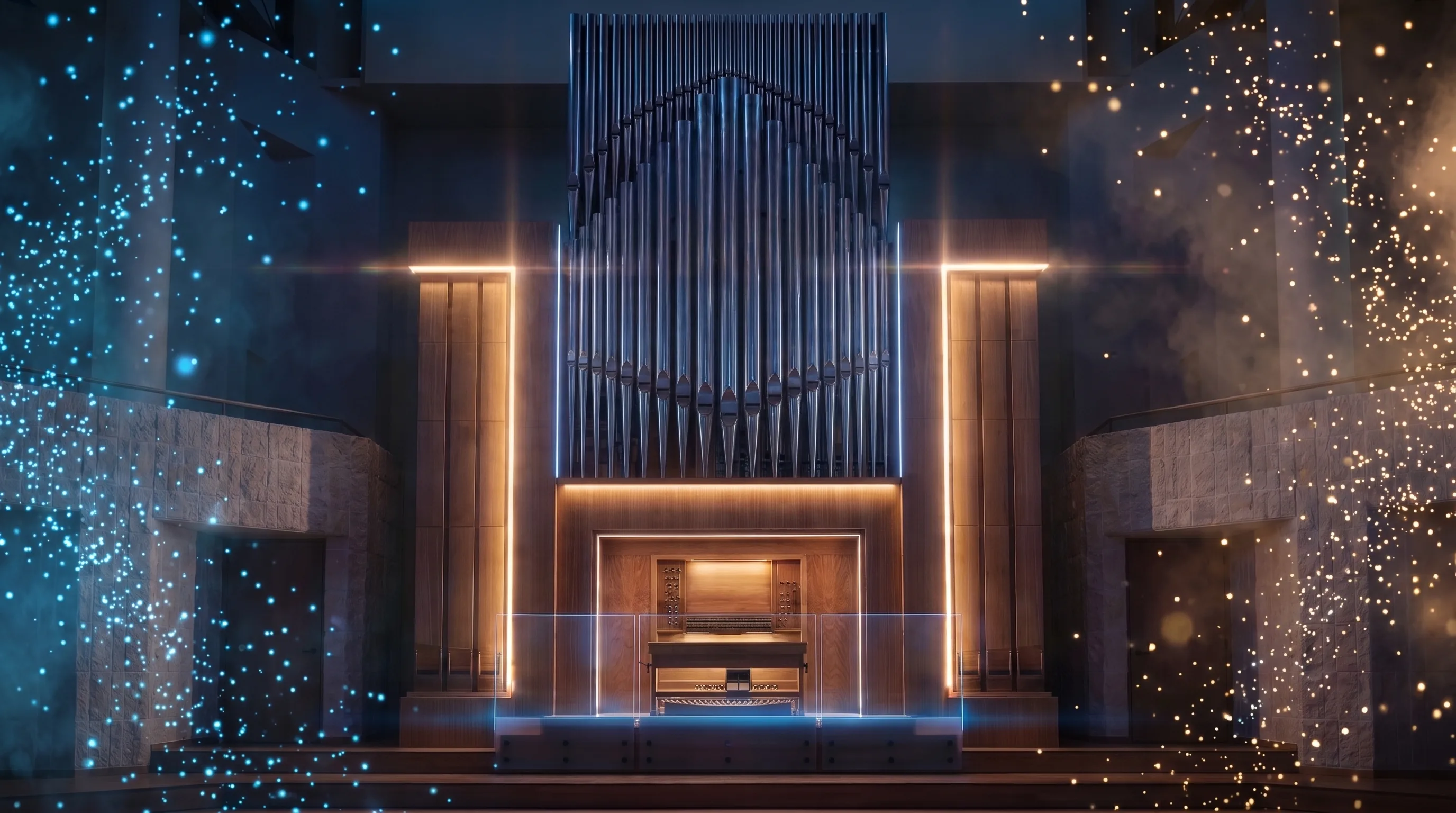
Martin Ott Opus 104 at Zion Lutheran Church
Martin Ott Opus 104 was commissioned in 2001 for Zion Lutheran Church in Portland, Oregon. The stop specification gives 30 stops, 40 ranks, four extensions, electric pull-down slider chests, electro-pneumatic chests, and electric stop action.
A room shaped for sound: Belluschi's A-frame sanctuary
Martin Ott visited that July and studied Pietro Belluschi's circa-1950 A-frame church. The earlier organ had stood behind a curved wall on the choir balcony. That wall was removed, and the new case followed the same 30-foot radius in Belluschi's architecture. In Portland, Oregon, Zion Lutheran Church supplied the interior for this project. What survives about the room at Zion Lutheran Church is enough to say this: photographs may establish placement, but only measurements can describe the room's decay time.
At Zion Lutheran Church, the architecture helps account for the instrument's form, although the written record remains selective. An architectural plan placing organ, choir and congregation together would clarify the record of Zion Lutheran Church.
30 stops and 40 ranks: the scale of Opus 104
A first reading of the instrument begins with 30 stops and 40 ranks. For Opus 104, the stop total describes selectable resources, while the count of pipe ranks counts the underlying rows of pipes. The 30-stop, 40-rank summary for Zion Lutheran Church shows that this is a broad specification, but a large count is not a synonym for loudness. Wind pressure, voicing and the interior still govern the result. The Opus 104 outline adds that the condensed entry does not give the keyboard count. The outline notes 4 extensions; extension work allows pipework to be reused at another pitch or under another stop control. A reliable tonal reading still requires the full stoplist of Opus 104.
Counting rows of pipes gives 10 more than counting stop controls in Opus 104. Within the published specification for Zion Lutheran Church, mixtures are one possible reason; the full disposition would settle the question. The entry separately lists 4 extensions. For Opus 104, a full specification would show where each rank actually appears.
From console to pipe: Belluschi's A-frame sanctuary
The technical summary places electrical control at the slider chests of Opus 104. Such an arrangement can accommodate a detached console or separated divisions, but the project entry does not measure speed, noise or reliability.
An attached console makes the organ case itself the player's workstation. For Opus 104, that fact is documented even though key depth and touch weight are not.
Music and people: Belluschi's A-frame sanctuary
Music director Helen Hollenbeck contacted the Martin Ott company about a new organ in March 2000. Congregation members helped unload the instrument, while the tonal design was planned to support Lutheran musical traditions. Opus 104 entered a working musical community at Zion Lutheran Church. For Opus 104, the entry records selected people and events, while the ordinary rhythm of services and rehearsals remains largely offstage. The performance evidence for Zion Lutheran Church sets the limit of the account: the record identifies no resident organist or later concert.
According to the musical record for Zion Lutheran Church, no program is available here to connect the disposition with repertory. Local bulletins or musicians' papers may eventually supply that missing side of Opus 104.
Evidence, images and unanswered questions for Opus 104
A copy of the Martin Ott project entry was captured on February 6, 2020 and documents Opus 104. Its visual material consists of 6 linked images. They are the project views the former company chose to publish with Opus 104. The image group offers no individual credit line. Among the surviving sources for Zion Lutheran Church, the dated page cannot establish subsequent ownership or maintenance. For Opus 104, a current institutional photograph and full disposition would fill the largest gaps.