
Air
A resonating column chooses frequencies from a turbulent flow.
A listener’s physics
Four physical starting points connect most instruments in the atlas.
A resonating column chooses frequencies from a turbulent flow.
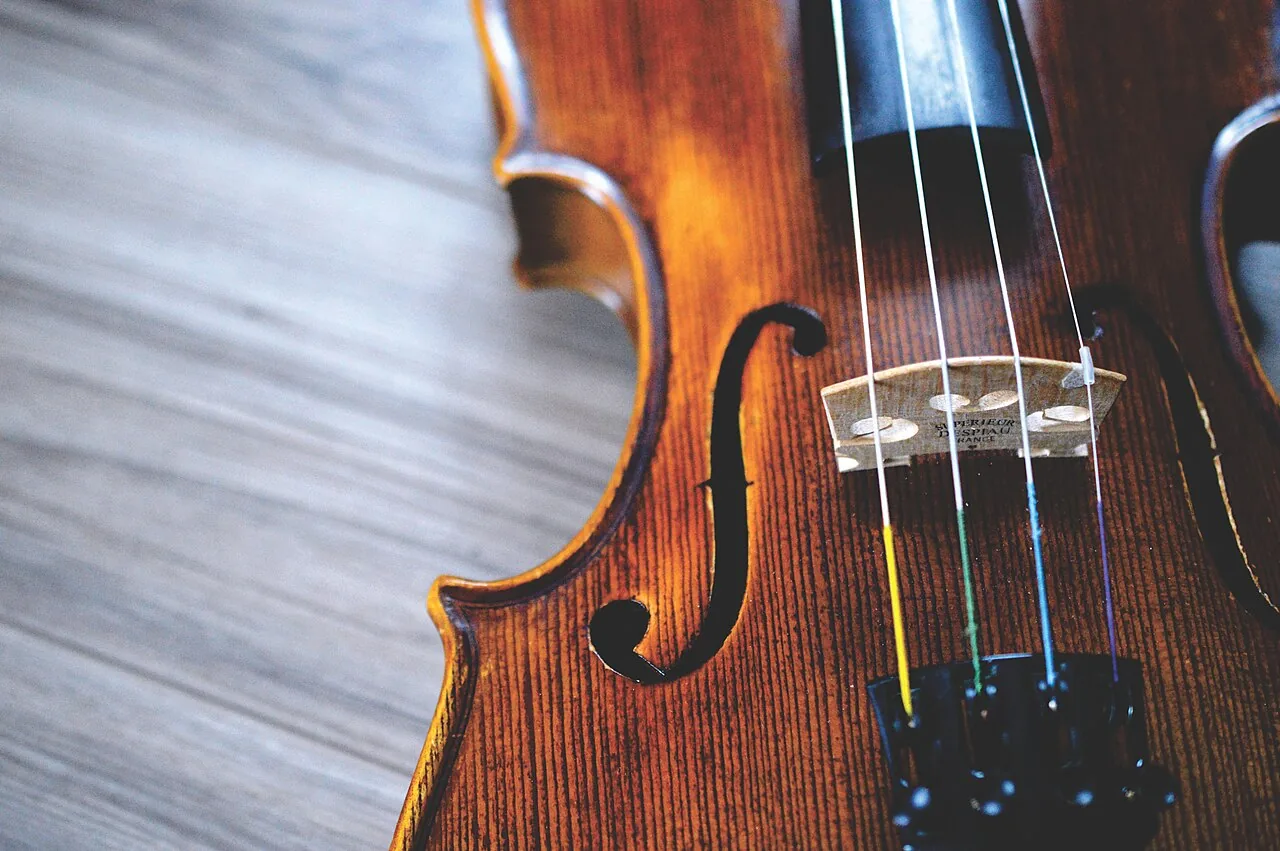
Length, tension, and mass establish pitch; the body makes it audible.

A stretched surface supports many overlapping vibration patterns.
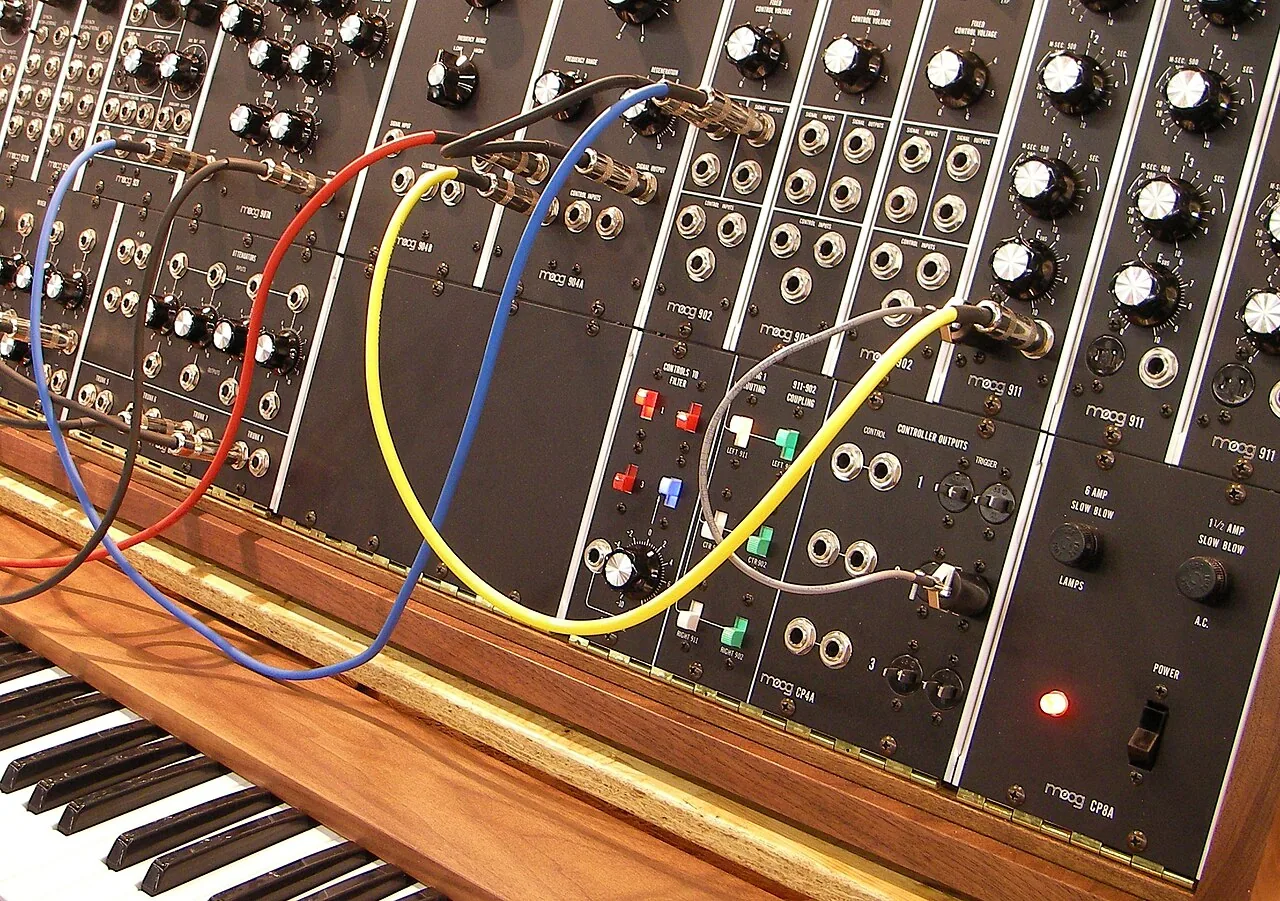
Oscillators create a spectrum; filters and envelopes give it shape in time.
How musical instruments make sound is easier to understand when the explanation starts before the note. A finger pulls a string away from rest. Air meets a lip, reed or sharp edge. A stick deforms a membrane. A hammer hits strings and immediately escapes. An oscillator creates a repeating signal that will eventually move a loudspeaker. Energy enters the system, while mass, tension, stiffness and damping decide how the motion continues.
Frequency describes cycles per second, but a musical sound is more than one frequency. Attack, changing spectrum, noise, pitch movement and release help a listener recognise an instrument. Two players can produce the same named note and create very different envelopes and balances of partials.
A resonator does not create energy from nothing. It responds strongly to some patterns and weakly to others. String length, tension and mass influence string modes. Air-column length and boundary conditions influence pipes and brass tubing. A violin body, piano soundboard, drum shell or room couples several vibrating systems, so the sound at the listener is not simply the source made louder.
Ideal models are useful because they isolate a relationship. An octave doubles frequency. A simple open pipe is modelled near half a wavelength, while a stopped pipe is modelled near a quarter. Real instruments add geometry, materials, losses, temperature, construction and the maker's voicing decisions. The model is a first lens, not a verdict.
Direct sound reaches the listener first. Reflections follow from floor, ceiling, walls, balcony and objects in the room. Early reflections can reinforce clarity or blur an attack; later reverberation can join releases into a larger musical space. Audience, curtains, seats and open doors change absorption. That is why an organ registration, drum kit or violin can feel different during an empty rehearsal and a full concert.
The acoustics overview gives a broad map of vibration, waves and hearing. The open OpenStax introduction to sound develops wave relationships with equations and examples. Use them beside an actual instrument, where imperfect materials and rooms make the physics audible.
Use the Instrument Atlas to trace a complete energy path, then open Sound Lab for controlled pitch, time and waveform references. Stop any experiment that requires internal access, unsafe volume, electrical work, structural force or interference with another player's instrument.