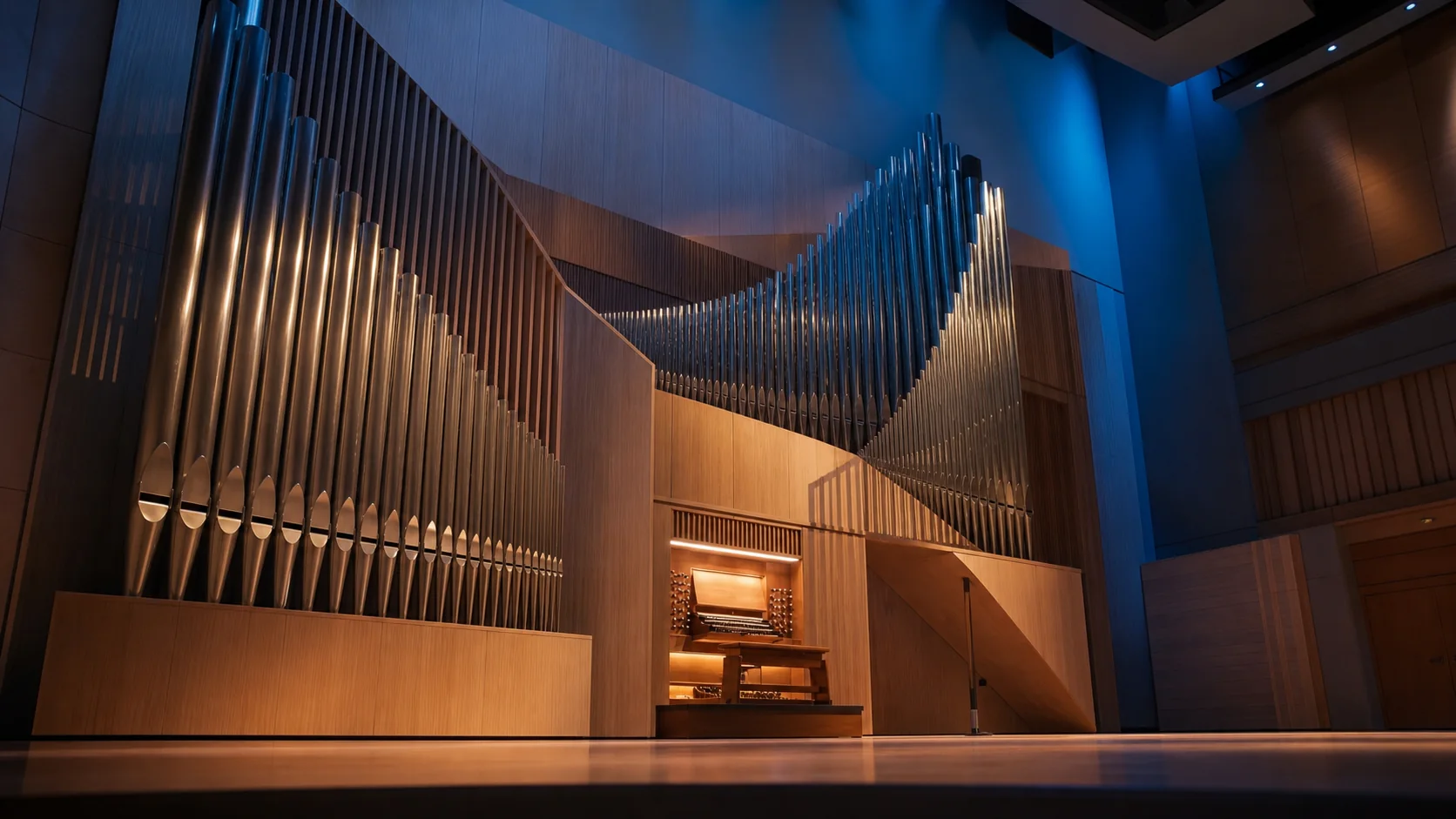
The instrument associated with Our Lady of Pillar R.C. Church: Opus 15
Martin Ott Opus 15 was built in 1979 for Our Lady of Pillar Catholic Church in Frontenac, Missouri. It incorporated pipes from the church's preceding organ. Chests and pipework were placed in a masonry chamber above the left nave, while the console and choir remained below on the sanctuary floor.
Opus 15 carries a recorded year of 1979. The wording remains broad because the source does not name the milestone it marks. Our Lady of Pillar R.C. Church and Frontenac, Missouri anchor the project, and any later move or alteration belongs to a separate date. Present condition requires a present-day statement.
The room question behind Opus 15
The record associates Opus 15 with Our Lady of Pillar R.C. Church, Frontenac, Missouri. That supplies a social and religious setting, not a description of how the sanctuary sounded. A plan, a placement photograph, or a measured acoustic report would be needed before the building could enter the musical analysis in greater detail.
Reading the numerical outline for Our Lady of Pillar R.C. Church: Opus 15
Reading Opus 15 numerically starts with 22 stops and 26 ranks. One number describes controls and the other describes pipe rows. Opus 15 lists 4 more ranks than stop controls. The relationship describes scale rather than a division plan, and it does not identify a single tonal voice. That is enough to compare scale, but not enough to reconstruct manuals, Pedal, wind system, or chorus structure.
The summary for Opus 15 cannot tell us how each division sounded, but it does establish the scale printed for Our Lady of Pillar R.C. Church. That distinction matters when later photographs or programmes surface in Frontenac, Missouri. A reliable Opus 15 stop list could connect the count with actual pipe families and pitches. Until an Opus 15 list is found, no tonal resource should be added simply because it would be typical of another Ott organ.
Touch, control, and the missing technical detail: Opus 15
For Opus 15 at Our Lady of Pillar R.C. Church, the technical line assigns electro-pneumatic action to the instrument. It distinguishes the project from a purely mechanical organ while leaving the exact mechanism undocumented. Touch, delay, noise, and maintenance history would require direct inspection or a later technical source.
What the project facts suggest, cautiously: Opus 15
The Our Lady of Pillar R.C. Church project is not described by numbers alone: it incorporated earlier pipework and it has a masonry chamber above the left nave. The reading stays close to the documented church project. Placement, materials, action, and named events can be reported, while the full chorus structure and everyday role remain unknown. A specification would clarify the instrument; local programmes would clarify how musicians used it. The listed 22-stop, 26-rank scale remains the numerical boundary for this reading.
What happened after the organ was built: Opus 15
The page connects the terrazzo floor and partial marble paneling with the room's acoustic response. Robert Neidlinger is named as music director and Marie Kremer as consultant. No recital or later work is recorded; the surviving history concerns retained pipework, the split vertical arrangement, and the hard surfaces of the church interior.
Where the evidence stops for Opus 15
The former builder page associates 1 numbered image file with Opus 15; images/015/015_m.jpg appears first. The project-number match supports identification, but it does not settle authorship or permission to publish. The available text names neither a usable creator credit nor a reuse licence.
The known chronology for Opus 15 ends before a present-day survey. For a current account, Our Lady of Pillar R.C. Church would need to confirm the location and supply a dated specification or condition note. Without that material, the article can describe the documented past but not present access or performance.