NIU confirms the identity of Opus 17
Northern Illinois University's School of Music identifies the organ in Boutell Memorial Hall as Martin Ott Opus 17 and dates it to 1983. That official page is the strongest direct evidence for the instrument's identity and DeKalb location. The older builder page gives 1981 as the commission year, which can sit beside the university's 1983 date without treating order and completion as the same event.
The builder narrative introduces a separate error by naming Illinois State University. NIU and Illinois State are different institutions. Nothing on the old page explains the substitution, so quotations about the hall must remain tied to that historical narrative. The university's own identification resolves where Opus 17 belongs, but not how the mistaken name entered the builder text.
Boutell Memorial Hall as described by the builder
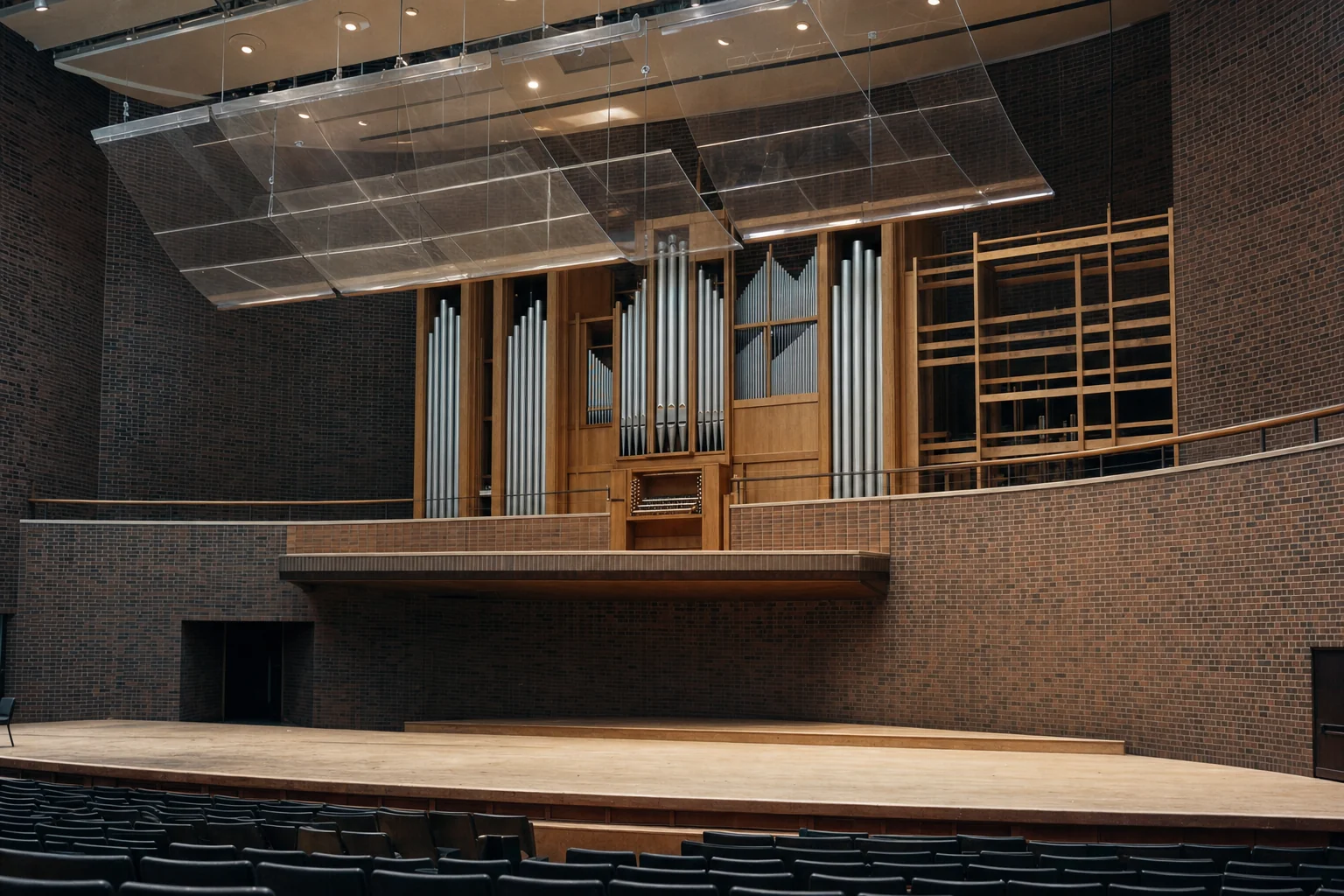
The archived narrative describes a multipurpose concert hall used for organ recitals, orchestra concerts, and chamber music. The organ stood on a balcony above the orchestra stage. Large transparent spheres and saucer-shaped reflectors hung over the platform and could be raised or lowered to help players hear across an ensemble.
Those details give the commission a physical setting, but they come from the former builder site rather than a hall plan. The page does not name the architect, date the acoustic equipment, or describe later renovations. They should be read as the builder's account of Boutell Memorial Hall around the time of the organ project.
Brick walls, curtains, and reported reverberation
The same account assigns a three-second reverberation time to brick side walls built with flush mortar joints. Movable curtains could cover the brick and reduce the figure to one-half second for performances needing a drier response. The contrast explains why an organ builder would care about the hall's adjustable surfaces as much as its size.
Neither figure is a current measurement. The page gives no test date, frequency, audience condition, or measuring method. It also does not say whether the curtains and overhead reflectors were used together. The numbers belong to a historical description, not a present acoustic certificate for Boutell Hall.
Dirk Flentrop and the balcony position
The builder page names Dutch organ builder Dirk A. Flentrop as a consultant on placement. It does not credit him with the stop list, case design, action, or voicing. His documented role is narrower: the organ's location. Set above the orchestra platform, the balcony case faced the room directly while leaving the stage available for changing ensembles.
What the current NIU specification actually lists
The old builder heading gives 42 stops and 63 ranks, while NIU now publishes a division-by-division stop list. The Hauptwerk begins with Prinzipal 16 and Prinzipal 8, then includes flutes, upperwork, Kornett, and two trumpets. The Schwellwerk has Bordun 16, several 8-foot colours, principal and flute chorus work, mutations, reeds, and Tremulant. The Pedal lists eight voices from two 16-foot foundations through Posaune 16 and Trompete 8.
NIU places Rückpositiv under its own heading with the words 'prepared for.' It also lists the manual and pedal couplers. That wording matters more than forcing the old 42-stop, 63-rank total into a modern pipe count. Stops, ranks, couplers, and prepared positions are different categories, and the two sources do not show which elements the historical total included.
Robert Reeves, April 1983, and the planned Rückpositiv
Organ faculty member Robert Reeves played the dedicatory recital on April 25, 1983. The builder narrative says Professor James Russell Brown and Martin Ott still hoped to add the Rückpositiv in the balcony rail. They expected that division to finish the case visually and widen the available repertoire.
NIU's official page still labels the Rückpositiv as prepared for. That is current published specification wording, not a physical inspection, but it gives no support to a claim that the division was later completed. The recital date confirms the organ was used publicly in 1983 while part of the intended scheme remained pending.
Historical images and the questions still open
The archived builder page links images/017/017_m.jpg and images/017/017_d.jpg. Their paths match the Opus 17 number, but the extracted page supplies no photographer, caption, date, licence, or reuse permission. NIU's text establishes identity and specification; it does not grant rights to reuse photographs from the former company site.
A builder contract or 1983 recital programme could clarify the sequence from the 1981 commission date to NIU's 1983 date. A dated condition report would be needed for claims about maintenance, access, or playing condition. The known facts are firmer now: Opus 17 belongs to Northern Illinois University in Boutell Memorial Hall, the old Illinois State wording is erroneous, and the official stop list continues to describe the Rückpositiv as prepared for.