The 1983 chapter of Opus 22 at First Presbyterian Church
Martin Ott Opus 22 was a three-stop, three-rank mechanical continuo built in 1983 for First Presbyterian Church in Knoxville. It has a 47-note manual compass from E to the upper d and a cherry case.
For Opus 22, 1983 is the date attached to the original project line. It may denote an order, workshop period, installation, or dedication, but the builder account for First Presbyterian Church does not say which. The pairing with First Presbyterian Church in Knoxville, Tennessee prevents confusion with another instrument. Any current claim needs a later institutional record.
Knoxville as the setting for Opus 22
For this project, First Presbyterian Church in Knoxville, Tennessee is more than a city label but less than a room survey. It identifies the congregation that commissioned or received the organ. The page does not give enough architectural evidence to describe seating, reflective surfaces, organ placement, or measured reverberation.
The recorded scale of Opus 22 at First Presbyterian Church
The catalogue records 3 stops and 3 ranks for Opus 22. In the First Presbyterian Church account from Knoxville, Tennessee, stops are choices at the console; ranks are rows of pipes that may serve those choices singly or in groups. Here the two Opus 22 figures match. Only the disposition can show whether the apparent one-to-one relationship continues through every register. The brief line does not supply division names, pitches, or the individual voices behind the totals recorded for First Presbyterian Church.
Action and control in the Knoxville project: Opus 22
For Opus 22 at First Presbyterian Church, a mechanical action carries key movement to the wind valves through physical parts such as trackers and levers. Within the documented Knoxville chapter, the overview confirms that principle without drawing the linkage used in this organ. At First Presbyterian Church in Knoxville, Tennessee, key weight, adjustment, repairs, and present feel all require later technical evidence.
The label continuo places Opus 22 in a compact accompanying tradition, not automatically on the road. For the instrument connected with First Presbyterian Church, mobility and pitch standards remain separate facts. They are reported only where the project history identifies casters, handles, two-part construction, or an A440 and A415 arrangement.
Beyond the totals: one clue from First Presbyterian Church: Opus 22
The archival portrait becomes most useful when it stays specific: the record highlights a forty-seven-note manual compass and it belongs to a four-instrument continuo series. These details describe an organ made for a church, but they should not be stretched into an acoustic or tonal portrait. The source does not tell us which choruses, reeds, or accompanimental colours the player relied on. That analysis requires the original specification and a dated account of use. The listed 3-stop, 3-rank scale remains the numerical boundary for this reading.
The later chapter at First Presbyterian Church: Opus 22
The page groups Opus 22 with three related continuos: Opus 23, 31, and 48. It says the cases for Opus 22, 31, and 48 were cherry, while Opus 23 used walnut. Compass, case wood, destination, and opus number distinguish the Knoxville instrument within that four-organ series; no recital, owner change, technical alteration, or later move is recorded. It names no consultant or performer for the Knoxville commission.
Photographs and unanswered questions from Knoxville: Opus 22
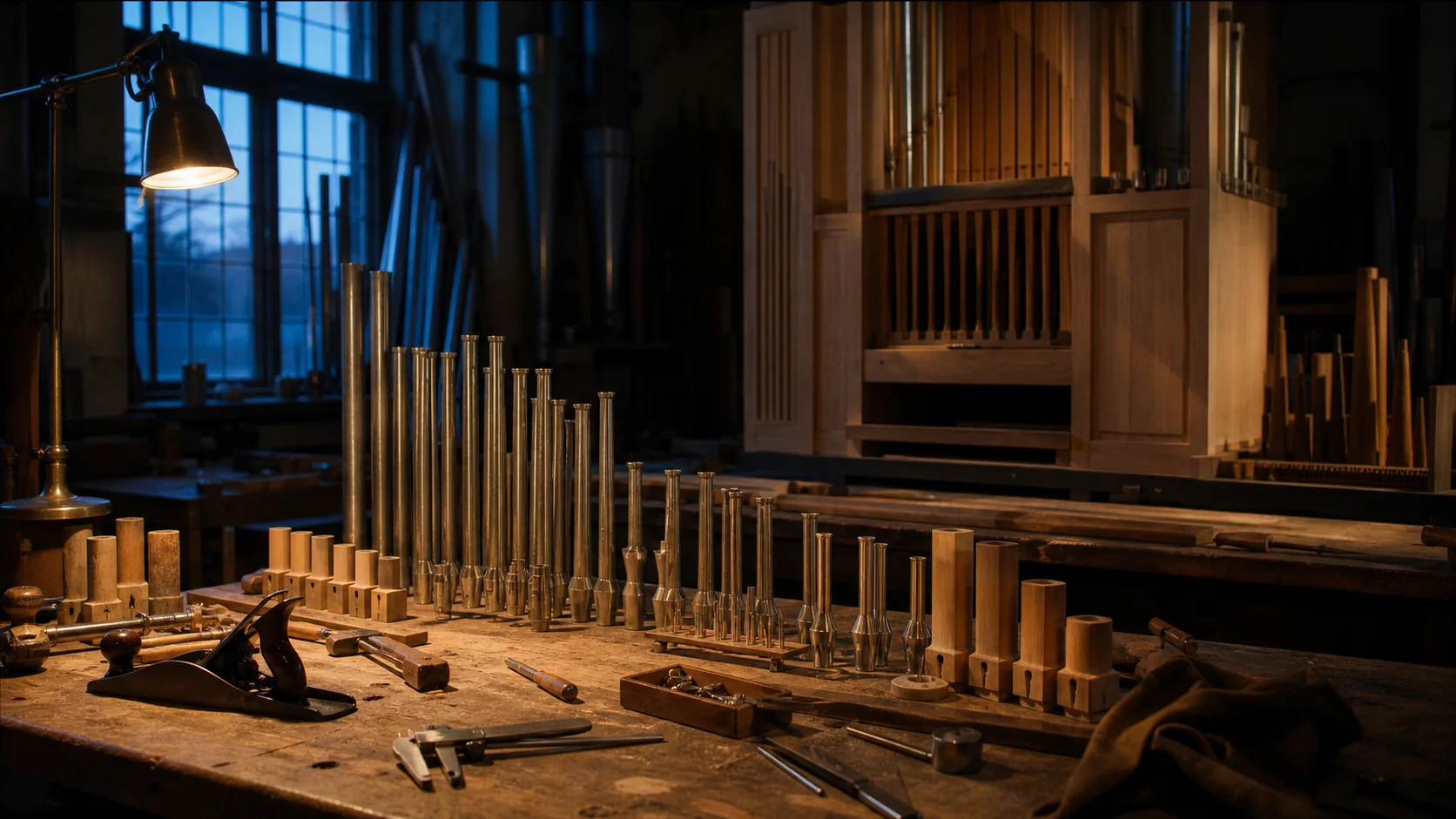
A project-number match exists for 1 Opus 22 image file, including images/022/022_m.jpg. That makes the matched material a better candidate than a generic organ photograph for the Knoxville, Tennessee project. Their creator and reuse terms are not stated in the available caption text.
Historical photographs and recital dates can show where Opus 22 once stood in musical life, but they do not prove its present state. The next decisive evidence would be a dated specification or condition note from First Presbyterian Church. Until one appears, current use and access remain unanswered.