The documented Opus 35 chapter at National Avenue Christian Church
Martin Ott Opus 35 was built in 1985 for National Avenue Christian Church in Springfield, Missouri. Two facing cases answer the church's colonial architecture: Hauptwerk, Brustwerk, and keydesk occupy the left chancel wall, while the Pedal hangs from two structural beams on the opposite wall.
The historical heading gives 1985 for Opus 35, but it does not identify whether that year marks the contract, completion, or dedication. The church and city anchor the commission, while David Gifford's 1987 recital provides a separate dated event. Present ownership, access, and condition require a newer institutional source.
What survives about the room at National Avenue Christian Church: Opus 35
National Avenue Christian Church gives Opus 35 a clear parish setting in Springfield, Missouri. Unlike many short catalogue entries, the builder account describes the chancel arrangement: two facing cases and a choir beneath the suspended Pedal division. What it does not supply are room measurements, a reverberation time, or a current plan.
Here the builder's account does provide architectural evidence. The organ occupied two facing sides of the chancel: Hauptwerk, Brustwerk, and keydesk on the left, with the Pedal division carried on two structural beams opposite. The choir stood below that suspended Pedal case. Those details explain how the project answered a limited chancel footprint and the church's colonial design without inventing a reverberation time or present layout.
Numbers before tonal claims: Opus 35
The recorded scale is 19 stops and 22 ranks. Stops describe controls at the console; ranks count organized rows of pipes. The three-rank difference points to compound resources somewhere in the design, but only the full stop list could identify them. The source therefore supports the totals without supplying unlisted reeds, flutes, mixtures, manual divisions, or Pedal voices.
Those totals also give future researchers a useful checkpoint. A later church specification could show whether the 19-stop, 22-rank outline survived and whether changes affected the facing cases differently. Until such a document is dated and tied to the Springfield organ, the 1985 figures remain a historical description rather than a current inventory.
The mechanism described for National Avenue Christian Church: Opus 35
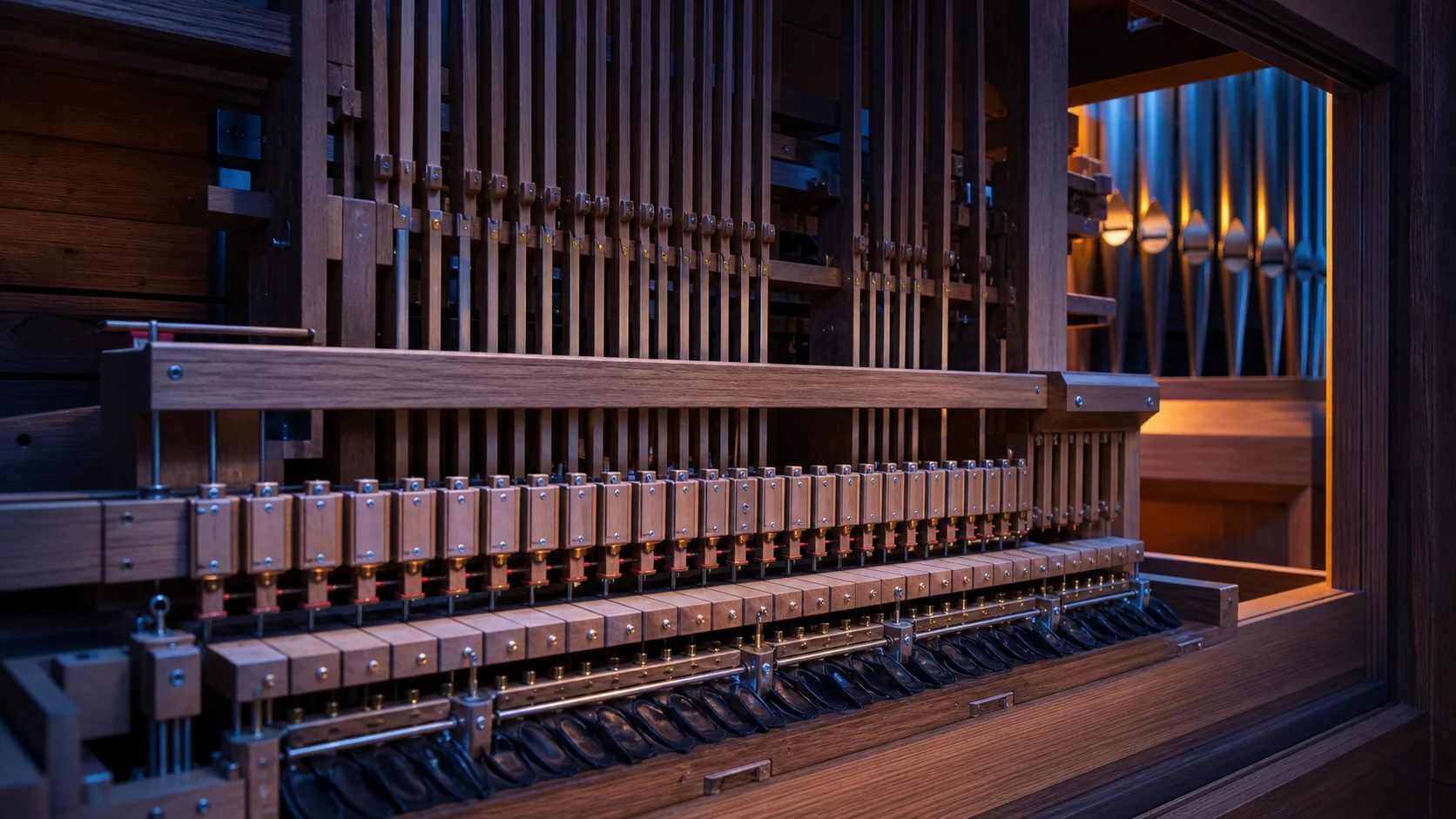
For Opus 35 at National Avenue Christian Church, the action line combines direct mechanical control of the keys with electric control of the stops. This can give a player physical key linkage while allowing electrically managed registration. It is not evidence for a particular console layout, touch, or current system condition.
How to read the surviving design evidence: Opus 35
The facing cases and suspended Pedal are more than decoration. They show how the builder divided the organ across the chancel, kept the choir below the elevated Pedal case, and answered a limited footprint without abandoning the church's colonial visual language. The missing disposition still prevents a complete tonal map, and no programme beyond the named dedication recital establishes the parish's wider repertoire.
What the source says after 1985: Opus 35
The choir sits beneath the suspended Pedal division, preserving floor space in the chancel. David Gifford played the dedication recital on May 3, 1987. The 19-stop, 22-rank organ uses mechanical key action and electric stop action. The archived account is defined by the structural solution that placed organ and choir within the same limited area.
A source trail for the National Avenue Christian Church instrument: Opus 35
The archived page links three files numbered for Opus 35, beginning with images/035/035_m.jpg. Their numbering makes them strong identity candidates, but the extracted text does not name a photographer, give a date, or grant reuse permission. Visual checking should confirm that each file shows the two-case Springfield installation before publication.
The present chapter of Opus 35 is not covered by the builder account. Location, access, and technical condition would need confirmation from National Avenue Christian Church or a qualified survey. Until then, the last historical event should remain the end of the public narrative.