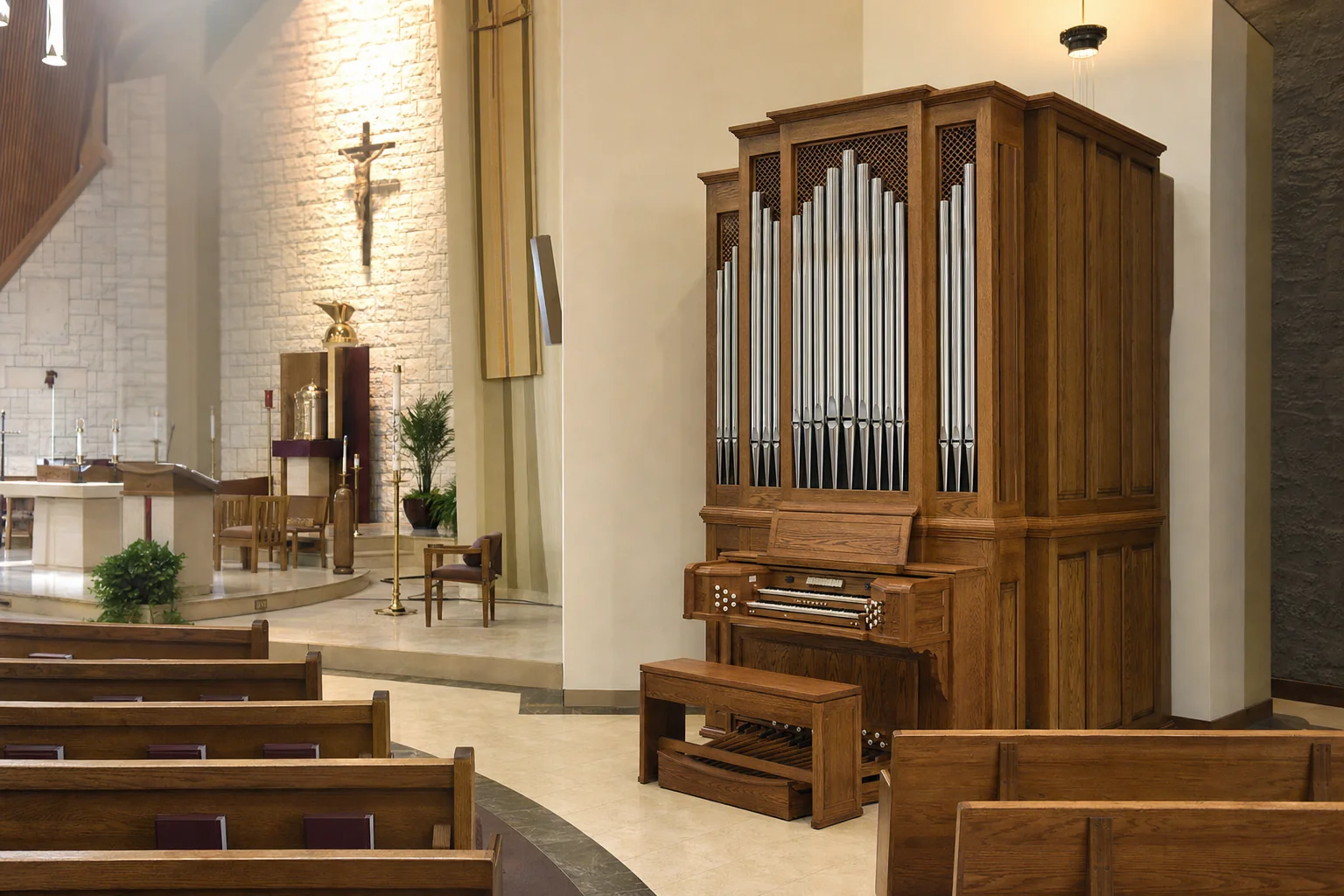
The instrument associated with Our Lady of Providence: Opus 51
Martin Ott Opus 51 was the second Ott organ built for Our Lady of Providence in St. Louis. The earlier Opus 11 had served a sanctuary adapted from a gymnasium. When the parish built a larger sanctuary, it sold Opus 11 to Peace Lutheran Church in New Berlin.
Opus 51 carries a recorded year of 1988. The wording remains broad because the builder account for Our Lady of Providence does not name the milestone it marks. Our Lady of Providence and St. Louis, Missouri anchor the project, and any later move or alteration belongs to a separate date. Present condition requires a present-day statement.
The room question behind Opus 51
Opus 51 is linked in the catalogue with Our Lady of Providence in St. Louis, Missouri. Beyond that identification, the room and its purpose are not documented here. No acoustic, access, or present-use claim is added to fill the gap.
Reading the numerical outline for Our Lady of Providence: Opus 51
Reading Opus 51 numerically starts with 17 stops and 21 ranks. In the Our Lady of Providence account from St. Louis, Missouri, one number describes controls and the other describes pipe rows. Opus 51 lists 4 more ranks than stop controls. At Our Lady of Providence in St. Louis, Missouri, the relationship describes scale rather than a division plan, and it does not identify a single tonal voice. For the Our Lady of Providence project in St. Louis, Missouri, that is enough to compare scale, but not enough to reconstruct manuals, Pedal, wind system, or chorus structure.
The summary for Opus 51 cannot tell us how each division sounded, but it does establish the scale printed for Our Lady of Providence. That distinction matters when later photographs or programmes surface in St. Louis, Missouri. A reliable Opus 51 stop list could connect the count with actual pipe families and pitches. Until an Opus 51 list is found, no tonal resource should be added simply because it would be typical of another Ott organ.
Touch, control, and the missing technical detail: Opus 51
For Opus 51 at Our Lady of Providence, mechanical key action is documented for the project. Within the documented St. Louis chapter, that separates the key command from an electric-only transmission while leaving the console relationship and tracker route undescribed. The builder account for Our Lady of Providence makes no claim about wear, noise, regulation, or playing condition today.
What the project facts suggest, cautiously: Opus 51
The Our Lady of Providence project is not described by numbers alone: it was the second Ott organ for the parish and the earlier Opus 11 was sold to help fund it. Those points can be interpreted only within the limits of the page. They do not establish voicing, room response, repertoire, current access, or playing condition. A complete specification and dated institutional evidence would be needed for a stronger musical account. The listed 17-stop, 21-rank scale remains the numerical boundary for this reading.
What happened after the organ was built: Opus 51
Proceeds from that sale and a major parish gift helped fund the 1988 replacement. Opus 51 has a free-standing red-oak case at the front right of the altar and an attached keydesk. A caption credits the parish for the photograph. The page presents the new commission as a direct continuation of the parish's earlier relationship with the builder.
Where the evidence stops for Opus 51
The former builder page associates 2 numbered image files with Opus 51; images/051/051_d1.jpg appears first. The St. Louis project-number match supports identification, but it does not settle authorship or permission to publish. At Our Lady of Providence in St. Louis, Missouri, caption credit offers a research lead while the licence remains unconfirmed.
The known chronology for Opus 51 ends before a present-day survey. For a current account, Our Lady of Providence would need to confirm the location and supply a dated specification or condition note. Within the documented St. Louis chapter, without that material, the article can describe the documented past but not present access or performance.