How Opus 7 entered the history of Mark's Lutheran Church
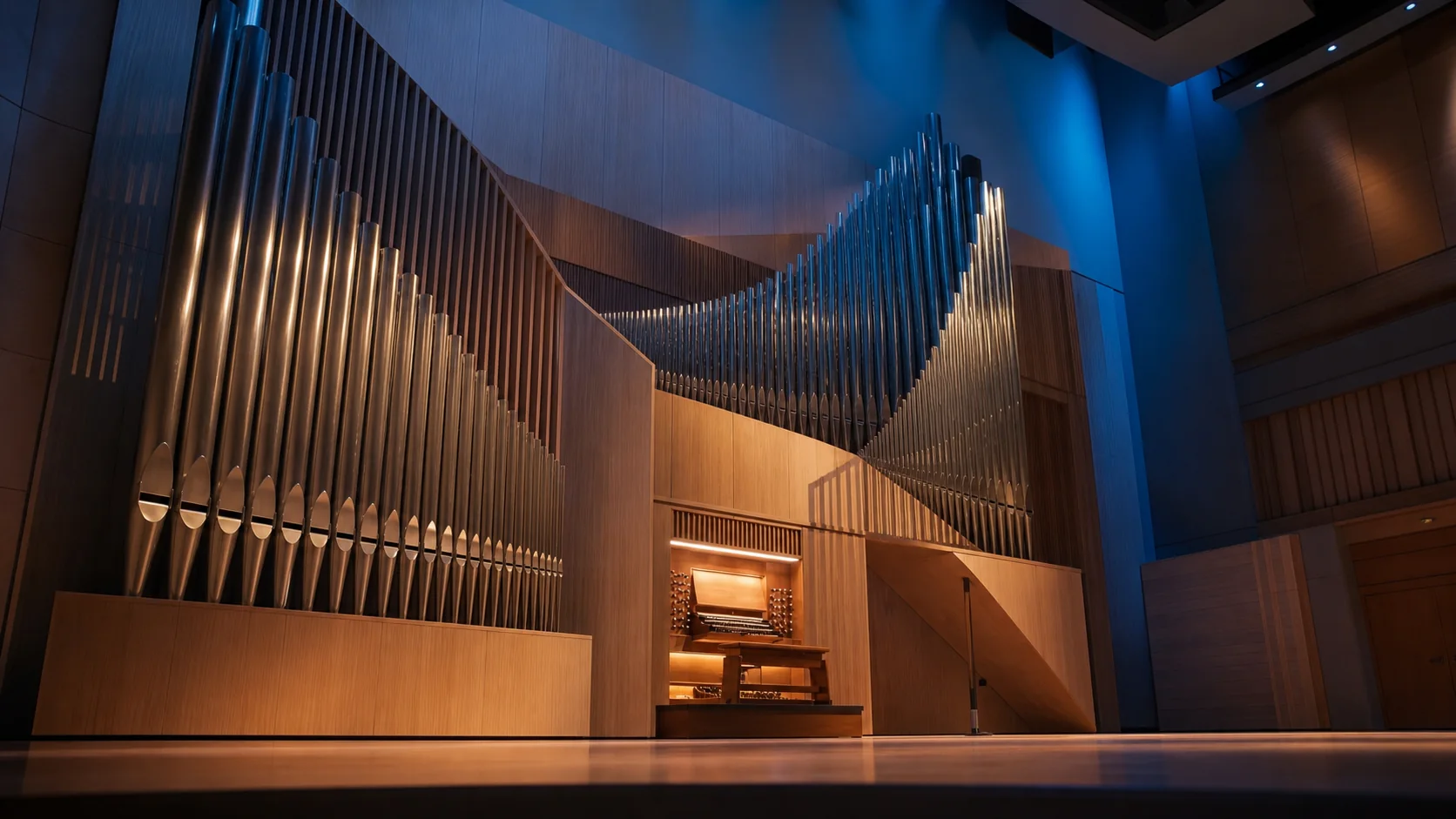
Martin Ott Opus 7 was a ten-stop, 15-rank mechanical organ commissioned in 1977 for Mark's Lutheran Church in Clayton, Missouri. Its free-standing red-oak case has an attached keydesk. The organ and choir originally occupied the right side near the front of the sanctuary.
The surviving account pairs Opus 7 with 1977. Without an event label, that pair is best read as catalogue chronology. The named place, Mark's Lutheran Church in Clayton, Missouri, gives the date its context; a programme or invoice could distinguish order from completion. No present-state conclusion follows.
What the Clayton location tells us, and what it does not: Opus 7
Opus 7 is documented at Mark's Lutheran Church in Clayton, Missouri. The church name establishes who stood behind the project, but it does not reveal the room's size, materials, or acoustic behaviour. Claims about worship use or public recital belong here only when a dated local source supplies them.
What the numerical overview actually establishes for Opus 7
The Opus 7 overview lists 10 stop controls alongside 15 ranks. A rank follows the keyboard compass at a given pitch and tone, whereas a stop may engage one rank or several. A difference of 5 separates the rank and stop counts for Opus 7. Several pipe rows may answer one control, but the exact arrangement remains undocumented here. Names and pitches remain missing, so the musical reading stays deliberately limited.
A complete disposition would turn the short Opus 7 overview into a much clearer technical portrait. It could show how the recorded totals were distributed and which controls drew more than one pipe row. For Mark's Lutheran Church, such a document would also make later alterations easier to recognize. The current evidence stops with 10 stops | 15 ranks Mechanical action, so the missing detail remains a research question rather than an invitation to guess.
The action named for Opus 7
For Opus 7 at Mark's Lutheran Church, the project summary uses the term mechanical action. In practice, that means the key movement reaches a wind valve through physical linkage rather than an electric-only command. The page does not diagram that linkage or report its later maintenance.
A cautious musical reading for Mark's Lutheran Church: Opus 7
The source adds a human and physical dimension to Opus 7: it was moved to the rear in 2004 and it has a red-oak case with attached keydesk. A church organ can carry several musical duties, but this evidence supports only the features and events it names. It does not reveal a normal registration practice or the balance between organ, choir, and congregation. The stop list and parish programmes would answer those questions separately. The listed 10-stop, 15-rank scale remains the numerical boundary for this reading.
The chronology after the first commission: Opus 7
During a 2004 renovation, the church moved the organ, piano, and choir to the rear. The source records the relocation as part of a wider reorganization of the church's musical forces, not as an isolated move of the case. It names no consultant, dedicatory performer, or tonal alteration associated with either placement, before or after the move.
The photograph trail and the limits of the evidence: Opus 7
Opus 7 has 2 archived image references that agree with the project number. The first is images/007/007_m.jpg. Before an image is placed beside the Mark's Lutheran Church article, its subject, date, photographer, and reuse terms need verification. No complete attribution or permission statement survives in the extracted page.
The archived narrative gives Opus 7 a history, not a current inspection. A new statement from Mark's Lutheran Church could confirm whether the organ remains in Clayton, Missouri and identify later work. A dated stop list would then allow a responsible comparison with the original project.