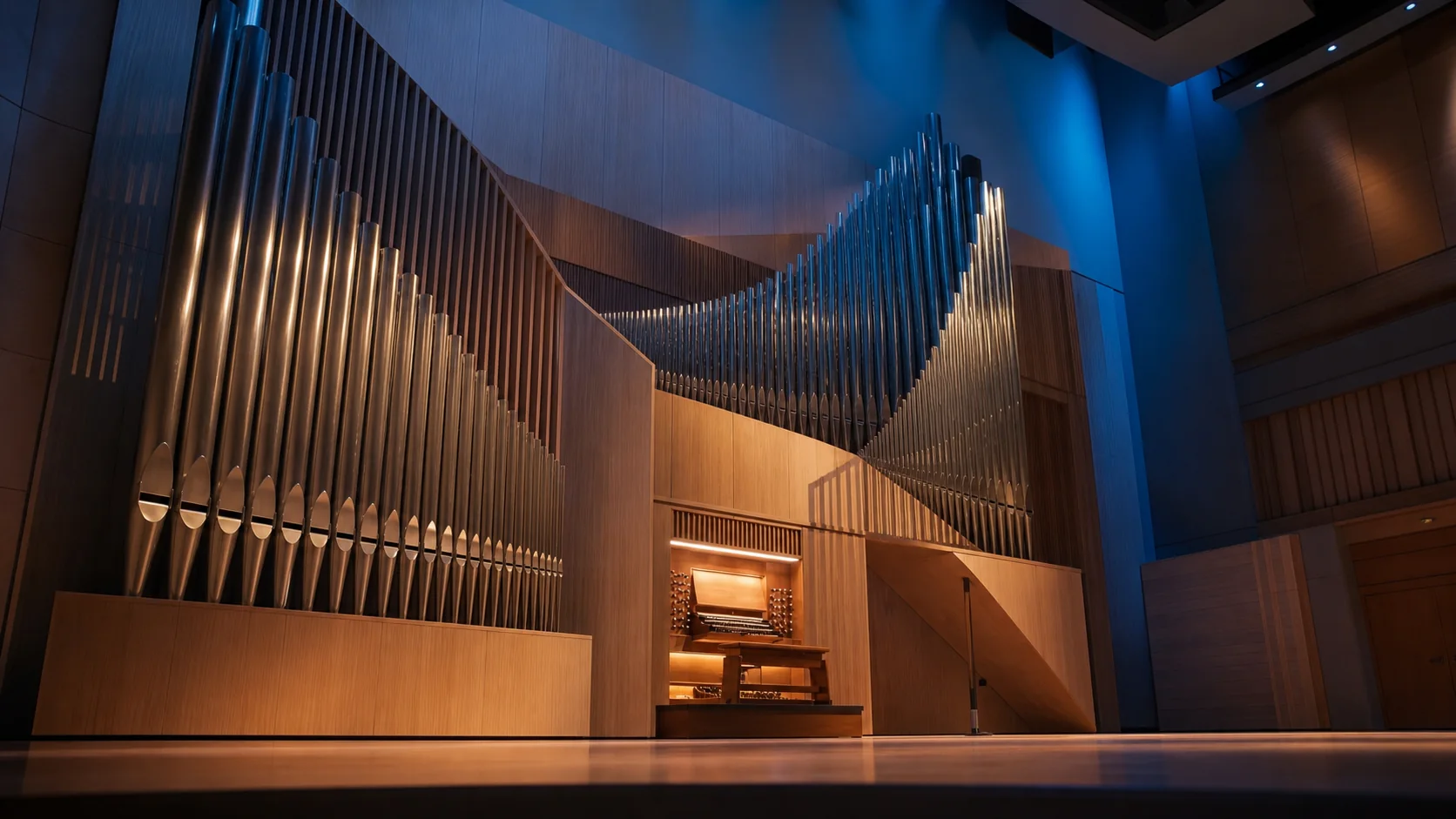
Martin Ott Opus 71 at Ms. Diane Grenwelge Residence
The project identity dates Martin Ott Opus 71 to 1992 and records its relocation in 2002. Its specification gives six stops and seven ranks with mechanical action. The 1992 date belongs to the original Kansas City commission; 2002 marks the Houston purchase and relocation.
Architecture and placement: the Kansas City to Houston house organ
The page therefore links the residence instrument to an earlier Kansas City commission rather than describing a new build for Houston. The documented home for Opus 71 was a private residence connected with Houston, Texas. Domestic instruments answer to ceiling height, access and close listening distances, but the page gives no room plan from which to reconstruct those conditions. The description includes no acoustic measurements.
Close listening distances distinguish a house organ from a large sanctuary instrument. The page locates Opus 71 in a residence but gives no measurements of that room. The available account does not include it.
6 stops and 7 ranks: the scale of Opus 71
The catalogue figures for Opus 71 read 6 stops and 7 ranks. At Ms. Diane Grenwelge Residence, one total counts the player's controls, the other the pipe sets available behind them. This is a small instrument by pipe-organ standards, though pitch levels and pipe families can still provide useful contrast. The overview leaves the number of keyboards unspecified. A stop-by-stop account of Opus 71 must wait for the complete disposition.
Opus 71 has 1 more rank than stops. Within the published specification for Ms. Diane Grenwelge Residence, a mixture or another compound resource may account for part of the gap, though the short summary does not locate it. For Opus 71, the arithmetic is a useful check on the missing stoplist.
How the notes travel: the Kansas City to Houston house organ
In Opus 71, the player reached the windchest through a physical key linkage rather than an electrical key signal. That is the essential meaning of mechanical action. At Ms. Diane Grenwelge Residence, it cannot tell us how the finished keyboard felt or how the action has worn since installation.
An attached console makes the case itself the player's workstation. For Opus 71, that fact is documented even though key depth and touch weight are not.
Inside the physical design: the Kansas City to Houston house organ
The freestanding organ had an oak case and an attached keydesk. In the design record for Ms. Diane Grenwelge Residence, the materials and placement named here make the commission recognizable in photographs. They do not amount to a pipe-by-pipe inventory or a full set of shop drawings for Opus 71.
The surviving design account for Ms. Diane Grenwelge Residence clarifies this point: a clear project photograph may verify timber, placement and facade rhythm. Windchests, trackers and enclosed divisions of Opus 71 remain partly hidden from that view.
The human side of the commission: the Kansas City to Houston house organ
Daniel Cline of Kansas City, Missouri, was the instrument's original commissioner. Diana Grenwelge of Houston purchased the organ in 2002. It records one later tonal change: a Kleinoboe was added in 2005. The source provides no further account of later alterations, location, ownership, or condition. Private ownership can leave fewer public traces than a church commission. For Opus 71, the known move and tonal changes matter more than an imagined schedule of recitals. According to the musical record for Ms. Diane Grenwelge Residence, no dedicatory recital is named in the available material.
The project page is quiet about performances. A church, school or owner's archive may hold the first dependable musical date for Opus 71.
Evidence, images and unanswered questions for Opus 71
For Opus 71, the closest source is the former builder's project page dated February 6, 2020. It links 1 image from the corresponding project directory. Together they form the visual record published beside Opus 71. The page does not name a photographer for the listed views. The project sources for Ms. Diane Grenwelge Residence leave one question open: uncaptioned views remain broadly labeled, and the old page cannot answer questions about later alterations. For Opus 71, dated photographs or an institutional inventory could continue the story.