Two organs shaped for one Benedictine church
Mount Angel Abbey did not ask one instrument to serve every musical position in its church. Martin Ott Opus 79 was made for the monastic choir, close to the daily work of sung prayer. Opus 80 took the larger role in the nave, where the Abbey describes its task as supporting both the monks and a full congregation. Read together, the two instruments form one architectural and musical commission rather than two unrelated catalogue numbers.
The early catalogue associates both numbers with 1993, which is best read as part of the commission history. Mount Angel Abbey supplies the later construction sequence: the choir organ was built in 1995 and installed in spring 1996, while the grand organ was constructed from May 1997 to February 1998 and completed at the Abbey in June 1998. Those dates explain a project that unfolded over several years.
Mount Angel Abbey and the sound of daily prayer
The Abbey stands in St. Benedict, Oregon, and follows the Benedictine pattern of worship in which the day is repeatedly marked by prayer and singing. That rhythm gives the choir organ a clear practical setting. It needed to respond at close range to voices, while the nave instrument had to carry congregational song through the broader church. The Abbey’s own history names those duties without turning them into a claim about every service or registration.
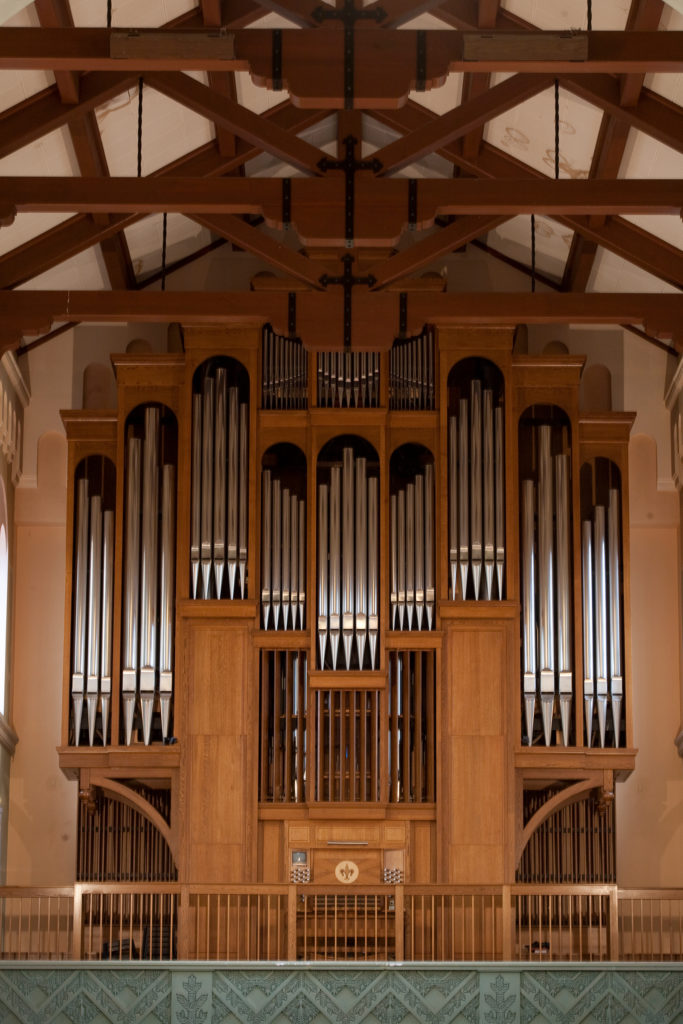
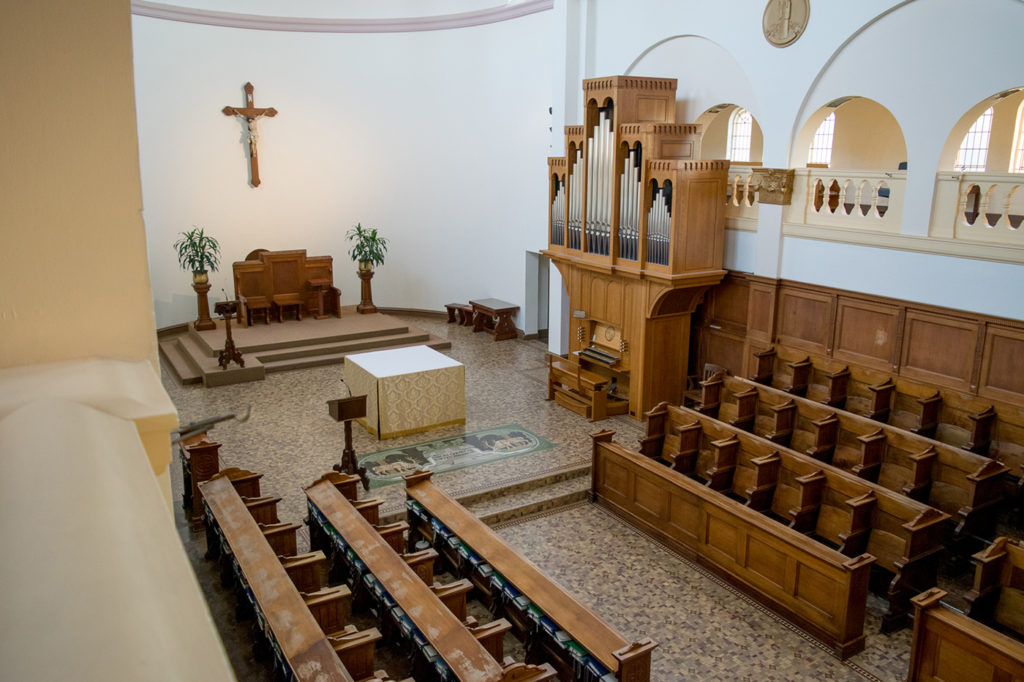
Placement matters because an organ does not sound apart from its room. Opus 79 faces the choir area in a compact case beside the stalls. Opus 80 rises at the opposite scale, with its divisions arranged visibly in a tall oak front. The pair lets a listener see two answers to the same question: how should wind, pipes, timber, and human voices meet in this particular building?
Captions distinguish an organ photograph from a venue view or editorial reconstruction.
Opus 79: 856 pipes within a compact choir organ
Opus 79 has 15 stops, 15 ranks, and 856 pipes divided between two manuals and pedal. Most of the instrument sits under a common expression control, allowing the organist to change its level with shutters. The Prinzipal 8-foot and twelve Subbass pipes stand outside that enclosure. Several resources came from the Abbey’s previous organ, including parts of the Viola Celeste, the Gedackt, and the Subbass.
Mechanical key and stop action connect the player directly to the windchests. The specification includes principal, flute, string, mutation, mixture, and reed colours without pretending to be a miniature version of the grand organ. Its scale belongs to the choir setting. The reused pipes also make Opus 79 a record of continuity, not a clean break with everything heard in the church before 1996.
Opus 80: 2,478 pipes arranged by Werkprinzip
Mount Angel Abbey lists the grand organ with 37 stops, 44 ranks, and 2,478 pipes across three manuals and pedal. The earlier catalogue summary gives 35 stops, so both figures need their dates and source roles. The Abbey’s present specification is the fuller account of the completed instrument; the smaller number belongs to an earlier stage of the project.
Its visual order follows Werkprinzip, a layout in which the main divisions can be read in the case. Hauptwerk occupies the centre, Schwellwerk sits below it behind expression shades, Kronenwerk crowns the composition, and the divided Pedal frames the sides. Mechanical key action preserves the physical path from keyboard to valve. Electric stop action and a multilevel combination system handle registration changes without replacing that key connection.
Oak cases, slider chests, and speaking facades
The instruments share a workshop language. Their white-oak cases were stained a light brown, with quarter-sawn raised panels and traditional mortise-and-tenon construction. The polished facade pipes contain 75 percent tin and are not mute decoration; they belong to sounding principal ranks. Grenadil, bone, oak, and ebony appear at the keyboards and pedalboards where the player meets the mechanism.
Both organs use slider windchests. Pipes for one note stand over a shared channel, while a movable slider admits wind only to the stops selected by the organist. Western cedar trackers, beech squares, and carefully made wooden parts turn a key movement into a pallet opening beneath the pipes. These details matter because they describe an actual construction method, not a vague claim about traditional craft.
The builders and advisers named by the Abbey
The official account names the people behind the cases and mechanisms. Albert J. Brass, Alexander E. Bronitsky, James F. Cullen, Alexander D. Leshchenko, Richard J. Murphy, Earl C. Naylor, Martin Ott, Sascha Ott, and Karen A. Perrone took part in the work. Richard Houghton handled electrical engineering, while Herbert Bilgram made the inlaid music racks.
The organ cases were developed with advice from the architectural firm Humayun Somjee and Associates of St. Louis. Ott Pipe Organs and the Abbey organ committee worked together on the stop lists. Naming that collaboration changes the story from a single-maker legend into a more accurate workshop and institutional history, with design, electrical work, woodcraft, voicing decisions, and local musical needs meeting in the same project.
What the paired record lets us hear and verify
The combined history is strongest when the two organs are compared in function rather than size alone. Opus 79 brings a modest, expressive palette close to the choir. Opus 80 offers the broader choruses, reeds, and pedal weight needed in the nave. The Abbey also says the grand organ can be registered and played from the choir organ’s keyboards, creating a practical connection between their two positions.
Mount Angel Abbey’s instrument page is the clearest source for the completed specifications, photographs, pipe counts, materials, and construction dates. The archived Martin Ott account preserves the builder’s version of the commission. Neither page is a dated condition survey, so present tuning, repairs, access, and performance schedules should be confirmed with the Abbey. What survives is already substantial: two instruments, two rooms within one church, and a carefully documented plan for sung prayer and congregational music.