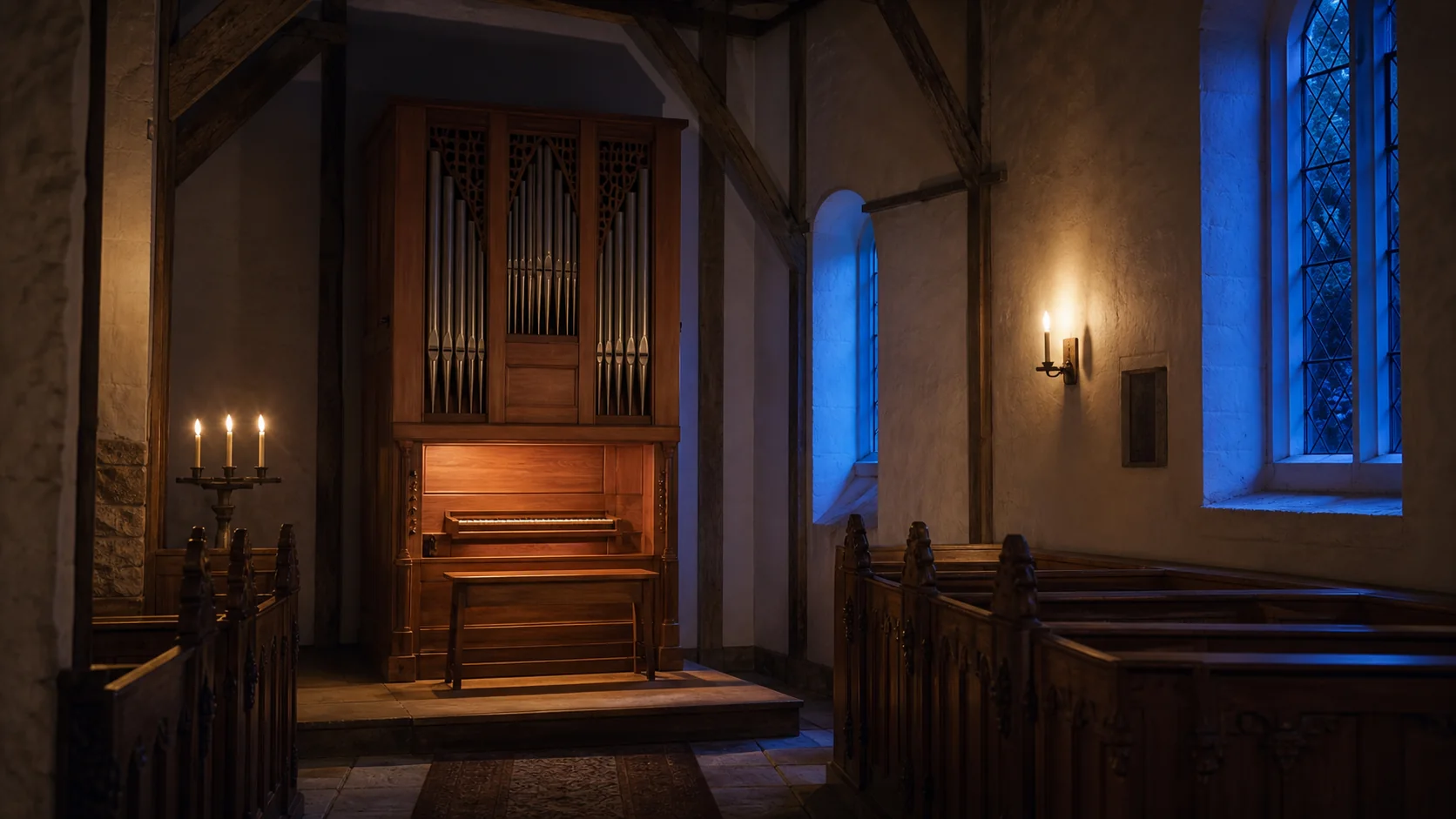
Martin Ott Opus 92 at First Church of Christ, Scientist
Martin Ott Opus 92 records the 1997 restoration of the Hutchings-Votey organ at First Church of Christ, Scientist, in St. Louis. The restored instrument had three manuals, 52 stops, 41 ranks, and slider-chest action.
The space around the organ: the 1905 Hutchings-Votey restoration
The church, organized in March 1894, outgrew its first 400-seat building and began construction of a larger home in September 1903. The auditorium opened in July 1904, but the building was not considered complete until the Hutchings-Votey organ was installed in January 1905. The work at First Church of Christ, Scientist in St. Louis, Missouri began with an existing organ. The earlier maker and date therefore remain central, while the Martin Ott phase belongs to a later history of repair, addition or rebuilding. Interior dimensions and sound-decay figures are absent.
A later photograph may show the restored whole without revealing which parts predate the commission. For Opus 92, location and authorship are separate documentary questions. The surviving account does not include it.
52 stops and 41 ranks: the scale of Opus 92
A first reading of the instrument begins with 52 stops and 41 ranks. The stop total describes selectable resources, while the count of pipe ranks counts the underlying rows of pipes. The numerical breadth is clear. Its actual power and blend would depend on pipe scales, materials, wind and the building around it. A 3-manual layout is named in the technical note. A reliable tonal reading still requires the full stoplist of Opus 92.
For Opus 92, 11 stop controls sit beyond the rank count. The abbreviated numbers do not reveal how the builder obtained those additional functions. A full specification would show where each rank actually appears.
Control at the keydesk: the 1905 Hutchings-Votey restoration
Slider chests are named for Opus 92. A slider admits wind to a selected rank, while the note mechanism controls individual pipes. The term identifies the chest principle but leaves the method of key actuation to the fuller specification.
The action description becomes more meaningful when read beside console placement and division layout. For Opus 92, only the details explicitly recorded above can complete that picture.
Construction in the room: the 1905 Hutchings-Votey restoration
The rebuilding retained nearly all original pipework, added new mechanical components and selected voices, and was carried out by the Martin Ott Pipe Organ Company and Organ Supply Industries under Martin Ott's supervision. Casework, console and siting give an individual profile to Opus 92. Further claims about construction inside the case would require drawings or a survey made at the site.
Casework has two jobs here: it gives Opus 92 a visible architectural presence and organizes the mechanism behind it. The entry does not say that every visible front pipe was certainly a sounding pipe.
Programs and performance evidence: the 1905 Hutchings-Votey restoration
The cornerstone was laid that November. A recital on January 20 inaugurated it. By 1997 the playing mechanism had become unreliable after 92 years of service. For Opus 92, registration history crosses two periods: the organ as built and the organ after Martin Ott's work. Programs from both sides of that divide would make the comparison audible. The next musical chapter remains to be documented.
The people identified above turn the stop specification of Opus 92 into a human story. Their documented role is clear, while later organists and programs still need sources.
Evidence, images and unanswered questions for Opus 92
A copy of the Martin Ott project entry was captured on February 6, 2020 and documents Opus 92. Its visual material consists of 4 linked images. They are the project views the former company chose to publish with Opus 92. The image group offers no individual credit line. The dated page cannot establish subsequent ownership or maintenance. A current institutional photograph and full disposition would fill the largest gaps.